The Volkswagen Polo IV (9N) 1.4 16V (101 Hp): A European Subcompact Standard-Bearer
The Volkswagen Polo IV, known internally by its chassis code 9N, represented a significant evolution for Volkswagen’s popular subcompact car line. Launched in 2001, this generation aimed to elevate the Polo’s standing in the highly competitive European B-segment, offering more sophisticated styling, improved interior quality, and enhanced driving dynamics compared to its predecessors. While never officially sold in the United States, the Polo has been a cornerstone of Volkswagen’s global strategy, particularly in European and Asian markets, where it competes fiercely as a versatile and efficient urban vehicle. This article delves into the specifics of the Volkswagen Polo IV (9N) 1.4 16V (101 Hp) variant, a particularly sprightly offering within the range, produced between 2001 and 2005, highlighting its technical prowess and market impact.
Engine & Performance: The Heart of the Volkswagen Polo IV (9N) 1.4 16V (101 Hp)
Under the hood, the Volkswagen Polo IV (9N) 1.4 16V (101 Hp) was powered by a naturally aspirated 1.4-liter (1390 cm3 or 84.82 cu. in.) inline four-cylinder gasoline engine, designated with the model code BBZ. This powerplant was a testament to Volkswagen’s commitment to delivering a balance of performance and fuel efficiency in a compact package. Featuring a Double Overhead Camshaft (DOHC) valvetrain with four valves per cylinder, the engine was capable of producing a respectable 101 horsepower at 6000 rpm. This output, for a vehicle of its size and class, provided a spirited driving experience.
Torque figures for this engine stood at 126 Nm (92.93 lb.-ft.) delivered at 4400 rpm, ensuring adequate pull across a useful rev range for city driving and highway cruising. The power was transmitted to the front wheels via a standard 5-speed manual transmission, a common and reliable setup for this segment. This combination allowed the Polo 1.4 16V to accelerate from 0 to 60 mph in a swift 9.5 seconds (0-100 km/h in 10 seconds), with a top speed reaching 116.82 mph (188 km/h). These figures positioned it as one of the more engaging options in its class, offering a blend of agility and responsiveness.
Fuel efficiency, a critical factor for European buyers, was also commendable. The urban fuel consumption was rated at 9.6 liters per 100 km (24.5 US mpg), while extra-urban driving saw figures improve significantly to 5.4 liters per 100 km (43.6 US mpg). With a 45-liter (11.89 US gal) fuel tank, the Polo offered a decent cruising range, making it suitable for both daily commutes and longer journeys. The engine’s compression ratio of 10:1 and multi-port manifold injection system ensured efficient combustion and reliable operation, utilizing standard gasoline fuel.
Design & Features: Sophistication in a Subcompact Package
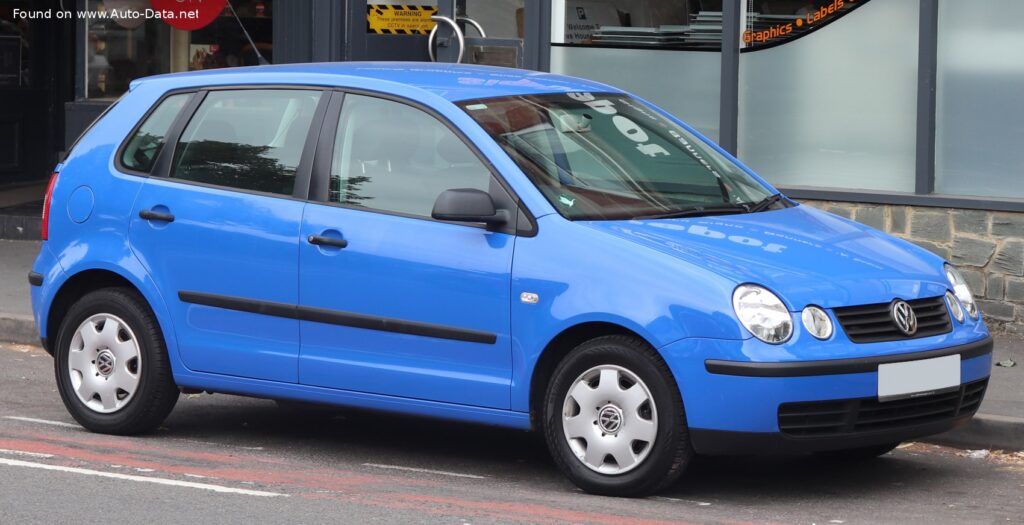
The Volkswagen Polo IV (9N) marked a departure from the more angular styling of its predecessors, adopting a rounder, more mature aesthetic that mirrored the design language of its larger sibling, the Golf. Available in both 3-door and 5-door hatchback configurations, the Polo 9N offered practical versatility. With an overall length of 147.36 inches (3743 mm), a width of 64.25 inches (1632 mm), and a height of 55.83 inches (1418 mm), it remained a compact car, ideal for navigating crowded European city streets and tight parking spaces. The wheelbase of 94.76 inches (2407 mm) contributed to a stable ride for its size.
Inside, the Polo 9N provided seating for five occupants, a common configuration for subcompacts, though rear passenger space was naturally more constrained. Volkswagen placed a strong emphasis on interior quality, using higher-grade materials and a more ergonomic layout than many competitors, giving the Polo a “premium” feel for its segment. The trunk space was practical, offering a minimum of 8.65 cu. ft. (245 liters), expandable to a generous 34.43 cu. ft. (975 liters) with the rear seats folded, enhancing its utility for shopping or weekend trips.
Safety features for the era included standard Antilock Braking System (ABS), a crucial active safety system. The vehicle utilized disc brakes on both the front and rear axles, providing confident stopping power. The suspension system comprised a coil spring setup at the front and a trailing arm design at the rear, a conventional yet effective arrangement for balancing ride comfort and handling dynamics. Steering was managed by a hydraulic rack and pinion system, offering direct and communicative feedback to the driver, a characteristic appreciated by enthusiasts. The car rode on 185/55 R14 tires mounted on 6J x 14 wheel rims, a sensible choice for efficiency and ride quality.
Technical Specifications for the Volkswagen Polo IV (9N) 1.4 16V (101 Hp)
| Category | Specification | US Equivalent (where applicable) |
|---|---|---|
| General Information | ||
| Brand | Volkswagen | |
| Model | Polo | |
| Generation | Polo IV (9N) | |
| Engine Type | 1.4 16V (101 Hp) | |
| Production Start | 2001 | |
| Production End | 2005 | |
| Powertrain Architecture | Internal Combustion Engine | |
| Body Type | Hatchback | |
| Seats | 5 | |
| Doors | 3-5 | |
| Performance Specs | ||
| Fuel Consumption (Urban) | 9.6 l/100 km | 24.5 US mpg |
| Fuel Consumption (Extra Urban) | 5.4 l/100 km | 43.6 US mpg |
| Fuel Type | Petrol (Gasoline) | |
| Acceleration 0-60 mph | 9.5 sec | |
| Acceleration 0-100 km/h | 10 sec | |
| Maximum Speed | 188 km/h | 116.82 mph |
| Weight-to-Power Ratio | 9.2 kg/Hp | 109.2 Hp/tonne |
| Weight-to-Torque Ratio | 7.3 kg/Nm | 136.2 Nm/tonne |
| Engine Specs | ||
| Power | 101 Hp @ 6000 rpm | |
| Power per liter | 72.7 Hp/l | |
| Torque | 126 Nm @ 4400 rpm | 92.93 lb.-ft. @ 4400 rpm |
| Engine Layout | Front, Transverse | |
| Engine Model/Code | BBZ | |
| Engine Displacement | 1390 cm3 | 84.82 cu. in. |
| Number of Cylinders | 4 | |
| Engine Configuration | Inline | |
| Cylinder Bore | 76.5 mm | 3.01 in. |
| Piston Stroke | 75.6 mm | 2.98 in. |
| Compression Ratio | 10:1 | |
| Valves per Cylinder | 4 | |
| Fuel Injection System | Multi-port manifold injection | |
| Engine Aspiration | Naturally aspirated | |
| Valvetrain | DOHC | |
| Engine Oil Capacity | 3.2 l | 3.38 US qt |
| Coolant Capacity | 4.2 l | 4.44 US qt |
| Space, Volume and Weights | ||
| Kerb Weight | 925 kg | 2039.28 lbs. |
| Max. Weight | 1420 kg | 3130.56 lbs. |
| Max Load | 495 kg | 1091.29 lbs. |
| Trunk Space (minimum) | 245 l | 8.65 cu. ft. |
| Trunk Space (maximum) | 975 l | 34.43 cu. ft. |
| Fuel Tank Capacity | 45 l | 11.89 US gal |
| Dimensions | ||
| Length | 3743 mm | 147.36 in. |
| Width | 1632 mm | 64.25 in. |
| Height | 1418 mm | 55.83 in. |
| Wheelbase | 2407 mm | 94.76 in. |
| Front Track | 1392 mm | 54.8 in. |
| Rear Track | 1400 mm | 55.12 in. |
| Drivetrain, Brakes and Suspension | ||
| Drivetrain Architecture | Front-wheel drive, Internal Combustion Engine | |
| Drive Wheel | Front wheel drive | |
| Gearbox Type | 5 gears, manual transmission | |
| Front Suspension | Coil spring | |
| Rear Suspension | Trailing arm | |
| Front Brakes | Disc | |
| Rear Brakes | Disc | |
| Assisting Systems | ABS (Anti-lock braking system) | |
| Steering Type | Steering rack and pinion | |
| Power Steering | Hydraulic Steering | |
| Tire Size | 185/55 R14 | |
| Wheel Rims Size | 6J x 14 |
Legacy & Market Impact of the Volkswagen Polo IV (9N)
The Volkswagen Polo IV (9N) carved out a significant niche in the European subcompact market during its production run from 2001 to 2005. It faced stiff competition from well-established rivals such as the Ford Fiesta, Opel Corsa, Renault Clio, and Peugeot 206, all vying for market share among urban dwellers and budget-conscious buyers. However, the Polo distinguished itself with its reputation for solid build quality, refined driving dynamics, and a more upmarket feel than many of its competitors, traits that are often associated with the Volkswagen brand.
The 1.4 16V (101 Hp) variant, in particular, was popular among those seeking a more engaging driving experience without sacrificing the practicality and efficiency inherent in the Polo lineup. Its relatively strong performance for its class, combined with its compact dimensions, made it an ideal choice for navigating crowded European cities while still being capable enough for occasional highway travel. The Polo’s robust construction and reliable powertrains also contributed to its strong resale value in its primary markets.
The Polo IV was instrumental in solidifying Volkswagen’s position in the B-segment, demonstrating the brand’s ability to deliver a small car that felt more substantial and premium than its size suggested. It set new benchmarks for refinement and safety in its class, influencing subsequent generations of subcompact vehicles. Although the Polo never officially graced American showrooms, its global success and the engineering principles embodied in models like the Volkswagen Polo IV (9N) 1.4 16V (101 Hp) underscore Volkswagen’s consistent effort to offer well-engineered, versatile, and appealing vehicles to a diverse international audience.