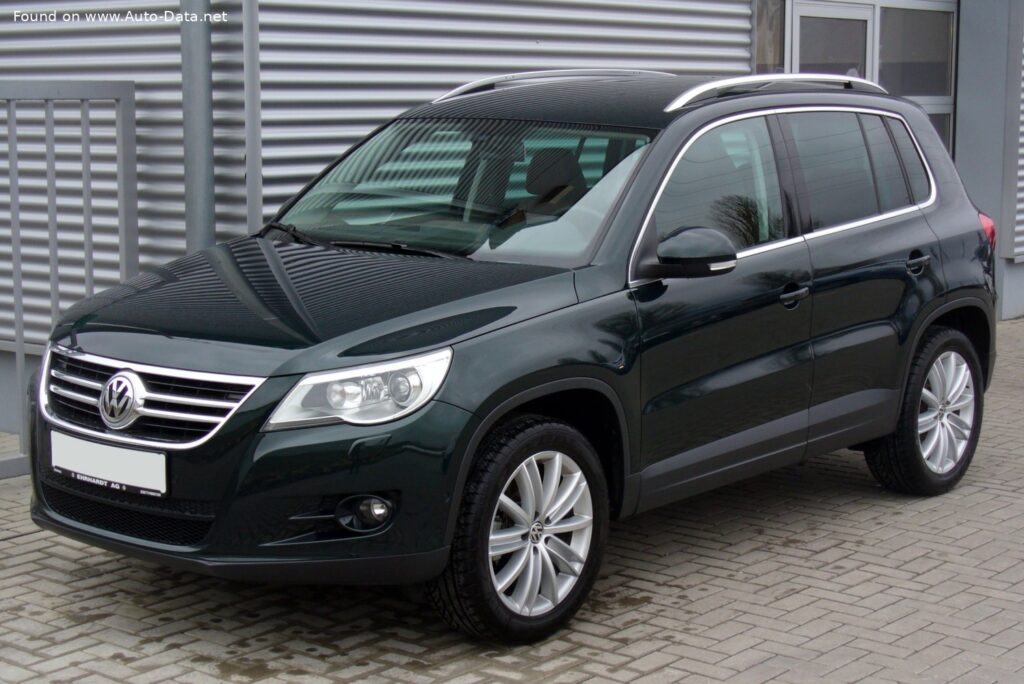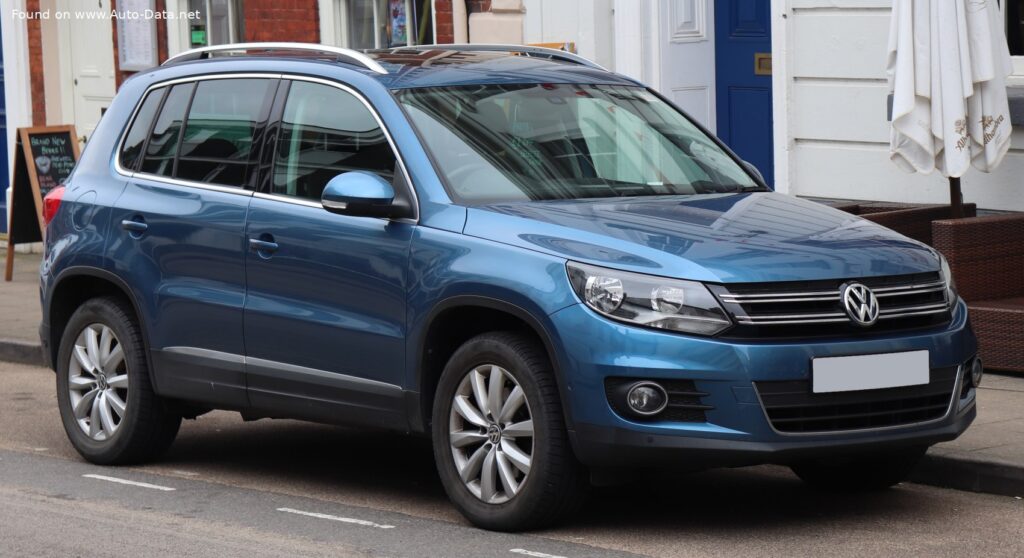
The Volkswagen Tiguan I (facelift 2011) 2.0 TDI BMT (140 Hp) 4MOTION represents a significant iteration of Volkswagen’s popular compact SUV, targeting the discerning European market where a blend of efficiency, versatility, and all-wheel-drive capability is highly valued. Introduced in 2011 as a refreshed version of the first-generation Tiguan, this model continued to build on its reputation as a sophisticated and practical vehicle in the highly competitive SUV segment. The “2.0 TDI” designation points to its robust turbodiesel engine, while “BMT” signifies BlueMotion Technology, Volkswagen’s suite of efficiency-enhancing features designed to reduce fuel consumption and emissions. The “4MOTION” system, Volkswagen’s proprietary all-wheel-drive technology, ensures confident handling and traction across diverse driving conditions, further solidifying its appeal to drivers seeking both urban agility and light off-road or inclement weather prowess. This specific variant, produced until 2015, served as a cornerstone of Volkswagen’s compact SUV offerings, particularly in regions with strong demand for diesel powertrains and advanced drivetrain systems.
Engine & Performance: The Volkswagen Tiguan I (facelift 2011) 2.0 TDI BMT (140 Hp) 4MOTION Powertrain
At the heart of the Volkswagen Tiguan I (facelift 2011) 2.0 TDI BMT (140 Hp) 4MOTION lies a highly regarded 2.0-liter (1968 cm3 or 120.09 cu. in.) inline-four turbodiesel engine, identified by the EA189 / CBAB, CFFB, CLJA engine codes. This powerplant delivers a robust 140 horsepower at 4200 revolutions per minute, translating to a power output of 71.1 horsepower per liter. More critically for an SUV, it produces a substantial 320 Newton-meters (236.02 lb.-ft.) of torque across a broad and accessible range, from 1750 to 2500 rpm. This ample torque at low engine speeds is crucial for effortless acceleration, strong pulling power, and efficient cruising, making it well-suited for both urban driving and highway journeys, especially when hauling cargo or towing. The engine’s configuration features a front, transverse layout with a DOHC valvetrain, four valves per cylinder, and a common rail diesel fuel injection system, all fed by a turbocharger and intercooler for optimized air intake and performance.
Performance figures for this Tiguan variant reflect its balanced approach to power and efficiency. It accelerates from 0 to 60 mph in a respectable 9.7 seconds (0-100 km/h in 10.2 seconds) and can reach a maximum speed of 118.06 mph (190 km/h). These figures demonstrate adequate performance for daily driving while emphasizing fuel economy. The inclusion of BlueMotion Technology (BMT) is particularly noteworthy, integrating features such as a Start & Stop system and a particulate filter. These technologies contribute significantly to its impressive fuel efficiency and lower emissions. The combined fuel consumption is rated at 5.8 liters per 100 kilometers, which translates to an excellent 40.6 US miles per gallon (48.7 UK mpg). Urban driving yields 34.1 US mpg (6.9 l/100 km), while extra-urban cruising can achieve an outstanding 46.1 US mpg (5.1 l/100 km). With CO2 emissions of 150 g/km and adherence to the Euro 5 emission standard, this Tiguan was designed to meet stringent environmental regulations of its time. Power is channeled through a precise 6-speed manual transmission to Volkswagen’s advanced 4MOTION all-wheel-drive system, which intelligently distributes power between the front and rear wheels, primarily driving the front wheels and engaging the rear wheels via an electrically or mechanically operated clutch when additional traction is required.
Design & Features: Volkswagen Tiguan I (facelift 2011)
The Volkswagen Tiguan I (facelift 2011) maintains the characteristic clean and functional design language of Volkswagen, presenting itself as a practical yet stylish compact SUV. With a body type defined as an SUV, it features five doors and comfortable seating for five occupants, making it an ideal choice for families or individuals requiring versatile space. Its dimensions are well-proportioned for its segment, measuring 174.25 inches (4426 mm) in length, 71.22 inches (1809 mm) in width (80.35 inches or 2041 mm including mirrors), and 67.05 inches (1703 mm) in height. The wheelbase of 102.52 inches (2604 mm) contributes to a stable ride and generous interior volume.
Practicality is a hallmark of the Tiguan’s design. The trunk (boot) space offers a minimum of 16.6 cubic feet (470 liters), which can expand to a substantial 53.33 cubic feet (1510 liters) with the rear seats folded, providing ample room for luggage, groceries, or sports equipment. The vehicle’s kerb weight ranges from 3483.3 to 3487.71 lbs (1580-1582 kg), with a maximum permissible weight of 4960.4 lbs (2250 kg), allowing for a maximum load capacity of 1472.69 – 1477.1 lbs (668-670 kg). Furthermore, its towing capabilities are impressive for its class, rated at 4850.17 lbs (2200 kg) with brakes (both 8% and 12% incline) and 1653.47 lbs (750 kg) without brakes, highlighting its utility for trailers or caravans. A maximum roof load of 165.35 lbs (75 kg) and a towbar download of 220.46 lbs (100 kg) further enhance its cargo-carrying versatility.
The Tiguan’s chassis and suspension systems are engineered for a comfortable yet engaging driving experience. It features an independent McPherson strut front suspension with coil springs and an anti-roll bar, paired with an independent multi-link spring suspension with a stabilizer at the rear. This setup ensures responsive handling and effective absorption of road imperfections. Braking performance is handled by ventilated discs at the front and disc brakes at the rear, complemented by an Anti-lock Braking System (ABS) for enhanced safety during emergency stops. The steering system employs a rack and pinion setup with electric power steering, offering precise control and ease of maneuverability, reflected in its minimum turning circle of 39.37 feet (12 meters). With a ground clearance of 7.87 inches (200 mm) and approach, departure, and ramp-over angles of 18°, 25°, and 20° respectively, the Tiguan 4MOTION possesses a respectable capability for tackling unpaved roads and moderate off-road conditions, living up to its SUV designation. A variety of tire and wheel rim sizes were available, ranging from 215/65 R16 to 255/40 R19, allowing for customization of both aesthetics and driving dynamics.
Technical Specifications
| Brand | Volkswagen |
| Model | Tiguan |
| Generation | Tiguan I (facelift 2011) |
| Type (Engine) | 2.0 TDI BMT (140 Hp) 4MOTION |
| Start of production | 2011 year |
| End of production | 2015 year |
| Powertrain Architecture | Internal Combustion engine |
| Body type | SUV |
| Seats | 5 |
| Doors | 5 |
| Fuel consumption (economy) – urban (NEDC) | 6.9 l/100 km (34.1 US mpg) |
| Fuel consumption (economy) – extra urban (NEDC) | 5.1 l/100 km (46.1 US mpg) |
| Fuel consumption (economy) – combined (NEDC) | 5.8 l/100 km (40.6 US mpg) |
| CO2 emissions (NEDC) | 150 g/km |
| Fuel Type | Diesel |
| Acceleration 0 – 60 mph | 9.7 sec |
| Acceleration 0 – 100 km/h | 10.2 sec |
| Maximum speed | 190 km/h (118.06 mph) |
| Emission standard | Euro 5 |
| Weight-to-power ratio | 11.3 kg/Hp (88.6 Hp/tonne) |
| Weight-to-torque ratio | 4.9 kg/Nm (202.5 Nm/tonne) |
| Power | 140 Hp @ 4200 rpm |
| Power per liter | 71.1 Hp/l |
| Torque | 320 Nm @ 1750-2500 rpm (236.02 lb.-ft. @ 1750-2500 rpm) |
| Engine layout | Front, Transverse |
| Engine Model/Code | EA189 / CBAB, CFFB, CLJA |
| Engine displacement | 1968 cm3 (120.09 cu. in.) |
| Number of cylinders | 4 |
| Engine configuration | Inline |
| Cylinder Bore | 81 mm (3.19 in.) |
| Piston Stroke | 95.5 mm (3.76 in.) |
| Compression ratio | 16.5:1 |
| Number of valves per cylinder | 4 |
| Fuel injection system | Diesel Commonrail |
| Engine aspiration | Turbocharger, Intercooler |
| Valvetrain | DOHC |
| Engine oil capacity | 4 l (4.23 US qt) |
| Coolant | 8 l (8.45 US qt) |
| Engine systems | Start & Stop System, Particulate filter |
| Kerb Weight | 1580-1582 kg (3483.3 – 3487.71 lbs) |
| Max. weight | 2250 kg (4960.4 lbs) |
| Max load | 668-670 kg (1472.69 – 1477.1 lbs) |
| Trunk (boot) space – minimum | 470 l (16.6 cu. ft.) |
| Trunk (boot) space – maximum | 1510 l (53.33 cu. ft.) |
| Fuel tank capacity | 64 l (16.91 US gal) |
| Max. roof load | 75 kg (165.35 lbs) |
| Permitted trailer load with brakes (8%) | 2200 kg (4850.17 lbs) |
| Permitted trailer load with brakes (12%) | 2200 kg (4850.17 lbs) |
| Permitted trailer load without brakes | 750 kg (1653.47 lbs) |
| Permitted towbar download | 100 kg (220.46 lbs) |
| Length | 4426 mm (174.25 in.) |
| Width | 1809 mm (71.22 in.) |
| Width including mirrors | 2041 mm (80.35 in.) |
| Height | 1703 mm (67.05 in.) |
| Wheelbase | 2604 mm (102.52 in.) |
| Front track | 1569 mm (61.77 in.) |
| Rear (Back) track | 1571 mm (61.85 in.) |
| Ride height (ground clearance) | 200 mm (7.87 in.) |
| Minimum turning circle (turning diameter) | 12 m (39.37 ft.) |
| Approach angle | 18° |
| Departure angle | 25° |
| Ramp-over (brakeover) angle | 20° |
| Drivetrain Architecture | ICE drives front wheels permanently, rear wheels driven through clutch if necessary. |
| Drive wheel | All wheel drive (4×4) |
| Number of gears and type of gearbox | 6 gears, manual transmission |
| Front suspension | Independent, type McPherson with coil spring and anti-roll bar |
| Rear suspension | Independent multi-link spring suspension with stabilizer |
| Front brakes | Ventilated discs |
| Rear brakes | Disc |
| Assisting systems | ABS (Anti-lock braking system) |
| Steering type | Steering rack and pinion |
| Power steering | Electric Steering |
| Tires size | 215/65 R16; 215/60 R17; 235/55 R17; 235/50 R18; 255/40 R19 |
| Wheel rims size | 6.5J x 16; 6.5J x 17; 7J x 17; 7J x 18; 8J x 18; 9J x 19 |