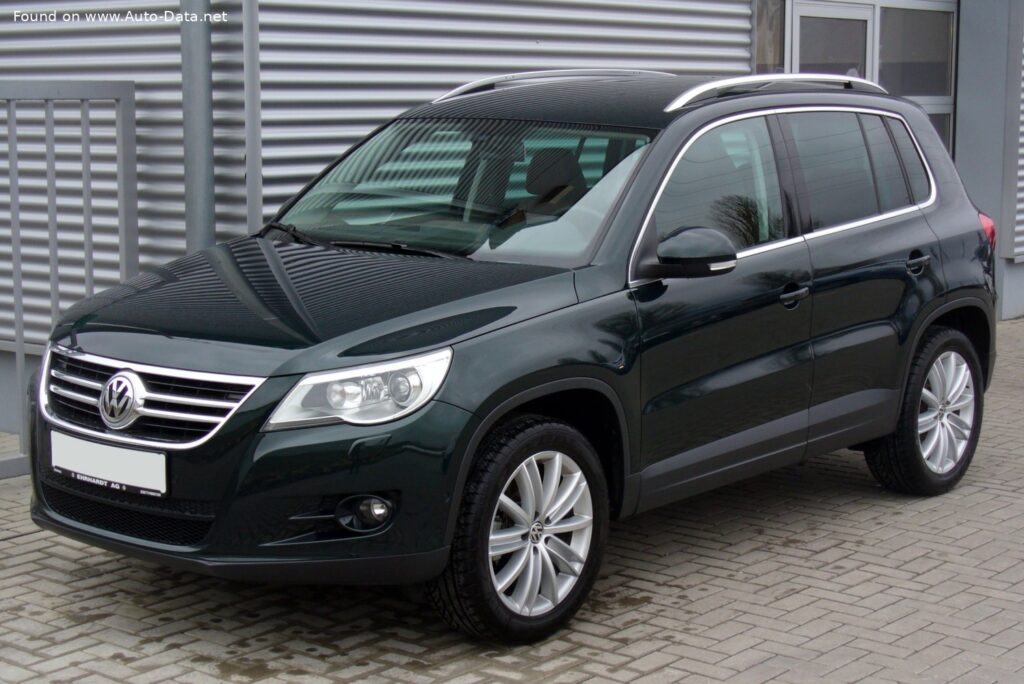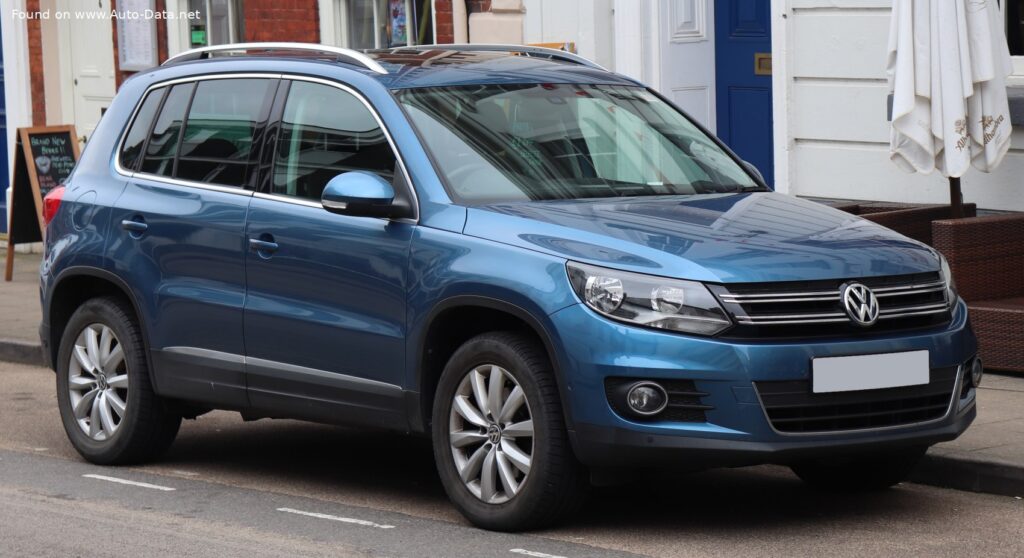
The Volkswagen Tiguan I (facelift 2011) 2.0 TDI BMT (150 Hp) 4MOTION DSG represents a compelling chapter in the evolution of compact SUVs, particularly within the European market. Introduced as a refreshed version of the first-generation Tiguan, this specific variant from its final production year, 2015, embodies Volkswagen’s commitment to efficiency, versatility, and refined driving dynamics. Positioned as a practical yet sophisticated family vehicle, the Tiguan I (facelift 2011) carved out a significant niche, offering a blend of car-like comfort with the elevated driving position and utility of an SUV. While not primarily marketed in the United States with this specific powertrain, its design language, robust engineering, and emphasis on fuel economy with the advanced 2.0 TDI BlueMotion Technology engine, combined with the capable 4MOTION all-wheel-drive system and a smooth DSG automatic transmission, made it a highly attractive option across continents where diesel technology thrived.
Engine and Performance of the Volkswagen Tiguan I (facelift 2011) 2.0 TDI BMT (150 Hp) 4MOTION DSG
At the heart of this particular Volkswagen Tiguan I (facelift 2011) lies a highly efficient and potent 2.0-liter TDI (Turbocharged Direct Injection) diesel engine, designated with the internal code CUVC. This inline four-cylinder powerplant, with a displacement of 1968 cm³ (120.09 cu. in.), is a testament to Volkswagen’s engineering prowess in diesel technology. It generates a robust 150 horsepower, peaking between 3500 and 4000 rpm, delivering a power-per-liter figure of 76.2 Hp/l. More significantly, the engine produces an impressive 340 Nm (250.77 lb.-ft.) of torque, available across a broad and usable band from 1750 to 3000 rpm. This substantial torque output is crucial for the Tiguan’s responsive acceleration and effortless highway cruising, especially when fully loaded or towing.
The engine’s advanced architecture features a DOHC (Dual Overhead Camshaft) valvetrain with four valves per cylinder, ensuring optimal airflow and combustion efficiency. Fuel is delivered via a sophisticated Commonrail diesel injection system, which allows for precise fuel metering and atomization, contributing to both power and economy. A turbocharger with an intercooler further enhances performance by compressing the intake air, leading to a denser charge and more complete combustion. As part of Volkswagen’s BlueMotion Technology (BMT) initiative, this engine incorporates a Start & Stop system, which automatically shuts off the engine when the vehicle is stationary, minimizing fuel consumption and emissions in urban traffic. A particulate filter is also standard, ensuring compliance with the stringent Euro 6 emission standards, a critical factor for its European market success.
Performance figures for the Tiguan I (facelift 2011) 2.0 TDI BMT (150 Hp) 4MOTION DSG are commendable for a compact SUV. It accelerates from 0 to 60 mph in an estimated 9.3 seconds, reaching 100 km/h (62 mph) in 9.8 seconds, and boasts a maximum speed of 118.68 mph (191 km/h). These figures underscore its capability as a versatile daily driver, capable of both city agility and highway prowess. The power is seamlessly managed by a 7-speed DSG (Direct Shift Gearbox) automatic transmission, known for its rapid, smooth, and efficient gear changes. The DSG’s dual-clutch design allows for pre-selection of the next gear, resulting in virtually uninterrupted power delivery and a sporty yet refined driving experience.
Complementing the powertrain is Volkswagen’s renowned 4MOTION all-wheel-drive system. This intelligent drivetrain architecture primarily drives the front wheels but can instantaneously engage the rear wheels via an electrically or mechanically operated clutch when slippage is detected or anticipated. This proactive system enhances traction and stability in adverse weather conditions or on challenging terrains, providing an added layer of safety and confidence. The combination of the efficient TDI engine, the responsive DSG, and the capable 4MOTION system makes the Tiguan a highly adaptable vehicle, equally at home on paved roads, gravel tracks, or in snowy conditions.
Fuel efficiency is a significant highlight of this model, especially given its all-wheel-drive capability. The combined fuel economy, based on the NEDC cycle, is rated at an impressive 41.3 US mpg (5.7 l/100 km), with extra-urban figures reaching 46.1 US mpg (5.1 l/100 km) and urban consumption at 35.6 US mpg (6.6 l/100 km). With a 16.91 US gallon (64-liter) fuel tank, the Tiguan offers an excellent cruising range, making it suitable for long journeys. Its CO2 emissions are a competitive 150 g/km, further solidifying its eco-conscious credentials within its segment.
Design and Features of the Volkswagen Tiguan I (facelift 2011) 2.0 TDI BMT (150 Hp) 4MOTION DSG
The Volkswagen Tiguan I (facelift 2011) 2.0 TDI BMT (150 Hp) 4MOTION DSG retains the familiar, understated elegance characteristic of Volkswagen design, while incorporating subtle updates that brought it in line with the brand’s contemporary aesthetic. As an SUV body type, it offers a practical five-door configuration and comfortable seating for five occupants. The facelift introduced revised front and rear bumpers, new headlamp designs, and updated taillights, giving the Tiguan a fresher, more sophisticated appearance that echoed its larger sibling, the Touareg, and other models in the Volkswagen lineup of the era.
Dimensionally, the Tiguan is a compact SUV designed for maneuverability and urban living, yet spacious enough for family duties. It measures 174.25 inches (4426 mm) in length, 71.22 inches (1809 mm) in width (80.35 inches or 2041 mm including mirrors), and stands 67.05 inches (1703 mm) tall. Its wheelbase spans 102.52 inches (2604 mm), contributing to a stable ride and comfortable interior space. The front track is 61.77 inches (1569 mm), and the rear track is 61.85 inches (1571 mm), providing a confident stance on the road. With a minimum turning circle of 39.37 feet (12 meters), the Tiguan remains agile and easy to park in crowded city environments.
Inside, the Tiguan prioritizes functionality and quality. While specific interior features are not detailed, Volkswagen interiors of this vintage are known for their ergonomic layouts, high-quality materials, and intuitive controls. The five-seat configuration offers ample room for passengers, and the SUV body style provides significant cargo versatility. The trunk (boot) space ranges from a generous 16.6 cu. ft. (470 liters) with all seats in place, expanding to a substantial 53.33 cu. ft. (1510 liters) with the rear seats folded down, making it highly adaptable for carrying luggage, groceries, or larger items. The maximum load capacity is 1397.73 lbs (634 kg), further enhancing its utility.
The Tiguan’s chassis and suspension are engineered for a balanced ride, combining comfort with confident handling. It features an independent McPherson-type front suspension with a transverse stabilizer, and an independent multi-link rear suspension, also with a transverse stabilizer. This setup ensures excellent wheel control, minimizing body roll and enhancing stability. Braking is handled by ventilated discs at the front and solid discs at the rear, coupled with an ABS (Anti-lock Braking System) for controlled stopping power. The steering system is a rack and pinion type, assisted by electric power steering, which offers precise feedback and light effort at low speeds for easy maneuvering.
Beyond its on-road capabilities, the Tiguan also offers a degree of off-road readiness, thanks to its 4MOTION system and respectable ground clearance of 7.87 inches (200 mm). Its approach angle of 18 degrees, departure angle of 25 degrees, and ramp-over (brakeover) angle of 20 degrees allow it to tackle moderate trails and uneven terrain without significant risk of scraping. The vehicle rides on 215/65 R16 tires mounted on 6.5J x 16-inch wheel rims, providing a good balance of comfort and traction. Furthermore, its towing capacity is impressive, rated at 4850.17 lbs (2200 kg) with brakes, and 1653.47 lbs (750 kg) without brakes, highlighting its versatility for those needing to haul trailers or small boats.
Overall, the Volkswagen Tiguan I (facelift 2011) 2.0 TDI BMT (150 Hp) 4MOTION DSG exemplifies a well-rounded compact SUV package. It combines a practical and stylish exterior with a thoughtfully designed interior, robust mechanicals, and a focus on efficiency and safety. Its blend of diesel power, advanced transmission, all-wheel-drive capability, and practical features made it a compelling choice in its segment, particularly in markets where diesel engines were highly favored for their torque and fuel economy.
Technical Specifications
| Brand | Volkswagen |
| Model | Tiguan |
| Generation | Tiguan I (facelift 2011) |
| Type (Engine) | 2.0 TDI BMT (150 Hp) 4MOTION DSG |
| Start of production | 2015 year |
| End of production | 2015 year |
| Powertrain Architecture | Internal Combustion engine |
| Body type | SUV |
| Seats | 5 |
| Doors | 5 |
| Fuel consumption (economy) – urban (NEDC) | 6.6 l/100 km (35.6 US mpg) |
| Fuel consumption (economy) – extra urban (NEDC) | 5.1 l/100 km (46.1 US mpg) |
| Fuel consumption (economy) – combined (NEDC) | 5.7 l/100 km (41.3 US mpg) |
| CO2 emissions (NEDC) | 150 g/km |
| Fuel Type | Diesel |
| Acceleration 0 – 62 mph | 9.8 sec |
| Acceleration 0 – 60 mph (Calculated) | 9.3 sec |
| Maximum speed | 191 km/h (118.68 mph) |
| Emission standard | Euro 6 |
| Weight-to-power ratio | 10.9 kg/Hp (91.7 Hp/tonne) |
| Weight-to-torque ratio | 4.8 kg/Nm (207.8 Nm/tonne) |
| Power | 150 Hp @ 3500-4000 rpm. |
| Power per liter | 76.2 Hp/l |
| Torque | 340 Nm (250.77 lb.-ft.) @ 1750-3000 rpm. |
| Engine layout | Front, Transverse |
| Engine Model/Code | CUVC |
| Engine displacement | 1968 cm³ (120.09 cu. in.) |
| Number of cylinders | 4 |
| Engine configuration | Inline |
| Cylinder Bore | 81 mm (3.19 in.) |
| Piston Stroke | 95.5 mm (3.76 in.) |
| Number of valves per cylinder | 4 |
| Fuel injection system | Diesel Commonrail |
| Engine aspiration | Turbocharger, Intercooler |
| Valvetrain | DOHC |
| Engine oil capacity | 4.7 l (4.97 US qt) |
| Engine systems | Start & Stop System, Particulate filter |
| Kerb Weight | 1636 kg (3606.76 lbs.) |
| Max. weight | 2270 kg (5004.49 lbs.) |
| Max load | 634 kg (1397.73 lbs.) |
| Trunk (boot) space – minimum | 470 l (16.6 cu. ft.) |
| Trunk (boot) space – maximum | 1510 l (53.33 cu. ft.) |
| Fuel tank capacity | 64 l (16.91 US gal) |
| Max. roof load | 75 kg (165.35 lbs.) |
| Permitted trailer load with brakes (8%) | 2200 kg (4850.17 lbs.) |
| Permitted trailer load with brakes (12%) | 2200 kg (4850.17 lbs.) |
| Permitted trailer load without brakes | 750 kg (1653.47 lbs.) |
| Permitted towbar download | 100 kg (220.46 lbs.) |
| Length | 4426 mm (174.25 in.) |
| Width | 1809 mm (71.22 in.) |
| Width including mirrors | 2041 mm (80.35 in.) |
| Height | 1703 mm (67.05 in.) |
| Wheelbase | 2604 mm (102.52 in.) |
| Front track | 1569 mm (61.77 in.) |
| Rear (Back) track | 1571 mm (61.85 in.) |
| Ride height (ground clearance) | 200 mm (7.87 in.) |
| Minimum turning circle (turning diameter) | 12 m (39.37 ft.) |
| Approach angle | 18° |
| Departure angle | 25° |
| Ramp-over (brakeover) angle | 20° |
| Drivetrain Architecture | ICE drives front wheels permanently; rear wheels driven through clutch if necessary. |
| Drive wheel | All wheel drive (4×4) |
| Number of gears and type of gearbox | 7 gears, automatic transmission DSG |
| Front suspension | Independent type McPherson, Transverse stabilizer |
| Rear suspension | Independent multi-link suspension, Transverse stabilizer |
| Front brakes | Ventilated discs |
| Rear brakes | Disc |
| Assisting systems | ABS (Anti-lock braking system) |
| Steering type | Steering rack and pinion |
| Power steering | Electric Steering |
| Tires size | 215/65 R16 |
| Wheel rims size | 6.5J x 16 |