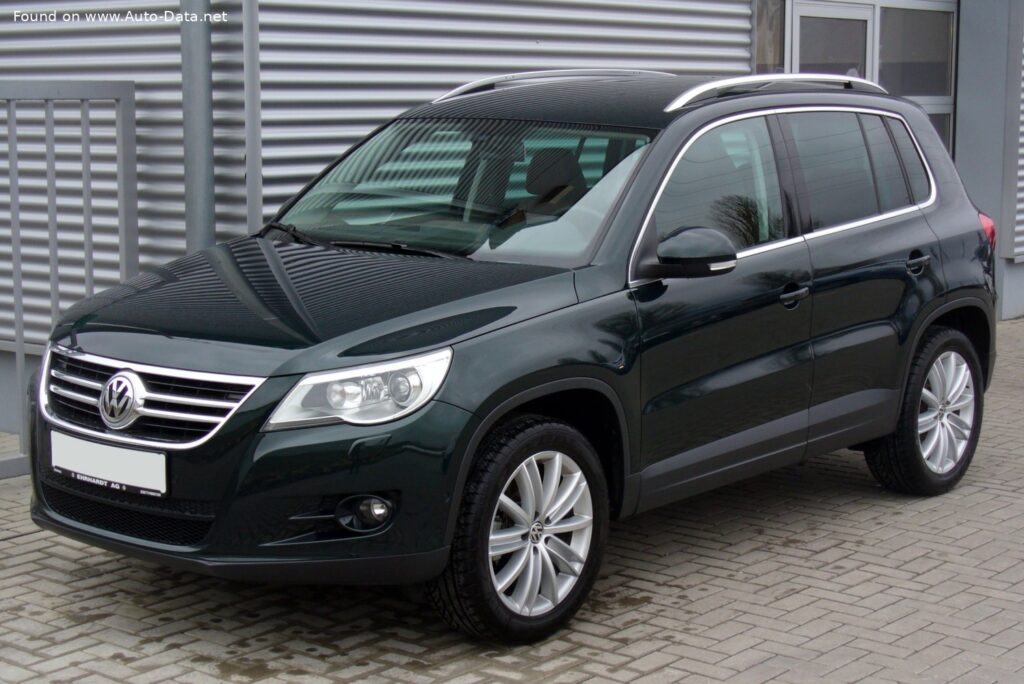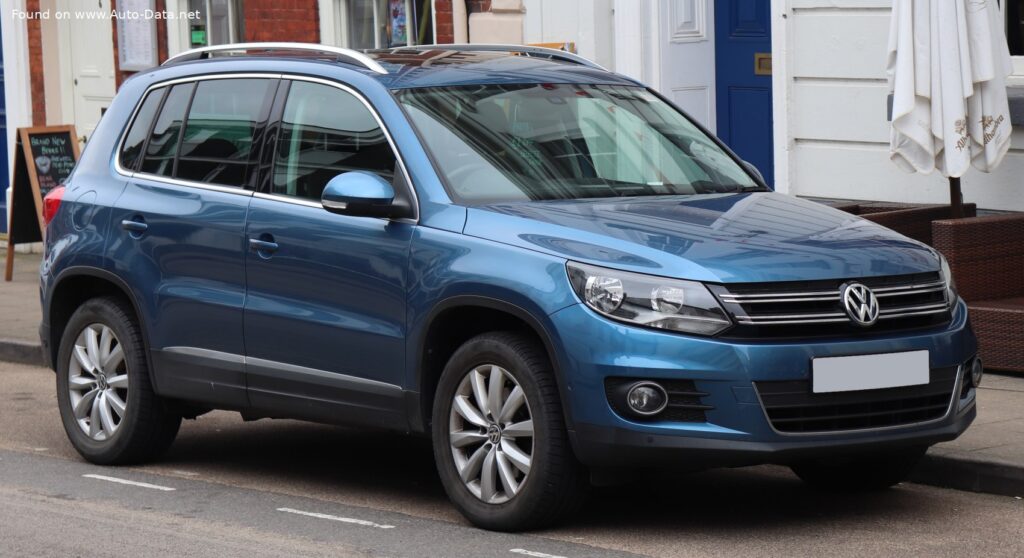
The Volkswagen Tiguan, a compact crossover SUV, established itself as a significant player in the global automotive market, particularly in Europe and other regions where diesel powertrains are highly valued. The model under scrutiny, the Volkswagen Tiguan I (facelift 2011) 2.0 TDI BMT (184 Hp) 4MOTION DSG, represents a refined iteration of the first-generation Tiguan, specifically highlighting its advanced diesel engine and sophisticated all-wheel-drive system. Produced for a brief period in 2015, this variant embodies Volkswagen’s commitment to efficiency, performance, and versatility within the popular SUV segment. While the Tiguan has been a staple in many markets, this particular configuration, with its robust TDI engine and BlueMotion Technology, was primarily targeted at European consumers, who appreciate its blend of strong torque, commendable fuel economy, and lower emissions, all while maintaining the practicality expected of a compact SUV.
The Evolution of the Volkswagen Tiguan I (facelift 2011) 2.0 TDI BMT (184 Hp) 4MOTION DSG
The first-generation Volkswagen Tiguan, introduced in 2007, quickly garnered acclaim for its car-like driving dynamics, premium interior, and robust build quality. The 2011 facelift brought a refreshed exterior design, updated interior elements, and a range of enhanced powertrains, including more efficient diesel options. The 2015 model year, though brief in its production run for this specific configuration, represented the pinnacle of the first generation’s diesel offerings, integrating Volkswagen’s advanced BlueMotion Technology (BMT) with a potent 2.0-liter TDI engine. This particular variant, the Volkswagen Tiguan I (facelift 2011) 2.0 TDI BMT (184 Hp) 4MOTION DSG, was engineered to deliver a compelling balance of performance, efficiency, and all-weather capability, making it a highly desirable option for families and individuals seeking a versatile and economical vehicle in the competitive compact SUV class. Its position in the market was defined by its ability to offer a premium experience without the premium price tag often associated with larger, more luxurious SUVs.
Engine and Performance
At the heart of the Volkswagen Tiguan I (facelift 2011) 2.0 TDI BMT (184 Hp) 4MOTION DSG is a sophisticated 2.0-liter (120.09 cu. in.) inline-four turbocharged diesel engine, designated with the code CUWA. This powertrain is a testament to Volkswagen’s engineering prowess in diesel technology, delivering a strong 184 horsepower at a usable 3500-4000 rpm. More impressively, it generates a substantial 280.27 lb.-ft. of torque, available across a broad rev range from 1750 to 3250 rpm. This wide torque band is crucial for an SUV, providing excellent responsiveness for city driving, highway overtaking, and even light off-road excursions. The engine’s layout is front, transverse, contributing to efficient packaging and a favorable weight distribution.
The 2.0 TDI BMT engine benefits from a commonrail direct fuel injection system and a turbocharger with an intercooler, ensuring optimal fuel atomization and air density for efficient combustion. Its DOHC (Double Overhead Camshaft) valvetrain with four valves per cylinder further enhances breathing and performance. With a bore of 3.19 inches and a stroke of 3.76 inches, the engine is designed for both power and efficiency. The inclusion of BlueMotion Technology features, such as a Start & Stop system and a particulate filter, underscores its commitment to environmental responsibility, allowing it to meet the stringent Euro 6 emission standard. This advanced diesel engine enables the Tiguan to accelerate from 0 to 60 mph in a swift 7.9 seconds and achieve a top speed of 126.76 mph, remarkable figures for a compact SUV of its size and class.
Fuel economy is a significant highlight of this Tiguan variant. Despite its robust performance and all-wheel-drive system, it achieves an impressive combined fuel consumption of 41.3 US mpg (5.7 l/100 km) under the NEDC cycle. Urban driving yields approximately 35.1 US mpg (6.7 l/100 km), while extra-urban conditions see figures as high as 47 US mpg (5 l/100 km). These figures, coupled with CO2 emissions of 150 g/km, make it an exceptionally economical choice, particularly appealing in markets where fuel efficiency is a primary purchasing factor. The vehicle’s 16.91 US gallon fuel tank capacity provides a substantial cruising range, further enhancing its practicality for long journeys.
Design and Features
The Volkswagen Tiguan I (facelift 2011) 2.0 TDI BMT (184 Hp) 4MOTION DSG retains the timeless and understated design language characteristic of Volkswagen vehicles. As a five-door, five-seat SUV, it offers a practical and comfortable cabin suitable for families. The facelift introduced subtle but effective changes, including redesigned headlights, a revised grille, and updated bumpers, giving it a more contemporary and sophisticated appearance. Its dimensions – a length of 174.25 inches, a width of 71.22 inches (80.35 inches including mirrors), and a height of 67.05 inches – provide a compact footprint while ensuring ample interior space.
Inside, the Tiguan offers a well-appointed and ergonomic environment. While specific trim levels and features can vary, models from this era typically included features like a multi-function steering wheel, climate control, and a comprehensive infotainment system. Safety was also a priority, with the inclusion of ABS (Anti-lock Braking System) as standard, along with a suite of airbags and stability control systems expected in a modern European vehicle. The SUV body type, coupled with a generous ride height of 7.87 inches, provides a commanding driving position and ease of entry and exit. Practicality is further enhanced by its cargo capacity: a minimum of 16.6 cu. ft. (470 liters) with the rear seats up, expanding to a cavernous 53.33 cu. ft. (1510 liters) when the rear seats are folded down, making it highly adaptable for various cargo needs.
Drivetrain and Chassis
The drivetrain architecture of the Volkswagen Tiguan I (facelift 2011) 2.0 TDI BMT (184 Hp) 4MOTION DSG is a key differentiator, featuring Volkswagen’s renowned 4MOTION all-wheel-drive system. This intelligent system primarily drives the front wheels but can seamlessly engage the rear wheels through an electrically or mechanically operated clutch when necessary, providing enhanced traction and stability in varying road conditions, from slippery surfaces to light off-road trails. This capability, combined with approach, departure, and ramp-over angles of 18°, 25°, and 20° respectively, imbues the Tiguan with genuine versatility beyond typical urban driving.
Power delivery to all four wheels is managed by a sophisticated 7-speed automatic DSG (Direct Shift Gearbox) transmission. The DSG is celebrated for its rapid, smooth gear changes, contributing to both the vehicle’s lively acceleration and its impressive fuel efficiency. The Tiguan’s chassis is engineered for a balanced ride and responsive handling. It features an independent McPherson strut front suspension with coil springs and an anti-roll bar, while the rear utilizes an independent multi-link spring suspension with a stabilizer. This setup ensures a comfortable ride over varied terrain while maintaining precise control. Braking performance is robust, with ventilated discs at the front and disc brakes at the rear, supported by the standard ABS. The electric power steering system provides precise feedback and reduces effort at low speeds, enhancing maneuverability, evident in its minimum turning circle of 39.37 feet.
The vehicle’s kerb weight of 3642.04 lbs. (1652 kg) contributes to its solid feel and stability. With a maximum permissible weight of 5026.54 lbs. (2280 kg) and a maximum load capacity of 1384.5 lbs. (628 kg), the Tiguan is well-equipped for passengers and cargo. Furthermore, its towing capabilities are impressive for its class, with a permitted trailer load of 4850.17 lbs. (2200 kg) with brakes and 1653.47 lbs. (750 kg) without brakes, making it a capable companion for recreational activities. The choice of tire sizes, ranging from 215/60 R17 to 255/40 R19, mounted on corresponding wheel rims, allows for customization based on performance or comfort preferences, further enhancing the Tiguan’s appeal as a versatile and well-engineered compact SUV.
Technical Specifications: Volkswagen Tiguan I (facelift 2011) 2.0 TDI BMT (184 Hp) 4MOTION DSG
| Brand | Volkswagen |
| Model | Tiguan |
| Generation | Tiguan I (facelift 2011) |
| Type (Engine) | 2.0 TDI BMT (184 Hp) 4MOTION DSG |
| Start of production | 2015 year |
| End of production | 2015 year |
| Powertrain Architecture | Internal Combustion engine |
| Body type | SUV |
| Seats | 5 |
| Doors | 5 |
| Fuel consumption (economy) – urban (NEDC) | 6.7 l/100 km (35.1 US mpg) |
| Fuel consumption (economy) – extra urban (NEDC) | 5 l/100 km (47 US mpg) |
| Fuel consumption (economy) – combined (NEDC) | 5.7 l/100 km (41.3 US mpg) |
| CO2 emissions (NEDC) | 150 g/km |
| Fuel Type | Diesel |
| Acceleration 0 – 100 km/h | 8.3 sec |
| Acceleration 0 – 62 mph | 8.3 sec |
| Acceleration 0 – 60 mph (Calculated) | 7.9 sec |
| Maximum speed | 204 km/h (126.76 mph) |
| Emission standard | Euro 6 |
| Weight-to-power ratio | 9 kg/Hp (111.4 Hp/tonne) |
| Weight-to-torque ratio | 4.3 kg/Nm (230 Nm/tonne) |
| Power | 184 Hp @ 3500-4000 rpm. |
| Power per litre | 93.5 Hp/l |
| Torque | 380 Nm @ 1750-3250 rpm (280.27 lb.-ft.) |
| Engine layout | Front, Transverse |
| Engine Model/Code | CUWA |
| Engine displacement | 1968 cm3 (120.09 cu. in.) |
| Number of cylinders | 4 |
| Engine configuration | Inline |
| Cylinder Bore | 81 mm (3.19 in.) |
| Piston Stroke | 95.5 mm (3.76 in.) |
| Number of valves per cylinder | 4 |
| Fuel injection system | Diesel Commonrail |
| Engine aspiration | Turbocharger, Intercooler |
| Valvetrain | DOHC |
| Engine oil capacity | 4.7 l (4.97 US qt) |
| Engine systems | Start & Stop System, Particulate filter |
| Kerb Weight | 1652 kg (3642.04 lbs.) |
| Max. weight | 2280 kg (5026.54 lbs.) |
| Max load | 628 kg (1384.5 lbs.) |
| Trunk (boot) space – minimum | 470 l (16.6 cu. ft.) |
| Trunk (boot) space – maximum | 1510 l (53.33 cu. ft.) |
| Fuel tank capacity | 64 l (16.91 US gal) |
| Max. roof load | 100 kg (220.46 lbs.) |
| Permitted trailer load with brakes (8%) | 2200 kg (4850.17 lbs.) |
| Permitted trailer load with brakes (12%) | 2200 kg (4850.17 lbs.) |
| Permitted trailer load without brakes | 750 kg (1653.47 lbs.) |
| Permitted towbar download | 100 kg (220.46 lbs.) |
| Length | 4426 mm (174.25 in.) |
| Width | 1809 mm (71.22 in.) |
| Width including mirrors | 2041 mm (80.35 in.) |
| Height | 1703 mm (67.05 in.) |
| Wheelbase | 2604 mm (102.52 in.) |
| Front track | 1569 mm (61.77 in.) |
| Rear (Back) track | 1571 mm (61.85 in.) |
| Ride height (ground clearance) | 200 mm (7.87 in.) |
| Minimum turning circle (turning diameter) | 12 m (39.37 ft.) |
| Approach angle | 18° |
| Departure angle | 25° |
| Ramp-over (brakeover) angle | 20° |
| Drivetrain Architecture | The Internal combustion engine (ICE) drives the front wheels permanently, and the rear wheels are driven through an electrically or mechanically operated clutch if necessary. |
| Drive wheel | All wheel drive (4×4) |
| Number of gears and type of gearbox | 7 gears, automatic transmission DSG |
| Front suspension | Independent, type McPherson with coil spring and anti-roll bar |
| Rear suspension | Independent multi-link spring suspension with stabilizer |
| Front brakes | Ventilated discs |
| Rear brakes | Disc |
| Assisting systems | ABS (Anti-lock braking system) |
| Steering type | Steering rack and pinion |
| Power steering | Electric Steering |
| Tires size | 215/60 R17; 235/55 R17; 235/50 R18; 255/40 R19 |
| Wheel rims size | 6.5J x 17; 7J x 17; 7J x 18; 8J x 18; 9J x 19 |