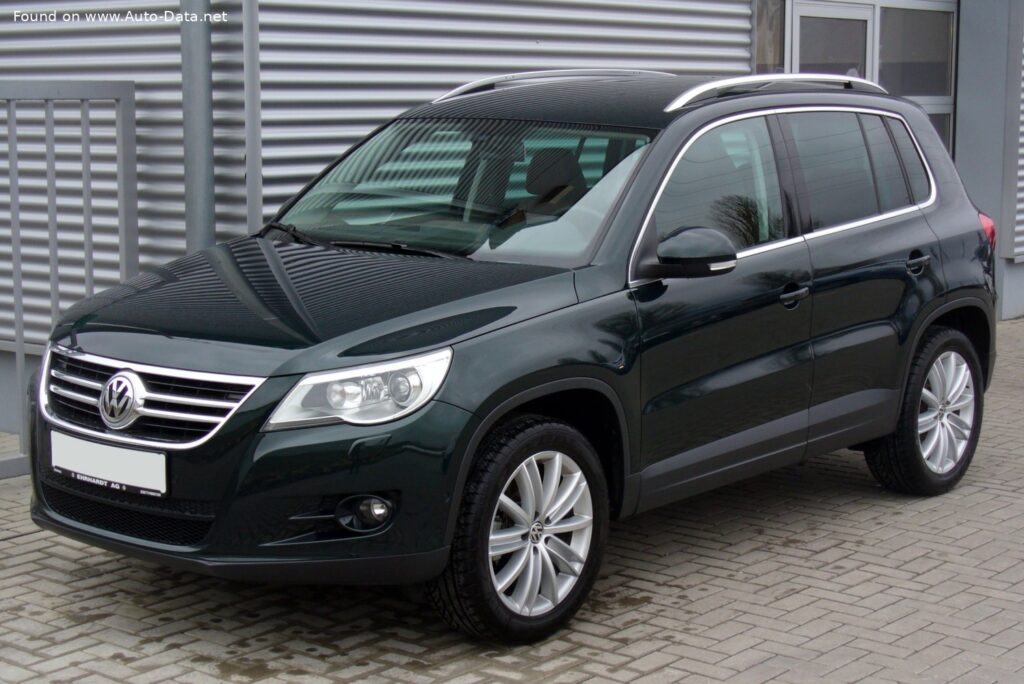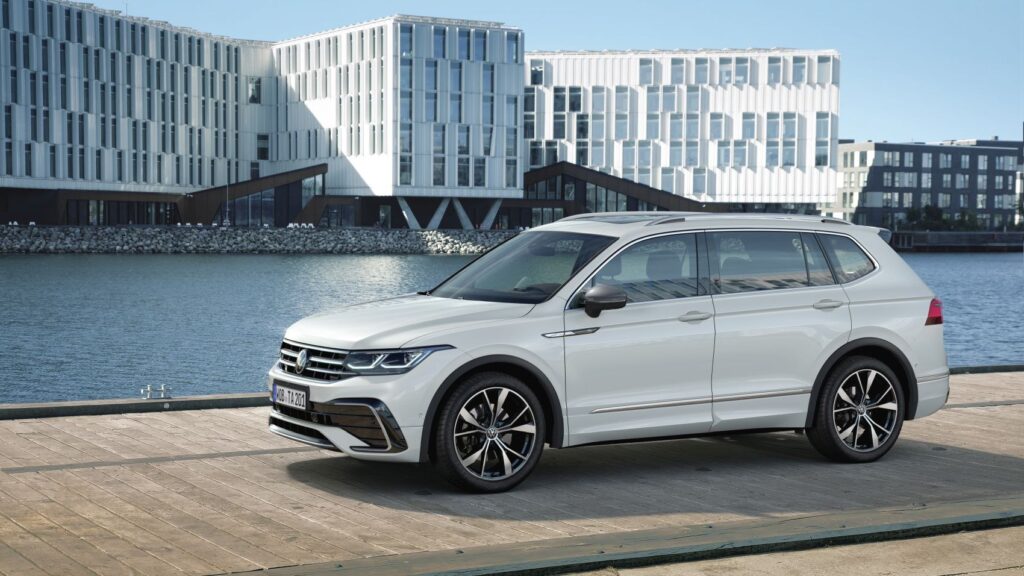
The Volkswagen Tiguan II Allspace (facelift 2021) 2.0 TSI 4MOTION DSG is a compact SUV produced by the German manufacturer Volkswagen. This version represents a mid-cycle refresh of the Tiguan Allspace, a long-wheelbase variant of the standard Tiguan, primarily marketed in Europe and other regions outside of North America. The Allspace model offers increased interior space and optional seven-passenger seating, differentiating it from the standard Tiguan. The 2.0 TSI designation indicates the vehicle is powered by a turbocharged, direct-injection gasoline engine producing 190 horsepower, coupled with a dual-clutch DSG transmission and Volkswagen’s 4MOTION all-wheel-drive system. This model year, spanning from May 2021 to August 2024, focused on refining the existing platform with updated technology and styling.
Volkswagen Tiguan II Allspace: An Overview
The Tiguan Allspace, and specifically this 2021 facelift, caters to buyers needing more space than the standard Tiguan offers. It’s positioned as a practical family vehicle, competing with other compact SUVs like the Skoda Kodiaq (also a Volkswagen Group product), Nissan X-Trail, and Peugeot 5008 in the European market. Unlike many SUVs sold in the United States, the Tiguan Allspace prioritizes fuel efficiency and a more manageable size for European roads and city driving. The facelift brought styling updates, improved technology, and refinements to the powertrain for enhanced performance and reduced emissions.
Engine & Performance
At the heart of the Tiguan II Allspace 2.0 TSI 4MOTION DSG lies Volkswagen’s EA888 evo4 2.0-liter inline-four cylinder turbocharged gasoline engine. This engine produces 190 horsepower (Hp) and 320 Newton-meters (236.02 lb.-ft.) of torque between 1500 and 4100 rpm. The direct injection system and turbocharging contribute to both power output and fuel efficiency. Power is delivered to all four wheels via Volkswagen’s 4MOTION all-wheel-drive system, which utilizes a multi-plate clutch to distribute torque between the front and rear axles as needed. This system enhances traction and stability, particularly in adverse weather conditions. The seven-speed dual-clutch DSG (Direct-Shift Gearbox) transmission provides quick and smooth gear changes, contributing to a 0-100 km/h (0-62 mph) acceleration time of 7.7 seconds. The engine’s power-to-weight ratio is 8.7 kg/Hp, and the torque-to-weight ratio is 5.2 kg/Nm, indicating a responsive driving experience. Maximum speed is electronically limited to 213 km/h (132.35 mph).
Design & Features
The Tiguan II Allspace is a five-door SUV with a body length of 4728 mm (186.14 in). The facelifted model features revised front and rear styling, including updated headlights and taillights, a redesigned grille, and a new front bumper. The interior is characterized by a modern and functional design, with a focus on practicality and comfort. Standard features typically include a touchscreen infotainment system, climate control, and a range of driver-assistance systems. The Allspace model’s extended wheelbase provides ample legroom for passengers in both the first and second rows, and the optional third-row seating increases passenger capacity to seven. Trunk space is a significant advantage, offering 760 liters (26.84 cu. ft.) with the rear seats up and 1920 liters (67.8 cu. ft.) with the rear seats folded down. Safety features include ABS, electronic stability control, and multiple airbags. The vehicle’s kerb weight is 1660 kg (3659.67 lbs), with a maximum permissible weight of 2300 kg (5070.63 lbs).
Technical Specifications
| Brand | Volkswagen |
| Model | Tiguan |
| Generation | Tiguan II Allspace (facelift 2021) |
| Type (Engine) | 2.0 TSI (190 Hp) 4MOTION DSG |
| Start of production | May, 2021 |
| End of production | August, 2024 |
| Powertrain Architecture | Internal Combustion engine |
| Body type | SUV |
| Seats | 5 |
| Doors | 5 |
| Fuel consumption at Low speed (WLTP) | 10.6 l/100 km (22.2 US mpg, 26.6 UK mpg, 9.4 km/l) |
| Fuel consumption at Medium speed (WLTP) | 8.5 l/100 km (27.7 US mpg, 33.2 UK mpg, 11.8 km/l) |
| Fuel consumption at high speed (WLTP) | 7.5 l/100 km (31.4 US mpg, 37.7 UK mpg, 13.3 km/l) |
| Fuel consumption at very high speed (WLTP) | 8.7 l/100 km (27 US mpg, 32.5 UK mpg, 11.5 km/l) |
| Combined fuel consumption (WLTP) | 8.5 l/100 km (27.7 US mpg, 33.2 UK mpg, 11.8 km/l) |
| CO2 emissions (WLTP) | 194 g/km |
| Fuel consumption (economy) – urban (NEDC) | 7.9 l/100 km (29.8 US mpg, 35.8 UK mpg, 12.7 km/l) |
| Fuel consumption (economy) – extra urban (NEDC) | 6.4 l/100 km (36.8 US mpg, 44.1 UK mpg, 15.6 km/l) |
| Fuel consumption (economy) – combined (NEDC) | 7 l/100 km (33.6 US mpg, 40.4 UK mpg, 14.3 km/l) |
| CO2 emissions (NEDC) | 160 g/km |
| Fuel Type | Petrol (Gasoline) |
| Acceleration 0 – 100 km/h | 7.7 sec |
| Acceleration 0 – 62 mph | 7.7 sec |
| Acceleration 0 – 60 mph | 7.3 sec |
| Maximum speed | 213 km/h (132.35 mph) |
| Emission standard | Euro 6d-ISC-FCM |
| Weight-to-power ratio | 8.7 kg/Hp, 114.5 Hp/tonne |
| Weight-to-torque ratio | 5.2 kg/Nm, 192.8 Nm/tonne |
| Power | 190 Hp |
| Power per litre | 95.8 Hp/l |
| Torque | 320 Nm @ 1500-4100 rpm (236.02 lb.-ft. @ 1500-4100 rpm) |
| Engine layout | Front, Transverse |
| Engine Model/Code | EA888 evo4 / DNNA |
| Engine displacement | 1984 cm3 (121.07 cu. in.) |
| Number of cylinders | 4 |
| Engine configuration | Inline |
| Cylinder Bore | 82.5 mm (3.25 in.) |
| Piston Stroke | 92.8 mm (3.65 in.) |
| Number of valves per cylinder | 4 |
| Fuel injection system | Direct injection |
| Engine aspiration | Turbocharger, Intercooler |
| Valvetrain | DOHC |
| Engine oil capacity | 5.7 l (6.02 US qt | 5.02 UK qt) |
| Kerb Weight | 1660 kg (3659.67 lbs.) |
| Max. weight | 2300 kg (5070.63 lbs.) |
| Max load | 640 kg (1410.96 lbs.) |
| Trunk (boot) space – minimum | 760 l (26.84 cu. ft.) |
| Trunk (boot) space – maximum | 1920 l (67.8 cu. ft.) |
| Fuel tank capacity | 58 l (15.32 US gal | 12.76 UK gal) |
| Max. roof load | 75 kg (165.35 lbs.) |
| Permitted trailer load with brakes (12%) | 2500 kg (5511.56 lbs.) |
| Permitted trailer load without brakes | 750 kg (1653.47 lbs.) |
| Permitted towbar download | 100 kg (220.46 lbs.) |
| Length | 4728 mm (186.14 in.) |
| Width | 1839 mm (72.4 in.) |
| Width including mirrors | 2099 mm (82.64 in.) |
| Height | 1686 mm (66.38 in.) |
| Wheelbase | 2789 mm (109.8 in.) |
| Front track | 1575-1585 mm (62.01 – 62.4 in.) |
| Rear (Back) track | 1565-1575 mm (61.61 – 62.01 in.) |
| Approach angle | 16.8° |
| Departure angle | 15.6° |
| Ramp-over (brakeover) angle | 16.1° |
| Drivetrain Architecture | The Internal combustion engine (ICE) drives the front wheels permanently, and the rear wheels are driven through an electrically or mechanically operated clutch if necessary. |
| Drive wheel | All wheel drive (4×4) |
| Number of gears and type of gearbox | 7 gears, automatic transmission DSG |
| Front suspension | Independent type McPherson, Transverse stabilizer |
| Rear suspension | Independent multi-link suspension, Transverse stabilizer |
| Front brakes | Ventilated discs |
| Rear brakes | Disc |
| Assisting systems | ABS (Anti-lock braking system) |
| Steering type | Steering rack and pinion |
| Power steering | Electric Steering |
| Tires size | 235/50 R19; 235/45 R20 |
| Wheel rims size | 7J x 19; 8J x 20 |