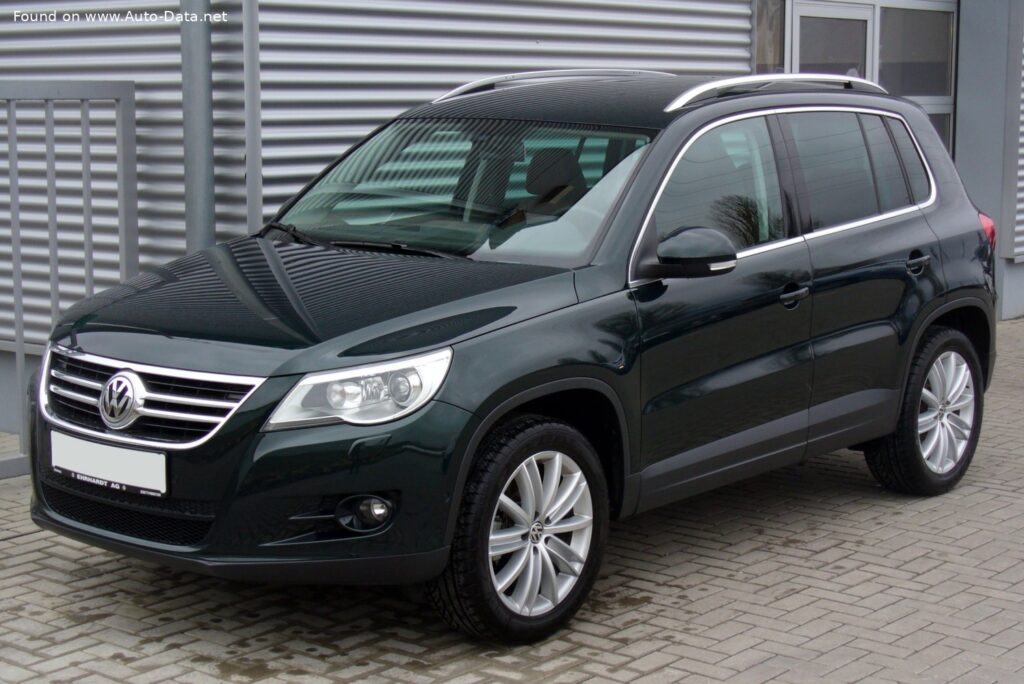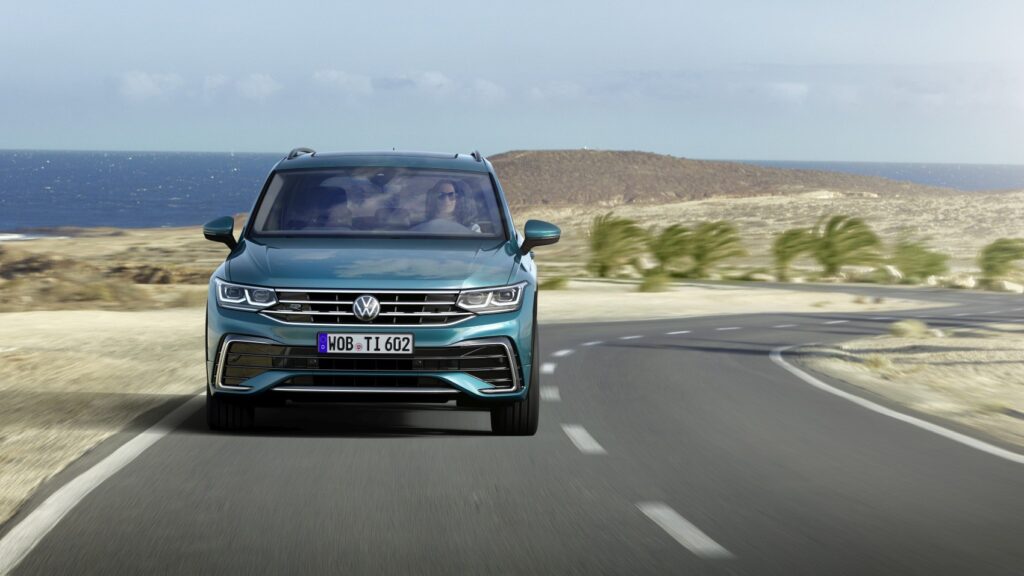
The Volkswagen Tiguan II R 2.0 TSI (320 Hp) 4MOTION DSG, produced from November 2020 to August 2023, represents the performance-oriented pinnacle of the Tiguan II facelift range. Positioned as a compact SUV, the Tiguan has been a key model in Volkswagen’s global lineup, particularly successful in the European market where it competes with vehicles like the BMW X3, Audi Q5, and Mercedes-Benz GLC. While the Tiguan is sold in North America, the ‘R’ variant was not officially offered there, making it a more exclusive offering in other regions. This model aimed to deliver a blend of everyday practicality, sporty performance, and advanced technology within the popular SUV segment.
Volkswagen Tiguan II R: A Performance SUV
The Tiguan II, launched in 2016, was a significant evolution of the original Tiguan, offering increased space, improved technology, and a more refined driving experience. The 2020 facelift brought updated styling, enhanced interior features, and, crucially, the introduction of the ‘R’ performance model. The ‘R’ designation, historically used by Volkswagen for its high-performance vehicles, signifies a substantial upgrade in power and handling compared to the standard Tiguan models. This variant was designed to appeal to drivers seeking a more engaging and dynamic SUV experience without sacrificing the practicality and versatility expected of the class.
Engine & Performance
At the heart of the Tiguan II R lies a 2.0-liter turbocharged inline-four cylinder engine, designated DNFG. This engine produces a robust 320 horsepower and 420 Nm (309.78 lb.-ft.) of torque, available from 2100 to 5350 rpm. This power is delivered to all four wheels via Volkswagen’s 4MOTION all-wheel-drive system, coupled with a seven-speed dual-clutch DSG (Direct-Shift Gearbox) transmission. The combination results in impressive performance figures: a 0-100 km/h (0-62 mph) acceleration time of just 4.9 seconds, and a 0-60 mph time of 4.7 seconds. The top speed is electronically limited to 250 km/h (155.34 mph). The engine’s specific output is 161.3 horsepower per liter, highlighting its efficiency and advanced engineering. Features like a start/stop system and a particulate filter contribute to managing emissions, adhering to Euro 6d-ISC-FCM standards.
Design & Features
The Tiguan II R maintains the SUV body style of the standard Tiguan, offering five seats and five doors. However, it distinguishes itself with several sporty design cues. These include a more aggressive front bumper, unique alloy wheel designs (typically 20-inch), and subtle ‘R’ badging. The interior features sport seats with distinctive upholstery, a sport steering wheel, and aluminum pedal caps. Beyond the aesthetic enhancements, the Tiguan II R benefits from a sophisticated all-wheel-drive system that actively distributes torque between the front and rear axles, enhancing handling and stability. The suspension is also tuned for performance, providing a firmer ride and improved cornering ability. Standard safety features include ABS, and a comprehensive suite of driver-assistance systems. The vehicle offers a fuel tank capacity of 58 liters (15.32 US gallons), a maximum roof load of 75 kg (165.35 lbs), and a permitted trailer load of up to 2200 kg (4850.17 lbs) with brakes.
Technical Specifications
| Brand | Volkswagen |
| Model | Tiguan |
| Generation | Tiguan II (facelift 2020) |
| Type (Engine) | R 2.0 TSI (320 Hp) 4MOTION DSG |
| Start of production | November, 2020 |
| End of production | August, 2023 |
| Powertrain Architecture | Internal Combustion engine |
| Body type | SUV |
| Seats | 5 |
| Doors | 5 |
| Fuel consumption at Low speed (WLTP) | 13.9 l/100 km (16.9 US mpg, 20.3 UK mpg, 7.2 km/l) |
| Fuel consumption at Medium speed (WLTP) | 9.8 l/100 km (24 US mpg, 28.8 UK mpg, 10.2 km/l) |
| Fuel consumption at high speed (WLTP) | 8.4 l/100 km (28 US mpg, 33.6 UK mpg, 11.9 km/l) |
| Fuel consumption at very high speed (WLTP) | 9.8 l/100 km (24 US mpg, 28.8 UK mpg, 10.2 km/l) |
| Combined fuel consumption (WLTP) | 9.9 l/100 km (23.8 US mpg, 28.5 UK mpg, 10.1 km/l) |
| CO2 emissions (WLTP) | 225 g/km |
| Fuel consumption (economy) – urban (NEDC) | 10.2 l/100 km (23.1 US mpg, 27.7 UK mpg, 9.8 km/l) |
| Fuel consumption (economy) – extra urban (NEDC) | 7 l/100 km (33.6 US mpg, 40.4 UK mpg, 14.3 km/l) |
| Fuel consumption (economy) – combined (NEDC) | 8.1 l/100 km (29 US mpg, 34.9 UK mpg, 12.3 km/l) |
| CO2 emissions (NEDC) | 186 g/km |
| Fuel Type | Petrol (Gasoline) |
| Acceleration 0 – 100 km/h | 4.9 sec |
| Acceleration 0 – 62 mph | 4.9 sec |
| Acceleration 0 – 60 mph | 4.7 sec |
| Maximum speed | 250 km/h (155.34 mph) |
| Emission standard | Euro 6d-ISC-FCM |
| Weight-to-power ratio | 5.2 kg/Hp, 191.5 Hp/tonne |
| Weight-to-torque ratio | 4 kg/Nm, 251.3 Nm/tonne |
| Power | 320 Hp |
| Power per litre | 161.3 Hp/l |
| Torque | 420 Nm @ 2100-5350 rpm (309.78 lb.-ft. @ 2100-5350 rpm) |
| Engine layout | Front, Transverse |
| Engine Model/Code | DNFG |
| Engine displacement | 1984 cm3 (121.07 cu. in.) |
| Number of cylinders | 4 |
| Engine configuration | Inline |
| Cylinder Bore | 82.5 mm (3.25 in.) |
| Piston Stroke | 92.8 mm (3.65 in.) |
| Number of valves per cylinder | 4 |
| Fuel injection system | Direct injection |
| Engine aspiration | Turbocharger, Intercooler |
| Valvetrain | DOHC |
| Engine oil capacity | 5.7 l (6.02 US qt | 5.02 UK qt) |
| Kerb Weight | 1671 kg (3683.92 lbs.) |
| Max. weight | 2260 kg (4982.45 lbs.) |
| Max load | 589 kg (1298.52 lbs.) |
| Fuel tank capacity | 58 l (15.32 US gal | 12.76 UK gal) |
| Max. roof load | 75 kg (165.35 lbs.) |
| Permitted trailer load with brakes (12%) | 2200 kg (4850.17 lbs.) |
| Permitted trailer load without brakes | 750 kg (1653.47 lbs.) |
| Permitted towbar download | 100 kg (220.46 lbs.) |
| Length | 4514 mm (177.72 in.) |
| Width | 1859 mm (73.19 in.) |
| Height | 1668 mm (65.67 in.) |
| Wheelbase | 2678 mm (105.43 in.) |
| Front track | 1579-1589 mm (62.17 – 62.56 in.) |
| Rear (Back) track | 1570-1580 mm (61.81 – 62.2 in.) |
| Approach angle | 16.4° |
| Departure angle | 16.3° |
| Ramp-over (brakeover) angle | 16.1° |
| Drivetrain Architecture | The Internal combustion engine (ICE) drives the front wheels permanently, and the rear wheels are driven through an electrically or mechanically operated clutch if necessary. |
| Drive wheel | All wheel drive (4×4) |
| Number of gears and type of gearbox | 7 gears, automatic transmission DSG |
| Front suspension | Independent type McPherson, Transverse stabilizer |
| Rear suspension | Independent multi-link suspension, Transverse stabilizer |
| Front brakes | Ventilated discs |
| Rear brakes | Ventilated discs |
| Assisting systems | ABS (Anti-lock braking system) |
| Steering type | Steering rack and pinion |
| Power steering | Electric Steering |
| Tires size | 255/40 R20 |
| Wheel rims size | 8.5J x 20 |