
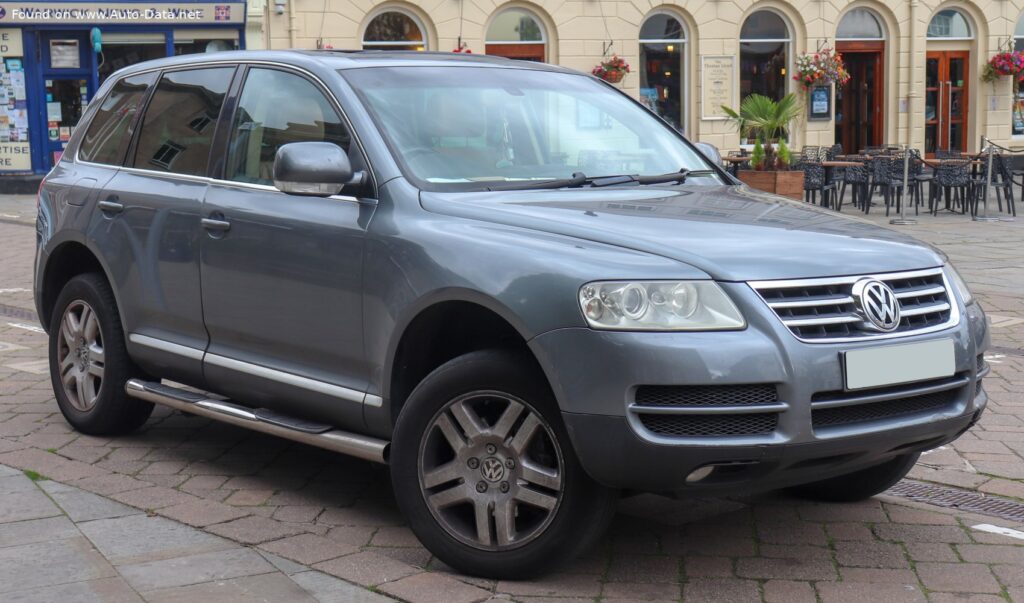
The Volkswagen Touareg I (7L), produced from 2002 to 2006, represents Volkswagen’s initial foray into the burgeoning luxury mid-size SUV segment. Developed alongside the Porsche Cayenne (with whom it shares a platform), the Touareg aimed to provide a capable and refined all-road vehicle, blending Volkswagen’s engineering prowess with a touch of premium aspiration. While not initially a high-volume seller in the United States – Volkswagen focused more on the Tiguan and later, the Atlas – the Touareg established a foothold for the brand in the SUV market and showcased its ability to compete with established European and Japanese rivals. The 2.5 TDI 4MOTION variant, equipped with a five-cylinder diesel engine, was a popular choice in Europe, offering a balance of fuel efficiency and respectable performance.
Volkswagen Touareg I (7L): A Detailed Overview
The Touareg I (7L) was a significant vehicle for Volkswagen, marking a departure from its traditionally smaller, more economical offerings. It was designed to appeal to customers seeking a vehicle capable of both on-road comfort and off-road capability. The “7L” designation refers to the internal platform code, signifying its shared architecture with the Porsche Cayenne and Audi Q7. This collaboration allowed Volkswagen to reduce development costs and leverage the expertise of its sister brands. The 2.5 TDI 4MOTION model specifically targeted European markets where diesel engines were – and continue to be – highly favored due to their fuel efficiency and torque characteristics.
Engine & Performance
The heart of the Touareg I (7L) 2.5 TDI 4MOTION is a 2.5-liter inline five-cylinder diesel engine, designated BAC or BLK depending on minor revisions. This engine produces 174 horsepower at 3500 rpm and a substantial 400 Nm (295.02 lb.-ft.) of torque at 2000 rpm. The engine features a pump-nozzle (unit injector) fuel injection system and is equipped with a turbocharger and intercooler to enhance performance. While not exceptionally powerful by modern standards, the engine’s torque output provides ample pulling power for towing and off-road driving. Acceleration from 0 to 100 km/h (0-62 mph) takes 12.4 seconds, and 0 to 60 mph is achieved in approximately 11.8 seconds. The Touareg’s top speed is electronically limited to 184 km/h (114.33 mph). The engine’s longitudinal front-engine layout contributes to a balanced weight distribution. Fuel economy is rated at 9.8 liters per 100 kilometers (24 US mpg), making it relatively efficient for a vehicle of its size and capability.
Design & Features
The Touareg I (7L) boasts a classic SUV silhouette, characterized by a boxy shape, high ground clearance, and a prominent front grille. The vehicle is a five-door SUV with seating for five passengers. Key design features include robust body cladding, large headlights, and a relatively understated aesthetic compared to some of its more aggressively styled competitors. The interior is designed with practicality and comfort in mind, featuring durable materials and a functional layout. The 4MOTION all-wheel-drive system is a central feature, providing enhanced traction and stability in various driving conditions. The air suspension system, fitted to both the front and rear axles, offers adjustable ride height and improved off-road capability. Safety features, while not as comprehensive as those found in modern vehicles, include ABS (Anti-lock Braking System) and ventilated disc brakes on all four wheels. Trunk space is generous, ranging from 555 liters (19.6 cu. ft.) with the rear seats up to 1570 liters (55.44 cu. ft.) with the seats folded down.
Technical Specifications
| Brand | Volkswagen |
| Model | Touareg |
| Generation | Touareg I (7L) |
| Type (Engine) | 2.5 TDI (174 Hp) 4MOTION |
| Start of production | 2002 |
| End of production | 2006 |
| Powertrain Architecture | Internal Combustion engine |
| Body type | SUV |
| Seats | 5 |
| Doors | 5 |
| Fuel consumption (combined) | 9.8 l/100 km (24 US mpg, 28.8 UK mpg, 10.2 km/l) |
| Fuel Type | Diesel |
| Acceleration 0 – 100 km/h | 12.4 sec |
| Acceleration 0 – 62 mph | 12.4 sec |
| Acceleration 0 – 60 mph | 11.8 sec |
| Maximum speed | 184 km/h (114.33 mph) |
| Weight-to-power ratio | 12.8 kg/Hp |
| Weight-to-torque ratio | 5.6 kg/Nm |
| Power | 174 Hp @ 3500 rpm |
| Power per litre | 70.7 Hp/l |
| Torque | 400 Nm @ 2000 rpm (295.02 lb.-ft. @ 2000 rpm) |
| Engine layout | Front, Longitudinal |
| Engine Model/Code | BAC, BLK |
| Engine displacement | 2460 cm3 (150.12 cu. in.) |
| Number of cylinders | 5 |
| Engine configuration | Inline |
| Cylinder Bore | 81 mm (3.19 in.) |
| Piston Stroke | 95.5 mm (3.76 in.) |
| Compression ratio | 18.5:1 |
| Number of valves per cylinder | 2 |
| Fuel injection system | Pump-nozzle (Unit Injector) |
| Engine aspiration | Turbocharger, Intercooler |
| Engine oil capacity | 8.9 l (9.4 US qt | 7.83 UK qt) |
| Coolant | 9 l (9.51 US qt | 7.92 UK qt) |
| Kerb Weight | 2229-2435 kg (4914.1 – 5368.26 lbs.) |
| Trunk (boot) space – minimum | 555 l (19.6 cu. ft.) |
| Trunk (boot) space – maximum | 1570 l (55.44 cu. ft.) |
| Fuel tank capacity | 100 l (26.42 US gal | 22 UK gal) |
| Length | 4754 mm (187.17 in.) |
| Width | 1928 mm (75.91 in.) |
| Height | 1726 mm (67.95 in.) |
| Wheelbase | 2855 mm (112.4 in.) |
| Front track | 1653 mm (65.08 in.) |
| Rear (Back) track | 1665 mm (65.55 in.) |
| Drive wheel | All wheel drive (4×4) |
| Number of gears and type of gearbox | 6 gears, manual transmission |
| Front suspension | Air suspension |
| Rear suspension | Air suspension |
| Front brakes | Ventilated discs |
| Rear brakes | Ventilated discs |
| Assisting systems | ABS (Anti-lock braking system) |
| Steering type | Steering rack and pinion |
| Power steering | Hydraulic Steering |
| Tires size | 235/65 R17 |
| Wheel rims size | 17 |
