
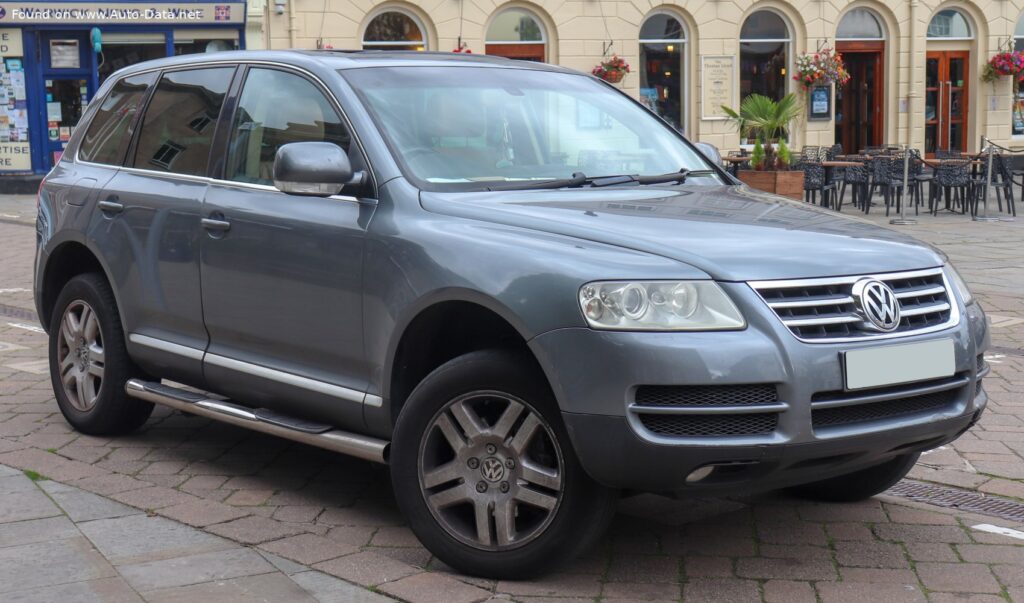
The Volkswagen Touareg I (7L), produced from 2002 to 2010, represented Volkswagen’s entry into the burgeoning luxury SUV market. This first generation, specifically the 3.0 TDI 4MOTION Tiptronic variant manufactured between 2005 and 2006, was a significant model for the brand, offering a blend of on-road comfort and respectable off-road capability. While not initially sold in the United States during this generation, the Touareg was a popular choice in Europe and other international markets, competing with vehicles like the BMW X5 and Mercedes-Benz M-Class. The 7L chassis designation refers to the internal platform code, and this model aimed to provide a premium SUV experience with Volkswagen’s renowned engineering.
Volkswagen Touareg I (7L) 3.0 TDI 4MOTION Tiptronic
The Touareg I (7L) 3.0 TDI 4MOTION Tiptronic was a key offering within the Touareg range, leveraging a diesel engine for fuel efficiency and torque. The “4MOTION” designation indicates Volkswagen’s all-wheel-drive system, and “Tiptronic” refers to the automatic transmission with manual shift capability. This combination aimed to deliver a versatile vehicle suitable for both daily commuting and more adventurous driving conditions. The 3.0 TDI engine was particularly popular in Europe due to favorable diesel fuel costs and emissions regulations at the time.
Engine & Performance
At the heart of the Touareg I (7L) 3.0 TDI 4MOTION Tiptronic lies a 3.0-liter V6 turbocharged diesel engine, designated the BKS engine code. This engine produces 224 horsepower at 4,000 rpm and a substantial 500 Nm (368.78 lb.-ft.) of torque at 1750 rpm. The longitudinal engine layout and common rail direct fuel injection contribute to its efficiency and power delivery. The turbocharger and intercooler further enhance performance. Paired with a six-speed Tiptronic automatic transmission, the Touareg achieves a 0-100 km/h (0-62 mph) acceleration time of 9.9 seconds, and a 0-60 mph time of approximately 9.4 seconds. Its maximum speed is electronically limited to 205 km/h (127.38 mph). Fuel economy is rated at 9.3 liters per 100 kilometers combined (25.3 US mpg, 30.4 UK mpg), with 15.2 l/100 km (15.5 US mpg) in urban settings and 8.7 l/100 km (27 US mpg) on the extra-urban cycle. The engine’s power-to-weight ratio is 10.5 kg/Hp, and the torque-to-weight ratio is 4.7 kg/Nm.
Design & Features
The Volkswagen Touareg I (7L) is a five-door SUV with seating for up to seven passengers, depending on the configuration. Its body style is characterized by a robust and relatively understated design, typical of early 2000s SUVs. The vehicle measures 4754 mm (187.17 in) in length, 1928 mm (75.91 in) in width, and 1726 mm (67.95 in) in height, with a wheelbase of 2855 mm (112.4 in). Key features included the 4MOTION all-wheel-drive system, providing enhanced traction and stability in various conditions. The air suspension system, fitted to both the front and rear axles, offered adjustable ride height and improved comfort. Safety features included ABS (Anti-lock Braking System) and ventilated disc brakes on all four wheels. The interior focused on providing a comfortable and functional space, with a focus on durability and practicality. Trunk space ranges from a minimum of 555 liters (19.6 cu. ft.) to a maximum of 1570 liters (55.44 cu. ft.) with the rear seats folded down. The Touareg’s design prioritized a balance between off-road capability and on-road refinement.
Technical Specifications
| Brand | Volkswagen |
| Model | Touareg |
| Generation | Touareg I (7L) |
| Type (Engine) | 3.0 TDI (224 Hp) 4MOTION Tiptronic |
| Start of production | 2005 |
| End of production | 2006 |
| Powertrain Architecture | Internal Combustion engine |
| Body type | SUV |
| Seats | 7 |
| Doors | 5 |
| Fuel consumption (urban) | 15.2 l/100 km (15.5 US mpg, 18.6 UK mpg) |
| Fuel consumption (extra urban) | 8.7 l/100 km (27 US mpg, 32.5 UK mpg) |
| Fuel consumption (combined) | 9.3 l/100 km (25.3 US mpg, 30.4 UK mpg) |
| Fuel Type | Diesel |
| Acceleration 0 – 100 km/h | 9.9 sec |
| Acceleration 0 – 62 mph | 9.9 sec |
| Acceleration 0 – 60 mph | 9.4 sec |
| Maximum speed | 205 km/h (127.38 mph) |
| Emission standard | Euro 4 |
| Weight-to-power ratio | 10.5 kg/Hp |
| Weight-to-torque ratio | 4.7 kg/Nm |
| Power | 224 Hp @ 4000 rpm |
| Torque | 500 Nm @ 1750 rpm (368.78 lb.-ft. @ 1750 rpm) |
| Engine layout | Front, Longitudinal |
| Engine Model/Code | BKS |
| Engine displacement | 2967 cm3 (181.06 cu. in.) |
| Number of cylinders | 6 |
| Engine configuration | V-engine |
| Cylinder Bore | 83 mm (3.27 in.) |
| Piston Stroke | 91.4 mm (3.6 in.) |
| Compression ratio | 17:1 |
| Number of valves per cylinder | 4 |
| Fuel injection system | Diesel Commonrail |
| Engine aspiration | Turbocharger, Intercooler |
| Engine oil capacity | 8.3 l (8.77 US qt | 7.3 UK qt) |
| Coolant | 9 l (9.51 US qt | 7.92 UK qt) |
| Kerb Weight | 2350 kg (5180.86 lbs.) |
| Max. weight | 2945 kg (6492.61 lbs.) |
| Max load | 595 kg (1311.75 lbs.) |
| Trunk (boot) space – minimum | 555 l (19.6 cu. ft.) |
| Trunk (boot) space – maximum | 1570 l (55.44 cu. ft.) |
| Fuel tank capacity | 100 l (26.42 US gal | 22 UK gal) |
| Length | 4754 mm (187.17 in.) |
| Width | 1928 mm (75.91 in.) |
| Height | 1726 mm (67.95 in.) |
| Wheelbase | 2855 mm (112.4 in.) |
| Front track | 1653 mm (65.08 in.) |
| Rear (Back) track | 1665 mm (65.55 in.) |
| Drive wheel | All wheel drive (4×4) |
| Number of gears and type of gearbox | 6 gears, automatic transmission |
| Front suspension | Air suspension |
| Rear suspension | Air suspension |
| Front brakes | Ventilated discs |
| Rear brakes | Ventilated discs |
| Assisting systems | ABS (Anti-lock braking system) |
| Steering type | Steering rack and pinion |
| Power steering | Hydraulic Steering |
| Tires size | 235/65 R17 |
| Wheel rims size | 17 |
