
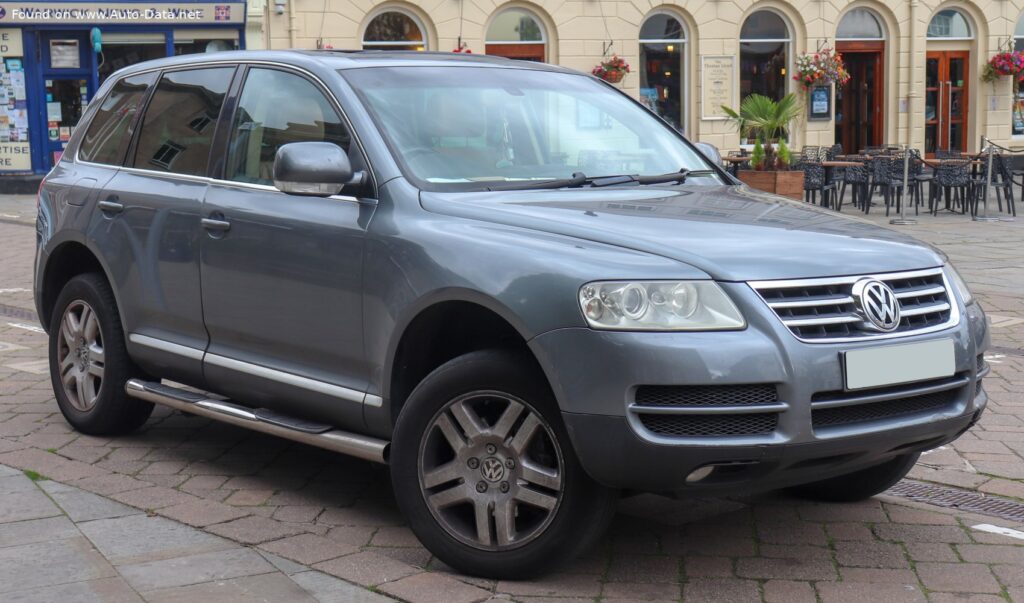
The Volkswagen Touareg I (7L), produced from 2002 to 2004, marked Volkswagen’s entry into the burgeoning luxury mid-size SUV segment. Developed alongside the Porsche Cayenne (with whom it shares a platform), the Touareg aimed to provide a blend of on-road comfort and genuine off-road capability. This first generation, designated 7L internally, was a significant departure for Volkswagen, representing a move upmarket and a commitment to a more premium vehicle experience. While not initially a high-volume seller in the United States compared to established American and Japanese SUVs, the Touareg established a foothold for Volkswagen in this competitive class and laid the groundwork for subsequent generations.
Volkswagen Touareg I (7L): A Detailed Overview
The Touareg I represented a strategic move for Volkswagen, leveraging shared development with Porsche to reduce costs and accelerate time to market. The vehicle was designed to appeal to buyers seeking a sophisticated SUV with a reputation for German engineering. It offered a compelling alternative to established players like the BMW X5 and Mercedes-Benz ML-Class, particularly for those desiring a vehicle with demonstrable off-road prowess. The 3.2i V6 24V 4MOTION variant, discussed here, was a key engine option, offering a balance of performance and fuel efficiency.
Engine & Performance
The heart of the Touareg I 3.2i is a naturally aspirated 3.2-liter V6 engine, designated AZZ, BAA, or BKJ depending on the specific production year and market. This engine produces 220 horsepower at 6,400 rpm and 305 Nm (224.96 lb.-ft.) of torque at 3,200 rpm. The engine features a double overhead camshaft (DOHC) valvetrain with four valves per cylinder and utilizes multi-port fuel injection. Power is delivered to all four wheels via Volkswagen’s 4MOTION all-wheel-drive system, providing enhanced traction and stability in various driving conditions. The 6-speed manual transmission allows for driver engagement, while the engine’s longitudinal front-mounted layout contributes to balanced handling. Acceleration from 0 to 100 km/h (0-62 mph) takes 9.9 seconds, and 0 to 60 mph is achieved in approximately 9.4 seconds. The Touareg I 3.2i has a maximum speed of 201 km/h (124.9 mph).
Design & Features
The Touareg I boasts a classic SUV silhouette, characterized by a robust build and a relatively conservative design aesthetic. Its five-door body style provides ample passenger space for five occupants. The interior is designed with a focus on functionality and comfort, featuring quality materials and a user-friendly layout. Key features included air suspension on both the front and rear axles, providing a smooth ride and adjustable ride height for improved off-road capability. Safety features, while not as comprehensive as modern SUVs, included an Anti-lock Braking System (ABS). The Touareg’s trunk offers a generous 555 liters (19.6 cu. ft.) of space with the rear seats up, expanding to 1570 liters (55.44 cu. ft.) when folded down. The vehicle’s dimensions – 4754 mm (187.17 in.) in length, 1928 mm (75.91 in.) in width, and 1726 mm (67.95 in.) in height – position it squarely within the mid-size SUV category.
Technical Specifications
| Brand | Volkswagen |
| Model | Touareg |
| Generation | Touareg I (7L) |
| Type (Engine) | 3.2i V6 24V (220 Hp) 4MOTION |
| Start of production | October, 2002 |
| End of production | November, 2004 |
| Powertrain Architecture | Internal Combustion engine |
| Body type | SUV |
| Seats | 5 |
| Doors | 5 |
| Fuel consumption (urban) | 18.6 l/100 km (12.6 US mpg, 15.2 UK mpg, 5.4 km/l) |
| Fuel consumption (extra urban) | 10.6 l/100 km (22.2 US mpg, 26.6 UK mpg, 9.4 km/l) |
| Fuel consumption (combined) | 13.5 l/100 km (17.4 US mpg, 20.9 UK mpg, 7.4 km/l) |
| Fuel Type | Petrol (Gasoline) |
| Acceleration 0 – 100 km/h | 9.9 sec |
| Acceleration 0 – 62 mph | 9.9 sec |
| Acceleration 0 – 60 mph | 9.4 sec |
| Maximum speed | 201 km/h (124.9 mph) |
| Weight-to-power ratio | 10.1 kg/Hp, 98.7 Hp/tonne |
| Weight-to-torque ratio | 7.3 kg/Nm, 136.8 Nm/tonne |
| Power | 220 Hp @ 6400 rpm |
| Power per litre | 69 Hp/l |
| Torque | 305 Nm @ 3200 rpm (224.96 lb.-ft. @ 3200 rpm) |
| Engine layout | Front, Longitudinal |
| Engine Model/Code | AZZ, BAA, BKJ |
| Engine displacement | 3189 cm3 (194.6 cu. in.) |
| Number of cylinders | 6 |
| Engine configuration | V-engine |
| Cylinder Bore | 84 mm (3.31 in.) |
| Piston Stroke | 95.9 mm (3.78 in.) |
| Compression ratio | 11.3:1 |
| Number of valves per cylinder | 4 |
| Fuel injection system | Multi-port manifold injection |
| Engine aspiration | Naturally aspirated engine |
| Valvetrain | DOHC |
| Engine oil capacity | 6.6 l (6.97 US qt | 5.81 UK qt) |
| Coolant | 9 l (9.51 US qt | 7.92 UK qt) |
| Kerb Weight | 2230 kg (4916.31 lbs.) |
| Max. weight | 2945 kg (6492.61 lbs.) |
| Max load | 715 kg (1576.31 lbs.) |
| Trunk (boot) space – minimum | 555 l (19.6 cu. ft.) |
| Trunk (boot) space – maximum | 1570 l (55.44 cu. ft.) |
| Fuel tank capacity | 100 l (26.42 US gal | 22 UK gal) |
| Length | 4754 mm (187.17 in.) |
| Width | 1928 mm (75.91 in.) |
| Height | 1726 mm (67.95 in.) |
| Wheelbase | 2855 mm (112.4 in.) |
| Front track | 1653 mm (65.08 in.) |
| Rear (Back) track | 1665 mm (65.55 in.) |
| Drive wheel | All wheel drive (4×4) |
| Number of gears and type of gearbox | 6 gears, manual transmission |
| Front suspension | Air suspension |
| Rear suspension | Air suspension |
| Front brakes | Ventilated discs |
| Rear brakes | Ventilated discs |
| Assisting systems | ABS (Anti-lock braking system) |
| Steering type | Steering rack and pinion |
| Power steering | Hydraulic Steering |
| Tires size | 235/65 R17 |
| Wheel rims size | 17 |
The Volkswagen Touareg I (7L) 3.2i V6 4MOTION, while superseded by later generations, remains a noteworthy vehicle in Volkswagen’s history. It demonstrated the company’s ambition to compete in the luxury SUV market and showcased its engineering capabilities through its shared platform with Porsche and its advanced features like air suspension and 4MOTION all-wheel drive.
