
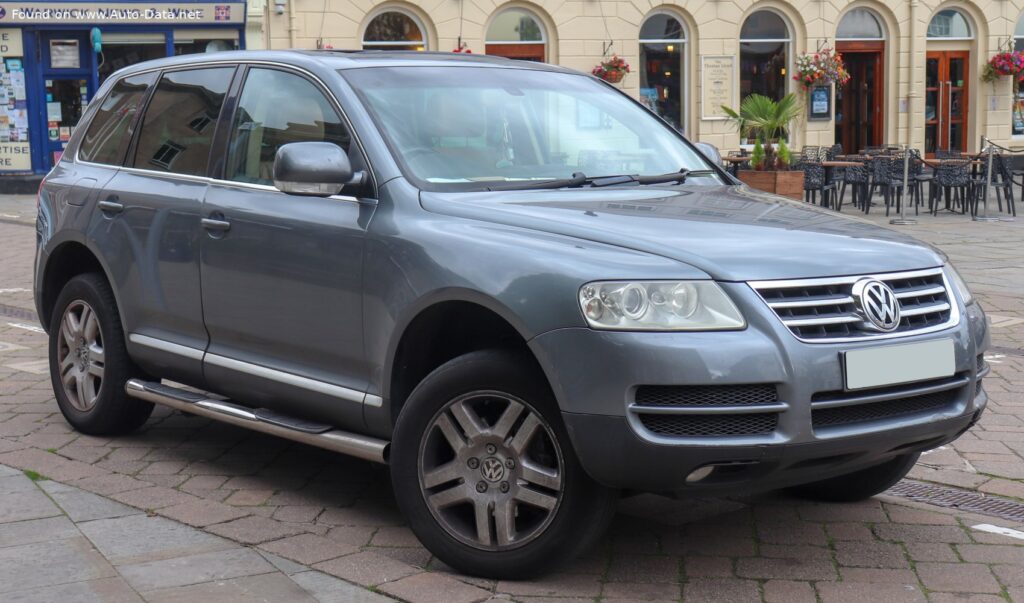
The Volkswagen Touareg I (7L), produced from 2002 to 2004, marked Volkswagen’s entry into the burgeoning luxury mid-size SUV segment. Developed alongside the Porsche Cayenne – with whom it shared a platform – the Touareg aimed to provide a blend of on-road comfort and genuine off-road capability. This first generation Touareg was a significant departure for Volkswagen, representing a move upmarket and a commitment to competing with established premium brands. While not initially a huge seller in the United States, the Touareg established a foothold for VW in the SUV market and laid the groundwork for future generations.
Volkswagen Touareg I (7L): A Detailed Overview
The Touareg I (7L) was Volkswagen’s first attempt at a dedicated SUV, differing from earlier, more car-based offerings. It was designed to appeal to buyers seeking a vehicle capable of handling both daily commutes and more adventurous pursuits. The 7L chassis code designates this as the first generation, and it was characterized by its robust construction, sophisticated four-wheel-drive system, and a range of engine options, including the 3.2-liter V6 detailed here. The Touareg’s design reflected a desire for a rugged yet refined aesthetic, aiming to balance practicality with a sense of luxury.
Engine & Performance
The 3.2i V6 24V engine powering this variant of the Touareg is a naturally aspirated 3.2-liter (3189 cm3 or 194.6 cu. in.) V6, producing 220 horsepower (Hp) at 6400 rpm and 305 Newton-meters (224.96 lb.-ft.) of torque at 3200 rpm. This engine, identified by codes AZZ, BAA, or BKJ, features a double overhead camshaft (DOHC) valvetrain with four valves per cylinder. The engine’s power-to-liter ratio is 69 Hp/l. Power is delivered to all four wheels via Volkswagen’s 4MOTION all-wheel-drive system and a six-speed Tiptronic automatic transmission. This combination allows for a 0-100 km/h (0-62 mph) acceleration time of 9.9 seconds, and a 0-60 mph time of 9.4 seconds. The Touareg’s top speed is electronically limited to 197 km/h (122.41 mph). The weight-to-power ratio is 10.1 kg/Hp, and the weight-to-torque ratio is 7.3 kg/Nm.
Design & Features
The Touareg I (7L) is a five-door, five-seat SUV with a longitudinal front-engine layout. Its body style is characterized by a relatively boxy silhouette, typical of early 2000s SUV design. Key features included a spacious interior, a large cargo area (555 liters minimum, expanding to 1570 liters with the rear seats folded), and a focus on comfort and convenience. The air suspension system, fitted to both the front and rear axles, provided a smooth ride and adjustable ride height for improved off-road capability. Safety features, while not as comprehensive as modern standards, included ABS (Anti-lock Braking System) and ventilated disc brakes on all four wheels. The Touareg’s interior was designed to be functional and upscale, with a focus on durable materials and a user-friendly layout. The vehicle’s dimensions are: length 4754 mm (187.17 in), width 1928 mm (75.91 in), and height 1726 mm (67.95 in). The wheelbase measures 2855 mm (112.4 in).
Technical Specifications
| Brand | Volkswagen |
| Model | Touareg |
| Generation | Touareg I (7L) |
| Type | 3.2i V6 24V (220 Hp) 4MOTION Tiptronic |
| Start of production | October, 2002 |
| End of production | November, 2004 |
| Powertrain Architecture | Internal Combustion engine |
| Body type | SUV |
| Seats | 5 |
| Doors | 5 |
| Fuel consumption (urban) | 19.1 l/100 km (12.3 US mpg, 14.8 UK mpg, 5.2 km/l) |
| Fuel consumption (extra urban) | 10.8 l/100 km (21.8 US mpg, 26.2 UK mpg, 9.3 km/l) |
| Fuel consumption (combined) | 13.8 l/100 km (17 US mpg, 20.5 UK mpg, 7.2 km/l) |
| Fuel Type | Petrol (Gasoline) |
| Acceleration 0 – 100 km/h | 9.9 sec |
| Acceleration 0 – 62 mph | 9.9 sec |
| Acceleration 0 – 60 mph | 9.4 sec |
| Maximum speed | 197 km/h (122.41 mph) |
| Weight-to-power ratio | 10.1 kg/Hp |
| Weight-to-torque ratio | 7.3 kg/Nm |
| Power | 220 Hp @ 6400 rpm |
| Torque | 305 Nm @ 3200 rpm (224.96 lb.-ft. @ 3200 rpm) |
| Engine layout | Front, Longitudinal |
| Engine Model/Code | AZZ, BAA, BKJ |
| Engine displacement | 3189 cm3 (194.6 cu. in.) |
| Number of cylinders | 6 |
| Engine configuration | V-engine |
| Cylinder Bore | 84 mm (3.31 in.) |
| Piston Stroke | 95.9 mm (3.78 in.) |
| Compression ratio | 11.3:1 |
| Number of valves per cylinder | 4 |
| Fuel injection system | Multi-port manifold injection |
| Engine aspiration | Naturally aspirated engine |
| Valvetrain | DOHC |
| Engine oil capacity | 6.6 l (6.97 US qt | 5.81 UK qt) |
| Coolant capacity | 9 l (9.51 US qt | 7.92 UK qt) |
| Kerb Weight | 2230 kg (4916.31 lbs.) |
| Max. weight | 2945 kg (6492.61 lbs.) |
| Max load | 715 kg (1576.31 lbs.) |
| Trunk (boot) space – minimum | 555 l (19.6 cu. ft.) |
| Trunk (boot) space – maximum | 1570 l (55.44 cu. ft.) |
| Fuel tank capacity | 100 l (26.42 US gal | 22 UK gal) |
| Length | 4754 mm (187.17 in.) |
| Width | 1928 mm (75.91 in.) |
| Height | 1726 mm (67.95 in.) |
| Wheelbase | 2855 mm (112.4 in.) |
| Front track | 1653 mm (65.08 in.) |
| Rear (Back) track | 1665 mm (65.55 in.) |
| Drive wheel | All wheel drive (4×4) |
| Number of gears and type of gearbox | 6 gears, automatic transmission |
| Front suspension | Air suspension |
| Rear suspension | Air suspension |
| Front brakes | Ventilated discs |
| Rear brakes | Ventilated discs |
| Assisting systems | ABS (Anti-lock braking system) |
| Steering type | Steering rack and pinion |
| Power steering | Hydraulic Steering |
| Tires size | 235/65 R17 |
| Wheel rims size | 17 |
