The Volkswagen Transporter (T5, facelift 2009) Panel Van: A European Workhorse Defined
The Volkswagen Transporter, a name synonymous with commercial utility and versatile transportation across the globe, especially in Europe, saw a significant evolution with its fifth generation, the T5. The specific variant under review, the Volkswagen Transporter (T5, facelift 2009) Panel Van 2.0 TDI (180 Hp) DSG L2H3, represents a crucial refresh of this iconic platform. Launched in 2009 and produced until 2015, this model embodied Volkswagen’s commitment to efficiency, performance, and practicality in the light commercial vehicle segment. While not as commonly seen in this exact configuration in the United States, where larger, purpose-built vans from domestic manufacturers often dominate, the T5 Transporter was a cornerstone of European commerce, serving a vast array of businesses from delivery services to construction trades.
This particular iteration, with its 2.0-liter TDI engine delivering 180 horsepower, paired with a sophisticated DSG automatic transmission, and featuring the L2H3 designation (Long wheelbase, High roof), offered a compelling blend of power, fuel economy, and expansive cargo capacity. It was designed to meet the rigorous demands of daily commercial operations, providing a comfortable driving experience alongside robust hauling capabilities, firmly cementing its place as a benchmark in its class.
Engine & Performance: Powering the Volkswagen Transporter (T5, facelift 2009) Panel Van
Under the hood of the Volkswagen Transporter (T5, facelift 2009) Panel Van lies a highly efficient and potent 2.0-liter TDI (Turbocharged Direct Injection) inline-four engine. This powerplant, internally designated EA189 / CFCA, was a testament to Volkswagen’s diesel engineering prowess, featuring a BiTurbo setup and an intercooler to optimize performance across the rev range. It produced a robust 180 horsepower at 4000 rpm, translating to a power output of 91.5 horsepower per liter, an impressive figure for a commercial vehicle engine of its time.
More crucial for a panel van is torque, and the T5 facelift delivered generously with 295.02 lb.-ft. available between a low 1500 and 2000 rpm. This broad torque band was instrumental in providing excellent pulling power, essential for hauling heavy loads or navigating challenging urban environments. The engine’s DOHC (Double Overhead Camshaft) valvetrain and common rail fuel injection system ensured precise fuel delivery and combustion, contributing to both power and efficiency. With a compression ratio of 16.5:1 and four valves per cylinder, the engine was designed for optimal thermodynamic performance.
Mated to this powerful diesel engine was a 7-speed DSG (Direct Shift Gearbox) automatic transmission. This advanced dual-clutch gearbox provided seamless and rapid gear changes, enhancing both driving comfort and fuel efficiency, a significant advantage over traditional automatic or manual transmissions in the commercial segment. The front-wheel-drive architecture, with the engine mounted transversely, ensured efficient power transfer and optimized interior space. Performance figures were respectable for a vehicle of its size and purpose: acceleration from 0 to 60 mph was achieved in a brisk 9.9 seconds, with a maximum speed of 109.36 mph. This allowed the Transporter to keep pace with traffic on highways while offering ample acceleration for urban driving.
Fuel economy, a critical factor for commercial operators, was a strong suit for this TDI variant. The combined NEDC (New European Driving Cycle) consumption was rated between 28 and 29 US mpg, with extra-urban figures reaching an impressive 32.2 to 33.6 US mpg. These figures, coupled with an 80-liter (21.13 US gallon) fuel tank, provided a substantial operating range, minimizing downtime for refueling. The engine also met the stringent Euro 5 emission standard, incorporating a particulate filter to reduce harmful emissions, reflecting Volkswagen’s commitment to environmental responsibility.
Design & Features: Practicality Meets Volkswagen Engineering
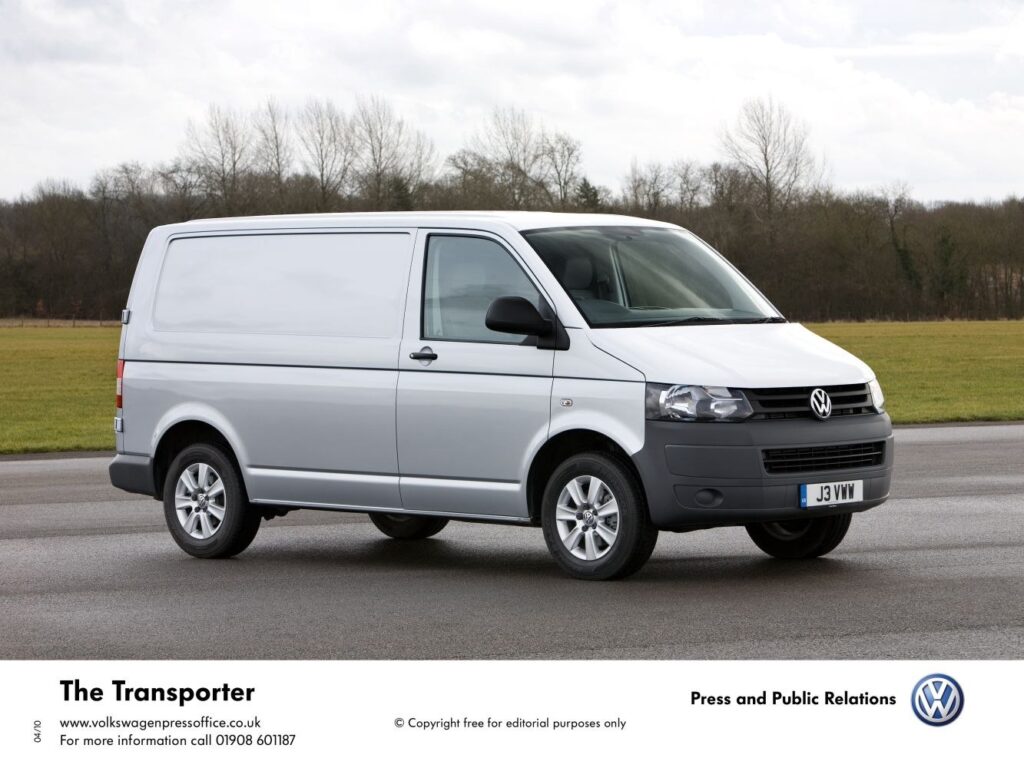
The Volkswagen Transporter (T5, facelift 2009) Panel Van, particularly in its L2H3 configuration, was a masterclass in functional design. The “Panel Van” designation clearly indicates its primary role as a cargo carrier, devoid of rear passenger windows. The “L2H3” refers to its dimensions: L2 signifies a long wheelbase (3400 mm or 133.86 inches), providing enhanced stability and increased cargo length, while H3 denotes a high roof (2476 mm or 97.48 inches), maximizing internal load volume. This combination resulted in an expansive maximum trunk (boot) space of 9300 liters (328.43 cu. ft.), making it exceptionally capable for transporting large items or substantial quantities of goods.
The exterior design of the T5 facelift was characterized by a refreshed front fascia, including new headlights, grille, and bumper, giving it a more modern and cohesive look compared to its pre-facelift predecessor. With a length of 208.35 inches and a width of 74.96 inches (89.88 inches including mirrors), the Transporter commanded a significant road presence, yet its minimum turning circle of 43.31 feet made it surprisingly maneuverable for its size, an essential attribute for urban deliveries. The vehicle typically featured 4-5 doors, including a large rear access point and often a sliding side door, facilitating easy loading and unloading.
Inside, the Panel Van was designed with the driver and front passenger (2-3 seats) in mind, offering a practical and durable cabin. While focused on utility, Volkswagen ensured a comfortable driving position and ergonomic controls. Safety features for the era included ABS (Anti-lock Braking System), providing crucial braking stability, especially when the vehicle was heavily laden. The robust chassis was supported by an independent McPherson strut front suspension with coil springs and an anti-roll bar, paired with an independent coil spring rear suspension featuring a transverse stabilizer and trailing arm. This setup provided a balanced ride, good handling characteristics, and durability under varying load conditions. Braking power was supplied by large ventilated discs, 340×32.5 mm at the front and 294×22 mm at the rear, ensuring effective stopping power for a vehicle with a maximum gross weight of up to 7054.79 lbs. Hydraulic power steering made maneuvering the van less strenuous, contributing to driver comfort during long working days.
Technical Specifications
| Category | Specification | Value |
|---|---|---|
| General Information | ||
| Brand | Volkswagen | |
| Model | Transporter | |
| Generation | Transporter (T5, facelift 2009) Panel Van | |
| Type (Engine) | 2.0 TDI (180 Hp) DSG L2H3 | |
| Production Start | 2009 | |
| Production End | 2015 | |
| Powertrain Architecture | Internal Combustion Engine (ICE) | |
| Body Type | Van | |
| Seats | 2-3 | |
| Doors | 4-5 | |
| Performance Specs | ||
| Fuel Consumption (Urban, NEDC) | 23.1 – 23.8 US mpg | |
| Fuel Consumption (Extra Urban, NEDC) | 32.2 – 33.6 US mpg | |
| Fuel Consumption (Combined, NEDC) | 28 – 29 US mpg | |
| CO2 Emissions (NEDC) | 214-221 g/km | |
| Fuel Type | Diesel | |
| Acceleration 0-60 mph (Calculated) | 9.9 sec | |
| Maximum Speed | 109.36 mph | |
| Emission Standard | Euro 5 | |
| Weight-to-Power Ratio | 10.2 kg/Hp (98.3 Hp/tonne) | |
| Weight-to-Torque Ratio | 4.6 kg/Nm (218.3 Nm/tonne) | |
| Engine Specs | ||
| Power | 180 Hp @ 4000 rpm | |
| Power per liter | 91.5 Hp/l | |
| Torque | 295.02 lb.-ft. @ 1500-2000 rpm | |
| Engine Layout | Front, Transverse | |
| Engine Model/Code | EA189 / CFCA | |
| Engine Displacement | 2.0 liters (120.09 cu. in.) | |
| Number of Cylinders | 4, Inline | |
| Cylinder Bore | 3.19 in. (81 mm) | |
| Piston Stroke | 3.76 in. (95.5 mm) | |
| Compression Ratio | 16.5:1 | |
| Valves per Cylinder | 4 | |
| Fuel Injection System | Diesel Commonrail | |
| Engine Aspiration | BiTurbo, Intercooler | |
| Valvetrain | DOHC | |
| Engine Oil Capacity | 7.4 US qt (7 l) | |
| Coolant Capacity | 11.62 US qt (11 l) | |
| Engine Systems | Particulate filter | |
| Space, Volume and Weights | ||
| Curb Weight | 4038.87 – 4958.2 lbs. (1832-2249 kg) | |
| Max. Weight (GVWR) | 6172.94 – 7054.79 lbs. (2800-3200 kg) | |
| Max Load | 2096.6 – 2134.07 lbs. (951-968 kg) | |
| Trunk (boot) space – maximum | 328.43 cu. ft. (9300 l) | |
| Fuel Tank Capacity | 21.13 US gal (80 l) | |
| Permitted Trailer Load with Brakes (12%) | 5511.56 lbs. (2500 kg) | |
| Permitted Trailer Load without Brakes | 1653.47 lbs. (750 kg) | |
| Permitted Towbar Download | 220.46 lbs. (100 kg) | |
| Dimensions | ||
| Length | 208.35 in. (5292 mm) | |
| Width | 74.96 in. (1904 mm) | |
| Width including mirrors | 89.88 in. (2283 mm) | |
| Height | 97.48 in. (2476 mm) | |
| Wheelbase | 133.86 in. (3400 mm) | |
| Front Overhang | 35.28 in. (896 mm) | |
| Rear Overhang | 39.21 in. (996 mm) | |
| Ride Height (Ground Clearance) | 7.91 in. (201 mm) | |
| Minimum Turning Circle | 43.31 ft. (13.2 m) | |
| Approach Angle | 21° | |
| Departure Angle | 17° | |
| Ramp-over (Brakeover) Angle | 12° | |
| Drivetrain, Brakes and Suspension Specs | ||
| Drivetrain Architecture | Front-wheel drive, Internal Combustion Engine | |
| Drive Wheel | Front wheel drive | |
| Number of Gears & Gearbox Type | 7 gears, automatic transmission DSG | |
| Front Suspension | Independent, McPherson with coil spring and anti-roll bar | |
| Rear Suspension | Independent coil spring, Transverse stabilizer, Trailing arm | |
| Front Brakes | Ventilated discs, 340×32.5 mm | |
| Rear Brakes | Ventilated discs, 294×22 mm | |
| Assisting Systems | ABS (Anti-lock braking system) | |
| Steering Type | Steering rack and pinion | |
| Power Steering | Hydraulic Steering | |
| Tires Size | 215/60 R17; 235/55 R17; 255/45 R18 | |
| Wheel Rims Size | 7J x 17; 8J x 18 | |
Legacy & Market Impact
The Volkswagen Transporter series, often affectionately known as the “Bus” or “Microbus” in its passenger variants, has an enduring legacy that stretches back to the T1 in the 1950s. The T5 generation, and particularly its 2009 facelift, continued this rich heritage by adapting to the modern demands of the commercial vehicle sector. The Volkswagen Transporter (T5, facelift 2009) Panel Van was not just another vehicle; it was a highly respected tool for businesses across Europe, the UK, Australia, and many other markets where robust, efficient, and reliable light commercial vehicles are indispensable.
Its reputation as a durable workhorse was well-earned. The T5 facelift, with its improved engines and transmissions, solidified its position as a premium offering in the segment. It was often chosen by tradespeople, logistics companies, and small businesses for its blend of driving dynamics, build quality, and impressive load-carrying capabilities. The option of various body lengths and roof heights, such as the L2H3 variant, allowed businesses to tailor the vehicle precisely to their specific needs, from transporting bulky equipment to acting as a mobile workshop.
In its primary European market, the T5 Transporter faced stiff competition from other established players in the van segment. Key rivals included the Mercedes-Benz Vito and Sprinter (though the Sprinter often competed in a slightly heavier class), the Ford Transit (another global benchmark), the Renault Trafic, Opel/Vauxhall Vivaro, and the Fiat Ducato. What set the Transporter apart was its car-like driving experience, often attributed to its sophisticated independent suspension and refined powertrain options, particularly the DSG transmission. This made it a more appealing choice for drivers who spent long hours behind the wheel, reducing fatigue and improving overall productivity.
The T5 facelift’s impact was significant. It demonstrated that commercial vehicles could offer advanced technology, strong performance, and environmental consciousness without compromising on their core utility. Its design proved timeless, leading to its continued strong resale value even after the introduction of the T6 generation. The 2.0 TDI (180 Hp) DSG L2H3 variant, with its potent engine and expansive cargo area, became a prime example of how Volkswagen successfully merged passenger car refinement with commercial vehicle robustness, leaving an indelible mark on the European light commercial vehicle landscape.