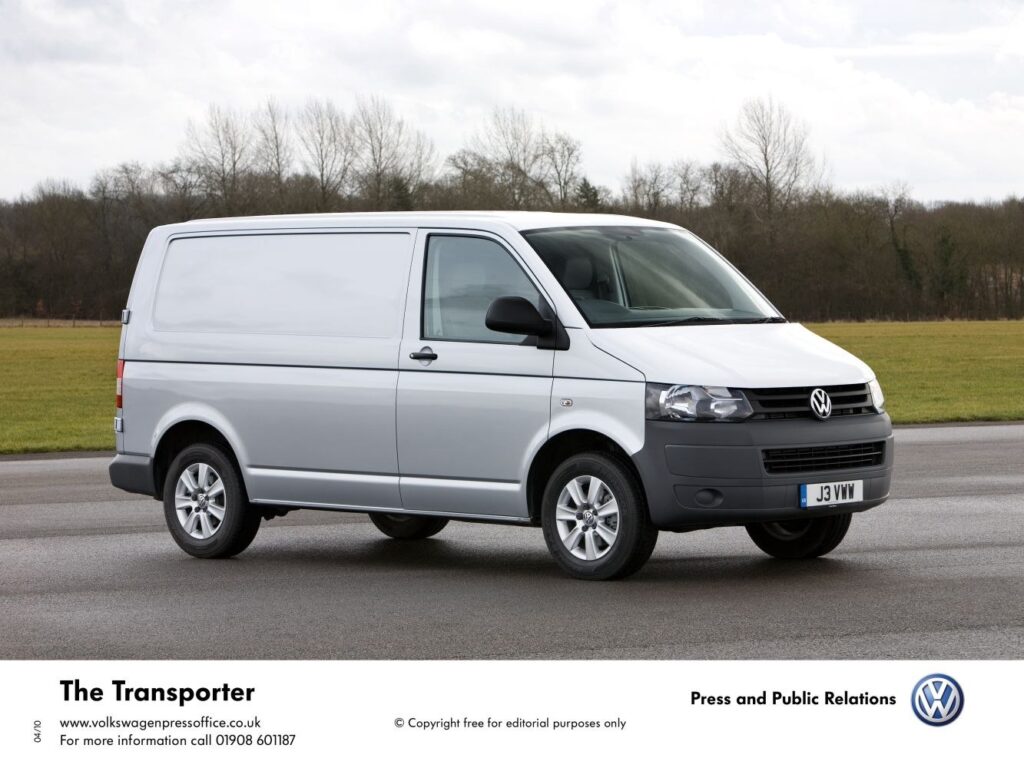
Volkswagen Transporter (T5, Facelift 2009) Panel Van
The Volkswagen Transporter (T5, facelift 2009) Panel Van represents a significant evolution in Volkswagen’s long-standing lineage of commercial vehicles, a heritage that dates back to the iconic Type 2. Launched in 2009 as a refreshed version of the fifth-generation (T5) Transporter, this model continued to solidify its position as a dominant force in the light commercial vehicle segment across Europe and other international markets. While not a common sight on American roads, where Volkswagen’s commercial offerings have historically been limited, the Transporter is an automotive icon globally, revered for its robust construction, versatility, and efficiency. The facelift brought a host of updates, including revised styling, improved interior ergonomics, and most notably, a new range of more powerful and efficient diesel engines, such as the 2.0 TDI (180 Hp) variant discussed here. This particular configuration, the L1H1, denotes a short wheelbase and standard roof height, offering a balance of cargo capacity and maneuverability, making it an ideal workhorse for a wide array of businesses.
Engine and Performance of the Volkswagen Transporter (T5, facelift 2009) Panel Van
Under the hood, the Volkswagen Transporter (T5, facelift 2009) Panel Van in its 2.0 TDI (180 Hp) L1H1 configuration featured a sophisticated powertrain designed for both strength and fuel economy. The heart of this system was a 1,968 cm3 (120.09 cu. in.) inline four-cylinder diesel engine, internally designated as EA189 / CFCA. This unit was a prime example of Volkswagen’s commitment to advanced diesel technology, employing a Commonrail fuel injection system and a BiTurbo setup coupled with an intercooler. The BiTurbo architecture allowed for a broad power band, delivering impressive performance for a commercial vehicle of its size.
The engine produced a robust 180 horsepower at 4000 rpm, paired with a substantial 295.02 lb.-ft. (400 Nm) of torque, available across a useful range of 1500 to 2000 rpm. This low-end torque was crucial for a panel van, ensuring strong pulling power for heavy loads and confident acceleration. Mated to a 6-speed manual transmission, the Transporter could accelerate from 0 to 60 mph in a respectable 9.4 seconds, with a top speed of 118.68 mph (191 km/h). These figures underscored its capability to handle both urban deliveries and longer highway journeys with ease.
Despite its performance, efficiency remained a key focus. The 2.0 TDI engine was designed to meet Euro 5 emission standards, incorporating a particulate filter to reduce harmful emissions. Fuel consumption figures, based on the NEDC cycle, were commendable for a vehicle of its class. Combined fuel economy ranged from 30.2 to 31.4 US mpg (7.5-7.8 l/100 km), with extra-urban figures reaching an impressive 35.1 to 36.8 US mpg (6.4-6.7 l/100 km). Urban consumption stood at 24.8 to 24 US mpg (9.5-9.8 l/100 km). These figures, combined with an 80-liter (21.13 US gallon) fuel tank, provided a significant operating range, reducing downtime for refueling and contributing to lower running costs for businesses.
Design and Features
The design of the Volkswagen Transporter (T5, facelift 2009) Panel Van emphasized practicality, durability, and a clean, functional aesthetic. As a panel van, its primary purpose was cargo transportation, reflected in its robust body structure and expansive load area. The L1H1 designation indicated a length of 192.6 inches (4892 mm) and a height of 78.35 inches (1990 mm), with a wheelbase of 118.11 inches (3000 mm). This configuration offered a maximum trunk (boot) space of 5800 liters (204.83 cu. ft.), providing ample volume for a wide variety of goods and equipment. The maximum payload capacity ranged from 2272.97 to 2297.22 lbs. (1031-1042 kg), further highlighting its utility.
Inside, the Transporter was configured with 2-3 seats, catering to a driver and one or two passengers, depending on the specific bench seat option. The cabin, while utilitarian, was designed with driver comfort and ergonomics in mind, featuring durable materials and a logical layout of controls. The facelift introduced subtle refinements to the dashboard and infotainment options, enhancing the overall user experience.
Handling and stability were critical for a commercial vehicle, and the Transporter delivered with a well-engineered suspension system. It featured an independent McPherson strut setup with coil springs and an anti-roll bar at the front, complemented by an independent coil spring, transverse stabilizer, and trailing arm arrangement at the rear. This sophisticated suspension provided a comfortable ride, even when fully loaded, and ensured predictable handling. Braking power came from ventilated discs all around—340×32.5 mm at the front and 294×22 mm at the rear—supported by ABS (Anti-lock Braking System) for enhanced safety. The hydraulic power steering system, a rack and pinion type, offered precise control and ease of maneuvering, especially in tight urban environments, further aided by a minimum turning circle of 39.04 ft. (11.9 m). The vehicle also boasted a respectable ground clearance of 7.91 inches (201 mm) and a wading depth of 11.81 inches (300 mm), indicating a degree of capability on varied terrain.
Technical Specifications
| Category | Specification | US/Imperial Equivalent |
|---|---|---|
General Information |
||
| Brand | Volkswagen | |
| Model | Transporter | |
| Generation | Transporter (T5, facelift 2009) Panel Van | |
| Type (Engine) | 2.0 TDI (180 Hp) L1H1 | |
| Start of production | 2009 year | |
| End of production | 2015 year | |
| Powertrain Architecture | Internal Combustion engine | |
| Body type | Van | |
| Seats | 2-3 | |
| Doors | 4-5 | |
Performance Specs |
||
| Fuel consumption (economy) – urban (NEDC) | 9.5-9.8 l/100 km | 24.8 – 24 US mpg |
| Fuel consumption (economy) – extra urban (NEDC) | 6.4-6.7 l/100 km | 36.8 – 35.1 US mpg |
| Fuel consumption (economy) – combined (NEDC) | 7.5-7.8 l/100 km | 31.4 – 30.2 US mpg |
| CO2 emissions (NEDC) | 197-205 g/km | |
| Fuel Type | Diesel | |
| Acceleration 0 – 60 mph (Calculated) | 9.4 sec | |
| Acceleration 0 – 100 km/h | 9.9 sec | |
| Maximum speed | 191 km/h | 118.68 mph |
| Emission standard | Euro 5 | |
| Weight-to-power ratio | 9.8 kg/Hp | 101.8 Hp/tonne |
| Weight-to-torque ratio | 4.4 kg/Nm | 226.1 Nm/tonne |
Engine Specs |
||
| Power | 180 Hp @ 4000 rpm. | |
| Power per liter | 91.5 Hp/l | |
| Torque | 400 Nm @ 1500-2000 rpm. | 295.02 lb.-ft. @ 1500-2000 rpm. |
| Engine layout | Front, Transverse | |
| Engine Model/Code | EA189 / CFCA | |
| Engine displacement | 1968 cm3 | 120.09 cu. in. |
| Number of cylinders | 4 | |
| Engine configuration | Inline | |
| Cylinder Bore | 81 mm | 3.19 in. |
| Piston Stroke | 95.5 mm | 3.76 in. |
| Compression ratio | 16.5:1 | |
| Number of valves per cylinder | 4 | |
| Fuel injection system | Diesel Commonrail | |
| Engine aspiration | BiTurbo, Intercooler | |
| Valvetrain | DOHC | |
| Engine oil capacity | 7 l | 7.4 US qt |
| Coolant | 11 l | 11.62 US qt |
| Engine systems | Particulate filter | |
Space, Volume and Weights |
||
| Kerb Weight | 1769-2158 kg | 3899.98 – 4757.58 lbs. |
| Max. weight | 2800-3200 kg | 6172.94 – 7054.79 lbs. |
| Max load | 1031-1042 kg | 2272.97 – 2297.22 lbs. |
| Trunk (boot) space – maximum | 5800 l | 204.83 cu. ft. |
| Fuel tank capacity | 80 l | 21.13 US gal |
| Max. roof load | 100 kg | 220.46 lbs. |
| Permitted trailer load with brakes (12%) | 2500 kg | 5511.56 lbs. |
| Permitted trailer load without brakes | 750 kg | 1653.47 lbs. |
| Permitted towbar download | 100 kg | 220.46 lbs. |
Dimensions |
||
| Length | 4892 mm | 192.6 in. |
| Width | 1904 mm | 74.96 in. |
| Width including mirrors | 2283 mm | 89.88 in. |
| Height | 1990 mm | 78.35 in. |
| Wheelbase | 3000 mm | 118.11 in. |
| Front overhang | 896 mm | 35.28 in. |
| Rear overhang | 996 mm | 39.21 in. |
| Ride height (ground clearance) | 201 mm | 7.91 in. |
| Minimum turning circle (turning diameter) | 11.9 m | 39.04 ft. |
| Approach angle | 21° | |
| Departure angle | 17° | |
| Ramp-over (brakeover) angle | 14° | |
| Wading depth | 300 mm | 11.81 in. |
Drivetrain, Brakes and Suspension Specs |
||
| Drivetrain Architecture | The Internal combustion engine (ICE) drives the front wheels of the vehicle. | |
| Drive wheel | Front wheel drive | |
| Number of gears and type of gearbox | 6 gears, manual transmission | |
| Front suspension | Independent, type McPherson with coil spring and anti-roll bar | |
| Rear suspension | Independent coil spring, Transverse stabilizer, Trailing arm | |
| Front brakes | Ventilated discs, 340×32.5 mm | |
| Rear brakes | Ventilated discs, 294×22 mm | |
| Assisting systems | ABS (Anti-lock braking system) | |
| Steering type | Steering rack and pinion | |
| Power steering | Hydraulic Steering | |
| Tires size | 215/60 R17; 235/55 R17; 255/45 R18 | |
| Wheel rims size | 7J x 17; 8J x 18 | |
Legacy and Market Impact
The Volkswagen Transporter series has an enduring legacy, tracing its roots back to the post-war era. The T5 generation, and particularly the facelifted 2009 model, continued this tradition of reliability, versatility, and efficiency that has made it a cornerstone of commercial fleets and a popular choice for conversions into camper vans across Europe, Australia, and other global markets. While the Transporter nameplate has largely been absent from the mainstream U.S. market since the discontinuation of the Eurovan (a T4-based model) in 2003, its global impact is undeniable. In its primary markets, the T5 facelift was a critical success, maintaining Volkswagen’s strong market share in the competitive light commercial vehicle segment.
Its robust build quality, combined with the powerful and fuel-efficient 2.0 TDI (180 Hp) engine, made it a preferred choice for businesses requiring a dependable and economical work vehicle. Competitors in its segment included formidable rivals such as the Ford Transit Custom, Mercedes-Benz Vito, Renault Trafic, and Opel Vivaro, all vying for market dominance with their own strengths. However, the Transporter consistently stood out for its car-like driving dynamics, refined powertrains, and the perceived premium quality associated with the Volkswagen brand. Its strong resale value also contributed to its appeal among commercial buyers.
The T5 facelift generation, produced until 2015, paved the way for the subsequent T6 and T6.1 models, each building upon the solid foundation of its predecessors. The 2009 update, with its focus on modern diesel technology and enhanced features, ensured the Transporter remained competitive and relevant through the early 2010s. It solidified its reputation not just as a utilitarian van, but as a practical, comfortable, and capable vehicle that could serve a multitude of purposes, from urban delivery to long-haul logistics, and even recreational travel in its passenger variants. The Volkswagen Transporter (T5, facelift 2009) Panel Van remains a testament to Volkswagen’s engineering prowess and its understanding of the demanding requirements of the global commercial vehicle market.