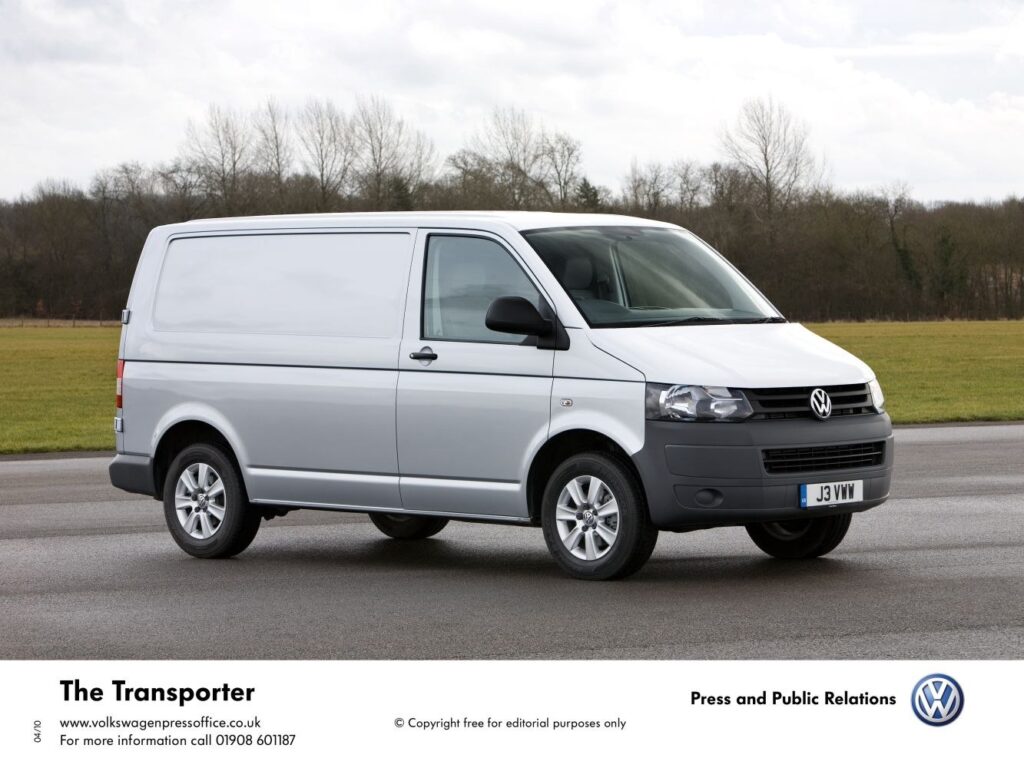
The Volkswagen Transporter (T5, facelift 2009) Panel Van: A European Workhorse
The Volkswagen Transporter, a name synonymous with versatility and reliability in the commercial vehicle segment, saw its fifth generation (T5) receive a significant facelift in 2009. This iteration, produced from 2011 to 2015, continued the Transporter’s storied legacy, cementing its position as a dominant force in the European light commercial vehicle (LCV) market. The specific model under review, the Volkswagen Transporter (T5, facelift 2009) Panel Van 2.0 TDI BMT (114 Hp) L2H1, represents a popular configuration designed for efficiency and practicality. As a panel van, its primary role was, and remains, the reliable transport of goods and equipment for businesses across the continent, from small tradespeople to large logistics operations. While not officially sold in the United States, the Transporter T5 is a prime example of European automotive engineering tailored for demanding commercial use, embodying Volkswagen’s commitment to robust and economical utility vehicles. This particular variant, designated L2H1, signifies a long wheelbase (L2) and a standard roof height (H1), offering a generous cargo volume without compromising maneuverability.
Powertrain and Efficiency
At the heart of the Volkswagen Transporter (T5, facelift 2009) Panel Van is a sophisticated 2.0-liter TDI (Turbocharged Direct Injection) diesel engine, a testament to Volkswagen’s expertise in efficient diesel powertrains. This inline-four engine, designated EA189 / CAAD, features a DOHC (Double Overhead Camshaft) valvetrain with four valves per cylinder, ensuring optimal airflow and combustion. Fuel is delivered via a common rail injection system, allowing for precise control and improved fuel atomization. Supplemented by a turbocharger and an intercooler, this setup produces a respectable 114 horsepower at 3500 rpm and a robust 184.39 lb.-ft. of torque, available across a broad rev range from 1500 to 2750 rpm. This low-end torque is crucial for a commercial vehicle, providing ample pulling power even when fully loaded, and contributing to effortless urban driving and highway cruising.
This specific model incorporates Volkswagen’s BlueMotion Technology (BMT), a suite of features aimed at maximizing fuel efficiency and reducing emissions. Key BMT elements include a Start & Stop system, which automatically shuts off the engine when the vehicle is stationary and restarts it when the driver depresses the clutch, and a particulate filter, which captures harmful soot particles from the exhaust. These technologies help the Transporter meet the stringent Euro 5 emission standard. Power is delivered to the front wheels via a smooth-shifting 5-speed manual transmission, a common and durable choice for commercial applications.
Performance figures reflect its utilitarian purpose rather than outright speed. The Volkswagen Transporter (T5, facelift 2009) Panel Van accelerates from 0 to 60 mph in a calculated 14.1 seconds and reaches a maximum speed of 101.28 mph. Where it truly shines is in its fuel economy. The combined NEDC cycle rates it at an impressive 33.6 – 35.1 US mpg, with extra-urban figures reaching up to 40.6 US mpg. This efficiency, combined with an 21.13 US gallon fuel tank, translates to a substantial driving range, reducing downtime for refueling and lowering operating costs for businesses.
Design, Utility, and Driver Comfort
The design of the Volkswagen Transporter (T5, facelift 2009) Panel Van is a masterclass in functional aesthetics. Its L2H1 configuration provides a substantial cargo area of 236.61 cubic feet (6700 liters), making it suitable for a wide array of commercial tasks. The exterior dimensions – a length of 208.35 inches, a width of 74.96 inches (89.88 inches including mirrors), and a height of 78.35 inches – strike a balance between maximizing load capacity and maintaining urban maneuverability. The 133.86-inch wheelbase contributes to a stable ride, even with heavy loads, and a minimum turning circle of 43.31 feet aids in navigating tight city streets and loading docks.
Inside, the Panel Van typically offers 2-3 seats, focusing on practicality for the driver and potentially one or two crew members. The cabin is designed for durability and ergonomics, acknowledging that drivers spend long hours behind the wheel. Controls are logically placed, and storage solutions are integrated to keep essential items within reach. The robust construction is evident in its maximum payload capacity of 2244.31 – 2341.31 lbs. and a maximum gross weight of 6172.94 – 7054.79 lbs., underscoring its capability as a genuine workhorse. It can also tow a substantial 4850.17 lbs. with brakes, further extending its utility.
Safety and stability are paramount in a commercial vehicle. The Transporter T5 features an independent McPherson strut front suspension with coil springs and an anti-roll bar, complemented by an independent coil spring rear suspension with a transverse stabilizer and trailing arms. This setup provides a comfortable ride for its class and predictable handling. Stopping power is handled by large ventilated disc brakes (308×29.5 mm front, 294×22 mm rear), assisted by an Anti-lock Braking System (ABS), ensuring confident braking even under load. The hydraulic rack-and-pinion steering offers direct feedback, essential for precise maneuvering. Standard tires are 215/65 R16 on 6.5J x 16 steel wheels, balancing load-carrying capacity with ride comfort.
Technical Specifications of the Volkswagen Transporter (T5, facelift 2009) Panel Van
| Feature | Detail |
|---|---|
| Brand | Volkswagen |
| Model | Transporter |
| Generation | Transporter (T5, facelift 2009) Panel Van |
| Type (Engine) | 2.0 TDI BMT (114 Hp) L2H1 |
| Production Start | 2011 |
| Production End | 2015 |
| Powertrain Architecture | Internal Combustion Engine |
| Body Type | Van |
| Seats | 2-3 |
| Doors | 4-5 |
| Fuel Consumption (Urban NEDC) | 27.4 – 28.3 US mpg (8.3-8.6 l/100 km) |
| Fuel Consumption (Extra Urban NEDC) | 38.6 – 40.6 US mpg (5.8-6.1 l/100 km) |
| Fuel Consumption (Combined NEDC) | 33.6 – 35.1 US mpg (6.7-7 l/100 km) |
| CO2 Emissions (NEDC) | 176-184 g/km |
| Fuel Type | Diesel |
| Acceleration 0-60 mph | 14.1 sec |
| Maximum Speed | 101.28 mph (163 km/h) |
| Emission Standard | Euro 5 |
| Power | 114 Hp @ 3500 rpm |
| Power per Liter | 57.9 Hp/l |
| Torque | 184.39 lb.-ft. @ 1500-2750 rpm (250 Nm) |
| Engine Layout | Front, Transverse |
| Engine Model/Code | EA189 / CAAD |
| Engine Displacement | 120.09 cu. in. (1968 cm3) |
| Number of Cylinders | 4 |
| Engine Configuration | Inline |
| Cylinder Bore | 3.19 in. (81 mm) |
| Piston Stroke | 3.76 in. (95.5 mm) |
| Compression Ratio | 16.5:1 |
| Valves per Cylinder | 4 |
| Fuel Injection System | Diesel Commonrail |
| Engine Aspiration | Turbocharger, Intercooler |
| Valvetrain | DOHC |
| Engine Oil Capacity | 7.4 US qt (7 l) |
| Coolant Capacity | 11.62 US qt (11 l) |
| Engine Systems | Start & Stop System, Particulate filter |
| Kerb Weight | 3831.63 – 4810.49 lbs. (1738-2182 kg) |
| Max. Weight | 6172.94 – 7054.79 lbs. (2800-3200 kg) |
| Max Load | 2244.31 – 2341.31 lbs. (1018-1062 kg) |
| Trunk (Boot) Space – Maximum | 236.61 cu. ft. (6700 l) |
| Fuel Tank Capacity | 21.13 US gal (80 l) |
| Max. Roof Load | 220.46 lbs. (100 kg) |
| Permitted Trailer Load with Brakes (12%) | 4850.17 lbs. (2200 kg) |
| Permitted Trailer Load without Brakes | 1653.47 lbs. (750 kg) |
| Permitted Towbar Download | 220.46 lbs. (100 kg) |
| Length | 208.35 in. (5292 mm) |
| Width | 74.96 in. (1904 mm) |
| Width Including Mirrors | 89.88 in. (2283 mm) |
| Height | 78.35 in. (1990 mm) |
| Wheelbase | 133.86 in. (3400 mm) |
| Front Overhang | 35.28 in. (896 mm) |
| Rear Overhang | 39.21 in. (996 mm) |
| Ride Height (Ground Clearance) | 7.91 in. (201 mm) |
| Minimum Turning Circle (Diameter) | 43.31 ft. (13.2 m) |
| Approach Angle | 21° |
| Departure Angle | 17° |
| Ramp-over (Brakeover) Angle | 12° |
| Drivetrain Architecture | Internal Combustion Engine drives the front wheels |
| Drive Wheel | Front Wheel Drive |
| Number of Gears and Type of Gearbox | 5 gears, Manual Transmission |
| Front Suspension | Independent, McPherson with coil spring and anti-roll bar |
| Rear Suspension | Independent coil spring, Transverse stabilizer, Trailing arm |
| Front Brakes | Ventilated discs, 308×29.5 mm |
| Rear Brakes | Ventilated discs, 294×22 mm |
| Assisting Systems | ABS (Anti-lock braking system) |
| Steering Type | Steering rack and pinion |
| Power Steering | Hydraulic Steering |
| Tires Size | 215/65 R16 |
| Wheel Rims Size | 6.5J x 16 |
Market Position and Lasting Impact
The Volkswagen Transporter series holds an iconic status, tracing its lineage back to the original Type 2 “Bus.” The T5 generation, and particularly its facelifted variant from 2009-2015, continued this legacy of robust, dependable, and highly adaptable commercial vehicles. In the fiercely competitive European light commercial vehicle market, the Volkswagen Transporter (T5, facelift 2009) Panel Van faced stiff competition from rivals such as the Ford Transit, Mercedes-Benz Vito, Renault Trafic, and Fiat Ducato. Yet, it consistently remained a top contender, often setting the benchmark for build quality, long-term durability, and strong residual values.
Its reputation for reliability and low running costs, significantly bolstered by the efficient 2.0 TDI BlueMotion Technology engine, made it a favored choice for fleets and independent businesses alike. The Transporter’s inherent adaptability also contributed to its widespread appeal; it could be configured for virtually any commercial task, from basic cargo transport to specialized conversions for tradespeople, mobile workshops, or even passenger shuttle services in its Kombi or Multivan forms. The L2H1 Panel Van variant, with its optimized balance of interior space and exterior dimensions, was particularly popular for urban and regional delivery services.
While the Transporter T5 was not offered in the North American market – where Volkswagen’s commercial vehicle strategy differed, focusing more on passenger-oriented vans like the Routan or collaborating on models like the Mercedes-Benz Sprinter – its influence in Europe and other global markets cannot be overstated. It represented the evolution of a classic concept into a modern, technologically advanced, and environmentally conscious work vehicle. The T5 facelift, in particular, demonstrated Volkswagen’s ability to refine an already successful platform, integrating improved engines, enhanced safety features, and subtle design updates to keep it fresh and competitive. Its enduring presence on European roads, even years after its production ceased, speaks volumes about its quality and the lasting impact of the Volkswagen Transporter on the commercial vehicle landscape. It remains a testament to German engineering and a true international automotive expert’s choice for a dependable commercial partner.