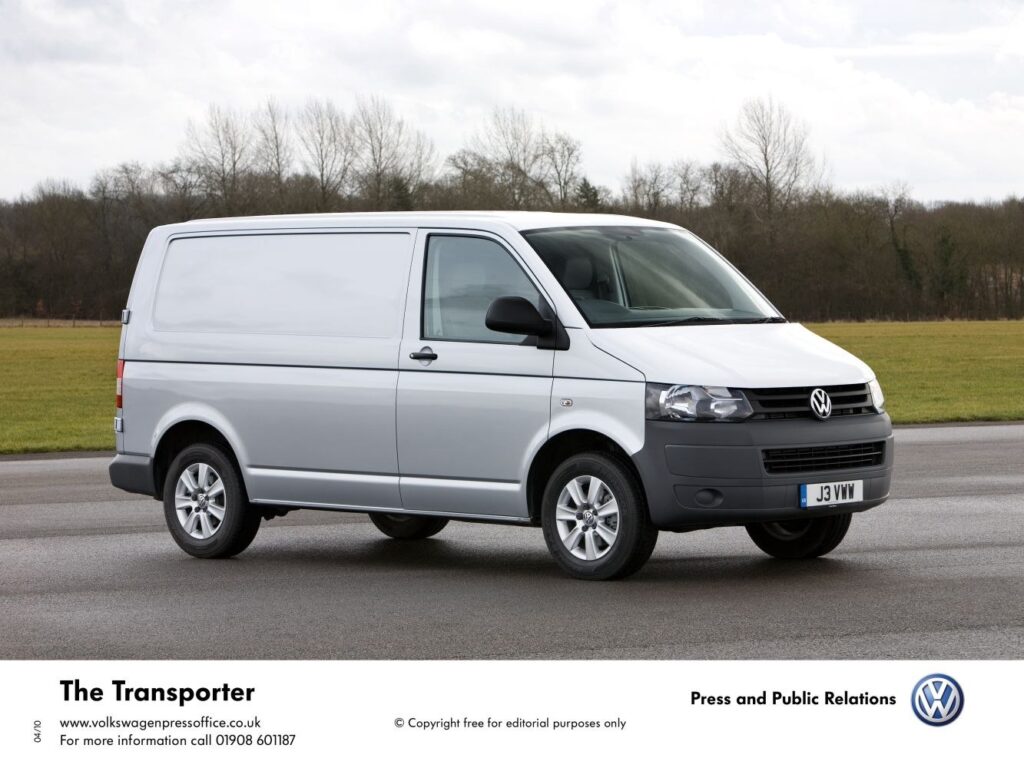
The Volkswagen Transporter (T5, Facelift 2009) Panel Van: A European Workhorse
The Volkswagen Transporter (T5, facelift 2009) Panel Van represents a significant iteration of Volkswagen’s iconic commercial vehicle line, a mainstay in European and international markets. Produced between 2011 and 2015, this specific model is part of the fifth generation (T5) of the Transporter, having undergone a substantial facelift in 2009 that introduced refreshed styling, updated interiors, and critically, a new range of more efficient powertrains. While not a direct offering in the North American market in this specific commercial panel van configuration, the Transporter series is globally renowned for its versatility, durability, and practical design, serving as the backbone for countless businesses, trades, and logistics operations across Europe, Asia, and beyond. This particular variant, equipped with the 2.0 TDI BlueMotion Technology (BMT) engine delivering 114 horsepower and featuring the L2H2 designation (long wheelbase, high roof), exemplifies the blend of efficiency, utility, and robust engineering that defines the Transporter’s enduring appeal.
Engine and Performance of the Volkswagen Transporter (T5, Facelift 2009) Panel Van
At the heart of this Volkswagen Transporter (T5, facelift 2009) Panel Van is a sophisticated 2.0-liter (1968 cm3 or 120.09 cu. in.) inline four-cylinder TDI (Turbocharged Direct Injection) diesel engine, specifically the EA189 / CAAD code. This powerplant is characterized by its modern common-rail fuel injection system, a turbocharger, and an intercooler, all working in concert to deliver a balance of power and efficiency crucial for commercial applications. The engine produces a respectable 114 horsepower at 3500 rpm, translating to a power output of 57.9 horsepower per liter. More importantly for a commercial vehicle, it generates a robust 184.39 lb.-ft. of torque, available across a broad and usable rev range from 1500 to 2750 rpm. This low-end torque is vital for hauling heavy loads and navigating urban environments with ease.
The inclusion of BlueMotion Technology (BMT) signifies Volkswagen’s commitment to environmental responsibility and fuel economy. This package typically includes features such as a Start & Stop system, which automatically shuts off the engine when the vehicle is stationary and restarts it when the clutch is engaged, and a particulate filter to reduce emissions. These technologies contribute to impressive fuel economy figures for a vehicle of its size and capability: 35.1 to 33.6 US mpg combined, with highway figures reaching 40.6 to 38.6 US mpg. CO2 emissions are rated at 176-184 g/km, adhering to the Euro 5 emission standard prevalent during its production years.
Power is sent to the front wheels via a 5-speed manual transmission, a choice that emphasizes driver engagement and control while offering proven reliability. While not a performance-oriented vehicle, the Transporter manages a 0-60 mph acceleration in a calculated 14.2 seconds, with a maximum speed of 98.18 mph (158 km/h), more than adequate for its intended purpose as a utility van. The engine’s DOHC valvetrain and 16.5:1 compression ratio further underscore its modern engineering and efficiency.
Design and Features
The Volkswagen Transporter (T5, facelift 2009) Panel Van is designed from the ground up for practicality and utility. Its body type is a traditional van, featuring 4-5 doors and seating for 2-3 occupants, prioritizing cargo space over passenger capacity. The L2H2 designation is critical here, indicating a Long wheelbase (3400 mm or 133.86 inches) and a High roof (2176 mm or 85.67 inches), which translates into an enormous maximum cargo volume of 7800 liters, or an impressive 275.45 cubic feet. This cavernous space makes it ideal for a wide array of commercial tasks, from parcel delivery to trades requiring the transport of large equipment and materials.
The facelift introduced in 2009 brought subtle yet impactful changes to the T5. Externally, revised headlights, a new grille, and updated bumpers gave the Transporter a more contemporary and assertive look, aligning it with Volkswagen’s evolving design language. Inside, improvements focused on ergonomics, material quality, and functionality. The dashboard was redesigned, and new infotainment options became available, enhancing the driver’s experience during long working hours. Despite these updates, the core philosophy remained utility-focused, with durable materials chosen to withstand the rigors of daily commercial use.
In terms of chassis and handling, the Transporter (T5) employs an independent McPherson strut front suspension with coil springs and an anti-roll bar, paired with an independent coil spring rear suspension featuring a transverse stabilizer and trailing arms. This setup provides a comfortable ride for a commercial vehicle and stable handling, even when fully loaded. Braking is handled by ventilated discs at both the front (308×29.5 mm) and rear (294×22 mm), complemented by an Anti-lock Braking System (ABS) for enhanced safety. The hydraulic power steering, combined with a relatively tight turning circle of 43.31 feet (13.2 meters), makes maneuvering this large van surprisingly manageable in tight urban spaces. The standard tire size is 215/65 R16 on 6.5J x 16 wheels, a common and cost-effective choice for commercial vehicles.
Technical Specifications
| Category | Specification |
|---|---|
| General Information | |
| Brand | Volkswagen |
| Model | Transporter |
| Generation | Transporter (T5, facelift 2009) Panel Van |
| Type (Engine) | 2.0 TDI BMT (114 Hp) L2H2 |
| Production Start | 2011 |
| Production End | 2015 |
| Powertrain Architecture | Internal Combustion Engine |
| Body Type | Van |
| Seats | 2-3 |
| Doors | 4-5 |
| Performance Specs | |
| Fuel Consumption (Urban, NEDC) | 28.3 – 27.4 US mpg (8.3-8.6 l/100 km) |
| Fuel Consumption (Extra Urban, NEDC) | 40.6 – 38.6 US mpg (5.8-6.1 l/100 km) |
| Fuel Consumption (Combined, NEDC) | 35.1 – 33.6 US mpg (6.7-7 l/100 km) |
| CO2 Emissions (NEDC) | 176-184 g/km |
| Fuel Type | Diesel |
| Acceleration 0-60 mph | 14.2 sec |
| Acceleration 0-62 mph (0-100 km/h) | 14.9 sec |
| Maximum Speed | 98.18 mph (158 km/h) |
| Emission Standard | Euro 5 |
| Weight-to-Power Ratio | 15.2 kg/Hp, 65.6 Hp/tonne |
| Weight-to-Torque Ratio | 7 kg/Nm, 143.8 Nm/tonne |
| Engine Specs | |
| Power | 114 Hp @ 3500 rpm |
| Power per liter | 57.9 Hp/l |
| Torque | 184.39 lb.-ft. @ 1500-2750 rpm (250 Nm) |
| Engine Layout | Front, Transverse |
| Engine Model/Code | EA189 / CAAD |
| Engine Displacement | 120.09 cu. in. (1968 cm3) |
| Number of Cylinders | 4 |
| Engine Configuration | Inline |
| Cylinder Bore | 3.19 in. (81 mm) |
| Piston Stroke | 3.76 in. (95.5 mm) |
| Compression Ratio | 16.5:1 |
| Valves per Cylinder | 4 |
| Fuel Injection System | Diesel Commonrail |
| Engine Aspiration | Turbocharger, Intercooler |
| Valvetrain | DOHC |
| Engine Oil Capacity | 7.4 US qt (7 l) |
| Coolant Capacity | 11.62 US qt (11 l) |
| Engine Systems | Start & Stop System, Particulate Filter |
| Space, Volume and Weights | |
| Kerb Weight | 3831.63 – 4810.49 lbs. (1738-2182 kg) |
| Max. Weight (GVWR) | 6172.94 – 7054.79 lbs. (2800-3200 kg) |
| Max Load (Payload) | 2244.31 – 2341.31 lbs. (1018-1062 kg) |
| Trunk (Boot) Space – Maximum | 275.45 cu. ft. (7800 l) |
| Fuel Tank Capacity | 21.13 US gal (80 l) |
| Permitted Trailer Load with Brakes (12%) | 4850.17 lbs. (2200 kg) |
| Permitted Trailer Load without Brakes | 1653.47 lbs. (750 kg) |
| Permitted Towbar Download | 220.46 lbs. (100 kg) |
| Dimensions | |
| Length | 208.35 in. (5292 mm) |
| Width | 74.96 in. (1904 mm) |
| Width Including Mirrors | 89.88 in. (2283 mm) |
| Height | 85.67 in. (2176 mm) |
| Wheelbase | 133.86 in. (3400 mm) |
| Front Overhang | 35.28 in. (896 mm) |
| Rear Overhang | 39.21 in. (996 mm) |
| Ride Height (Ground Clearance) | 7.91 in. (201 mm) |
| Minimum Turning Circle (Diameter) | 43.31 ft. (13.2 m) |
| Approach Angle | 21° |
| Departure Angle | 17° |
| Ramp-over (Brakeover) Angle | 12° |
| Drivetrain, Brakes and Suspension Specs | |
| Drivetrain Architecture | Front-wheel drive, Internal Combustion Engine |
| Drive Wheel | Front Wheel Drive |
| Number of Gears and Type of Gearbox | 5 gears, Manual Transmission |
| Front Suspension | Independent, McPherson with coil spring and anti-roll bar |
| Rear Suspension | Independent coil spring, Transverse stabilizer, Trailing arm |
| Front Brakes | Ventilated discs, 308×29.5 mm |
| Rear Brakes | Ventilated discs, 294×22 mm |
| Assisting Systems | ABS (Anti-lock braking system) |
| Steering Type | Steering rack and pinion |
| Power Steering | Hydraulic Steering |
| Tires Size | 215/65 R16 |
| Wheel Rims Size | 6.5J x 16 |
Legacy and Market Impact of the Volkswagen Transporter (T5, Facelift 2009) Panel Van
The Volkswagen Transporter (T5, facelift 2009) Panel Van, particularly in its efficient 2.0 TDI BMT L2H2 guise, solidified the Transporter’s reputation as a segment leader in its primary European and international markets. For decades, the Transporter series has been synonymous with reliability, practicality, and excellent residual values. The T5 generation, and especially the facelifted models, continued this tradition by offering a compelling package for businesses of all sizes. Its robust build quality and proven mechanicals ensured longevity, a critical factor for commercial vehicles that often face demanding daily usage.
In the highly competitive European light commercial vehicle (LCV) segment, the Transporter T5 faced strong rivals such as the Ford Transit Custom, Mercedes-Benz Vito, Renault Trafic, and Opel Vivaro. What often set the Transporter apart was its car-like driving dynamics, comfortable cabin for its class, and the strong brand image of Volkswagen, which conveyed quality and dependability. The availability of multiple body configurations, including the L2H2 variant, allowed businesses to tailor the vehicle precisely to their needs, maximizing efficiency and utility.
The BlueMotion Technology (BMT) models were particularly impactful, as they addressed the growing demand for fuel-efficient and lower-emission commercial vehicles. This not only reduced running costs for operators but also helped businesses meet increasingly stringent environmental regulations, like the Euro 5 standard. The Start & Stop system and particulate filter were forward-thinking features for a commercial van of its time, showcasing Volkswagen’s commitment to greener transport solutions.
The T5 Transporter’s legacy is one of continuous evolution and adaptation. It served as a bridge between the classic, utilitarian Transporters of old and the more modern, technologically advanced T6 that followed. Its robust chassis, powerful yet efficient diesel engines, and extensive cargo capacity made it an indispensable tool for countless enterprises. Even today, many T5 facelift models remain in active service, a testament to their inherent durability and the quality of Volkswagen engineering. Its presence in markets where commercial vehicles are often the backbone of the economy underscores its historical significance and ongoing contribution to global commerce.