The Volkswagen Transporter (T5, facelift 2009) Panel Van: A European Workhorse Defined by Power and All-Wheel Drive
The Volkswagen Transporter, a name synonymous with versatility, reliability, and robust utility, holds an iconic status in the global light commercial vehicle (LCV) market. The T5 generation, produced from 2003 to 2015, continued this esteemed lineage, and its 2009 facelift brought a host of refinements, particularly in powertrain technology and aesthetics. Among the most capable variants from this updated era was the Volkswagen Transporter (T5, facelift 2009) Panel Van 2.0 TDI BMT (180 Hp) 4MOTION DSG L1H2, produced between 2013 and 2015. This specific model represented the pinnacle of the T5’s commercial offering, combining a potent diesel engine with advanced all-wheel-drive capability and an efficient automatic transmission.
While the Transporter family, often known in North America as the Vanagon or Eurovan in earlier generations, has a storied history in the United States, this particular T5 Panel Van variant was not officially sold in the U.S. market. Instead, it carved out its niche as a premium, highly capable work vehicle across Europe, Asia, and other international markets. Its design and engineering were meticulously tailored to meet the demanding requirements of businesses needing a durable, efficient, and all-weather-capable transport solution, emphasizing cargo capacity, fuel economy, and strong performance even under heavy loads.
Engine and Performance: Power Meets Efficiency in the Volkswagen Transporter (T5, facelift 2009) Panel Van
At the heart of this formidable commercial vehicle was Volkswagen’s highly regarded 2.0-liter TDI (Turbocharged Direct Injection) engine, specifically the BiTurbo variant with BlueMotion Technology (BMT). This sophisticated four-cylinder inline diesel engine, identified by the EA189 / CFCA code, was engineered to deliver a remarkable balance of power and efficiency. With a displacement of 1968 cubic centimeters (120.09 cu. in.), it produced an impressive 180 horsepower at 4000 rpm and a substantial 295 lb.-ft. of torque, available across a broad and usable range from 1500 to 2000 rpm. This bi-turbocharged setup, coupled with an intercooler, ensured brisk acceleration and strong pulling power, making it ideal for hauling heavy cargo or navigating challenging terrains.
The engine’s advanced design included a DOHC (Double Overhead Camshaft) valvetrain with four valves per cylinder and a common-rail direct fuel injection system, optimizing combustion efficiency and reducing emissions. The high compression ratio of 16.5:1 further contributed to its diesel efficiency. As a BlueMotion Technology model, it incorporated features like a Start & Stop system and a particulate filter, allowing it to meet the stringent Euro 5 emission standards of its time. These technologies were crucial for minimizing fuel consumption and environmental impact, a significant consideration for fleet operators.
Power was delivered to all four wheels via Volkswagen’s renowned 4MOTION all-wheel-drive system, paired with a smooth and responsive 7-speed DSG (Direct Shift Gearbox) automatic transmission. The 4MOTION system, which primarily drives the front wheels and engages the rear wheels through an electrically or mechanically operated clutch when slippage is detected, provided superior traction and stability in adverse weather conditions or on unpaved surfaces. This combination of a powerful BiTurbo diesel, advanced all-wheel drive, and a rapid-shifting automatic transmission enabled the Transporter to accelerate from 0 to 60 mph in a swift 10.2 seconds and reach a top speed of 113 mph. Fuel economy figures were also competitive for its class and capability, with a combined (NEDC) rating of 28.3 – 29.4 US mpg.
Design and Features: Form Follows Function
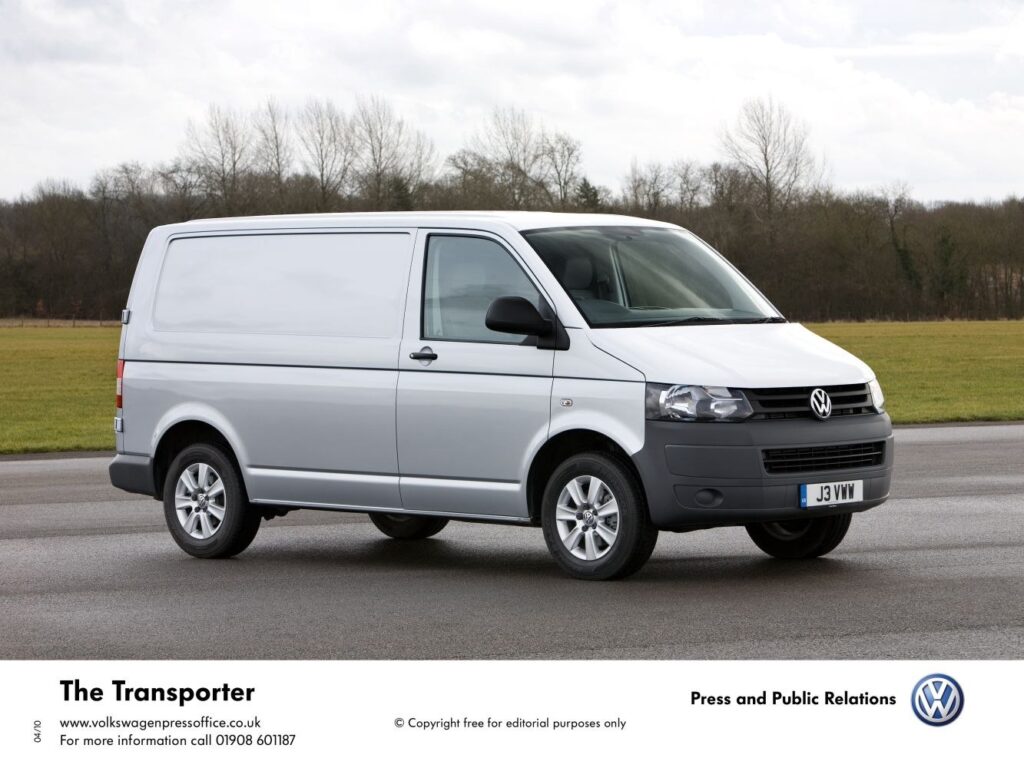
The Volkswagen Transporter (T5, facelift 2009) Panel Van was designed with a clear focus on utility and practicality. As a Panel Van, its primary function was cargo transport, featuring a windowless rear section to maximize load security and interior space. The L1H2 designation indicated a standard wheelbase (L1) combined with a high roof (H2), providing an exceptional maximum cargo volume of 6700 liters (236.61 cu. ft.). This generous space, coupled with a maximum payload capacity ranging from 1977.55 to 2001.8 lbs, made it an invaluable asset for various commercial applications, from courier services to construction trades.
Visually, the 2009 facelift brought a refreshed front fascia to the T5, incorporating Volkswagen’s contemporary design language with a revised grille, updated headlights, and restyled bumpers. The overall aesthetic remained functional and understated, reflecting its workhorse nature. The robust construction was evident in its dimensions: a length of 192.6 inches, a width of 74.96 inches (89.88 inches including mirrors), and a height of 85.67 inches. The 118.11-inch wheelbase ensured stability, while a minimum turning circle of 39.04 feet offered decent maneuverability for a vehicle of its size.
Inside, the cabin was configured for 2-3 occupants, prioritizing durability and ergonomics for long working hours. While features focused on functionality, the T5 facelift introduced improved materials and technology for its time. Safety features included an Anti-lock Braking System (ABS), and the vehicle’s robust chassis provided a solid foundation. The independent McPherson strut front suspension and independent coil spring rear suspension, combined with front and rear anti-roll bars, ensured a comfortable ride and stable handling, even with heavy loads. The hydraulic power steering provided direct feedback, while large ventilated disc brakes (340×32.5 mm front, 294×22 mm rear) offered strong stopping power.
Technical Specifications: Volkswagen Transporter (T5, facelift 2009) Panel Van 2.0 TDI BMT (180 Hp) 4MOTION DSG L1H2
| Category | Specification |
|---|---|
| General Information | |
| Brand | Volkswagen |
| Model | Transporter |
| Generation | Transporter (T5, facelift 2009) Panel Van |
| Type (Engine) | 2.0 TDI BMT (180 Hp) 4MOTION DSG L1H2 |
| Start of Production | 2013 year |
| End of Production | 2015 year |
| Powertrain Architecture | Internal Combustion engine |
| Body type | Van |
| Seats | 2-3 |
| Doors | 4-5 |
| Performance Specs | |
| Fuel Consumption (Urban, NEDC) | 9.4-9.7 l/100 km (24.2 – 25 US mpg) |
| Fuel Consumption (Extra Urban, NEDC) | 7.2-7.5 l/100 km (31.4 – 32.7 US mpg) |
| Fuel Consumption (Combined, NEDC) | 8-8.3 l/100 km (28.3 – 29.4 US mpg) |
| CO2 Emissions (NEDC) | 211-219 g/km |
| Fuel Type | Diesel |
| Acceleration 0 – 60 mph | 10.2 sec |
| Maximum Speed | 113.09 mph (182 km/h) |
| Emission Standard | Euro 5 |
| Weight-to-Power Ratio | 10.6 kg/Hp, 94.6 Hp/tonne |
| Weight-to-Torque Ratio | 4.8 kg/Nm, 210.2 Nm/tonne |
| Engine Specs | |
| Power | 180 Hp @ 4000 rpm |
| Power per liter | 91.5 Hp/l |
| Torque | 400 Nm (295.02 lb.-ft.) @ 1500-2000 rpm |
| Engine Layout | Front, Transverse |
| Engine Model/Code | EA189 / CFCA |
| Engine Displacement | 1968 cm3 (2.0 liters / 120.09 cu. in.) |
| Number of Cylinders | 4 |
| Engine Configuration | Inline |
| Cylinder Bore | 81 mm (3.19 in.) |
| Piston Stroke | 95.5 mm (3.76 in.) |
| Compression Ratio | 16.5:1 |
| Number of Valves per Cylinder | 4 |
| Fuel Injection System | Diesel Commonrail |
| Engine Aspiration | BiTurbo, Intercooler |
| Valvetrain | DOHC |
| Engine Oil Capacity | 7 liters (7.4 US qt) |
| Coolant Capacity | 11 liters (11.62 US qt) |
| Engine Systems | Start & Stop System, Particulate filter |
| Space, Volume and Weights | |
| Kerb Weight | 1903-2292 kg (4195.4 – 5053 lbs.) |
| Max. Weight | 2800-3200 kg (6172.94 – 7054.79 lbs.) |
| Max Load | 897-908 kg (1977.55 – 2001.8 lbs.) |
| Trunk (Boot) Space – Maximum | 6700 liters (236.61 cu. ft.) |
| Fuel Tank Capacity | 80 liters (21.13 US gal) |
| Permitted Trailer Load with Brakes (12%) | 2500 kg (5511.56 lbs.) |
| Permitted Trailer Load without Brakes | 750 kg (1653.47 lbs.) |
| Permitted Towbar Download | 100 kg (220.46 lbs.) |
| Dimensions | |
| Length | 4892 mm (192.6 in.) |
| Width | 1904 mm (74.96 in.) |
| Width including Mirrors | 2283 mm (89.88 in.) |
| Height | 2176 mm (85.67 in.) |
| Wheelbase | 3000 mm (118.11 in.) |
| Front Overhang | 896 mm (35.28 in.) |
| Rear Overhang | 996 mm (39.21 in.) |
| Ride Height (Ground Clearance) | 201 mm (7.91 in.) |
| Minimum Turning Circle (Turning Diameter) | 11.9 m (39.04 ft.) |
| Approach Angle | 21° |
| Departure Angle | 17° |
| Ramp-over (Brakeover) Angle | 14° |
| Climb Angle | 37° |
| Wading Depth | 300 mm (11.81 in.) |
| Drivetrain, Brakes and Suspension Specs | |
| Drivetrain Architecture | The Internal combustion engine (ICE) drives the front wheels permanently, and the rear wheels are driven through an electrically or mechanically operated clutch if necessary. |
| Drive Wheel | All wheel drive (4×4) |
| Number of Gears and Type of Gearbox | 7 gears, automatic transmission DSG |
| Front Suspension | Independent, type McPherson with coil spring and anti-roll bar |
| Rear Suspension | Independent coil spring, Transverse stabilizer, Trailing arm |
| Front Brakes | Ventilated discs, 340×32.5 mm |
| Rear Brakes | Ventilated discs, 294×22 mm |
| Assisting Systems | ABS (Anti-lock braking system) |
| Steering Type | Steering rack and pinion |
| Power Steering | Hydraulic Steering |
| Tire Sizes | 215/60 R17; 235/55 R17; 255/45 R18 |
| Wheel Rims Size | 7J x 17; 8J x 18 |
Legacy and Market Impact
The Volkswagen Transporter has an unparalleled legacy, dating back to the legendary Type 2. The T5 generation, and particularly the facelifted models from 2009 onward, solidified its position as a segment leader in the European and international LCV markets. The Volkswagen Transporter (T5, facelift 2009) Panel Van 2.0 TDI BMT (180 Hp) 4MOTION DSG L1H2 was a testament to Volkswagen’s commitment to offering highly specialized and capable variants to meet diverse commercial needs.
Its combination of a powerful yet efficient BiTurbo diesel engine, the sophisticated 7-speed DSG transmission, and the confidence-inspiring 4MOTION all-wheel-drive system set it apart from many competitors. This powertrain made it particularly attractive to businesses operating in regions with challenging climates, varied terrain, or those requiring robust towing and hauling capabilities. The ability to handle a maximum trailer load of 5511.56 lbs with brakes further underscored its utility.
In its primary markets, the T5 Transporter competed fiercely with other established players like the Ford Transit Custom, Mercedes-Benz Vito, Renault Trafic, and Opel Vivaro. However, the Transporter often distinguished itself with its more car-like driving dynamics, superior refinement, and the option of premium features and powertrains like the 180 Hp TDI and 4MOTION AWD. This allowed it to command a strong market presence and often a higher resale value, reflecting its reputation for quality and durability.
The T5 facelift models, produced until 2015 before the introduction of the T6, played a crucial role in maintaining Volkswagen’s dominance in the commercial van sector. They demonstrated that a work vehicle could be both practical and technologically advanced, offering a comfortable and efficient experience for drivers while delivering robust performance for businesses. The 2.0 TDI BMT (180 Hp) 4MOTION DSG L1H2 variant, in particular, remains a highly regarded example of how Volkswagen engineered a commercial vehicle to excel in demanding environments, leaving a significant mark on the industry for its blend of power, capability, and efficiency.