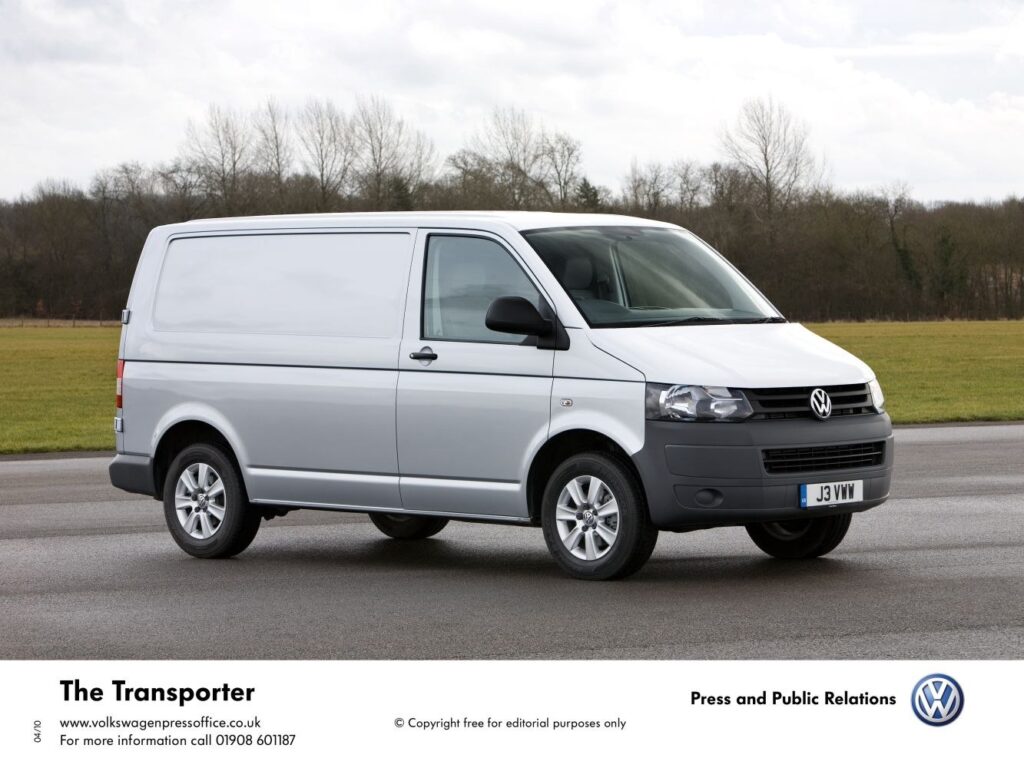
The Volkswagen Transporter (T5, facelift 2009) Panel Van 2.0 TDI BMT (180 Hp) DSG L1H2: A European Workhorse Defined
The Volkswagen Transporter, an iconic nameplate in the realm of light commercial vehicles (LCVs), represents a lineage of vans renowned for their durability, versatility, and engineering prowess. The specific variant, the Volkswagen Transporter (T5, facelift 2009) Panel Van 2.0 TDI BMT (180 Hp) DSG L1H2, produced between 2013 and 2015, stands as a testament to Volkswagen’s commitment to delivering highly capable and efficient vehicles for commercial use. While not officially sold in the United States in this panel van configuration, the Transporter series holds immense significance in Europe and other global markets, serving as the backbone for countless businesses, tradespeople, and service providers. This particular model, part of the T5 generation that received a significant facelift in 2009, combined robust utility with advanced powertrain technology, including its potent 2.0-liter TDI engine and sophisticated DSG automatic transmission. Its L1H2 designation signifies a short wheelbase (L1) and a high roof (H2) configuration, optimizing it for cargo capacity within urban and suburban environments.
Engine and Performance: Powering the Volkswagen Transporter (T5, facelift 2009) Panel Van
At the heart of this formidable panel van lies Volkswagen’s acclaimed 2.0-liter TDI (Turbocharged Direct Injection) engine, specifically the “BlueMotion Technology” (BMT) variant. This powertrain, designated with the engine code EA189 / CFCA, is a four-cylinder inline diesel unit featuring Double Overhead Camshafts (DOHC) and four valves per cylinder. Its advanced common rail fuel injection system, combined with a sophisticated BiTurbo setup and intercooler, allows it to generate an impressive 180 horsepower at 4000 rpm. More critically for a commercial vehicle, it delivers a substantial 295.02 lb.-ft. of torque across a broad and usable range, from 1500 to 2000 rpm. This low-end torque is crucial for hauling heavy loads and navigating challenging terrain, providing strong pulling power right off the line.
Power is efficiently managed and delivered to the front wheels via a 7-speed DSG (Direct Shift Gearbox) automatic transmission. This dual-clutch system is celebrated for its rapid, smooth gear changes, contributing significantly to both driving comfort and fuel efficiency. The integration of BlueMotion Technology further enhances its environmental credentials and operational economy. Features like a Start & Stop system and a particulate filter help the vehicle meet stringent Euro 5 emission standards, reducing its carbon footprint and operating costs.
Despite its primary role as a commercial vehicle, the Transporter 2.0 TDI BMT (180 Hp) DSG offers surprising agility. It can accelerate from 0 to 60 mph in a respectable 9.6 seconds, with a top speed of 114.33 mph. This level of performance ensures that the van can keep pace with highway traffic and execute overtakes confidently. The fuel economy, a vital aspect for any commercial operator, is commendable for a vehicle of its size and capability. The combined NEDC cycle estimates show 32.2 – 30.9 US mpg, with extra-urban figures reaching an impressive 35.6 – 34.1 US mpg, showcasing the efficiency gains from the TDI engine and DSG transmission combination.
Design and Features: Functionality Meets Volkswagen Engineering
The Volkswagen Transporter (T5, facelift 2009) Panel Van 2.0 TDI BMT (180 Hp) DSG L1H2 embodies a design philosophy centered on practicality, robustness, and ergonomic efficiency. As a panel van, its primary purpose is cargo transport, and its L1H2 configuration is tailored for maximum utility. The “L1” denotes the standard or short wheelbase, which, at 118.11 inches, provides a good balance between maneuverability in urban settings and stable handling on open roads. The “H2” signifies a high roof, dramatically increasing internal cargo volume, making it suitable for transporting taller items or for trades requiring ample standing room within the load area.
Visually, the T5 facelift brought a refreshed front fascia with updated headlights, grille, and bumper, aligning its aesthetics with Volkswagen’s passenger car lineup of the era. The overall silhouette remains classic Transporter: a boxy, functional shape designed to maximize interior space. The panel van typically features solid side panels instead of windows, offering enhanced security for its cargo and a large canvas for business branding. Access to the cargo area is facilitated by a large rear hatch or barn doors (depending on specification) and a sliding side door, ensuring ease of loading and unloading in various scenarios.
Inside, the cabin is built for durability and comfort during long working hours. The 2-3 seat configuration offers flexibility, allowing for either a single passenger or two, often with a folding central seat providing a practical workspace. Materials are hard-wearing and easy to clean, designed to withstand the rigors of daily commercial use. While not luxurious, the interior focuses on ergonomic layout, with intuitive controls and ample storage compartments for documents and tools. Key features for its time include power steering, a robust independent suspension system (McPherson struts with coil springs and an anti-roll bar at the front, and independent coil springs with a transverse stabilizer and trailing arm at the rear) to ensure a comfortable ride even when laden, and ventilated disc brakes on all four wheels for confident stopping power. Standard safety features like ABS (Anti-lock Braking System) were crucial for maintaining control under heavy braking, especially with varying loads. The vehicle’s impressive cargo volume of 236.61 cubic feet (6700 liters) underscores its capacity as a true workhorse.
Technical Specifications
| Volkswagen Transporter (T5, facelift 2009) Panel Van 2.0 TDI BMT (180 Hp) DSG L1H2 | |
|---|---|
| General Information | |
| Brand | Volkswagen |
| Model | Transporter |
| Generation | Transporter (T5, facelift 2009) Panel Van |
| Type (Engine) | 2.0 TDI BMT (180 Hp) DSG L1H2 |
| Start of production | 2013 year |
| End of production | 2015 year |
| Powertrain Architecture | Internal Combustion engine |
| Body type | Van |
| Seats | 2-3 |
| Doors | 4-5 |
| Performance Specs | |
| Fuel consumption (economy) – urban (NEDC) | 27.7 – 26.7 US mpg (8.5-8.8 l/100 km) |
| Fuel consumption (economy) – extra urban (NEDC) | 35.6 – 34.1 US mpg (6.6-6.9 l/100 km) |
| Fuel consumption (economy) – combined (NEDC) | 32.2 – 30.9 US mpg (7.3-7.6 l/100 km) |
| CO2 emissions (NEDC) | 192-199 g/km |
| Fuel Type | Diesel |
| Acceleration 0 – 60 mph | 9.6 sec |
| Acceleration 0 – 100 km/h | 10.1 sec |
| Maximum speed | 114.33 mph (184 km/h) |
| Emission standard | Euro 5 |
| Weight-to-power ratio | 9.9 kg/Hp, 101.1 Hp/tonne |
| Weight-to-torque ratio | 4.5 kg/Nm, 224.6 Nm/tonne |
| Engine Specs | |
| Power | 180 Hp @ 4000 rpm |
| Power per liter | 91.5 Hp/l |
| Torque | 295.02 lb.-ft. @ 1500-2000 rpm (400 Nm) |
| Engine layout | Front, Transverse |
| Engine Model/Code | EA189 / CFCA |
| Engine displacement | 2.0 liters (1968 cm3 / 120.09 cu. in.) |
| Number of cylinders | 4 |
| Engine configuration | Inline |
| Cylinder Bore | 3.19 in. (81 mm) |
| Piston Stroke | 3.76 in. (95.5 mm) |
| Compression ratio | 16.5:1 |
| Number of valves per cylinder | 4 |
| Fuel injection system | Diesel Commonrail |
| Engine aspiration | BiTurbo, Intercooler |
| Valvetrain | DOHC |
| Engine oil capacity | 7.4 US qt (7 l) |
| Coolant | 11.62 US qt (11 l) |
| Engine systems | Start & Stop System, Particulate filter |
| Space, Volume and Weights | |
| Kerb Weight | 3926.43 – 4784.03 lbs. (1781-2170 kg) |
| Max. weight (GVWR) | 6172.94 – 7054.79 lbs. (2800-3200 kg) |
| Max load | 2246.51 – 2270.76 lbs. (1019-1030 kg) |
| Trunk (boot) space – maximum | 236.61 cu. ft. (6700 l) |
| Fuel tank capacity | 21.13 US gal (80 l) |
| Permitted trailer load with brakes (12%) | 5511.56 lbs. (2500 kg) |
| Permitted trailer load without brakes | 1653.47 lbs. (750 kg) |
| Permitted towbar download | 220.46 lbs. (100 kg) |
| Dimensions | |
| Length | 192.6 in. (4892 mm) |
| Width | 74.96 in. (1904 mm) |
| Width including mirrors | 89.88 in. (2283 mm) |
| Height | 85.67 in. (2176 mm) |
| Wheelbase | 118.11 in. (3000 mm) |
| Front overhang | 35.28 in. (896 mm) |
| Rear overhang | 39.21 in. (996 mm) |
| Ride height (ground clearance) | 7.91 in. (201 mm) |
| Minimum turning circle (turning diameter) | 39.04 ft. (11.9 m) |
| Approach angle | 21° |
| Departure angle | 17° |
| Ramp-over (brakeover) angle | 14° |
| Wading depth | 11.81 in. (300 mm) |
| Drivetrain, Brakes and Suspension Specs | |
| Drivetrain Architecture | The Internal combustion engine (ICE) drives the front wheels of the vehicle. |
| Drive wheel | Front wheel drive |
| Number of gears and type of gearbox | 7 gears, automatic transmission DSG |
| Front suspension | Independent, type McPherson with coil spring and anti-roll bar |
| Rear suspension | Independent coil spring, Transverse stabilizer, Trailing arm |
| Front brakes | Ventilated discs, 340×32.5 mm |
| Rear brakes | Ventilated discs, 294×22 mm |
| Assisting systems | ABS (Anti-lock braking system) |
| Steering type | Steering rack and pinion |
| Power steering | Hydraulic Steering |
| Tires size | 215/60 R17; 235/55 R17; 255/45 R18 |
| Wheel rims size | 7J x 17; 8J x 18 |
Legacy and Market Impact
The Volkswagen Transporter series, often affectionately known as the “Bus” or “Kombi” in its passenger variants, boasts a rich and enduring legacy stretching back to the original T1 in the 1950s. The T5 generation, and particularly its facelifted version from 2009, continued this tradition of excellence, solidifying its position as a segment leader in many international markets. While the panel van variant, such as the Volkswagen Transporter (T5, facelift 2009) Panel Van 2.0 TDI BMT (180 Hp) DSG L1H2, was never officially imported into the United States due to market dynamics and regulatory hurdles (such as the “chicken tax” on imported light trucks), its impact in Europe, Australia, and parts of Asia and Africa is immense.
In its primary markets, the Transporter T5 was a dominant force, widely regarded for its unparalleled reliability, robust build quality, and impressive residual values. It was a go-to choice for businesses of all sizes, from sole traders needing a compact yet spacious van for urban deliveries to larger fleets requiring dependable transportation for goods and equipment. Its reputation for longevity meant a strong used vehicle market, further cementing its appeal.
Competitors in the fiercely contested European LCV segment during its production years included formidable rivals such as the Ford Transit Custom, Mercedes-Benz Vito, Renault Trafic, and Opel Vivaro. However, the Transporter consistently stood out for its car-like driving dynamics, refined powertrains (especially the powerful and efficient TDI engines paired with the DSG transmission), and a perceived premium quality that often justified its slightly higher price point. The BlueMotion Technology, with its focus on fuel efficiency and lower emissions, was a significant selling point in an era of increasing environmental awareness and rising fuel costs.
Beyond its commercial utility, the T5 Transporter also spawned popular passenger and leisure variants, most notably the Multivan and the California camper van, which garnered a cult following for their versatility and comfortable accommodations. This dual appeal, catering to both demanding commercial users and lifestyle-oriented private buyers, underscores the Transporter’s ingenious design and engineering flexibility. The 2.0 TDI BMT (180 Hp) DSG L1H2 panel van, in particular, represents a pinnacle of the T5’s commercial offerings, blending high performance, advanced technology, and practical design into a package that remained highly relevant and respected until the introduction of the T6 generation. Its legacy is one of unwavering service, efficiency, and a continuing testament to Volkswagen’s mastery in the light commercial vehicle sector.