The Volkswagen Transporter (T5, Facelift 2009) Panel Van 2.0 TSI (204 Hp) 4MOTION DSG L1H1: A European Workhorse with Premium Performance
The Volkswagen Transporter, an iconic nameplate in the global automotive landscape, has long been synonymous with versatility, reliability, and robust utility. The T5 generation, specifically the facelifted model introduced in 2009 and produced from 2011 to 2015, continued this esteemed lineage, solidifying its position as a dominant force in the light commercial vehicle segment, particularly across European and international markets. The variant under scrutiny, the Volkswagen Transporter (T5, facelift 2009) Panel Van 2.0 TSI (204 Hp) 4MOTION DSG L1H1, represented a potent and technologically advanced offering, combining a powerful gasoline engine with sophisticated all-wheel drive and an automatic transmission. While not a common sight in the United States in this specific panel van configuration, its engineering prowess and market relevance in its primary territories are undeniable. This particular model, with its L1H1 designation (short wheelbase, standard roof height), was designed to offer an optimal balance of compact maneuverability and substantial cargo capacity, catering to businesses requiring both speed and capability.
Engine and Performance: The Heart of the Volkswagen Transporter (T5, facelift 2009) Panel Van
At the core of this high-performance panel van lay Volkswagen’s renowned EA888 engine, specifically the CJKA code, a 2.0-liter (121.07 cubic inches) inline four-cylinder gasoline unit. This sophisticated powerplant featured direct fuel injection, a turbocharger, and an intercooler, technologies designed to maximize both power output and fuel efficiency. The engine delivered a robust 204 horsepower at a broad range of 4200-6000 rpm, a figure that was exceptionally strong for a commercial vehicle of its class. Equally impressive was the torque output, peaking at 258.15 lb.-ft. (350 Nm) and available from a low 1500 rpm all the way up to 4000 rpm, ensuring excellent pulling power and responsiveness even when fully loaded.
Power was seamlessly managed by a 7-speed DSG (Direct-Shift Gearbox) automatic transmission, a dual-clutch unit celebrated for its rapid and smooth gear changes. This transmission not only contributed to the vehicle’s lively performance but also enhanced fuel economy compared to traditional torque-converter automatics. The drivetrain architecture further distinguished this Transporter with its advanced 4MOTION all-wheel-drive system. Primarily front-wheel drive, the system intelligently engaged the rear wheels through an electrically or mechanically operated clutch when slip was detected or anticipated, providing superior traction and stability in challenging weather conditions or on unpaved surfaces.
The combination of this potent engine, advanced transmission, and intelligent all-wheel drive resulted in remarkable performance for a panel van. The Volkswagen Transporter (T5, facelift 2009) Panel Van 2.0 TSI (204 Hp) 4MOTION DSG L1H1 could accelerate from 0 to 60 mph in a swift 8.4 seconds, with a top speed of 122.41 mph. While fuel economy was not its primary selling point compared to diesel variants, the combined NEDC rating of 22.8 – 22.4 US mpg was respectable for a powerful, all-wheel-drive gasoline commercial vehicle. It met Euro 5 emission standards, reflecting its commitment to environmental considerations for its time.
Design and Features: Form Follows Function
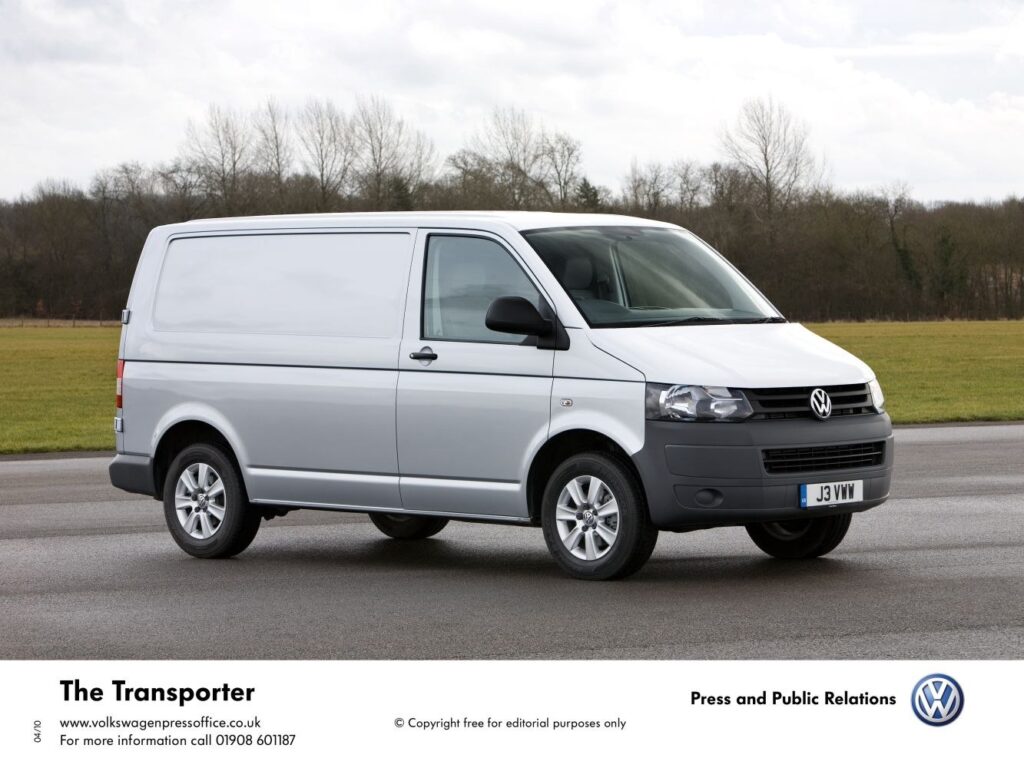
The T5 Transporter’s design was a masterclass in functional aesthetics, presenting a clean, robust, and timeless appearance. The facelifted model retained the familiar silhouette but introduced subtle updates to the front fascia, including revised headlights, grille, and bumper, giving it a more modern and assertive look. As a panel van, its primary purpose was cargo transport, and the L1H1 configuration (Length 1, Height 1) offered a practical solution for urban deliveries and general utility. With an overall length of 192.6 inches and a width of 74.96 inches (89.88 inches including mirrors), it was maneuverable enough for city streets while still providing substantial interior volume.
The interior was designed for durability and driver comfort, recognizing that commercial drivers spend long hours behind the wheel. Depending on the configuration, it offered seating for two or three occupants. The cargo area was expansive, boasting a maximum trunk space of 5800 liters (204.83 cubic feet), making it highly capable of accommodating a wide range of goods. The maximum payload capacity ranged from 2021.64 to 2045.89 lbs., underscoring its heavy-duty capabilities.
Underneath, the Transporter featured an independent suspension setup both front and rear, utilizing McPherson struts with coil springs and an anti-roll bar at the front, and independent coil springs with a transverse stabilizer and trailing arms at the rear. This sophisticated suspension ensured a comfortable ride, precise handling, and excellent stability, even with heavy loads. Stopping power was provided by large ventilated disc brakes (340×32.5 mm front, 294×22 mm rear), complemented by an Anti-lock Braking System (ABS) for enhanced safety. Hydraulic rack and pinion steering offered direct feedback and assistance, making the van surprisingly easy to pilot. Standard tire sizes typically included 215/60 R17, with options for 235/55 R17 or even 255/45 R18 on larger wheels, further enhancing grip and road presence.
Technical Specifications
| Category | Specification |
|---|---|
| Brand | Volkswagen |
| Model | Transporter |
| Generation | Transporter (T5, facelift 2009) Panel Van |
| Type (Engine) | 2.0 TSI (204 Hp) 4MOTION DSG L1H1 |
| Start of production | 2011 year |
| End of production | 2015 year |
| Powertrain Architecture | Internal Combustion engine |
| Body type | Van |
| Seats | 2-3 |
| Doors | 4-5 |
| Performance Specs | |
| Fuel consumption (urban NEDC) | 13.8-14 l/100 km (17 – 16.8 US mpg) |
| Fuel consumption (extra urban NEDC) | 8.3-8.5 l/100 km (28.3 – 27.7 US mpg) |
| Fuel consumption (combined NEDC) | 10.3-10.5 l/100 km (22.8 – 22.4 US mpg) |
| CO2 emissions (NEDC) | 239-245 g/km |
| Fuel Type | Petrol (Gasoline) |
| Acceleration 0 – 60 mph | 8.4 sec |
| Maximum speed | 122.41 mph (197 km/h) |
| Emission standard | Euro 5 |
| Weight-to-power ratio | 9.2 kg/Hp (108.3 Hp/tonne) |
| Weight-to-torque ratio | 5.4 kg/Nm (185.9 Nm/tonne) |
| Engine Specs | |
| Power | 204 Hp @ 4200-6000 rpm |
| Power per liter | 102.8 Hp/l |
| Torque | 258.15 lb.-ft. (350 Nm) @ 1500-4000 rpm |
| Engine layout | Front, Transverse |
| Engine Model/Code | EA888 / CJKA |
| Engine displacement | 2.0 liters (1984 cm3 / 121.07 cu. in.) |
| Number of cylinders | 4 |
| Engine configuration | Inline |
| Cylinder Bore | 3.25 in. (82.5 mm) |
| Piston Stroke | 3.65 in. (92.8 mm) |
| Compression ratio | 9.8:1 |
| Number of valves per cylinder | 4 |
| Fuel injection system | Direct injection |
| Engine aspiration | Turbocharger, Intercooler |
| Valvetrain | DOHC |
| Engine oil capacity | 6.02 US qt (5.7 l) |
| Coolant | 11.62 US qt (11 l) |
| Space, Volume and Weights | |
| Kerb Weight | 4151.3 – 5008.9 lbs. (1883-2272 kg) |
| Max. weight | 6172.94 – 7054.79 lbs. (2800-3200 kg) |
| Max load | 2021.64 – 2045.89 lbs. (917-928 kg) |
| Trunk (boot) space – maximum | 204.83 cu. ft. (5800 l) |
| Fuel tank capacity | 21.13 US gal (80 l) |
| Max. roof load | 220.46 lbs. (100 kg) |
| Permitted trailer load with brakes (12%) | 5511.56 lbs. (2500 kg) |
| Permitted trailer load without brakes | 1653.47 lbs. (750 kg) |
| Permitted towbar download | 220.46 lbs. (100 kg) |
| Dimensions | |
| Length | 192.6 in. (4892 mm) |
| Width | 74.96 in. (1904 mm) |
| Width including mirrors | 89.88 in. (2283 mm) |
| Height | 78.35 in. (1990 mm) |
| Wheelbase | 118.11 in. (3000 mm) |
| Front overhang | 35.28 in. (896 mm) |
| Rear overhang | 39.21 in. (996 mm) |
| Ride height (ground clearance) | 7.91 in. (201 mm) |
| Minimum turning circle (turning diameter) | 39.04 ft. (11.9 m) |
| Approach angle | 21° |
| Departure angle | 17° |
| Ramp-over (brakeover) angle | 14° |
| Wading depth | 11.81 in. (300 mm) |
| Drivetrain, Brakes and Suspension Specs | |
| Drivetrain Architecture | The Internal combustion engine (ICE) drives the front wheels permanently, and the rear wheels are driven through an electrically or mechanically operated clutch if necessary. |
| Drive wheel | All wheel drive (4×4) |
| Number of gears and type of gearbox | 7 gears, automatic transmission DSG |
| Front suspension | Independent, type McPherson with coil spring and anti-roll bar |
| Rear suspension | Independent coil spring, Transverse stabilizer, Trailing arm |
| Front brakes | Ventilated discs, 340×32.5 mm |
| Rear brakes | Ventilated discs, 294×22 mm |
| Assisting systems | ABS (Anti-lock braking system) |
| Steering type | Steering rack and pinion |
| Power steering | Hydraulic Steering |
| Tires size | 215/60 R17; 235/55 R17; 255/45 R18 |
| Wheel rims size | 7J x 17; 8J x 18 |
Legacy and Market Impact
The Volkswagen Transporter series holds a revered place in automotive history, tracing its origins back to the iconic T1 “Bus” of the 1950s. Each generation has built upon this legacy, adapting to evolving market demands while retaining the core values of utility, durability, and versatility. The T5 generation, and particularly the facelifted models from 2011 to 2015, were pivotal in demonstrating how commercial vehicles could integrate advanced passenger car technology without compromising their workhorse capabilities.
The Volkswagen Transporter (T5, facelift 2009) Panel Van 2.0 TSI (204 Hp) 4MOTION DSG L1H1 carved out a niche as a premium offering within the light commercial vehicle segment. Its powerful gasoline engine, combined with the sophisticated DSG transmission and 4MOTION all-wheel drive, made it an ideal choice for businesses requiring more than just basic transport. It was particularly appealing for operations demanding quick deliveries, reliable performance in adverse weather conditions, or those needing to tow substantial loads (up to 5511.56 lbs. with brakes). The combination of comfort, performance, and all-weather capability also made it a popular base for specialist conversions, such as mobile workshops or even recreational vehicles, further cementing its adaptable nature.
In its primary markets, the T5 Transporter faced stiff competition from other well-established players like the Mercedes-Benz Vito, Ford Transit Custom, and Renault Trafic. However, Volkswagen’s reputation for engineering quality, combined with the T5’s broad range of configurations and powertrains, allowed it to maintain a strong market presence. The 2.0 TSI 4MOTION DSG variant, while not the highest volume seller compared to more economical diesel options, served as a halo model, showcasing the Transporter’s potential for performance and technological integration. It demonstrated that a commercial van could be both a highly practical tool and a refined, enjoyable vehicle to drive.
The T5 generation’s robust construction, excellent payload capacity, and impressive towing abilities ensured its longevity and strong resale values. Its advanced drivetrain, including the efficient DSG and capable 4MOTION system, set a high benchmark for what was expected from a modern commercial vehicle. Even after the introduction of the T6 generation, the T5 remains a highly respected and sought-after vehicle, a testament to its enduring design, engineering quality, and its significant impact on the light commercial vehicle landscape.