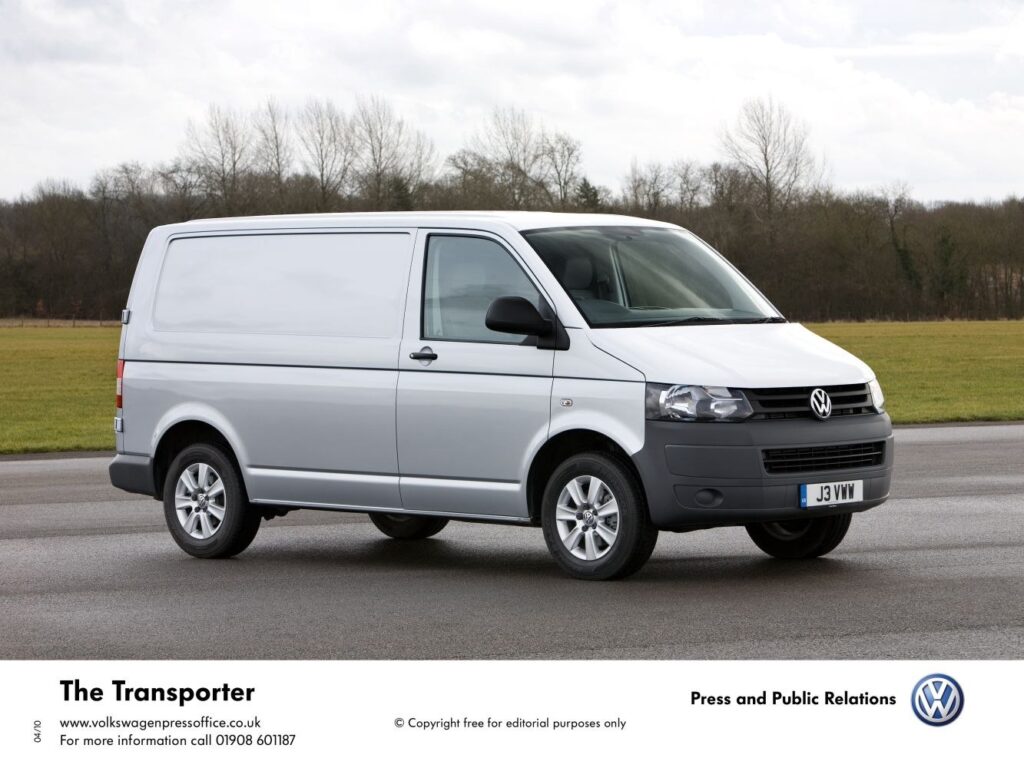
The Volkswagen Transporter (T5, Facelift 2009) Panel Van 2.0 TSI (204 Hp) DSG L1H2: A European Workhorse
The Volkswagen Transporter, a name synonymous with reliability and utility across global markets, particularly in Europe, received a significant update with its T5 generation facelift in 2009. This iteration, produced from 2011 to 2015, cemented its reputation as a versatile and robust light commercial vehicle. The specific variant under examination, the Volkswagen Transporter (T5, facelift 2009) Panel Van 2.0 TSI (204 Hp) DSG L1H2, represents a potent and efficient offering within its class, combining a powerful gasoline engine with a sophisticated automatic transmission, tailored for businesses requiring both performance and practicality.
While the Volkswagen Transporter series has a storied history, including the iconic Microbus that found a niche following in the United States, the modern T5 generation, particularly in its panel van configuration, was not directly marketed or widely available in the North American commercial vehicle segment. Instead, it served as a cornerstone of Volkswagen’s commercial vehicle division in Europe, the UK, Asia, and other international markets. Its role was to provide a dependable platform for various business needs, from logistics and delivery services to tradespeople requiring ample cargo space and a comfortable, car-like driving experience.
The T5 facelift brought a refreshed exterior design, updated interior ergonomics, and, crucially, a new range of more efficient engines, including the advanced 2.0-liter TSI gasoline unit. The L1H2 designation indicates a specific body configuration: ‘L1’ referring to the standard length chassis and ‘H2’ denoting a high roof, maximizing cargo volume for businesses needing to transport bulkier items without opting for a longer wheelbase. This particular model, equipped with the 204 horsepower 2.0 TSI engine and a 7-speed DSG automatic transmission, stood out for its impressive performance capabilities in a segment often dominated by diesel powertrains.
Engine & Performance: The Potent 2.0 TSI in the Volkswagen Transporter (T5, facelift 2009) Panel Van
At the heart of this particular Volkswagen Transporter (T5, facelift 2009) Panel Van lies the renowned EA888 / CJKA 2.0-liter TSI (Turbocharged Stratified Injection) inline-four engine. This powertrain is a testament to Volkswagen’s engineering prowess, delivering a remarkable 204 horsepower at a broad range of 4200-6000 rpm. Such power output is exceptional for a commercial van, providing ample grunt for heavy loads and maintaining comfortable cruising speeds on highways.
The engine’s performance is further bolstered by its robust torque figures: 350 Nm, or approximately 258.15 lb.-ft., available from a low 1500 rpm and sustained up to 4000 rpm. This wide torque band is critical for a commercial vehicle, ensuring strong pulling power from a standstill and excellent flexibility in urban driving conditions without constant gear changes. The engine’s advanced features, including direct fuel injection, a turbocharger, and an intercooler, contribute to its impressive power per liter of 102.8 Hp/l, while adhering to Euro 5 emission standards.
Mated to this powerful engine is Volkswagen’s sophisticated 7-speed DSG (Direct-Shift Gearbox) automatic transmission. This dual-clutch unit is celebrated for its rapid, smooth, and efficient gear changes, offering a blend of performance and fuel economy that traditional torque-converter automatics often struggle to match. The DSG’s quick shifts contribute to the van’s spirited acceleration, allowing it to sprint from 0 to 62 mph (0-100 km/h) in a swift 8.5 seconds, with a calculated 0-60 mph time of 8.1 seconds. These figures are more akin to a modern passenger car than a commercial panel van, underscoring its dynamic capabilities. The maximum speed is rated at 120.55 mph (194 km/h).
Despite its performance orientation, the 2.0 TSI engine also aims for efficiency. The combined fuel economy, according to NEDC standards, ranges from 9.8-10.1 liters per 100 km, which translates to an estimated 24-23.3 US mpg. While not the absolute pinnacle of fuel economy compared to some modern diesels, it represents a respectable balance for a gasoline engine of its output in a vehicle of this size and capability, especially when considering the smooth power delivery and lower emissions of certain pollutants compared to diesel counterparts.
Design & Features: Utilitarian Elegance and Practicality
The Volkswagen Transporter (T5, facelift 2009) Panel Van 2.0 TSI (204 Hp) DSG L1H2 embodies a design philosophy that prioritizes functionality and durability, characteristic of a commercial workhorse. Its body type is a classic panel van, featuring 4-5 doors (typically two front doors, one or two sliding side doors, and a rear tailgate or barn doors) and a 2-3 seat configuration in the cabin, leaving the vast majority of the interior dedicated to cargo space.
Measuring 192.6 inches (4892 mm) in length, 74.96 inches (1904 mm) in width (89.88 inches or 2283 mm including mirrors), and 85.67 inches (2176 mm) in height, the L1H2 variant offers a substantial footprint without being overly cumbersome for urban environments. The 118.11-inch (3000 mm) wheelbase contributes to stable handling and a comfortable ride, while the minimum turning circle of 39.04 feet (11.9 m) aids maneuverability in tight spaces, a crucial aspect for delivery vehicles.
The primary feature of any panel van is its cargo capacity, and the T5 L1H2 excels here with a cavernous maximum trunk space of 6700 liters (236.61 cu. ft.). This immense volume, combined with a maximum payload capacity of 2290.6-2314.85 lbs (1039-1050 kg), makes it highly adaptable for a wide range of commercial applications. The robust construction is evident in its kerb weight of 3882.34 – 4739.94 lbs (1761-2150 kg) and a maximum gross weight of 6172.94 – 7054.79 lbs (2800-3200 kg).
For enhanced utility, the Transporter also boasts impressive towing capabilities, with a permitted trailer load of 5511.56 lbs (2500 kg) with brakes and 1653.47 lbs (750 kg) without brakes. The generous ground clearance of 7.91 inches (201 mm) and respectable approach (21°), departure (17°), and ramp-over (14°) angles, along with a wading depth of 11.81 inches (300 mm), hint at its capability to handle varied terrains, making it suitable for construction sites or less-developed roads.
In terms of driver comfort and safety, the T5 facelift brought refinements to the cabin, improving ergonomics and material quality. Standard features for the era included power steering (hydraulic), ABS (Anti-lock Braking System) for controlled braking, and robust ventilated disc brakes (340×32.5 mm front, 294×22 mm rear) to ensure reliable stopping power even under load. The independent McPherson front suspension with coil springs and an anti-roll bar, combined with an independent coil spring rear suspension with a transverse stabilizer and trailing arm, provided a good balance of ride comfort and handling stability, crucial for long workdays.
Technical Specifications
| Category | Specification | US Equivalent | |
|---|---|---|---|
| General Information | |||
| Brand | Volkswagen | ||
| Model | Transporter | ||
| Generation | Transporter (T5, facelift 2009) Panel Van | ||
| Type (Engine) | 2.0 TSI (204 Hp) DSG L1H2 | ||
| Start of Production | 2011 year | ||
| End of Production | 2015 year | ||
| Powertrain Architecture | Internal Combustion engine | ||
| Body type | Van | ||
| Seats | 2-3 | ||
| Doors | 4-5 | ||
| Performance Specs | |||
| Fuel consumption (urban NEDC) | 13.2-13.5 l/100 km | 17.8 – 17.4 US mpg | |
| Fuel consumption (extra urban NEDC) | 7.8-8.1 l/100 km | 30.2 – 29 US mpg | |
| Fuel consumption (combined NEDC) | 9.8-10.1 l/100 km | 24 – 23.3 US mpg | |
| CO2 emissions (NEDC) | 228-236 g/km | ||
| Fuel Type | Petrol (Gasoline) | ||
| Acceleration 0 – 60 mph | 8.1 sec | ||
| Acceleration 0 – 100 km/h | 8.5 sec | ||
| Maximum speed | 194 km/h | 120.55 mph | |
| Emission standard | Euro 5 | ||
| Weight-to-power ratio | 8.6 kg/Hp | 115.8 Hp/tonne | |
| Weight-to-torque ratio | 5 kg/Nm | 198.8 Nm/tonne | |
| Engine Specs | |||
| Power | 204 Hp @ 4200-6000 rpm | ||
| Power per liter | 102.8 Hp/l | ||
| Torque | 350 Nm @ 1500-4000 rpm | 258.15 lb.-ft. @ 1500-4000 rpm | |
| Engine layout | Front, Transverse | ||
| Engine Model/Code | EA888 / CJKA | ||
| Engine displacement | 1984 cm3 | 121.07 cu. in. (2.0 L) | |
| Number of cylinders | 4 | ||
| Engine configuration | Inline | ||
| Cylinder Bore | 82.5 mm | 3.25 in. | |
| Piston Stroke | 92.8 mm | 3.65 in. | |
| Compression ratio | 9.8:1 | ||
| Number of valves per cylinder | 4 | ||
| Fuel injection system | Direct injection | ||
| Engine aspiration | Turbocharger, Intercooler | ||
| Valvetrain | DOHC | ||
| Engine oil capacity | 5.7 l | 6.02 US qt | |
| Coolant | 11 l | 11.62 US qt | |
| Space, Volume and Weights | |||
| Kerb Weight | 1761-2150 kg | 3882.34 – 4739.94 lbs. | |
| Max. weight | 2800-3200 kg | 6172.94 – 7054.79 lbs. | |
| Max load | 1039-1050 kg | 2290.6 – 2314.85 lbs. | |
| Trunk (boot) space – maximum | 6700 l | 236.61 cu. ft. | |
| Fuel tank capacity | 80 l | 21.13 US gal | |
| Permitted trailer load with brakes (12%) | 2500 kg | 5511.56 lbs. | |
| Permitted trailer load without brakes | 750 kg | 1653.47 lbs. | |
| Permitted towbar download | 100 kg | 220.46 lbs. | |
| Dimensions | |||
| Length | 4892 mm | 192.6 in. | |
| Width | 1904 mm | 74.96 in. | |
| Width including mirrors | 2283 mm | 89.88 in. | |
| Height | 2176 mm | 85.67 in. | |
| Wheelbase | 3000 mm | 118.11 in. | |
| Front overhang | 896 mm | 35.28 in. | |
| Rear overhang | 996 mm | 39.21 in. | |
| Ride height (ground clearance) | 201 mm | 7.91 in. | |
| Minimum turning circle (turning diameter) | 11.9 m | 39.04 ft. | |
| Approach angle | 21° | ||
| Departure angle | 17° | ||
| Ramp-over (brakeover) angle | 14° | ||
| Wading depth | 300 mm | 11.81 in. | |
| Drivetrain, Brakes and Suspension Specs | |||
| Drivetrain Architecture | The Internal combustion engine (ICE) drives the front wheels of the vehicle. | ||
| Drive wheel | Front wheel drive | ||
| Number of gears and type of gearbox | 7 gears, automatic transmission DSG | ||
| Front suspension | Independent, type McPherson with coil spring and anti-roll bar | ||
| Rear suspension | Independent coil spring, Transverse stabilizer, Trailing arm | ||
| Front brakes | Ventilated discs, 340×32.5 mm | ||
| Rear brakes | Ventilated discs, 294×22 mm | ||
| Assisting systems | ABS (Anti-lock braking system) | ||
| Steering type | Steering rack and pinion | ||
| Power steering | Hydraulic Steering | ||
| Tires size | 215/60 R17; 235/55 R17; 255/45 R18 | ||
| Wheel rims size | 7J x 17; 8J x 18 | ||
Legacy & Market Impact of the Volkswagen Transporter (T5, facelift 2009) Panel Van
The Volkswagen Transporter has an enduring legacy, tracing its roots back to the original Type 2 “Bus” of the 1950s. The T5 generation, particularly after its 2009 facelift, continued this tradition of robust utility and broad appeal in its target markets. While not a direct competitor in the US commercial van market, where full-size vans like the Ford Transit (introduced later as a global model), Ram ProMaster, and Mercedes-Benz Sprinter dominate, the T5 carved out a formidable niche in Europe and other international regions as a highly capable mid-size van.
In Europe, the Transporter (T5, facelift 2009) Panel Van faced stiff competition from established rivals such as the Ford Transit Custom, Mercedes-Benz Vito, Renault Trafic, and Opel/Vauxhall Vivaro. What set the Transporter apart, especially this 2.0 TSI DSG variant, was its blend of passenger-car-like refinement and driving dynamics, combined with serious hauling and towing capabilities. The powerful gasoline engine and smooth DSG transmission offered an alternative to the predominantly diesel-powered commercial van segment, appealing to businesses that valued performance, quicker acceleration, and potentially lower noise and vibration levels, particularly for drivers spending long hours behind the wheel.
The T5 facelift was praised for its improved interior quality, enhanced safety features for its time, and a more modern aesthetic. Its reputation for reliability and strong residual values made it a sound investment for businesses. The modular design, including various wheelbase and roof height options (like the L1H2), allowed for extensive customization, from basic cargo transport to specialized conversions for trades, emergency services, or mobile workshops.
Ultimately, the Volkswagen Transporter (T5, facelift 2009) Panel Van, and specifically the 2.0 TSI (204 Hp) DSG L1H2 model, represents a highly competent and versatile commercial vehicle. Its impact was primarily felt in markets where compact and mid-size vans form the backbone of light commercial transport. It solidified Volkswagen’s position as a leader in this segment, offering a premium and performance-oriented option for businesses that demanded more than just basic utility from their work vehicles. Its combination of a potent gasoline engine, advanced automatic transmission, and practical design ensures its place as a significant chapter in the ongoing saga of the venerable Volkswagen Transporter.