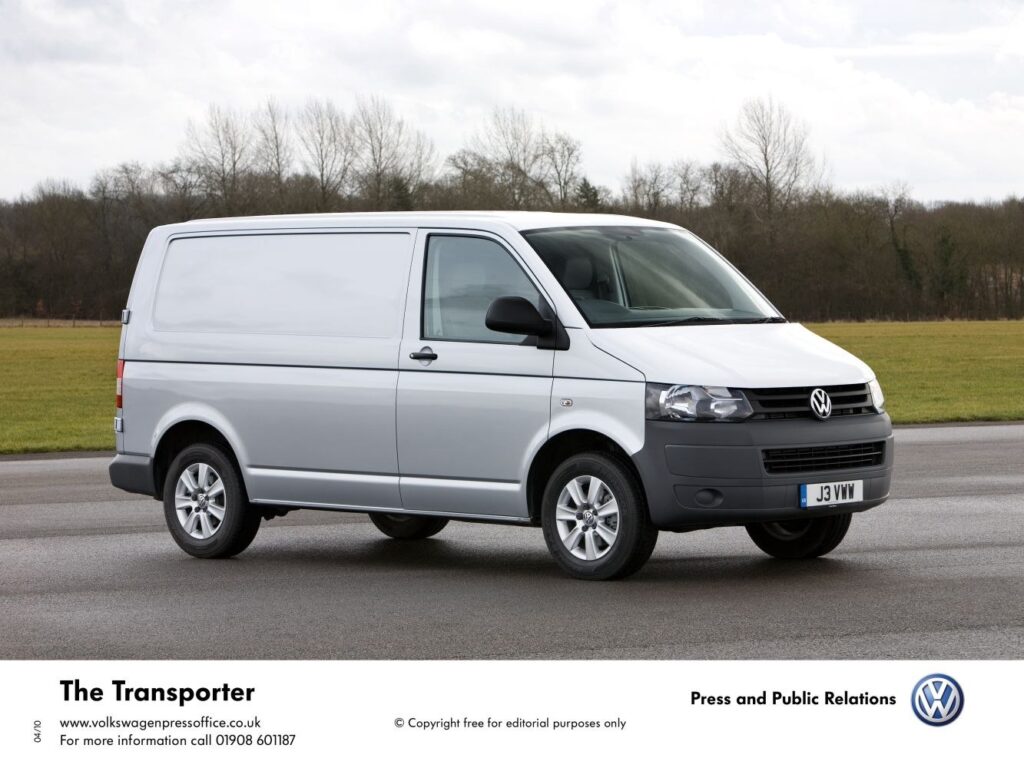
Volkswagen Transporter (T5, facelift 2009) Panel Van 2.0 TSI (204 Hp) L2H3
The Volkswagen Transporter (T5, facelift 2009) Panel Van represents a significant iteration of Volkswagen’s highly successful commercial vehicle line. Produced between 2011 and 2015, this specific variant, the 2.0 TSI (204 Hp) L2H3, offered a compelling blend of robust performance and substantial cargo capacity, primarily targeting the demanding European and international commercial markets. As a facelift of the fifth-generation Transporter (T5), it incorporated design refinements, technological updates, and improved powertrains to maintain its competitive edge in the fiercely contested light commercial vehicle (LCV) segment. While not officially sold in the United States, the Transporter series, known as the ‘Bus’ or ‘Microbus’ in its earlier generations, holds an iconic status globally, and the T5 continued this legacy with modern engineering and practicality. This L2H3 configuration denotes a long wheelbase (L2) and a super high roof (H3), maximizing its utility as a dedicated panel van.
Engine and Performance of the Volkswagen Transporter (T5, facelift 2009)
Under the hood, the Volkswagen Transporter (T5, facelift 2009) 2.0 TSI L2H3 variant featured a sophisticated 2.0-liter turbocharged, direct-injection gasoline engine, designated as EA888 / CJKA. This inline four-cylinder powerplant was engineered to deliver an impressive 204 horsepower (Hp) at a broad range of 4200-6000 revolutions per minute (rpm). More remarkably for a commercial vehicle, it produced a substantial 258.15 lb.-ft. of torque, available from a very low 1500 rpm all the way up to 4000 rpm. This wide torque band was crucial for a panel van, ensuring excellent pulling power and responsiveness, even when fully loaded.
The engine’s design, featuring a turbocharger and intercooler along with a DOHC (Double Overhead Camshaft) valvetrain and four valves per cylinder, underscored its advanced engineering for both efficiency and power delivery. With a compression ratio of 9.8:1 and direct fuel injection, it achieved a power-per-liter output of 102.8 Hp/l, demonstrating its modern design. Mated to a 6-speed manual transmission, this powertrain propelled the Transporter L2H3 from 0 to 60 mph in a swift 8.4 seconds, an astonishing figure for a vehicle of its size and purpose. Its maximum speed was rated at 114.95 mph (185 km/h), making it capable of comfortable highway cruising.
Fuel economy for this powerful gasoline engine, while not its primary selling point compared to diesel variants, was respectable for its class. The combined NEDC (New European Driving Cycle) figures ranged from 9.9-10.2 liters per 100 km, translating to approximately 23.1-23.8 US mpg. Urban consumption was naturally higher, ranging from 12.7-13 l/100 km (18.1-18.5 US mpg), while extra-urban driving saw figures improve to 8.3-8.6 l/100 km (27.4-28.3 US mpg). Adhering to the Euro 5 emission standard, the 2.0 TSI engine produced CO2 emissions between 231-238 g/km, reflecting a balance between performance and environmental considerations for its era.
Design and Features: The Practicality of the L2H3 Panel Van
The Volkswagen Transporter (T5, facelift 2009) L2H3 Panel Van was a testament to functional design, prioritizing cargo utility and durability. As a panel van, it featured an enclosed rear compartment devoid of windows, providing security for cargo and a blank canvas for branding. The L2H3 designation indicated its specific dimensions: L2 signifying a long wheelbase of 133.86 inches (3400 mm), and H3 denoting a super high roof, contributing to an overall height of 97.48 inches (2476 mm). This combination resulted in an exceptionally generous maximum cargo volume of 9300 liters (328.43 cubic feet), making it ideal for businesses requiring substantial carrying capacity.
Measuring 208.35 inches (5292 mm) in length and 74.96 inches (1904 mm) in width (89.88 inches or 2283 mm including mirrors), the Transporter commanded a significant road presence. Despite its size, its minimum turning circle of 43.31 feet (13.2 meters) provided reasonable maneuverability in urban environments. The exterior design, refreshed in 2009, brought a more contemporary look to the T5, aligning it with Volkswagen’s passenger car lineup of the time. This included revised headlights, a new grille, and updated bumpers, giving it a more modern and professional appearance.
Inside, the cabin was designed for utility and comfort for its 2-3 occupants. Robust materials, intuitive controls, and ample storage solutions were standard. While specific luxury features were minimal in a panel van, emphasis was placed on ergonomic seating, clear instrumentation, and practical amenities for long working days. Safety features for the era included ABS (Anti-lock Braking System) as standard, complemented by ventilated disc brakes on both front (340×32.5 mm) and rear (294×22 mm) axles, ensuring confident stopping power even under load. The suspension system, featuring an independent McPherson strut with coil springs and an anti-roll bar at the front, and an independent coil spring with a transverse stabilizer and trailing arm at the rear, was tuned to handle varying loads while providing a stable and comfortable ride. The hydraulic power steering offered precise control, and various tire and wheel options (e.g., 215/60 R17, 235/55 R17, 255/45 R18) allowed for customization based on specific load and driving requirements.
Technical Specifications
| General Information | |
|---|---|
| Brand | Volkswagen |
| Model | Transporter |
| Generation | Transporter (T5, facelift 2009) Panel Van |
| Engine Type | 2.0 TSI (204 Hp) L2H3 |
| Production Start | 2011 |
| Production End | 2015 |
| Powertrain Architecture | Internal Combustion Engine |
| Body Type | Van |
| Seats | 2-3 |
| Doors | 4-5 |
| Performance Specifications | |
| Fuel Consumption (Urban, NEDC) | 12.7-13 l/100 km (18.1-18.5 US mpg) |
| Fuel Consumption (Extra Urban, NEDC) | 8.3-8.6 l/100 km (27.4-28.3 US mpg) |
| Fuel Consumption (Combined, NEDC) | 9.9-10.2 l/100 km (23.1-23.8 US mpg) |
| CO2 Emissions (NEDC) | 231-238 g/km |
| Fuel Type | Petrol (Gasoline) |
| Acceleration 0-60 mph | 8.4 seconds |
| Acceleration 0-62 mph (0-100 km/h) | 8.8 seconds |
| Maximum Speed | 114.95 mph (185 km/h) |
| Emission Standard | Euro 5 |
| Weight-to-Power Ratio | 8.8 kg/Hp (113.3 Hp/tonne) |
| Weight-to-Torque Ratio | 5.1 kg/Nm (194.4 Nm/tonne) |
| Engine Specifications | |
| Power | 204 Hp @ 4200-6000 rpm |
| Power per Liter | 102.8 Hp/l |
| Torque | 350 Nm (258.15 lb.-ft.) @ 1500-4000 rpm |
| Engine Layout | Front, Transverse |
| Engine Model/Code | EA888 / CJKA |
| Engine Displacement | 1984 cm3 (2.0 liters / 121.07 cu. in.) |
| Number of Cylinders | 4 |
| Engine Configuration | Inline |
| Cylinder Bore | 82.5 mm (3.25 in.) |
| Piston Stroke | 92.8 mm (3.65 in.) |
| Compression Ratio | 9.8:1 |
| Valves per Cylinder | 4 |
| Fuel Injection System | Direct injection |
| Engine Aspiration | Turbocharger, Intercooler |
| Valvetrain | DOHC |
| Engine Oil Capacity | 5.7 l (6.02 US qt) |
| Coolant Capacity | 11 l (11.62 US qt) |
| Space, Volume, and Weights | |
| Kerb Weight | 1800-2217 kg (3968.32 – 4887.65 lbs.) |
| Max. Weight (GVWR) | 2800-3200 kg (6172.94 – 7054.79 lbs.) |
| Max. Load | 983-1000 kg (2167.14 – 2204.62 lbs.) |
| Trunk (Boot) Space – Maximum | 9300 l (328.43 cu. ft.) |
| Fuel Tank Capacity | 80 l (21.13 US gal) |
| Permitted Trailer Load with Brakes (12%) | 2500 kg (5511.56 lbs.) |
| Permitted Trailer Load without Brakes | 750 kg (1653.47 lbs.) |
| Permitted Towbar Download | 100 kg (220.46 lbs.) |
| Dimensions | |
| Length | 5292 mm (208.35 in.) |
| Width | 1904 mm (74.96 in.) |
| Width Including Mirrors | 2283 mm (89.88 in.) |
| Height | 2476 mm (97.48 in.) |
| Wheelbase | 3400 mm (133.86 in.) |
| Front Overhang | 896 mm (35.28 in.) |
| Rear Overhang | 996 mm (39.21 in.) |
| Ride Height (Ground Clearance) | 201 mm (7.91 in.) |
| Minimum Turning Circle (Turning Diameter) | 13.2 m (43.31 ft.) |
| Approach Angle | 21° |
| Departure Angle | 17° |
| Ramp-over (Brakeover) Angle | 12° |
| Drivetrain, Brakes, and Suspension | |
| Drivetrain Architecture | Front-wheel drive |
| Drive Wheel | Front-wheel drive |
| Number of Gears and Gearbox Type | 6 gears, Manual Transmission |
| Front Suspension | Independent, McPherson type with coil spring and anti-roll bar |
| Rear Suspension | Independent coil spring, Transverse stabilizer, Trailing arm |
| Front Brakes | Ventilated discs, 340×32.5 mm |
| Rear Brakes | Ventilated discs, 294×22 mm |
| Assisting Systems | ABS (Anti-lock Braking System) |
| Steering Type | Steering rack and pinion |
| Power Steering | Hydraulic Steering |
| Tire Sizes | 215/60 R17; 235/55 R17; 255/45 R18 |
| Wheel Rim Sizes | 7J x 17; 8J x 18 |
Legacy and Market Impact
The Volkswagen Transporter series, and particularly the T5 generation with its 2009 facelift, solidified its position as a benchmark in the European light commercial vehicle market. The Volkswagen Transporter (T5, facelift 2009) 2.0 TSI (204 Hp) L2H3 Panel Van, with its powerful gasoline engine, stood out in a segment often dominated by diesel powertrains, offering a compelling alternative for businesses prioritizing performance and a smoother, quieter operation. Its ability to combine substantial cargo volume with car-like driving dynamics and impressive acceleration made it a versatile tool for a wide array of trades and services.
In its primary markets, the Transporter T5 faced stiff competition from rivals such as the Ford Transit Custom, Mercedes-Benz Vito, Renault Trafic, and Opel Vivaro. However, the Transporter consistently held its own, largely due to its reputation for reliability, build quality, and strong residual values. The facelifted T5 benefited from Volkswagen’s continuous refinement, ensuring it remained relevant and desirable throughout its production run. The availability of multiple body configurations, including the L2H3 panel van, meant that Volkswagen could cater to a broad spectrum of commercial needs, from urban delivery to long-haul logistics.
The Transporter’s historical significance cannot be overstated. From the iconic T1 “Splitscreen” to the modern T5, it has consistently evolved, adapting to changing market demands while retaining its core identity as a practical, dependable workhorse. The T5 generation, in particular, marked a shift towards more refined driving characteristics and advanced technology, bridging the gap between utilitarian commercial vehicles and comfortable passenger carriers (like its Caravelle and Multivan siblings). The 2.0 TSI (204 Hp) L2H3 variant, while niche due to its powerful gasoline engine in a commercial application, exemplified Volkswagen’s commitment to offering diverse powertrain options to meet specific customer preferences, particularly in markets where gasoline might be preferred or advantageous. Its legacy is one of enduring utility, robust engineering, and a continuous evolution that has kept the Transporter at the forefront of its segment for decades.