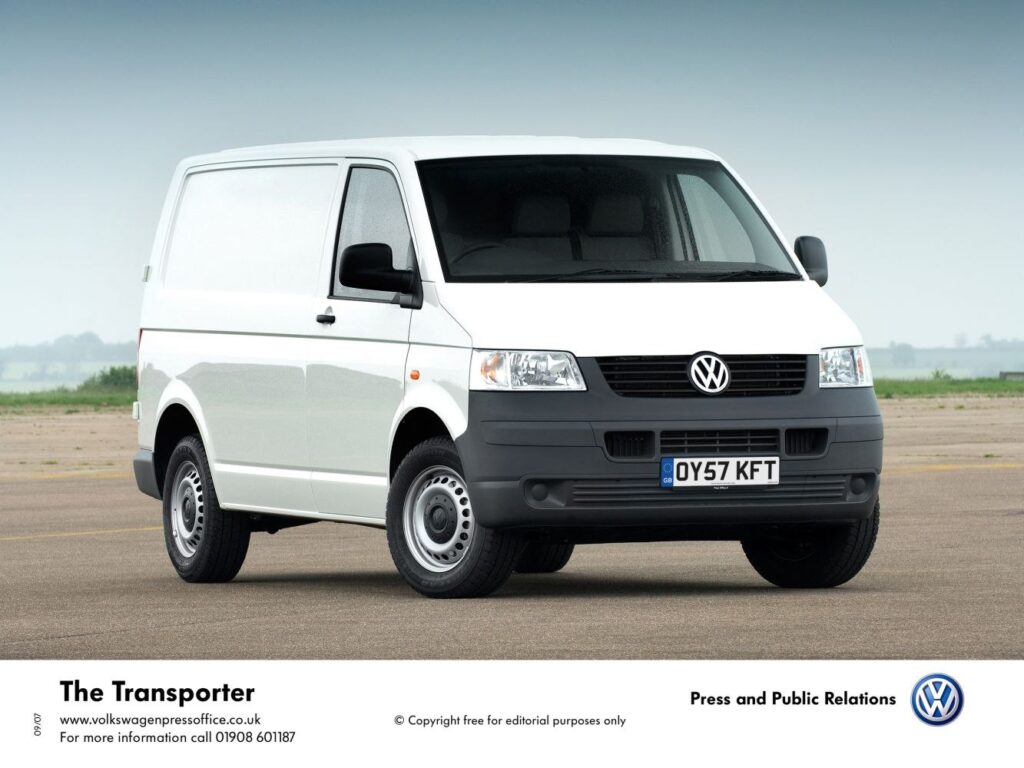
Volkswagen Transporter (T5) Panel Van 2.5 TDI (174 Hp) L2H1: A European Commercial Icon
The Volkswagen Transporter (T5) Panel Van 2.5 TDI (174 Hp) L2H1 represents a significant chapter in the storied history of Volkswagen’s commercial vehicle lineage. Introduced in 2003, the T5 generation continued the legacy of its highly successful predecessors, establishing itself as a dominant force in the light commercial vehicle (LCV) segment across Europe and other international markets. While not a primary offering in the United States, where the larger Sprinter (a joint venture with Daimler) or smaller Caddy vans might be seen, the Transporter series, often affectionately known as the “Bus” or “Kombi” in its passenger variants, holds an iconic status globally. This specific variant, the L2H1 panel van with the potent 2.5-liter TDI engine, was engineered to blend robust utility with respectable performance and efficiency, catering to a wide array of business and trade applications. Its production ran from 2003 to 2006 for this particular engine configuration, cementing its reputation as a reliable workhorse during its tenure.
Engine and Performance of the Volkswagen Transporter (T5) Panel Van 2.5 TDI (174 Hp) L2H1
At the heart of this formidable commercial vehicle was Volkswagen’s highly regarded 2.5-liter TDI (Turbocharged Direct Injection) engine, designated with the internal code EA153 / AXE. This five-cylinder inline diesel powerplant was a marvel of engineering for its time, designed to deliver a compelling balance of power, torque, and fuel economy crucial for commercial operations. With a displacement of 2460 cubic centimeters (approximately 150.12 cubic inches), the engine produced a robust 174 horsepower at 3500 rpm. More importantly for a utility vehicle, it generated a substantial 295.02 lb.-ft. of torque, available across a practical rev range of 2000-2300 rpm. This broad torque band ensured strong pulling power, essential for hauling heavy loads or navigating challenging terrain.
The engine’s advanced fuel injection system utilized pump-nozzle (unit injector) technology, which allowed for precise fuel delivery and improved combustion efficiency. Coupled with a turbocharger and intercooler, the engine’s aspiration system ensured optimal power output while maintaining thermal efficiency. Power was channeled to the front wheels via a smooth and durable 6-speed manual transmission, offering drivers precise control and the ability to optimize gear selection for varying load and road conditions.
Performance figures for the Volkswagen Transporter (T5) Panel Van 2.5 TDI (174 Hp) L2H1 were impressive for a vehicle of its class. It could accelerate from 0 to 60 mph in a swift 11.6 seconds, with a top speed reaching 116.82 mph (188 km/h). Despite its power, the Transporter was also engineered for efficiency. The extra-urban fuel consumption was rated at an economical 37.3 US mpg (6.3 l/100 km), a significant factor for businesses looking to minimize operational costs. Adhering to the Euro 3 emission standard, it reflected the prevailing environmental regulations of its early 2000s production window. The robust powertrain architecture, driving the front wheels, contributed to predictable handling and improved traction under various conditions.
Design and Features
The T5 generation of the Transporter introduced a more contemporary and aerodynamic design compared to its predecessors, while retaining the functional and utilitarian aesthetics expected of a commercial van. This specific variant, the L2H1, signifies a Long wheelbase (L2) and a Standard roof height (H1), providing an optimal balance between maneuverability and cargo capacity. With an overall length of 208.27 inches, a width of 74.96 inches (88.27 inches including mirrors), and a height of 77.13 inches, the T5 L2H1 offered a generous footprint for commercial operations. Its substantial 133.86-inch wheelbase contributed to a stable ride, even when fully loaded.
As a panel van, the primary focus of its design was practicality and cargo versatility. The interior provided seating for 2-3 occupants, emphasizing the driver and crew, while the rear section was dedicated entirely to cargo. The maximum trunk (boot) space was an impressive 6700 liters (236.61 cubic feet), allowing for the transport of substantial volumes of goods or equipment. The van’s design incorporated a durable body type with 4-5 doors, typically including a sliding side door for easy access to the cargo area in confined spaces and rear barn doors or a tailgate.
Key features of the T5 Transporter reflected its role as a modern work vehicle. Safety was addressed with the inclusion of an Anti-lock Braking System (ABS) as a standard assisting system, providing improved control during emergency braking. The steering system utilized a hydraulic rack and pinion setup, ensuring responsive and predictable handling even with heavy loads. The suspension system was designed for both comfort and load-bearing capability, featuring an independent McPherson strut setup with coil springs and an anti-roll bar at the front, and an independent coil spring system with a transverse stabilizer and trailing arms at the rear. This sophisticated suspension ensured a relatively comfortable ride for occupants and stable handling characteristics. Braking performance was robust, with ventilated discs on both the front (308×29.5 mm) and rear (294×22 mm) axles. The vehicle rode on 215/65 R16 tires mounted on 6.5J x 16 wheel rims, providing a good balance of load capacity and ride quality.
Technical Specifications for the Volkswagen Transporter (T5) Panel Van 2.5 TDI (174 Hp) L2H1
| Specification | Value |
|---|---|
| Brand | Volkswagen |
| Model | Transporter |
| Generation | Transporter (T5) Panel Van |
| Type (Engine) | 2.5 TDI (174 Hp) L2H1 |
| Start of Production | 2003 |
| End of Production | 2006 |
| Powertrain Architecture | Internal Combustion engine |
| Body Type | Van |
| Seats | 2-3 |
| Doors | 4-5 |
| Performance Specifications | |
| Fuel Consumption (Extra Urban) | 37.3 US mpg (6.3 l/100 km) |
| Fuel Type | Diesel |
| Acceleration 0-60 mph | 11.6 seconds |
| Maximum Speed | 116.82 mph (188 km/h) |
| Emission Standard | Euro 3 |
| Weight-to-Power Ratio | 10.9 kg/Hp (91.3 Hp/tonne) |
| Weight-to-Torque Ratio | 4.8 kg/Nm (210 Nm/tonne) |
| Engine Specifications | |
| Power | 174 Hp @ 3500 rpm |
| Power per Liter | 70.7 Hp/l |
| Torque | 295.02 lb.-ft. @ 2000-2300 rpm (400 Nm) |
| Engine Layout | Front, Transverse |
| Engine Model/Code | EA153 / AXE |
| Engine Displacement | 150.12 cu. in. (2460 cm³) |
| Number of Cylinders | 5 |
| Engine Configuration | Inline |
| Cylinder Bore | 3.19 in. (81 mm) |
| Piston Stroke | 3.76 in. (95.5 mm) |
| Compression Ratio | 18.5:1 |
| Number of Valves per Cylinder | 2 |
| Fuel Injection System | Pump-nozzle (Unit Injector) |
| Engine Aspiration | Turbocharger, Intercooler |
| Valvetrain | SOHC |
| Engine Oil Capacity | 7.82 US qt (7.4 l) |
| Coolant Capacity | 7.5 US qt (7.1 l) |
| Space, Volume, and Weights | |
| Kerb Weight | 4199.81 – 4717.89 lbs. (1905-2140 kg) |
| Max. Weight (GVWR) | 6172.94 – 7054.79 lbs. (2800-3200 kg) |
| Max Load | 1973.14 – 2336.9 lbs. (895-1060 kg) |
| Trunk (Boot) Space – Maximum | 236.61 cu. ft. (6700 l) |
| Fuel Tank Capacity | 21.13 US gal (80 l) |
| Max. Roof Load | 220.46 lbs. (100 kg) |
| Permitted Trailer Load with Brakes (8%) | 5511.56 lbs. (2500 kg) |
| Permitted Trailer Load with Brakes (12%) | 5511.56 lbs. (2500 kg) |
| Permitted Trailer Load without Brakes | 1653.47 lbs. (750 kg) |
| Permitted Towbar Download | 220.46 lbs. (100 kg) |
| Dimensions | |
| Length | 208.27 in. (5290 mm) |
| Width | 74.96 in. (1904 mm) |
| Width Including Mirrors | 88.27 in. (2242 mm) |
| Height | 77.13 in. (1959 mm) |
| Wheelbase | 133.86 in. (3400 mm) |
| Front Track | 64.09 in. (1628 mm) |
| Rear (Back) Track | 64.09 in. (1628 mm) |
| Front Overhang | 35.2 in. (894 mm) |
| Rear Overhang | 39.21 in. (996 mm) |
| Ride Height (Ground Clearance) | 6.5 in. (165 mm) |
| Minimum Turning Circle (Turning Diameter) | 43.31 ft. (13.2 m) |
| Approach Angle | 22° |
| Departure Angle | 16° |
| Wading Depth | 11.81 in. (300 mm) |
| Drivetrain, Brakes, and Suspension Specifications | |
| Drivetrain Architecture | Front wheel drive, Internal Combustion Engine |
| Drive Wheel | Front-wheel drive |
| Number of Gears and Type of Gearbox | 6 gears, manual transmission |
| Front Suspension | Independent, McPherson type with coil spring and anti-roll bar |
| Rear Suspension | Independent coil spring, Transverse stabilizer, Trailing arm |
| Front Brakes | Ventilated discs, 12.13 x 1.16 in. (308×29.5 mm) |
| Rear Brakes | Ventilated discs, 11.57 x 0.87 in. (294×22 mm) |
| Assisting Systems | ABS (Anti-lock braking system) |
| Steering Type | Steering rack and pinion |
| Power Steering | Hydraulic Steering |
| Tires Size | 215/65 R16 |
| Wheel Rims Size | 6.5J x 16 |
Legacy and Market Impact
The Volkswagen Transporter T5, and particularly its robust commercial variants like the Volkswagen Transporter (T5) Panel Van 2.5 TDI (174 Hp) L2H1, carved out a significant legacy as a benchmark in the European light commercial vehicle market. Its reputation was built on a foundation of reliability, versatility, and efficiency, making it a favored choice for small businesses, delivery services, tradespeople, and even as a base for various conversions, including campers and specialized service vehicles. The T5 continued the Transporter’s tradition of being a true workhorse, capable of enduring demanding daily use while providing a relatively comfortable and car-like driving experience for its class.
In its primary markets, the T5 faced stiff competition from other established players in the van segment. Key rivals included the Mercedes-Benz Vito, Ford Transit, Renault Trafic, and Fiat Ducato. However, the Transporter consistently held its own, often being lauded for its build quality, the strength and efficiency of its TDI engines, and its strong residual values. The 2.5 TDI with 174 horsepower was particularly well-regarded for its ability to handle heavy loads with ease, making it a popular choice for those requiring maximum pulling power and consistent performance.
The T5’s historical significance lies in its evolution of a beloved and iconic vehicle family. It successfully modernized the Transporter concept, introducing improved safety features, more refined driving dynamics, and enhanced ergonomics while retaining the core utility that defined its predecessors. It bridged the gap between a purely utilitarian commercial vehicle and one that offered a degree of driver comfort and technological advancement. Its enduring presence on European roads, even years after the end of its production, is a testament to its robust engineering and the trust it garnered from countless businesses and individuals. The T5 generation solidified the Transporter’s position not just as a practical tool, but as an integral part of the European automotive landscape, embodying reliability and versatility in the commercial sector.