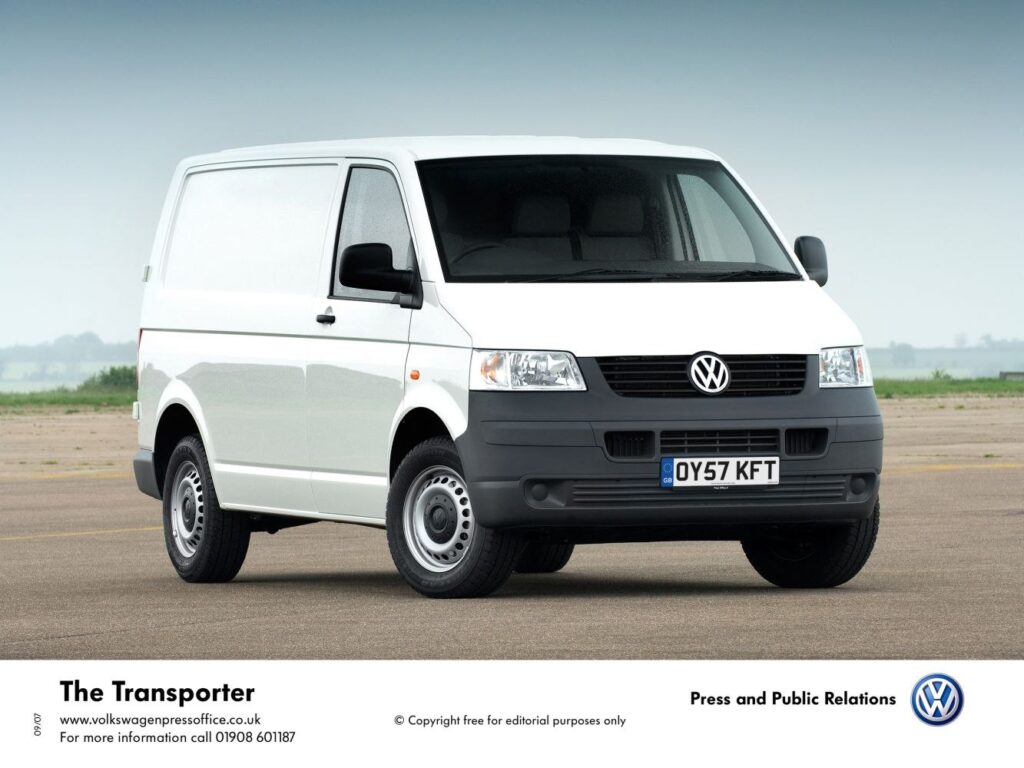
Volkswagen Transporter (T5) Panel Van 2.5 TDI (174 Hp) Tiptronic L2H2: A European Workhorse Defined
The Volkswagen Transporter, a name synonymous with versatility and robust utility across the globe, particularly in Europe, entered its fifth generation (T5) in 2003. Among its many configurations, the Volkswagen Transporter (T5) Panel Van 2.5 TDI (174 Hp) Tiptronic L2H2 stood out as a highly capable and efficient light commercial vehicle (LCV). Produced from 2003 to 2006 in this specific powertrain and body style, this variant epitomized Volkswagen’s commitment to delivering reliable, comfortable, and powerful solutions for businesses and individuals requiring substantial cargo capacity and a refined driving experience. While not officially sold in the United States market, where larger, truck-based vans historically dominated, the T5 Transporter carved out an immense niche in its primary European and international markets, becoming a ubiquitous sight on city streets and highways.
This particular L2H2 (Long Wheelbase, High Roof) configuration, coupled with the potent 2.5-liter TDI engine and Tiptronic automatic transmission, represented a premium offering within the T5 range. It was designed to tackle demanding commercial tasks, from delivery services to trades, offering impressive payload capabilities, generous cargo volume, and a level of driving dynamics and comfort often associated with passenger cars. Its sophisticated powertrain architecture, featuring an internal combustion engine driving the front wheels, contributed to both efficiency and predictable handling, making it a favorite among professionals who spent long hours behind the wheel.
Engine and Performance: Powering the Volkswagen Transporter (T5) Panel Van
At the heart of this formidable commercial vehicle was Volkswagen’s renowned 2.5-liter TDI (Turbocharged Direct Injection) engine. This inline 5-cylinder diesel unit, with an engine displacement of 2460 cubic centimeters (150.12 cubic inches), was engineered for durability, efficiency, and substantial torque output. It generated a robust 174 horsepower at 3500 rpm, a significant figure for a panel van of its era, ensuring ample power for hauling heavy loads and maintaining highway speeds. Even more impressive was its torque output: a colossal 295.02 lb.-ft. (400 Nm), available across a broad rev range from 2000 to 2300 rpm. This low-end torque was crucial for easy starts, strong acceleration under load, and effortless cruising, mitigating the need for frequent gear changes.
The engine’s advanced technology included a turbocharger with an intercooler, optimizing air intake and combustion efficiency, and a sophisticated pump-nozzle (unit injector) fuel injection system. This system delivered precise fuel atomization directly into the cylinders, contributing to both power and the engine’s commendable fuel economy. Mated to a smooth-shifting 6-speed Tiptronic automatic transmission, the powertrain offered a refined driving experience, a notable advantage over many manual-only commercial vans. This combination allowed the Transporter to accelerate from 0 to 60 mph in a respectable 11.8 seconds, with a maximum speed of nearly 110 mph (177 km/h), demonstrating its capability beyond mere utility. Despite its power, the 2.5 TDI was also relatively efficient for its size, achieving an extra-urban fuel consumption rating of approximately 35.1 US mpg (6.7 l/100 km), aligning with the Euro 3 emission standard prevalent during its production years.
Design and Features: Maximizing Utility and Comfort
The Volkswagen Transporter (T5) Panel Van 2.5 TDI L2H2 was a masterclass in functional design, prioritizing cargo capacity and driver ergonomics. As a panel van, its primary function was to transport goods, and the L2H2 designation highlighted its long wheelbase (133.86 inches or 3400 mm) and high roof (85.04 inches or 2160 mm), which together provided an immense maximum cargo volume of 275.45 cubic feet (7800 liters). This cavernous space was easily accessible via multiple doors, typically including a large sliding side door and rear barn doors, making loading and unloading efficient even in tight urban environments.
With seating for 2 to 3 occupants, the cabin was designed to be a functional workspace. While details on specific interior features are not exhaustive, Volkswagen was known for its high-quality materials and thoughtful layouts, even in its commercial vehicles. Drivers benefited from a hydraulic power steering system, offering precise control and reduced fatigue, essential for long working days. Safety features included an Anti-lock Braking System (ABS) as standard, complementing the robust braking system comprising 308×29.5 mm ventilated discs at the front and 294×22 mm ventilated discs at the rear. The independent suspension system, featuring McPherson struts with coil springs and an anti-roll bar at the front, and independent coil springs with a transverse stabilizer and trailing arm at the rear, provided a remarkably comfortable and stable ride for a commercial vehicle, even when fully loaded. The vehicle rode on 215/65 R16 tires fitted to 6.5J x 16 wheel rims, providing a good balance of load-bearing capacity and ride quality.
Technical Specifications
| Feature | Specification |
|---|---|
| Brand | Volkswagen |
| Model | Transporter |
| Generation | Transporter (T5) Panel Van |
| Type (Engine) | 2.5 TDI (174 Hp) Tiptronic L2H2 |
| Start of Production | 2003 year |
| End of Production | 2006 year |
| Powertrain Architecture | Internal Combustion engine |
| Body Type | Van |
| Seats | 2-3 |
| Doors | 4-5 |
| Fuel Consumption (extra urban) | 35.1 US mpg (6.7 l/100 km) |
| Fuel Type | Diesel |
| Acceleration 0 – 60 mph | 11.8 seconds |
| Maximum Speed | 109.98 mph (177 km/h) |
| Emission Standard | Euro 3 |
| Weight-to-Power Ratio | 11.1 kg/Hp, 89.9 Hp/tonne |
| Weight-to-Torque Ratio | 4.8 kg/Nm, 206.7 Nm/tonne |
| Power | 174 Hp @ 3500 rpm |
| Power per Liter | 70.7 Hp/l |
| Torque | 295.02 lb.-ft. (400 Nm) @ 2000-2300 rpm |
| Engine Layout | Front, Transverse |
| Engine Model/Code | EA153 / AXE |
| Engine Displacement | 2460 cm3 (150.12 cu. in.) |
| Number of Cylinders | 5 |
| Engine Configuration | Inline |
| Cylinder Bore | 3.19 in. (81 mm) |
| Piston Stroke | 3.76 in. (95.5 mm) |
| Compression Ratio | 18.5:1 |
| Number of Valves per Cylinder | 2 |
| Fuel Injection System | Pump-nozzle (Unit Injector) |
| Engine Aspiration | Turbocharger, Intercooler |
| Valvetrain | SOHC |
| Engine Oil Capacity | 7.82 US qt (7.4 l) |
| Coolant Capacity | 7.5 US qt (7.1 l) |
| Kerb Weight | 4265.94 – 4784.03 lbs. (1935-2170 kg) |
| Max. Weight (GVWR) | 6172.94 – 7054.79 lbs. (2800-3200 kg) |
| Max Load | 1907 – 2270.76 lbs. (865-1030 kg) |
| Trunk (Boot) Space – maximum | 275.45 cu. ft. (7800 l) |
| Fuel Tank Capacity | 21.13 US gal (80 l) |
| Permitted Trailer Load with Brakes (8%) | 5511.56 lbs. (2500 kg) |
| Permitted Trailer Load with Brakes (12%) | 5511.56 lbs. (2500 kg) |
| Permitted Trailer Load without Brakes | 1653.47 lbs. (750 kg) |
| Permitted Towbar Download | 220.46 lbs. (100 kg) |
| Length | 208.27 in. (5290 mm) |
| Width | 74.96 in. (1904 mm) |
| Width including Mirrors | 88.27 in. (2242 mm) |
| Height | 85.04 in. (2160 mm) |
| Wheelbase | 133.86 in. (3400 mm) |
| Front Track | 64.09 in. (1628 mm) |
| Rear (Back) Track | 64.09 in. (1628 mm) |
| Front Overhang | 35.2 in. (894 mm) |
| Rear Overhang | 39.21 in. (996 mm) |
| Ride Height (Ground Clearance) | 6.5 in. (165 mm) |
| Minimum Turning Circle (Turning Diameter) | 43.31 ft. (13.2 m) |
| Approach Angle | 22° |
| Departure Angle | 16° |
| Wading Depth | 11.81 in. (300 mm) |
| Drivetrain Architecture | The Internal combustion engine (ICE) drives the front wheels of the vehicle. |
| Drive Wheel | Front wheel drive |
| Number of Gears and Type of Gearbox | 6 gears, automatic transmission Tiptronic |
| Front Suspension | Independent, type McPherson with coil spring and anti-roll bar |
| Rear Suspension | Independent coil spring, Transverse stabilizer, Trailing arm |
| Front Brakes | Ventilated discs, 308×29.5 mm |
| Rear Brakes | Ventilated discs, 294×22 mm |
| Assisting Systems | ABS (Anti-lock braking system) |
| Steering Type | Steering rack and pinion |
| Power Steering | Hydraulic Steering |
| Tires Size | 215/65 R16 |
| Wheel Rims Size | 6.5J x 16 |
Legacy and Market Impact of the Volkswagen Transporter (T5) Panel Van
The Volkswagen Transporter (T5) Panel Van, particularly in its powerful 2.5 TDI Tiptronic L2H2 configuration, solidified its position as a dominant force in the European light commercial vehicle market. Building upon a heritage stretching back to the original Type 2 “Bus,” the T5 continued the Transporter’s legacy of reliability, build quality, and incredible versatility. It was not merely a utilitarian box on wheels; it was a sophisticated tool for businesses, a comfortable long-distance hauler, and a robust platform for countless conversions, including camper vans, passenger shuttles (Multivan, Caravelle), and specialized service vehicles.
Its reputation for German engineering excellence translated into strong residual values and a loyal customer base. In a highly competitive segment, the T5 Transporter faced formidable rivals such as the Mercedes-Benz Vito, Ford Transit Custom (though the Custom’s direct competitor would arrive later in the T5’s lifecycle), Renault Trafic, and Opel Vivaro. However, the T5 distinguished itself with its car-like driving dynamics, superior interior refinement, and a comprehensive range of powerful yet efficient engines, with the 2.5 TDI being a standout performer.
The T5 generation marked a significant evolution for the Transporter line, introducing more advanced safety features, enhanced comfort, and more modern styling compared to its T4 predecessor. Its impact was profound, setting benchmarks for what a mid-size commercial van could offer in terms of performance, payload, and driver experience. For many European businesses, the Transporter was an indispensable partner, a testament to its enduring design and engineering prowess. Even today, many T5s remain in active service, a clear indicator of their durability and the lasting impression they made on the commercial vehicle landscape.