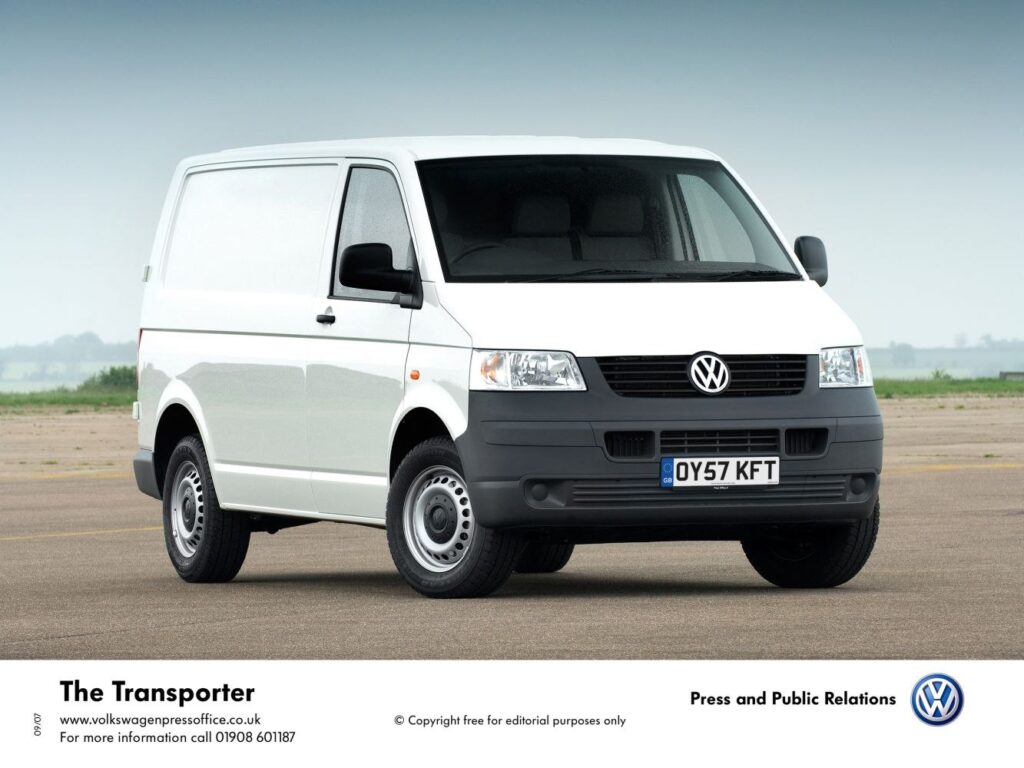
Volkswagen Transporter (T5) Panel Van 3.2 V6 (235 Hp) 4MOTION L1H2
The Volkswagen Transporter, an iconic nameplate in the light commercial vehicle (LCV) segment, continued its legacy with the fifth-generation model, internally designated as the T5. Produced from 2003 to 2009, the T5 series built upon decades of robust engineering and utilitarian design, cementing its position as a versatile workhorse across Europe and beyond. Among its many configurations, the Volkswagen Transporter (T5) Panel Van 3.2 V6 (235 Hp) 4MOTION L1H2 stands out as a particularly potent and capable variant, blending impressive power, advanced all-wheel-drive technology, and substantial cargo capacity. While the Transporter series has never been a mainstream offering in the North American market since the discontinuation of the T4 EuroVan, its global impact, especially in Europe, is undeniable. This specific L1H2 panel van model, with its powerful gasoline V6 engine and sophisticated 4MOTION system, offered a unique blend of performance, traction, and practicality for demanding commercial applications, heavy towing, or even specialized conversions.
Engine and Performance
At the heart of this formidable panel van was Volkswagen’s 3.2-liter VR6 engine, a compact six-cylinder powerhouse known for its smooth operation and strong torque delivery. This naturally aspirated unit, identified by engine codes like EA390 or BKK, was transversely mounted at the front, a common configuration for the T5. With a displacement of 3189 cm3 (194.6 cu. in.), it produced a robust 235 horsepower at 6200 rpm. This was a significant output for a commercial van of its time, translating to a power-per-liter ratio of 73.7 HP/l.
Torque figures were equally impressive, peaking at 232.33 lb.-ft. (315 Nm) at a relatively low 2950 rpm. This generous torque curve was crucial for a vehicle designed to carry heavy loads or tow substantial trailers, allowing for confident acceleration and sustained cruising even under demanding conditions. The engine featured a DOHC (Double Overhead Camshaft) valvetrain with four valves per cylinder and a multi-port manifold injection system, ensuring efficient fuel delivery and combustion. Its compression ratio of 10.85:1 further contributed to its efficiency and power output.
Paired with a slick-shifting 6-speed manual transmission, the 3.2 V6 engine propelled the Transporter (T5) Panel Van to 60 mph in a swift 10.2 seconds (0-100 km/h in 10.7 seconds), and on to a top speed of 124.27 mph (200 km/h). These performance figures are more akin to a passenger car than a commercial utility vehicle, underscoring the “sporty” potential of this particular Transporter variant. Fuel economy, while not the primary focus for such a powerful gasoline engine in a commercial vehicle, was rated at 23.8 US mpg (9.9 l/100 km) in extra-urban driving, respectable for its class and power output. The vehicle met the Euro 4 emission standard, reflecting its compliance with European environmental regulations of the mid-2000s.
A defining feature of this Transporter was its 4MOTION all-wheel-drive system. This sophisticated drivetrain architecture typically operated with permanent front-wheel drive, engaging the rear wheels via an electrically or mechanically operated clutch when slippage was detected or additional traction was required. This provided superior grip in adverse weather conditions, on unpaved roads, or when launching with a heavy load, significantly enhancing the vehicle’s versatility and safety. The combination of the powerful V6 engine and 4MOTION made this T5 variant an exceptionally capable choice for tradespeople operating in challenging environments, or for those requiring maximum towing capacity and stability.
Design and Features
The Volkswagen Transporter (T5) Panel Van maintained the familiar, functional, and clean design language characteristic of the Transporter lineage. As a panel van, its primary purpose was cargo transport, and its L1H2 designation indicated a standard length (L1) with a high roof (H2), maximizing internal volume for goods. The vehicle featured 4 to 5 doors, typically including large sliding side doors and rear barn doors or a tailgate, facilitating easy loading and unloading. The cabin was designed for utility and durability, offering seating for 2 to 3 occupants, depending on the configuration.
Dimensions for the L1H2 variant included a length of 192.52 inches (4890 mm), a width of 74.96 inches (1904 mm, or 88.27 inches/2242 mm including mirrors), and a substantial height of 85.43 inches (2170 mm). The generous 118.11-inch (3000 mm) wheelbase contributed to a stable ride and excellent cargo distribution. With a maximum cargo volume of 236.61 cubic feet (6700 liters) and a maximum payload capacity of 1697.56 lbs (770 kg), the T5 Panel Van was well-equipped to handle a wide array of commercial tasks. Its kerb weight ranged from 4475.38 lbs (2030 kg) to 4916.31 lbs (2230 kg), with a maximum permissible gross weight of 6172.94 lbs (2800 kg) to 6613.87 lbs (3000 kg).
Underneath, the T5 featured an advanced independent suspension setup for both front and rear axles, a departure from the more rudimentary leaf-spring setups found on some competitors. The front utilized a McPherson strut design with coil springs and an anti-roll bar, while the rear employed an independent coil spring system with a transverse stabilizer and trailing arms. This sophisticated suspension provided car-like handling and ride comfort, reducing driver fatigue on long journeys and improving vehicle control, especially when loaded. Braking was handled by large ventilated discs at both the front (333×32.5 mm) and rear (294×22 mm), complemented by an Anti-lock Braking System (ABS) for enhanced safety and control during emergency stops. Hydraulic rack and pinion steering provided precise feedback and effortless maneuverability, aided by a relatively tight minimum turning circle of 39.04 feet (11.9 m). The van rode on 235/55 R17 tires mounted on 7J x 17-inch wheel rims, providing ample grip and stability.
Further demonstrating its robust capabilities, the Transporter (T5) Panel Van 3.2 V6 4MOTION was rated for significant towing. It could handle a permitted trailer load with brakes of 5511.56 lbs (2500 kg) and a trailer load without brakes of 1653.47 lbs (750 kg), with a permitted towbar download of 220.46 lbs (100 kg). Its ground clearance of 6.5 inches (165 mm), along with approach, departure, and ramp-over angles of 22°, 16°, and 14° respectively, and a wading depth of 11.81 inches (300 mm), underscored its ability to tackle moderately challenging terrain, particularly with the benefit of 4MOTION.
Technical Specifications
| Category | Specification | Value |
|---|---|---|
| General Information | ||
| Brand | Volkswagen | |
| Model | Transporter | |
| Generation | Transporter (T5) Panel Van | |
| Type (Engine) | 3.2 V6 (235 Hp) 4MOTION L1H2 | |
| Start of production | 2003 year | |
| End of production | 2009 year | |
| Powertrain Architecture | Internal Combustion engine | |
| Body type | Van | |
| Seats | 2-3 | |
| Doors | 4-5 | |
| Performance Specifications | ||
| Fuel consumption (economy) – extra urban | 9.9 l/100 km (23.8 US mpg) | |
| Fuel Type | Petrol (Gasoline) | |
| Acceleration 0 – 60 mph | 10.2 sec | |
| Acceleration 0 – 100 km/h | 10.7 sec | |
| Maximum speed | 200 km/h (124.27 mph) | |
| Emission standard | Euro 4 | |
| Weight-to-power ratio | 8.6 kg/Hp (115.8 Hp/tonne) | |
| Weight-to-torque ratio | 6.4 kg/Nm (155.2 Nm/tonne) | |
| Engine Specifications | ||
| Power | 235 Hp @ 6200 rpm. | |
| Power per liter | 73.7 Hp/l | |
| Torque | 315 Nm @ 2950 rpm (232.33 lb.-ft. @ 2950 rpm) | |
| Engine layout | Front, Transverse | |
| Engine Model/Code | EA390 / BKK | |
| Engine displacement | 3189 cm3 (3.2 l / 194.6 cu. in.) | |
| Number of cylinders | 6 | |
| Engine configuration | VR-engine | |
| Cylinder Bore | 84 mm (3.31 in.) | |
| Piston Stroke | 95.9 mm (3.78 in.) | |
| Compression ratio | 10.85:1 | |
| Number of valves per cylinder | 4 | |
| Fuel injection system | Multi-port manifold injection | |
| Engine aspiration | Naturally aspirated engine | |
| Valvetrain | DOHC | |
| Engine oil capacity | 6.1 l (6.45 US qt) | |
| Coolant | 7.1 l (7.5 US qt) | |
| Space, Volume and Weights | ||
| Kerb Weight | 2030-2230 kg (4475.38 – 4916.31 lbs) | |
| Max. weight | 2800-3000 kg (6172.94 – 6613.87 lbs) | |
| Max load | 770 kg (1697.56 lbs) | |
| Trunk (boot) space – maximum | 6700 l (236.61 cu. ft.) | |
| Fuel tank capacity | 80 l (21.13 US gal) | |
| Permitted trailer load with brakes (8%) | 2500 kg (5511.56 lbs) | |
| Permitted trailer load with brakes (12%) | 2500 kg (5511.56 lbs) | |
| Permitted trailer load without brakes | 750 kg (1653.47 lbs) | |
| Permitted towbar download | 100 kg (220.46 lbs) | |
| Dimensions | ||
| Length | 4890 mm (192.52 in.) | |
| Width | 1904 mm (74.96 in.) | |
| Width including mirrors | 2242 mm (88.27 in.) | |
| Height | 2170 mm (85.43 in.) | |
| Wheelbase | 3000 mm (118.11 in.) | |
| Front track | 1620 mm (63.78 in.) | |
| Rear (Back) track | 1620 mm (63.78 in.) | |
| Front overhang | 894 mm (35.2 in.) | |
| Rear overhang | 996 mm (39.21 in.) | |
| Ride height (ground clearance) | 165 mm (6.5 in.) | |
| Minimum turning circle (turning diameter) | 11.9 m (39.04 ft.) | |
| Approach angle | 22° | |
| Departure angle | 16° | |
| Ramp-over (brakeover) angle | 14° | |
| Wading depth | 300 mm (11.81 in.) | |
| Drivetrain, Brakes and Suspension Specifications | ||
| Drivetrain Architecture | The Internal combustion engine (ICE) drives the front wheels permanently, and the rear wheels are driven through an electrically or mechanically operated clutch if necessary. | |
| Drive wheel | All wheel drive (4×4) | |
| Number of gears and type of gearbox | 6 gears, manual transmission | |
| Front suspension | Independent, type McPherson with coil spring and anti-roll bar | |
| Rear suspension | Independent coil spring, Transverse stabilizer, Trailing arm | |
| Front brakes | Ventilated discs, 333×32.5 mm | |
| Rear brakes | Ventilated discs, 294×22 mm | |
| Assisting systems | ABS (Anti-lock braking system) | |
| Steering type | Steering rack and pinion | |
| Power steering | Hydraulic Steering | |
| Tires size | 235/55 R17 | |
| Wheel rims size | 7J x 17 | |
Legacy and Market Impact
The Volkswagen Transporter T5, and particularly its powerful 3.2 V6 4MOTION variant, carved out a significant niche in the European commercial vehicle market. It continued the Transporter’s reputation as a highly reliable, durable, and versatile vehicle, capable of serving a vast range of commercial needs, from small businesses and tradespeople to larger fleet operations. Its car-like driving dynamics, thanks to its sophisticated independent suspension and refined powertrains, set it apart from many competitors that often prioritized sheer robustness over driving comfort.
In its primary market, the Transporter (T5) competed fiercely with rivals such as the Mercedes-Benz Vito, Ford Transit, Renault Trafic, and Fiat Ducato. What distinguished the T5, especially the 3.2 V6 4MOTION, was its unique blend of power, all-weather capability, and premium feel. While many competitors offered diesel engines as their workhorse options, the gasoline V6 provided a smoother, quieter, and more powerful alternative, appealing to customers who valued performance, refinement, or operated in regions where diesel was less favored. The