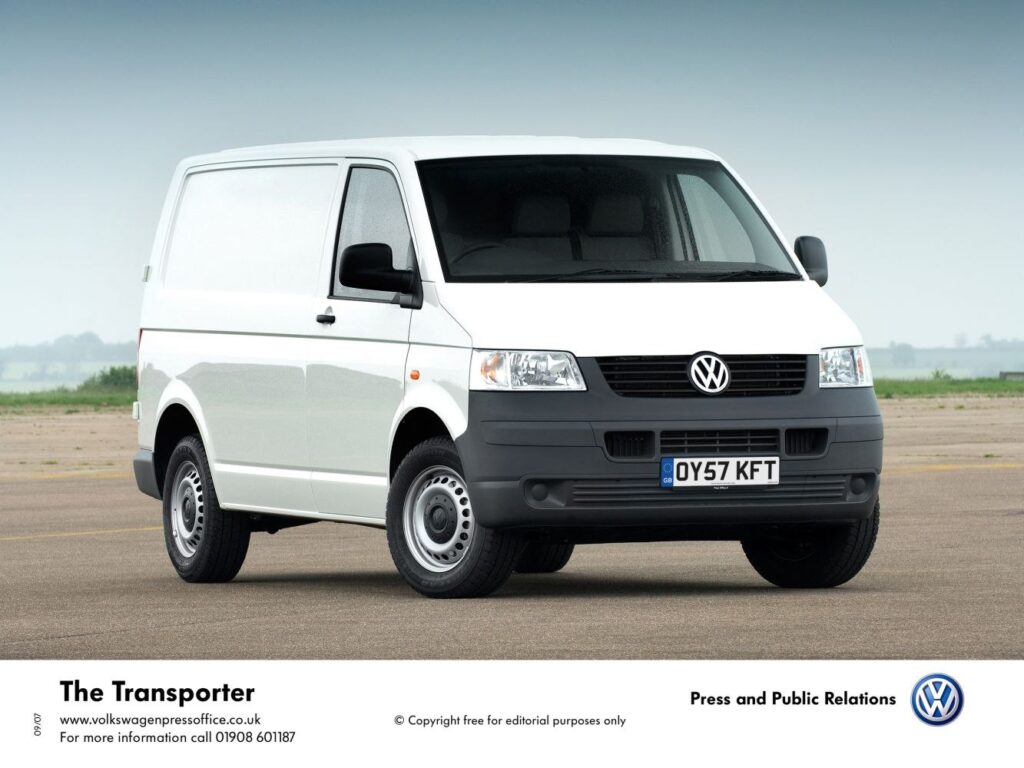
Volkswagen Transporter (T5) Panel Van 3.2 V6 (235 Hp) 4MOTION L2H3: A Powerful Workhorse
The Volkswagen Transporter, a name synonymous with versatility and utility in the commercial vehicle sector, entered its fifth generation, known as the T5, in 2003. Building on a heritage stretching back to the iconic Type 2 “Bus,” the T5 continued to define the segment with its blend of practicality, robust engineering, and car-like driving dynamics. While the Transporter line offered a wide array of configurations, from passenger-focused Caravelle and Multivan models to various cargo vans, the Volkswagen Transporter (T5) Panel Van 3.2 V6 (235 Hp) 4MOTION L2H3 represented a particularly potent and capable variant. This specific model, produced from 2003 to 2009, was designed for demanding commercial applications, combining a powerful gasoline engine with Volkswagen’s acclaimed 4MOTION all-wheel-drive system in a long-wheelbase, high-roof panel van body.
Primarily targeted at the European and international markets, where commercial vans play a crucial role in logistics and various trades, this T5 variant was not typically sold in the United States. However, its engineering prowess and specifications translate directly into US terminology, showcasing a vehicle built for significant hauling capacity, all-weather performance, and a surprising level of power for its segment. The L2H3 designation indicates a long wheelbase (L2) and a high roof (H3), maximizing cargo volume and making it suitable for a wide range of professional uses, from delivery services to mobile workshops.
Engine and Performance: The Heart of the Volkswagen Transporter (T5) Panel Van 3.2 V6 (235 Hp) 4MOTION L2H3
At the core of this formidable panel van was Volkswagen’s 3.2-liter VR6 engine, a compact and sophisticated naturally aspirated gasoline unit. This particular engine, with the internal code EA390 / BKK, was known for its smooth power delivery and distinctive sound. It produced a robust 235 horsepower at 6200 rpm and 232.33 lb.-ft. of torque at a relatively low 2950 rpm. This power output was exceptional for a commercial van of its era, providing ample muscle for accelerating with heavy loads, maintaining highway speeds, and confidently tackling inclines.
The VR6 engine’s configuration, with its narrow V-angle, allowed for a more compact design than a traditional V6, enabling it to fit transversely in the Transporter’s engine bay. Featuring a DOHC (Double Overhead Camshaft) valvetrain and multi-port manifold injection, the engine was designed for efficiency and responsiveness. Its compression ratio of 10.85:1 further optimized performance. For a vehicle with a curb weight ranging from 5026.54 to 5474.08 pounds, the 3.2-liter V6 delivered a respectable 0-60 mph acceleration time of 10.4 seconds and a top speed of 118.68 mph, figures more commonly associated with passenger cars than large utility vehicles.
The powertrain was mated to a durable 6-speed manual transmission, offering the driver precise control over the engine’s power band and optimal gear selection for various driving conditions and loads. A standout feature was the 4MOTION all-wheel-drive system. This sophisticated drivetrain architecture primarily drove the front wheels, engaging the rear wheels via an electrically or mechanically operated clutch only when additional traction was needed. This intelligent system provided enhanced grip and stability, crucial for operating in adverse weather conditions, on unpaved roads, or when towing heavy loads, significantly expanding the van’s operational capabilities beyond typical front-wheel-drive commercial vehicles.
Fuel economy for this powerful gasoline engine was rated at 10.5 liters per 100 kilometers (22.4 US mpg) in extra-urban driving, an acceptable figure given the vehicle’s size, weight, and performance capabilities. The vehicle met the Euro 4 emission standard, reflecting its compliance with European environmental regulations of the mid-2000s.
Design and Features: Utility Meets Robustness
The Volkswagen Transporter (T5) Panel Van 3.2 V6 (235 Hp) 4MOTION L2H3 was engineered first and foremost for functionality. Its L2H3 designation signified a long wheelbase (3400 mm or 133.86 inches) and a high roof (2470 mm or 97.24 inches), creating an expansive interior cargo volume of 9300 liters (328.43 cubic feet). This generous space, accessible via 4-5 doors, was ideal for businesses requiring substantial carrying capacity for goods, tools, or equipment.
The exterior design of the T5 was characterized by its clean, functional lines, reflecting Volkswagen’s commitment to practical aesthetics. Measuring 208.27 inches in length and 74.96 inches in width (88.27 inches including mirrors), the van presented a substantial footprint, ensuring stability and a commanding road presence. Despite its commercial focus, the T5 maintained a degree of refinement in its design, a hallmark of Volkswagen vehicles. The robust chassis was supported by an independent McPherson strut front suspension with coil springs and an anti-roll bar, paired with an independent coil spring rear suspension featuring a transverse stabilizer and trailing arm. This setup provided a surprisingly comfortable ride for a commercial vehicle, along with predictable handling characteristics.
Safety and control were paramount, especially for a vehicle designed to carry heavy loads. The Transporter T5 featured large ventilated disc brakes on both the front (333×32.5 mm) and rear (294×22 mm) axles, ensuring strong and consistent stopping power. An Anti-lock Braking System (ABS) was standard, enhancing braking safety by preventing wheel lock-up during hard braking. The hydraulic rack-and-pinion steering system provided precise feedback and ease of maneuverability, despite the vehicle’s size, with a minimum turning circle of 43.31 feet. The van rode on 235/55 R17 tires mounted on 7J x 17 wheel rims, providing a good balance of load-bearing capacity and road adhesion. With a ground clearance of 6.5 inches and impressive approach (22°) and departure (16°) angles, coupled with a wading depth of 11.81 inches, the 4MOTION variant was well-prepared for diverse terrains and challenging access points.
Inside, the panel van typically featured 2-3 seats, prioritizing cargo space over passenger accommodation. The cabin was designed for durability and ergonomics, with controls laid out logically for ease of use during long working hours. The maximum payload capacity ranged from 1139.79 to 1146.4 pounds, and the vehicle boasted an impressive towing capacity of 5511.56 pounds with brakes, further solidifying its credentials as a heavy-duty workhorse.
Technical Specifications
| General Information | |
| Brand | Volkswagen |
| Model | Transporter |
| Generation | Transporter (T5) Panel Van |
| Type (Engine) | 3.2 V6 (235 Hp) 4MOTION L2H3 |
| Start of Production | 2003 year |
| End of Production | 2009 year |
| Powertrain Architecture | Internal Combustion Engine |
| Body Type | Van |
| Seats | 2-3 |
| Doors | 4-5 |
| Performance Specifications | |
| Fuel Consumption (extra urban) | 10.5 l/100 km (22.4 US mpg) |
| Fuel Type | Petrol (Gasoline) |
| Acceleration 0 – 60 mph | 10.4 sec |
| Maximum Speed | 118.68 mph (191 km/h) |
| Emission Standard | Euro 4 |
| Weight-to-Power Ratio | 9.7 kg/Hp, 103.1 Hp/tonne |
| Weight-to-Torque Ratio | 7.2 kg/Nm, 138.2 Nm/tonne |
| Engine Specifications | |
| Power | 235 Hp @ 6200 rpm |
| Power per Liter | 73.7 Hp/l |
| Torque | 232.33 lb.-ft. (315 Nm) @ 2950 rpm |
| Engine Layout | Front, Transverse |
| Engine Model/Code | EA390 / BKK |
| Engine Displacement | 3189 cm3 (194.6 cu. in.) |
| Number of Cylinders | 6 |
| Engine Configuration | VR-engine |
| Cylinder Bore | 3.31 in. (84 mm) |
| Piston Stroke | 3.78 in. (95.9 mm) |
| Compression Ratio | 10.85:1 |
| Number of Valves per Cylinder | 4 |
| Fuel Injection System | Multi-port manifold injection |
| Engine Aspiration | Naturally aspirated engine |
| Valvetrain | DOHC |
| Engine Oil Capacity | 6.1 l (6.45 US qt) |
| Coolant Capacity | 7.1 l (7.5 US qt) |
| Space, Volume, and Weights | |
| Kerb Weight | 5026.54 – 5474.08 lbs. (2280-2483 kg) |
| Max. Weight (GVWR) | 6172.94 – 6613.87 lbs. (2800-3000 kg) |
| Max Load (Payload) | 1139.79 – 1146.4 lbs. (517-520 kg) |
| Trunk (Boot) Space – Maximum | 328.43 cu. ft. (9300 l) |
| Fuel Tank Capacity | 21.13 US gal (80 l) |
| Permitted Trailer Load with Brakes (8%) | 5511.56 lbs. (2500 kg) |
| Permitted Trailer Load with Brakes (12%) | 5511.56 lbs. (2500 kg) |
| Permitted Trailer Load without Brakes | 1653.47 lbs. (750 kg) |
| Permitted Towbar Download | 220.46 lbs. (100 kg) |
| Dimensions | |
| Length | 208.27 in. (5290 mm) |
| Width | 74.96 in. (1904 mm) |
| Width Including Mirrors | 88.27 in. (2242 mm) |
| Height | 97.24 in. (2470 mm) |
| Wheelbase | 133.86 in. (3400 mm) |
| Front Track | 63.78 in. (1620 mm) |
| Rear (Back) Track | 63.78 in. (1620 mm) |
| Front Overhang | 35.2 in. (894 mm) |
| Rear Overhang | 39.21 in. (996 mm) |
| Ride Height (Ground Clearance) | 6.5 in. (165 mm) |
| Minimum Turning Circle (Turning Diameter) | 43.31 ft. (13.2 m) |
| Approach Angle | 22° |
| Departure Angle | 16° |
| Wading Depth | 11.81 in. (300 mm) |
| Drivetrain, Brakes, and Suspension Specifications | |
| Drivetrain Architecture | ICE drives front wheels permanently; rear wheels driven via electrically/mechanically operated clutch if necessary. |
| Drive Wheel | All-wheel drive (4×4) |
| Number of Gears and Type of Gearbox | 6 gears, manual transmission |
| Front Suspension | Independent, McPherson with coil spring and anti-roll bar |
| Rear Suspension | Independent coil spring, Transverse stabilizer, Trailing arm |
| Front Brakes | Ventilated discs, 333×32.5 mm |
| Rear Brakes | Ventilated discs, 294×22 mm |
| Assisting Systems | ABS (Anti-lock Braking System) |
| Steering Type | Steering rack and pinion |
| Power Steering | Hydraulic Steering |
| Tire Size | 235/55 R17 |
| Wheel Rim Size | 7J x 17 |
Legacy and Market Impact
The Volkswagen Transporter T5, and particularly its more specialized variants like the Volkswagen Transporter (T5) Panel Van 3.2 V6 (235 Hp) 4MOTION L2H3, cemented the Transporter’s reputation as a leader in the European light commercial vehicle market. Its production run from 2003 to 2009 saw it compete fiercely against rivals such as the Ford Transit, Mercedes-Benz Vito, Renault Trafic, and Fiat Ducato. While many competitors offered diesel engines as their primary commercial powertrains, the 3.2 V6 gasoline engine provided a compelling alternative for those prioritizing raw power, smoother operation, and potentially lower noise levels, especially in specific applications or markets where diesel might have been less favored.
The combination of a powerful V6 engine and the 4MOTION all-wheel-drive system made this particular T5 variant a niche offering, but a highly valued one. It catered to businesses that required not just vast cargo space, but also the ability to operate reliably in challenging conditions, tow substantial loads, or transport sensitive equipment that benefited from the stable and refined ride provided by the more sophisticated powertrain. Its extended wheelbase and high roof (L2H3) made it a popular choice for conversions into specialized service vehicles, mobile workshops, or even expedition vehicles, showcasing its inherent versatility beyond simple cargo transport.
The T5 generation as a whole was lauded for its build quality, durability, and a driving experience that was remarkably car-like for a large van. This made it a favorite among drivers who spent long hours on the road. The 3.2 V6 4MOTION model, while perhaps not the highest volume seller due to its premium positioning and specific capabilities, contributed significantly to the Transporter’s image as a robust, capable, and technologically advanced commercial vehicle. Even years after its production ceased, T5 models, especially well-maintained 4MOTION variants, continue to command strong resale values in their primary markets, a testament to their enduring quality and functionality. Its legacy is one of a premium, high-performance workhorse that pushed the boundaries of what a panel van could achieve.