The Volkswagen Transporter (T5) Panel Van: A European Workhorse with V6 Power
The Volkswagen Transporter, an iconic nameplate with a lineage tracing back to the original Type 2 “Bus,” has long been a cornerstone of commercial and passenger transport in Europe and many other global markets. The fifth generation, known internally as the T5, built upon this rich heritage, offering a modern, versatile, and highly capable platform. Produced from 2003 to 2009, the Volkswagen Transporter (T5) Panel Van represented a significant leap forward in design, ergonomics, and powertrain technology for the brand’s light commercial vehicle segment. While not officially sold in the United States in this iteration, the T5 was a ubiquitous sight across European roads, serving countless businesses and individuals. This particular variant, the 3.2 V6 (235 Hp) Tiptronic L2H1, stood out in the lineup as a performance-oriented option, combining substantial power with the practicality of a long-wheelbase, standard-height panel van.
The T5 generation introduced a more car-like driving experience, improved safety features, and a wider array of engine choices compared to its predecessors. For the commercial sector, the Panel Van configuration was the bread and butter, designed to maximize cargo capacity and durability. The L2H1 designation signifies a Long Wheelbase (L2) and Standard Roof Height (H1), offering an optimal balance of maneuverability and interior volume for a vast range of applications. The inclusion of a robust 3.2-liter V6 gasoline engine paired with a sophisticated Tiptronic automatic transmission positioned this specific model as a premium and powerful choice for those demanding more than the typical diesel or smaller displacement gasoline options common in the segment.
Engine and Performance: The Heart of the Volkswagen Transporter (T5) Panel Van
At the core of this particular Volkswagen Transporter (T5) Panel Van lies a potent 3.2-liter (3189 cm³ or 194.6 cu. in.) VR6 gasoline engine, designated as EA390 / BKK. This naturally aspirated, DOHC (Double Overhead Camshaft) six-cylinder engine is configured in Volkswagen’s signature narrow-angle “VR” layout, allowing for a compact package that fits transversely under the hood. It delivers a formidable 235 horsepower at 6200 rpm, a figure that was exceptionally high for a commercial van of its era. This power output, combined with a healthy 232.33 lb.-ft. (315 Nm) of torque arriving at a relatively low 2950 rpm, provided the T5 Panel Van with impressive acceleration and strong pulling power.
The engine’s performance translated into a remarkably sprightly experience for a vehicle of its size and utility. The 0 to 60 mph sprint was dispatched in a quick 10 seconds, while the top speed reached 127.38 mph (205 km/h). These figures underscored the van’s capability to maintain high cruising speeds on autobahns or effortlessly merge into fast-moving traffic, even when fully loaded. Power was channeled to the front wheels through a smooth and responsive 6-speed Tiptronic automatic transmission. This advanced gearbox allowed for both fully automatic operation and manual gear selection, offering drivers greater control and adaptability to varying driving conditions or load requirements.
Despite its performance focus, the engine maintained a respectable level of efficiency for its class, achieving approximately 24.8 US mpg (9.5 liters/100 km) in extra-urban driving conditions. It also met the Euro 4 emission standard, reflecting Volkswagen’s commitment to environmental considerations even in its commercial vehicle offerings. The VR6 engine’s inherent smoothness and refined operation further enhanced the driving experience, making long hauls less fatiguing for drivers.
Design and Features: Form Meets Function in the T5 Panel Van
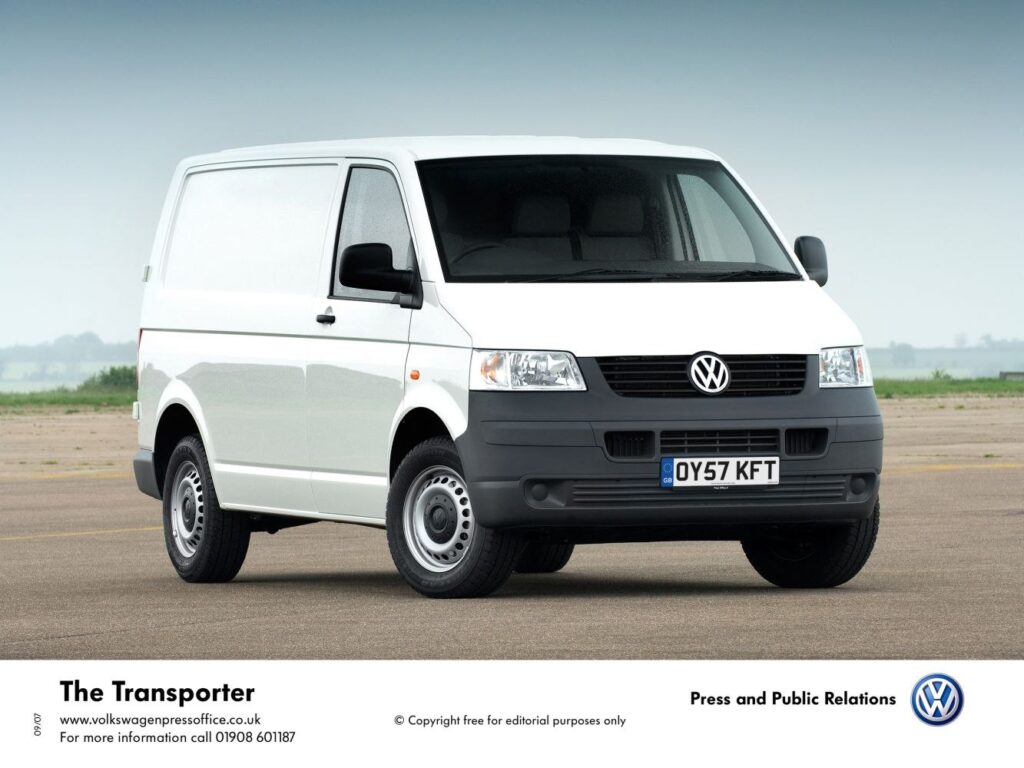
The design of the Volkswagen Transporter (T5) Panel Van was a significant departure from its more angular predecessors, adopting a sleeker, more aerodynamic profile that was both aesthetically pleasing and functionally efficient. The L2H1 configuration, with a length of 208.27 inches (5290 mm) and a standard height of 77.52 inches (1969 mm), provided a substantial cargo volume of up to 236.61 cubic feet (6700 liters). This generous space, combined with a maximum payload capacity ranging from 1911.41 to 1918.02 lbs. (867-870 kg), made it an incredibly versatile platform for various trades and logistical operations.
The Panel Van typically featured 4-5 doors, including side sliding doors for easy access to the cargo area and rear barn doors or a tailgate. The interior was designed for durability and practicality, with seating for 2-3 occupants in the front cabin. While the primary focus was utility, Volkswagen ensured a comfortable and ergonomic driver’s environment, often including features such as hydraulic power steering, ample storage compartments, and a robust heating and ventilation system.
Safety was a key consideration, with the T5 incorporating modern features for its time. Ventilated disc brakes on both the front (333×32.5 mm) and rear (294×22 mm) axles provided strong stopping power, complemented by an Anti-lock Braking System (ABS). The independent suspension setup, featuring McPherson struts with coil springs and an anti-roll bar at the front, and independent coil springs with a transverse stabilizer and trailing arms at the rear, ensured stable handling and a comfortable ride, even when heavily laden. The robust chassis was also capable of towing significant loads, with a permitted trailer load of up to 5511.56 lbs. (2500 kg) with brakes. The vehicle rode on 235/55 R17 tires mounted on 7J x 17-inch wheel rims, providing a good balance of load-carrying capacity and road grip.
Technical Specifications: Volkswagen Transporter (T5) Panel Van 3.2 V6 (235 Hp) Tiptronic L2H1
| Category | Specification | Value (US Units) | Value (Metric) |
|---|---|---|---|
| General Information | |||
| Brand | Volkswagen | ||
| Model | Transporter | ||
| Generation | Transporter (T5) Panel Van | ||
| Type (Engine) | 3.2 V6 (235 Hp) Tiptronic L2H1 | ||
| Production Start | 2003 | ||
| Production End | 2009 | ||
| Powertrain Architecture | Internal Combustion Engine | ||
| Body Type | Van | ||
| Seats | 2-3 | ||
| Doors | 4-5 | ||
| Performance Specifications | |||
| Fuel Consumption (Extra Urban) | 24.8 US mpg | 9.5 l/100 km | |
| Fuel Type | Gasoline (Petrol) | ||
| Acceleration 0-60 mph | 10 seconds | 10.5 seconds (0-100 km/h) | |
| Maximum Speed | 127.38 mph | 205 km/h | |
| Emission Standard | Euro 4 | ||
| Weight-to-Power Ratio | 8.2 kg/Hp (121.8 Hp/tonne) | ||
| Weight-to-Torque Ratio | 6.1 kg/Nm (163.2 Nm/tonne) | ||
| Engine Specifications | |||
| Power | 235 Hp @ 6200 rpm | 235 Hp @ 6200 rpm | |
| Power per Liter | 73.7 Hp/l | 73.7 Hp/l | |
| Torque | 232.33 lb.-ft. @ 2950 rpm | 315 Nm @ 2950 rpm | |
| Engine Layout | Front, Transverse | ||
| Engine Model/Code | EA390 / BKK | ||
| Engine Displacement | 194.6 cu. in. | 3189 cm³ | |
| Number of Cylinders | 6 | ||
| Engine Configuration | VR-engine | ||
| Cylinder Bore | 3.31 in. | 84 mm | |
| Piston Stroke | 3.78 in. | 95.9 mm | |
| Compression Ratio | 10.85:1 | ||
| Valves per Cylinder | 4 | ||
| Fuel Injection System | Multi-port manifold injection | ||
| Engine Aspiration | Naturally Aspirated | ||
| Valvetrain | DOHC | ||
| Engine Oil Capacity | 6.45 US qt | 6.1 l | |
| Coolant Capacity | 7.5 US qt | 7.1 l | |
| Dimensions, Volume, and Weights | |||
| Kerb Weight | 4254.92 – 4702.46 lbs. | 1930-2133 kg | |
| Max. Weight (GVWR) | 6172.94 – 6613.87 lbs. | 2800-3000 kg | |
| Max. Load (Payload) | 1911.41 – 1918.02 lbs. | 867-870 kg | |
| Trunk (Boot) Space – Max. | 236.61 cu. ft. | 6700 l | |
| Fuel Tank Capacity | 21.13 US gal | 80 l | |
| Max. Roof Load | 220.46 lbs. | 100 kg | |
| Permitted Trailer Load (with brakes 8%) | 5511.56 lbs. | 2500 kg | |
| Permitted Trailer Load (with brakes 12%) | 5511.56 lbs. | 2500 kg | |
| Permitted Trailer Load (without brakes) | 1653.47 lbs. | 750 kg | |
| Permitted Towbar Download | 220.46 lbs. | 100 kg | |
| Length | 208.27 in. | 5290 mm | |
| Width | 74.96 in. | 1904 mm | |
| Width (incl. mirrors) | 88.27 in. | 2242 mm | |
| Height | 77.52 in. | 1969 mm | |
| Wheelbase | 133.86 in. | 3400 mm | |
| Front Track | 63.78 in. | 1620 mm | |
| Rear Track | 63.78 in. | 1620 mm | |
| Front Overhang | 35.2 in. | 894 mm | |
| Rear Overhang | 39.21 in. | 996 mm | |
| Ride Height (Ground Clearance) | 6.5 in. | 165 mm | |
| Minimum Turning Circle | 43.31 ft. | 13.2 m | |
| Approach Angle | 22° | ||
| Departure Angle | 16° | ||
| Wading Depth | 11.81 in. | 300 mm | |
| Drivetrain, Brakes, and Suspension | |||
| Drivetrain Architecture | Front-wheel drive, Internal Combustion Engine | ||
| Drive Wheel | Front-wheel drive | ||
| Gearbox Type | 6-speed automatic Tiptronic | ||
| Front Suspension | Independent, McPherson with coil spring and anti-roll bar | ||
| Rear Suspension | Independent coil spring, Transverse stabilizer, Trailing arm | ||
| Front Brakes | Ventilated discs | 333×32.5 mm | |
| Rear Brakes | Ventilated discs | 294×22 mm | |
| Assisting Systems | ABS (Anti-lock braking system) | ||
| Steering Type | Steering rack and pinion | ||
| Power Steering | Hydraulic Steering | ||
| Tire Size | 235/55 R17 | ||
| Wheel Rim Size | 7J x 17 | ||
Legacy and Market Impact of the Volkswagen Transporter (T5) Panel Van
The Volkswagen Transporter (T5) Panel Van, particularly in its more potent configurations like the 3.2 V6 Tiptronic L2H1, carved out a significant niche in the highly competitive European light commercial vehicle market. Its reputation was built on a foundation of reliability, versatility, and a more refined driving experience compared to many of its rivals. While the V6 gasoline engine was a less common choice than the highly popular TDI diesel engines, it appealed to specific buyers who prioritized performance, smoother operation, or had particular needs for gasoline-powered fleet vehicles. Its ability to accelerate swiftly and maintain high speeds made it suitable for express deliveries or long-distance transport, where time was a critical factor.
In its primary European market, the T5 Transporter faced stiff competition from other well-established players such as the Mercedes-Benz Vito, Ford Transit, Renault Trafic, and Opel Vivaro. However, the Volkswagen Transporter consistently stood out for its premium build quality, strong residual values, and extensive range of configurations, from basic panel vans to luxurious Multivan passenger carriers and rugged California campers. The 3.2 V6 variant, in particular, offered a unique blend of utility and unexpected performance, setting it apart from the often utilitarian driving dynamics of its competitors. This distinction made it a desirable option for professionals and businesses that sought a more powerful and comfortable work vehicle.
The T5 generation also further cemented the Transporter’s status as a cultural icon, continuing the legacy of its predecessors. Its robust engineering and practical design ensured a long service life, and many T5s remain in active duty across Europe today, a testament to their durability. The availability of a high-performance gasoline engine like the VR6, alongside efficient diesels, showcased Volkswagen’s commitment to offering a broad spectrum of choices to meet diverse customer demands. The Volkswagen Transporter (T5) Panel Van with the 3.2 V6 Tiptronic L2H1 engine remains a significant chapter in the Transporter story, representing a period of modernization and an emphasis on driving dynamics within the commercial vehicle segment. It left a lasting impact by demonstrating that a workhorse could also be refined, powerful, and enjoyable to drive.