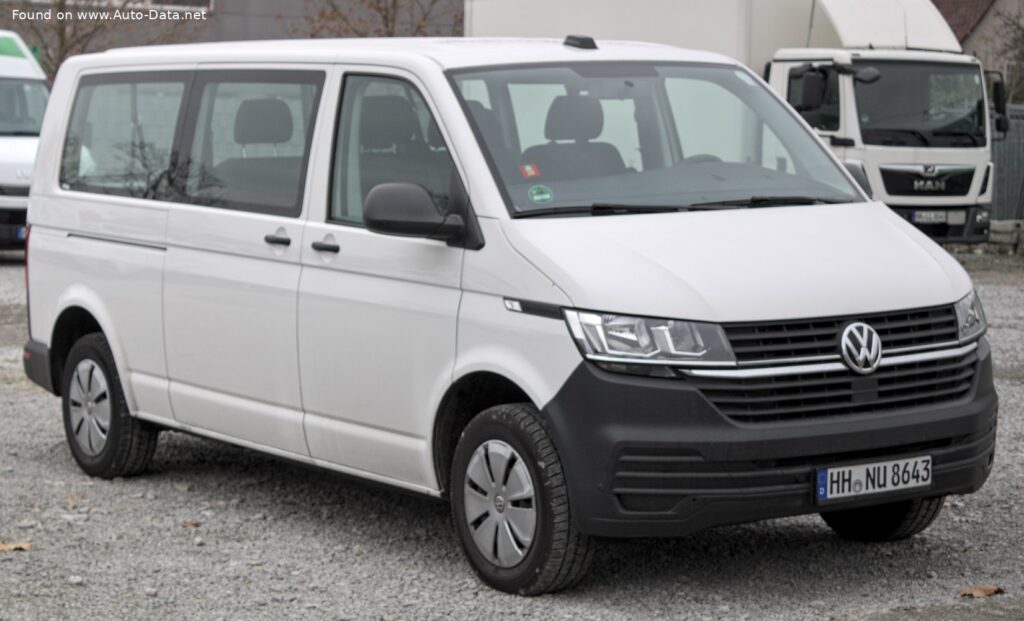
The Volkswagen Transporter, known as the Transporter T6.1 following a significant facelift in 2019, is a versatile light commercial vehicle and passenger van produced by the German manufacturer Volkswagen Commercial Vehicles. This iteration of the Transporter, particularly the Kombi variant with the 2.0 TDI engine, represents a refinement of the T6 generation, focusing on enhanced technology, improved efficiency, and updated styling. Primarily sold in Europe, Australia, and other international markets, the T6.1 caters to a broad range of needs, from commercial tradespeople requiring a robust work vehicle to families seeking a spacious and adaptable multi-purpose vehicle. The Kombi configuration, specifically, bridges the gap between a full cargo van and a passenger-focused MPV, offering flexible seating arrangements and ample cargo space.
Volkswagen Transporter T6.1: Overview and Market Position
The T6.1 generation of the Transporter is not officially sold in the United States, but its predecessors have a strong following among van enthusiasts. The T6.1 builds upon the success of the T6, addressing criticisms and incorporating advancements in engine technology, driver-assistance systems, and interior comfort. The Kombi variant, as detailed here, is characterized by its flexible seating – typically accommodating between four and nine passengers – and a rear cargo area that can be configured to suit various needs. It occupies a competitive segment alongside vehicles like the Mercedes-Benz Vito, Ford Transit Custom, and Peugeot Expert, offering a blend of practicality, reliability, and driving dynamics.
Engine & Performance
The 2.0 TDI engine powering the Transporter T6.1 Kombi is a four-cylinder, turbocharged diesel engine. In this configuration, it produces 150 horsepower at 3250-3750 rpm and 340 Nm (250.77 lb.-ft.) of torque between 1500-3000 rpm. This engine is coupled with a 7-speed Dual Clutch Gearbox (DSG) automatic transmission and a 4MOTION all-wheel-drive system, providing enhanced traction and stability in various driving conditions. The 4MOTION system operates by permanently driving the front wheels and engaging the rear wheels as needed via an electronically controlled clutch. Performance figures include a 0-100 km/h (0-62 mph) acceleration time of 13 seconds and a maximum speed of 169 km/h (105.01 mph). Fuel economy, measured using the NEDC and WLTP standards, ranges from 7.0 to 7.9 l/100 km (33.6 to 29.8 US mpg) combined, with CO2 emissions between 185 and 207 g/km. The engine also incorporates a diesel particulate filter and a Start & Stop system to minimize emissions and improve fuel efficiency.
Design & Features
The Transporter T6.1 Kombi is a van characterized by its practical and functional design. It’s available in a L2H3 configuration, denoting a long wheelbase and a high roof, maximizing interior space. The body features four or five doors, providing easy access for passengers and cargo. Key design elements include a redesigned front fascia with a more prominent grille and updated headlights, along with revised interior trim and technology. The Kombi variant offers versatile seating arrangements, with options for multiple rows of seats that can be folded, removed, or reconfigured to prioritize passenger space or cargo capacity. Standard and optional features include a touchscreen infotainment system with smartphone integration, driver-assistance systems such as adaptive cruise control and lane-keeping assist, and various comfort and convenience features like air conditioning, heated seats, and parking sensors. Safety features include ABS, electronic stability control, and multiple airbags.
Technical Specifications
| Brand | Volkswagen |
| Model | Transporter |
| Generation | Transporter (T6.1, facelift 2019) Kombi |
| Type (Engine) | 2.0 TDI (150 Hp) 4MOTION DSG L2H3 |
| Start of production | 2020 |
| End of production | 2022 |
| Powertrain Architecture | Internal Combustion engine |
| Body type | Van |
| Seats | 4-9 |
| Doors | 4-5 |
| Fuel consumption (economy) – urban | 7.6-8.7 l/100 km (30.9 – 27 US mpg, 37.2 – 32.5 UK mpg, 13.2 – 11.5 km/l) |
| Fuel consumption (economy) – extra urban | 6.6-7.5 l/100 km (35.6 – 31.4 US mpg, 42.8 – 37.7 UK mpg, 15.2 – 13.3 km/l) |
| Fuel consumption (economy) – combined | 7-7.9 l/100 km (33.6 – 29.8 US mpg, 40.4 – 35.8 UK mpg, 14.3 – 12.7 km/l) |
| CO2 emissions | 185-207 g/km |
| Fuel Type | Diesel |
| Acceleration 0 – 100 km/h | 13 sec |
| Acceleration 0 – 62 mph | 13 sec |
| Acceleration 0 – 60 mph | 12.4 sec |
| Maximum speed | 169 km/h (105.01 mph) |
| Emission standard | Euro 6d-ISC-FCM |
| Weight-to-power ratio | 14.1 kg/Hp, 71 Hp/tonne |
| Weight-to-torque ratio | 6.2 kg/Nm, 160.9 Nm/tonne |
| Power | 150 Hp @ 3250-3750 rpm |
| Power per litre | 76.2 Hp/l |
| Torque | 340 Nm @ 1500-3000 rpm (250.77 lb.-ft. @ 1500-3000 rpm) |
| Engine layout | Front, Transverse |
| Engine Model/Code | EA288MAR / DNAA |
| Engine displacement | 1968 cm3 (120.09 cu. in.) |
| Number of cylinders | 4 |
| Engine configuration | Inline |
| Cylinder Bore | 81 mm (3.19 in.) |
| Piston Stroke | 95.5 mm (3.76 in.) |
| Compression ratio | 15.5:1 |
| Number of valves per cylinder | 4 |
| Fuel injection system | Diesel Commonrail |
| Engine aspiration | Turbocharger, Intercooler |
| Valvetrain | DOHC |
| Engine oil capacity | 7.4 l (7.82 US qt | 6.51 UK qt) |
| Kerb Weight | 2113-2399 kg (4658.37 – 5288.89 lbs.) |
| Max. weight | 3000-3200 kg (6613.87 – 7054.79 lbs.) |
| Max load | 801-887 kg (1765.9 – 1955.5 lbs.) |
| Trunk (boot) space – maximum | 9300 l (328.43 cu. ft.) |
| Fuel tank capacity | 70 l (18.49 US gal | 15.4 UK gal) |
| AdBlue tank | 22 l (5.81 US gal | 4.84 UK gal) |
| Permitted trailer load with brakes (12%) | 2500 kg (5511.56 lbs.) |
| Permitted trailer load without brakes | 750 kg (1653.47 lbs.) |
| Permitted towbar download | 100 kg (220.46 lbs.) |
| Length | 5304 mm (208.82 in.) |
| Width | 1904 mm (74.96 in.) |
| Width including mirrors | 2297 mm (90.43 in.) |
| Height | 2477 mm (97.52 in.) |
| Wheelbase | 3400 mm (133.86 in.) |
| Front overhang | 906 mm (35.67 in.) |
| Rear overhang | 998 mm (39.29 in.) |
| Ride height (ground clearance) | 202 mm (7.95 in.) |
| Minimum turning circle (turning diameter) | 13.2 m (43.31 ft.) |
| Drivetrain Architecture | The Internal combustion engine (ICE) drives the front wheels permanently, and the rear wheels are driven through an electrically or mechanically operated clutch if necessary. |
| Drive wheel | All wheel drive (4×4) |
| Number of gears and type of gearbox | 7 gears, automatic transmission DSG |