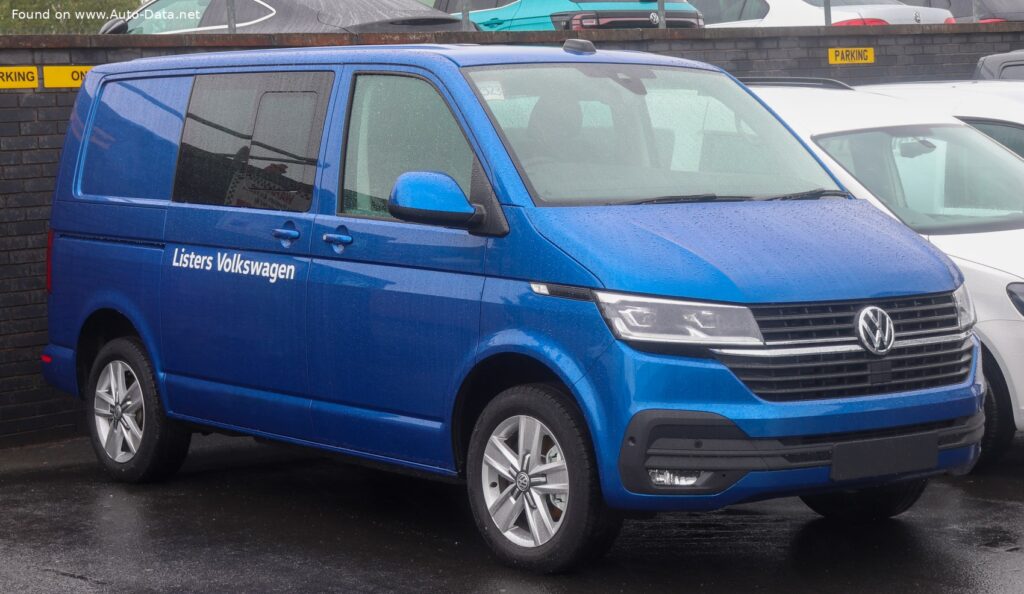
The Volkswagen Transporter, specifically the T6.1 generation facelift introduced in 2019, represents a significant evolution of a vehicle synonymous with commercial and family transport in Europe and beyond. This iteration, often configured as a Kombi Crew Van, balances practicality with modern features. Produced from 2021 to 2022, the T6.1 aimed to refine the already successful T6, offering improved efficiency, technology, and driver assistance systems. While not widely sold in the United States in this specific configuration, the Transporter’s lineage is well-known, and it serves as a crucial workhorse and leisure vehicle in European markets, competing with models like the Ford Transit and Mercedes-Benz Vito. The 2.0 TDI (150 Hp) 4MOTION L1H1 variant, detailed here, exemplifies the blend of capability and economy that defines the modern Transporter.
Volkswagen Transporter T6.1: Overview
The T6.1 represents a substantial refresh of the T6 Transporter, rather than a complete ground-up redesign. The facelift focused on bringing the vehicle into compliance with stricter Euro 6d emissions standards, updating the interior with more modern technology, and refining the exterior styling. The “Kombi Crew Van” designation indicates a versatile configuration, seating between five and six passengers, making it suitable for both commercial and family use. The “L1H1” code refers to the vehicle’s body length (L1 – short wheelbase) and roof height (H1 – standard roof). The 2.0 TDI engine, coupled with Volkswagen’s 4MOTION all-wheel-drive system, provides a robust and adaptable powertrain for a variety of conditions.
Engine & Performance
Powering the T6.1 Kombi Crew Van is a 2.0-liter turbocharged diesel engine (EA288MAR / DNAA), producing 150 horsepower at 3250-3750 rpm and 340 Nm (250.77 lb.-ft.) of torque between 1500-3000 rpm. This engine utilizes a diesel commonrail fuel injection system and features a turbocharger with an intercooler to optimize performance and efficiency. The engine’s transverse mounting and inline four-cylinder configuration contribute to a compact engine bay. The 4MOTION all-wheel-drive system provides enhanced traction, distributing power to all four wheels as needed. Acceleration from 0 to 100 km/h (0-62 mph) takes 11.3 seconds, while 0-60 mph is achieved in 10.7 seconds. The vehicle has a maximum speed of 180 km/h (111.85 mph). Fuel economy figures, measured using the NEDC and WLTP standards, range from 6.8 to 7.1 l/100 km (34.6 – 33.1 US mpg) combined, with CO2 emissions between 179-187 g/km. The engine also incorporates a Start & Stop system and a particulate filter to reduce emissions.
Design & Features
The Volkswagen Transporter T6.1 maintains the iconic van silhouette, but the facelift brought subtle yet noticeable changes to the front fascia, including a redesigned grille and headlights. The body type is a van, available with 4 or 5 doors, and offers seating for 5-6 occupants. The L1H1 configuration provides a practical balance between interior space and maneuverability. Key features include a spacious cabin, versatile seating arrangements, and a large cargo area with a maximum capacity of 3500 liters (123.6 cu. ft.). The vehicle is equipped with a 70-liter (18.49 US gal) fuel tank and a 22-liter (5.81 US gal) AdBlue tank for selective catalytic reduction (SCR) emissions control. Safety features, standard for the era, include ABS (Anti-lock braking system) and a robust braking system with ventilated discs on all wheels. The T6.1 also benefits from modern driver assistance systems, though specific features vary depending on trim level and optional equipment.
Technical Specifications
| Brand | Volkswagen |
| Model | Transporter |
| Generation | Transporter (T6.1, facelift 2019) Kombi Crew Van |
| Type (Engine) | 2.0 TDI (150 Hp) 4MOTION L1H1 |
| Start of production | 2021 year |
| End of production | 2022 year |
| Powertrain Architecture | Internal Combustion engine |
| Body type | Van |
| Seats | 5-6 |
| Doors | 4-5 |
| Fuel consumption (economy) – urban | 8.1-8.3 l/100 km (29 – 28.3 US mpg) |
| Fuel consumption (economy) – extra urban | 6-6.3 l/100 km (39.2 – 37.3 US mpg) |
| Fuel consumption (economy) – combined | 6.8-7.1 l/100 km (34.6 – 33.1 US mpg) |
| CO2 emissions | 179-187 g/km |
| Fuel Type | Diesel |
| Acceleration 0 – 100 km/h | 11.3 sec |
| Acceleration 0 – 62 mph | 11.3 sec |
| Acceleration 0 – 60 mph | 10.7 sec |
| Maximum speed | 180 km/h (111.85 mph) |
| Emission standard | Euro 6d-ISC-FCM |
| Weight-to-power ratio | 14.2 kg/Hp, 70.3 Hp/tonne |
| Weight-to-torque ratio | 6.3 kg/Nm, 159.3 Nm/tonne |
| Power | 150 Hp @ 3250-3750 rpm |
| Torque | 340 Nm @ 1500-3000 rpm (250.77 lb.-ft.) |
| Engine layout | Front, Transverse |
| Engine Model/Code | EA288MAR / DNAA |
| Engine displacement | 1968 cm3 (120.09 cu. in.) |
| Number of cylinders | 4 |
| Engine configuration | Inline |
| Cylinder Bore | 81 mm (3.19 in.) |
| Piston Stroke | 95.5 mm (3.76 in.) |
| Compression ratio | 15.5:1 |
| Number of valves per cylinder | 4 |
| Fuel injection system | Diesel Commonrail |
| Engine aspiration | Turbocharger, Intercooler |
| Valvetrain | DOHC |
| Engine oil capacity | 7.4 l (7.82 US qt | 6.51 UK qt) |
| Kerb Weight | 2135-2380 kg (4706.87 – 5247 lbs.) |
| Max. weight | 3000-3200 kg (6613.87 – 7054.79 lbs.) |
| Max load | 820-865 kg (1807.79 – 1907 lbs.) |
| Trunk (boot) space – maximum | 3500 l (123.6 cu. ft.) |
| Fuel tank capacity | 70 l (18.49 US gal | 15.4 UK gal) |
| AdBlue tank | 22 l (5.81 US gal | 4.84 UK gal) |
| Max. roof load | 100 kg (220.46 lbs.) |
| Permitted trailer load with brakes (12%) | 2500 kg (5511.56 lbs.) |
| Permitted trailer load without brakes | 750 kg (1653.47 lbs.) |
| Permitted towbar download | 100 kg (220.46 lbs.) |
| Length | 4904 mm (193.07 in.) |
| Width | 1904 mm (74.96 in.) |
| Width including mirrors | 2297 mm (90.43 in.) |
| Height | 1990 mm (78.35 in.) |
| Wheelbase | 3000 mm (118.11 in.) |
| Front overhang | 906 mm (35.67 in.) |
| Rear overhang | 998 mm (39.29 in.) |
| Ride height (ground clearance) | 201 mm (7.91 in.) |
| Minimum turning circle | 11.9 m (39.04 ft.) |
| Drivetrain Architecture | All wheel drive (4×4). ICE drives front wheels, rear wheels engaged via clutch. |
| Number of gears and type of gearbox | 6 gears, manual transmission |
| Front suspension | Independent, McPherson with coil spring and anti-roll bar |
| Rear suspension | Independent coil spring, Wishbone, Transverse stabilizer |
| Front brakes | Ventilated discs, 308×29.5 mm |
| Rear brakes | Ventilated discs, 294×22 mm |
| Steering type | Steering rack and pinion |
| Power steering | Electric Steering |
| Tires size | 205/65 R16; 215/65 R16 |
| Wheel rims size | 6.5J x 16 |