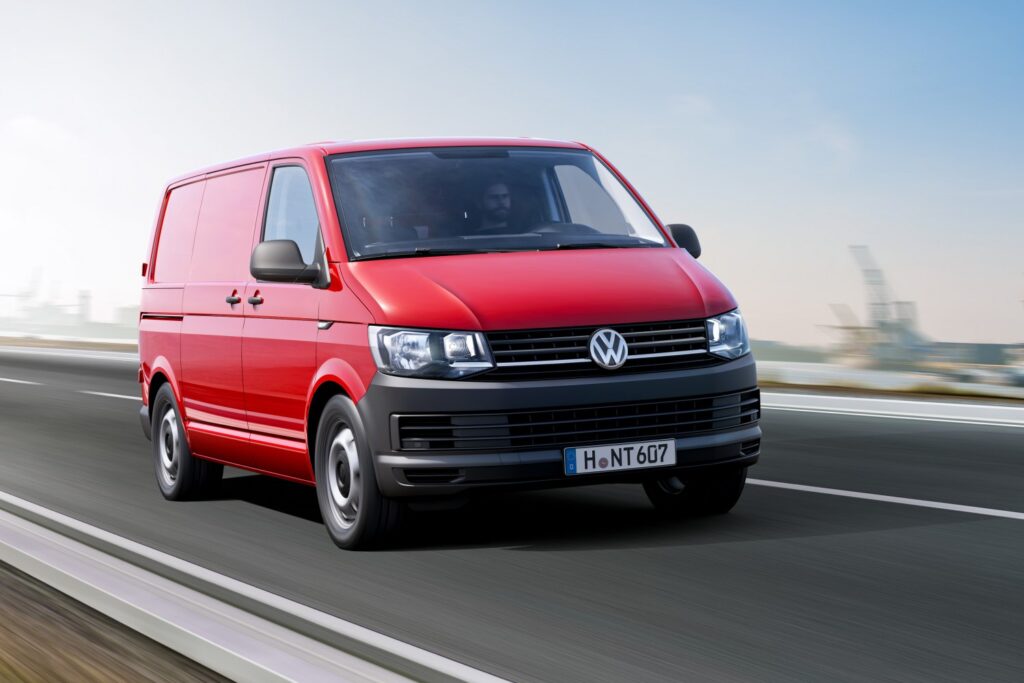
The Volkswagen Transporter, a name synonymous with versatility and robust utility, reached new heights of refinement and capability with its sixth generation, the T6. Among its many configurations, the Volkswagen Transporter (T6) Panel Van 2.0 TDI (204 Hp) DSG L2H3 stands out as a particularly potent and practical variant. Produced between 2016 and 2019, this iteration solidified the Transporter’s reputation as a leading light commercial vehicle (LCV) in markets primarily across Europe, where it serves a diverse range of businesses, from logistics and construction to mobile workshops and passenger transport. While not officially sold in the United States, its engineering prowess and design principles are universally recognized, reflecting Volkswagen’s commitment to durability, efficiency, and driver comfort within the commercial sector. This specific model, characterized by its powerful 2.0-liter TDI engine, advanced DSG automatic transmission, and L2H3 designation (Long wheelbase, High roof), represents a sophisticated blend of performance and expansive cargo capacity, tailored for demanding professional applications.
Engine and Performance of the Volkswagen Transporter (T6) Panel Van 2.0 TDI (204 Hp) DSG L2H3
At the heart of the Volkswagen Transporter (T6) Panel Van 2.0 TDI (204 Hp) DSG L2H3 lies a highly advanced and potent powertrain, meticulously engineered to deliver both robust performance and impressive efficiency. The vehicle is propelled by an internal combustion engine architecture, specifically a 2.0-liter (1968 cm³, or 120.09 cu. in.) inline four-cylinder diesel engine. This unit, identified by the engine code EA288 / CXEB, features a sophisticated DOHC (Double Overhead Camshaft) valvetrain with four valves per cylinder, ensuring optimal airflow and combustion. A key highlight of this powertrain is its BiTurbo setup, coupled with an intercooler, which significantly boosts power output across the rev range while maintaining thermal efficiency. The common rail fuel injection system further refines fuel delivery, contributing to both performance and reduced emissions.
Powertrain Configuration and Output
The 2.0 TDI engine in this Transporter variant is a powerhouse, generating a formidable 204 horsepower (HP) at 4000 revolutions per minute (rpm). This high power output for a commercial van is complemented by an equally impressive torque figure of 450 Newton-meters (Nm), or 331.9 lb.-ft., available across a broad and usable band from 1400 to 2400 rpm. This wide torque plateau is crucial for a commercial vehicle, providing excellent pulling power from low engine speeds, which is essential for hauling heavy loads or navigating challenging urban environments. The engine is mounted transversely at the front, driving the front wheels, a configuration that optimizes interior space and traction. Power is seamlessly managed by a 7-speed automatic DSG (Direct Shift Gearbox) transmission. This dual-clutch gearbox is renowned for its rapid, smooth shifts and efficiency, striking an excellent balance between driver convenience and fuel economy, making it ideal for both city driving and long-distance hauls.
Fuel Economy, Emissions, and Acceleration
Despite its considerable power, the Transporter T6 2.0 TDI (204 Hp) maintains commendable fuel efficiency for its class, adhering to the NEDC (New European Driving Cycle) standards prevalent during its production. Combined fuel consumption is rated between 6.1 and 6.8 liters per 100 kilometers (38.6 to 34.6 US mpg), showcasing its economical operation. Urban driving yields figures of 7-7.7 l/100 km (33.6 – 30.5 US mpg), while extra-urban cycles see efficiency improve to 5.5-6.4 l/100 km (42.8 – 36.8 US mpg). These figures are a testament to the engine’s advanced design and the efficiency of the DSG transmission. Contributing to its environmental responsibility, the vehicle meets the stringent Euro 6 emission standard, with CO2 emissions ranging from 158-179 g/km. This is aided by integrated engine systems such as a Start & Stop system, which reduces fuel consumption and emissions in stop-and-go traffic, and a particulate filter, which captures harmful soot particles. An AdBlue tank with a capacity of 13 liters (3.43 US gal) further ensures compliance with nitrogen oxide (NOx) emission limits. From a performance standpoint, the 204 HP engine propels the van from 0 to 60 mph in a swift 8.8 seconds, with a maximum speed of 117.44 mph (189 km/h), demonstrating that this Transporter variant is far from sluggish, even when laden.
Design, Utility, and Features of the Volkswagen Transporter (T6) Panel Van
The Volkswagen Transporter (T6) Panel Van is a masterclass in functional design, prioritizing utility, durability, and ergonomic efficiency. Its L2H3 designation signifies a specific configuration: L2 denotes the long wheelbase, measuring 3400 mm (133.86 in), and H3 indicates a high roof, which significantly enhances interior cargo volume. This combination makes it an ideal choice for tradespeople and delivery services requiring substantial load space and the ability to carry tall items.
Body Type, Dimensions, and Cargo Capacity
As a panel van, the T6 is designed primarily for cargo transport, featuring a sturdy body with 4 to 5 doors, typically including a sliding side door for easy access and rear barn doors. The cabin is configured for 2 to 3 seats, prioritizing utility over passenger capacity. Its exterior dimensions are substantial, reflecting its impressive interior volume: a length of 5304 mm (208.82 in), a width of 1904 mm (74.96 in) (or 2297 mm / 90.43 in including mirrors), and a towering height of 2477 mm (97.52 in). These dimensions, combined with its long wheelbase, contribute to a stable and commanding road presence. Crucially, the L2H3 variant boasts an immense maximum trunk (boot) space of 9300 liters (328.43 cu. ft.), making it one of the most capacious vans in its segment. This vast interior volume is complemented by a robust payload capacity, ranging from 949 to 1032 kg (2092.19 – 2275.17 lbs), allowing it to carry significant weight in addition to its own kerb weight of 1851-2168 kg (4080.76 – 4779.62 lbs). The maximum permissible weight (GVWR) is between 2800-3200 kg (6172.94 – 7054.79 lbs).
Chassis, Suspension, and Safety Features
The T6 Panel Van is built on a robust chassis designed to withstand the rigors of commercial use. It features an independent McPherson type front suspension with coil springs and an anti-roll bar, providing excellent stability and ride comfort even when loaded. The rear suspension also utilizes an independent coil spring system with wishbones and a transverse stabilizer, ensuring predictable handling and load-carrying capability. Braking performance is strong, with ventilated discs both at the front (340×32.5 mm) and rear (294×22 mm), complemented by an Anti-lock Braking System (ABS) for enhanced safety during emergency stops. Steering is managed by a hydraulic rack and pinion system, offering precise control and feedback. The vehicle is equipped with various tire and wheel sizes, including 215/60 R17, 215/65 R17, 235/55 R17, and 255/45 R18, mounted on 7J x 17 or 8J x 18 rims, providing suitable traction and load ratings for diverse applications. Practical considerations extend to its towing capabilities, with a permitted trailer load of 2500 kg (5511.56 lbs) with brakes and 750 kg (1653.47 lbs) without brakes, further underscoring its utility. The 70-liter (18.49 US gal) fuel tank ensures a substantial operating range between refills, minimizing downtime for commercial operators. Overall, the Transporter T6 combines clever spatial design with robust mechanicals, making it a highly capable and reliable partner for businesses.
Technical Specifications
| Brand | Volkswagen |
| Model | Transporter |
| Generation | Transporter (T6) Panel Van |
| Type (Engine) | 2.0 TDI (204 Hp) DSG L2H3 |
| Start of production | 2016 year |
| End of production | 2019 year |
| Powertrain Architecture | Internal Combustion engine |
| Body type | Van |
| Seats | 2-3 |
| Doors | 4-5 |
| Fuel consumption (economy) – urban (NEDC) | 7-7.7 l/100 km (33.6 – 30.5 US mpg) |
| Fuel consumption (economy) – extra urban (NEDC) | 5.5-6.4 l/100 km (42.8 – 36.8 US mpg) |
| Fuel consumption (economy) – combined (NEDC) | 6.1-6.8 l/100 km (38.6 – 34.6 US mpg) |
| CO2 emissions (NEDC) | 158-179 g/km |
| Fuel Type | Diesel |
| Acceleration 0 – 100 km/h | 9.3 sec |
| Acceleration 0 – 62 mph | 9.3 sec |
| Acceleration 0 – 60 mph (Calculated) | 8.8 sec |
| Maximum speed | 189 km/h (117.44 mph) |
| Emission standard | Euro 6 |
| Weight-to-power ratio | 9.1 kg/Hp (110.2 Hp/tonne) |
| Weight-to-torque ratio | 4.1 kg/Nm (243.1 Nm/tonne) |
| Power | 204 Hp @ 4000 rpm |
| Power per litre | 103.7 Hp/l |
| Torque | 450 Nm @ 1400-2400 rpm (331.9 lb.-ft. @ 1400-2400 rpm) |
| Engine layout | Front, Transverse |
| Engine Model/Code | EA288 / CXEB |
| Engine displacement | 1968 cm³ (120.09 cu. in.) |
| Number of cylinders | 4 |
| Engine configuration | Inline |
| Cylinder Bore | 81 mm (3.19 in.) |
| Piston Stroke | 95.5 mm (3.76 in.) |
| Compression ratio | 15.5:1 |
| Number of valves per cylinder | 4 |
| Fuel injection system | Diesel Commonrail |
| Engine aspiration | BiTurbo, Intercooler |
| Valvetrain | DOHC |
| Engine oil capacity | 7.4 l (7.82 US qt | 6.51 UK qt) |
| Engine oil specification | Not specified in public data |
| Engine systems | Start & Stop System, Particulate filter |
| Kerb Weight | 1851-2168 kg (4080.76 – 4779.62 lbs) |
| Max. weight | 2800-3200 kg (6172.94 – 7054.79 lbs) |
| Max load | 949-1032 kg (2092.19 – 2275.17 lbs) |
| Trunk (boot) space – maximum | 9300 l (328.43 cu. ft.) |
| Fuel tank capacity | 70 l (18.49 US gal | 15.4 UK gal) |
| AdBlue tank | 13 l (3.43 US gal | 2.86 UK gal) |
| Max. roof load | 100 kg (220.46 lbs) |
| Permitted trailer load with brakes (12%) | 2500 kg (5511.56 lbs) |
| Permitted trailer load without brakes | 750 kg (1653.47 lbs) |
| Permitted towbar download | 100 kg (220.46 lbs) |
| Length | 5304 mm (208.82 in.) |
| Width | 1904 mm (74.96 in.) |
| Width including mirrors | 2297 mm (90.43 in.) |
| Height | 2477 mm (97.52 in.) |
| Wheelbase | 3400 mm (133.86 in.) |
| Front overhang | 908 mm (35.75 in.) |
| Rear overhang | 993 mm (39.09 in.) |
| Ride height (ground clearance) | 202 mm (7.95 in.) |
| Minimum turning circle (turning diameter) | 13.2 m (43.31 ft.) |
| Approach angle | 21.2° |
| Departure angle | 16.2° |
| Ramp-over (brakeover) angle | 12.2° |
| Drivetrain Architecture | Front wheel drive. Internal Combustion engine. |
| Drive wheel | Front wheel drive |
| Number of gears and type of gearbox | 7 gears, automatic transmission DSG |
| Front suspension | Independent, type McPherson with coil spring and anti-roll bar |
| Rear suspension | Independent coil spring, Wishbone, Transverse stabilizer |
| Front brakes | Ventilated discs, 340×32.5 mm |
| Rear brakes | Ventilated discs, 294×22 mm |
| Assisting systems | ABS (Anti-lock braking system) |
| Steering type | Steering rack and pinion |
| Power steering | Hydraulic Steering |
| Tires size | 215/60 R17; 215/65 R17; 235/55 R17; 255/45 R18 |
| Wheel rims size | 7J x 17; 8J x 18 |