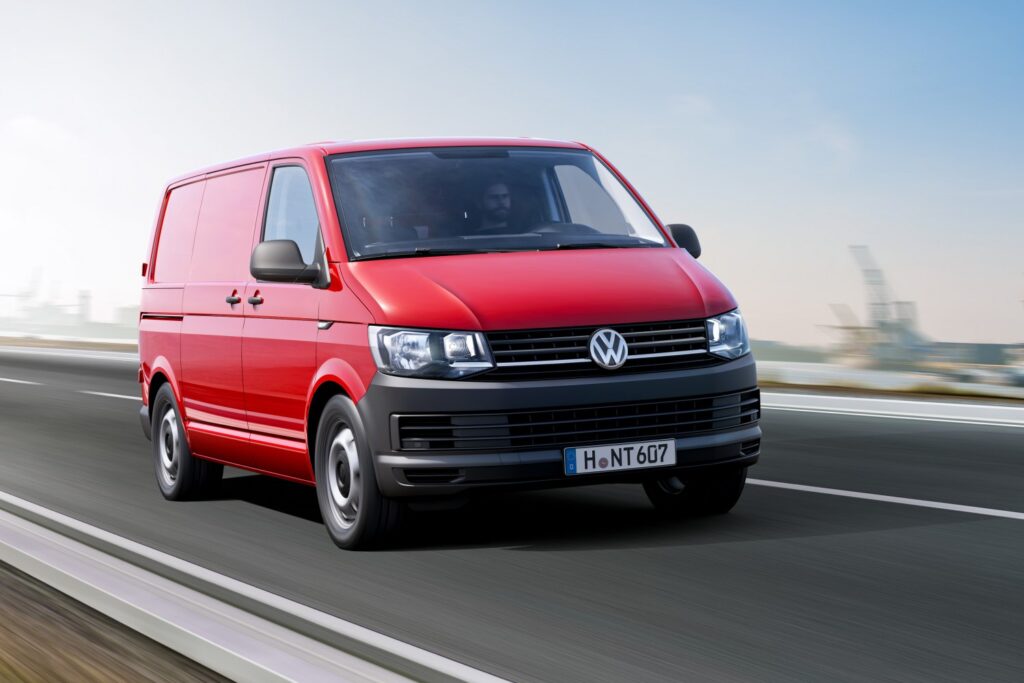
The Volkswagen Transporter, a venerable nameplate in the commercial vehicle segment, saw its sixth generation, the T6, introduced in 2015, continuing a legacy of reliability and versatility. Among its various configurations, the Volkswagen Transporter (T6) Panel Van 2.0 TDI (84 Hp) L2H1 stands out as a quintessential workhorse designed for the demanding operational needs of businesses across Europe and other international markets. Produced from 2015 to 2016, this specific variant embodies the core principles of the Transporter lineage: robust construction, practical utility, and efficient performance tailored for logistics and service industries. As a panel van, its primary role is cargo transport, offering a spacious and secure environment for goods, tools, and equipment, making it an indispensable asset for a wide array of professional applications.
Volkswagen Transporter (T6) Panel Van 2.0 TDI (84 Hp) L2H1: Engineering for Utility
At the heart of the Volkswagen Transporter (T6) Panel Van 2.0 TDI (84 Hp) L2H1 lies a 2.0-liter (1968 cm³, 120.09 cu. in.) inline four-cylinder diesel engine, designated by the code EA189 / CAAA. This engine, a staple of Volkswagen’s commercial vehicle lineup, is configured in a front, transverse layout, driving the front wheels. It employs a DOHC (Dual Overhead Camshaft) valvetrain with four valves per cylinder, a commonrail direct fuel injection system, and benefits from a turbocharger and intercooler, ensuring efficient combustion and responsive power delivery. Despite its modest output of 84 horsepower at 3500 rpm, the engine excels in producing ample torque, a critical factor for a commercial vehicle. It delivers a substantial 220 Nm (162.26 lb.-ft.) of torque across a broad and usable rev range, specifically from 1250 to 2500 rpm. This low-end torque is paramount for a van, enabling effortless acceleration even when fully loaded, and facilitating smooth urban driving and highway cruising without constantly needing to downshift.
Paired with a 5-speed manual transmission, the powertrain architecture of the T6 Panel Van is optimized for durability and fuel economy. While not designed for outright speed, its performance figures reflect its utility-first philosophy. The van can accelerate from 0 to 60 mph in a calculated 18.7 seconds, reaching a maximum speed of 90.72 mph (146 km/h). These figures are perfectly adequate for its intended purpose, prioritizing reliability and operational cost-effectiveness over raw acceleration. Fuel efficiency is a strong suit, with combined NEDC figures ranging from 6.7-7.4 liters per 100 km, translating to an impressive 31.8 to 35.1 US mpg. Urban consumption is rated at 27-28.3 US mpg, while extra-urban driving yields 35.1-40.6 US mpg. These consumption rates, coupled with an 80-liter (21.13 US gal) fuel tank, provide a commendable operational range, minimizing downtime for refueling and contributing to lower running costs for businesses. Furthermore, the engine adheres to the Euro 5 emission standard, producing 176-195 g/km of CO2, and incorporates modern engine systems such as a Start & Stop system and a particulate filter to enhance environmental performance and efficiency.
Design and Practical Features of the T6 Panel Van
The Volkswagen Transporter (T6) Panel Van, specifically the L2H1 variant, is characterized by its long wheelbase (L2) and standard roof height (H1), providing an optimal balance of cargo capacity and maneuverability. With an overall length of 208.82 inches (5304 mm), a width of 74.96 inches (1904 mm) without mirrors (90.43 inches or 2297 mm with mirrors), and a height of 78.35 inches (1990 mm), the T6 offers generous dimensions for its segment. The wheelbase of 133.86 inches (3400 mm) contributes to stable handling and a comfortable ride, even when laden. Designed primarily as a cargo carrier, the panel van features 4-5 doors, typically including sliding side doors and rear barn doors, facilitating easy loading and unloading of goods. The interior is configured for 2-3 occupants, with the remaining space dedicated entirely to cargo.
The cargo bay is exceptionally capacious, offering a maximum trunk (boot) space of 6700 liters (236.61 cu. ft.), making it highly versatile for various commercial applications, from courier services to trade professionals. The robust construction allows for a substantial maximum payload capacity ranging from 2085.57 to 2343.51 lbs. (946-1063 kg), while the gross vehicle weight rating (GVWR) spans 6172.94 to 6613.87 lbs. (2800-3000 kg). Additionally, the T6 Panel Van boasts impressive towing capabilities, rated for a permitted trailer load of 4850.17 lbs. (2200 kg) with brakes and 1653.47 lbs. (750 kg) without brakes, further extending its utility. A maximum roof load of 220.46 lbs. (100 kg) and a permitted towbar download of 220.46 lbs. (100 kg) add to its flexibility for carrying specialized equipment or additional cargo.
In terms of driving dynamics and safety, the T6 Panel Van is equipped with a well-engineered chassis. The front suspension features an independent McPherson strut design with coil springs and an anti-roll bar, while the rear utilizes an independent coil spring system with wishbones and a transverse stabilizer. This setup ensures a balanced ride, offering both comfort for the occupants and stability for the cargo. Braking performance is handled by ventilated discs on both the front (308×29.5 mm) and rear (294×22 mm) axles, complemented by an Anti-lock Braking System (ABS) for enhanced control during emergency stops. Steering is managed by a hydraulic rack and pinion system, providing direct feedback and ease of maneuverability, which is crucial in urban environments with a minimum turning circle of 43.31 feet (13.2 meters). Standard tires are sized 215/65 R16 on 6.5J x 16 wheel rims, providing a good balance of load-bearing capacity and ride comfort. The ground clearance of 7.95 inches (202 mm), along with approach, departure, and ramp-over angles of 21.2°, 16.2°, and 12.2° respectively, ensures it can handle various terrains and loading dock challenges with confidence.
Technical Specifications
| Brand | Volkswagen |
| Model | Transporter |
| Generation | Transporter (T6) Panel Van |
| Type (Engine) | 2.0 TDI (84 Hp) L2H1 |
| Start of production | 2015 year |
| End of production | 2016 year |
| Powertrain Architecture | Internal Combustion engine |
| Body type | Van |
| Seats | 2-3 |
| Doors | 4-5 |
| Fuel consumption (economy) – urban (NEDC) | 8.3-8.7 l/100 km (27-28.3 US mpg) |
| Fuel consumption (economy) – extra urban (NEDC) | 5.8-6.7 l/100 km (35.1-40.6 US mpg) |
| Fuel consumption (economy) – combined (NEDC) | 6.7-7.4 l/100 km (31.8-35.1 US mpg) |
| CO2 emissions (NEDC) | 176-195 g/km |
| Fuel Type | Diesel |
| Acceleration 0 – 60 mph | 18.7 sec |
| Maximum speed | 90.72 mph (146 km/h) |
| Emission standard | Euro 5 |
| Power | 84 Hp @ 3500 rpm |
| Torque | 220 Nm (162.26 lb.-ft.) @ 1250-2500 rpm |
| Engine layout | Front, Transverse |
| Engine Model/Code | EA189 / CAAA |
| Engine displacement | 1968 cm³ (120.09 cu. in.) |
| Number of cylinders | 4 |
| Engine configuration | Inline |
| Cylinder Bore | 81 mm (3.19 in.) |
| Piston Stroke | 95.5 mm (3.76 in.) |
| Compression ratio | 16.5:1 |
| Number of valves per cylinder | 4 |
| Fuel injection system | Diesel Commonrail |
| Engine aspiration | Turbocharger, Intercooler |
| Valvetrain | DOHC |
| Engine oil capacity | 7 l (7.4 US qt) |
| Engine systems | Start & Stop System, Particulate filter |
| Kerb Weight | 1737-2054 kg (3829.43-4528.29 lbs.) |
| Max. weight | 2800-3000 kg (6172.94-6613.87 lbs.) |
| Max load | 946-1063 kg (2085.57-2343.51 lbs.) |
| Trunk (boot) space – maximum | 6700 l (236.61 cu. ft.) |
| Fuel tank capacity | 80 l (21.13 US gal) |
| Max. roof load | 100 kg (220.46 lbs.) |
| Permitted trailer load with brakes (12%) | 2200 kg (4850.17 lbs.) |
| Permitted trailer load without brakes | 750 kg (1653.47 lbs.) |
| Permitted towbar download | 100 kg (220.46 lbs.) |
| Length | 5304 mm (208.82 in.) |
| Width | 1904 mm (74.96 in.) |
| Width including mirrors | 2297 mm (90.43 in.) |
| Height | 1990 mm (78.35 in.) |
| Wheelbase | 3400 mm (133.86 in.) |
| Front overhang | 908 mm (35.75 in.) |
| Rear overhang | 993 mm (39.09 in.) |
| Ride height (ground clearance) | 202 mm (7.95 in.) |
| Minimum turning circle (turning diameter) | 13.2 m (43.31 ft.) |
| Approach angle | 21.2° |
| Departure angle | 16.2° |
| Ramp-over (brakeover) angle | 12.2° |
| Drivetrain Architecture | Internal combustion engine drives front wheels |
| Drive wheel | Front wheel drive |
| Number of gears and type of gearbox | 5 gears, manual transmission |
| Front suspension | Independent, McPherson with coil spring and anti-roll bar |
| Rear suspension | Independent coil spring, Wishbone, Transverse stabilizer |
| Front brakes | Ventilated discs, 308×29.5 mm |
| Rear brakes | Ventilated discs, 294×22 mm |
| Assisting systems | ABS (Anti-lock braking system) |
| Steering type | Steering rack and pinion |
| Power steering | Hydraulic Steering |
| Tires size | 215/65 R16 |
| Wheel rims size | 6.5J x 16 |