
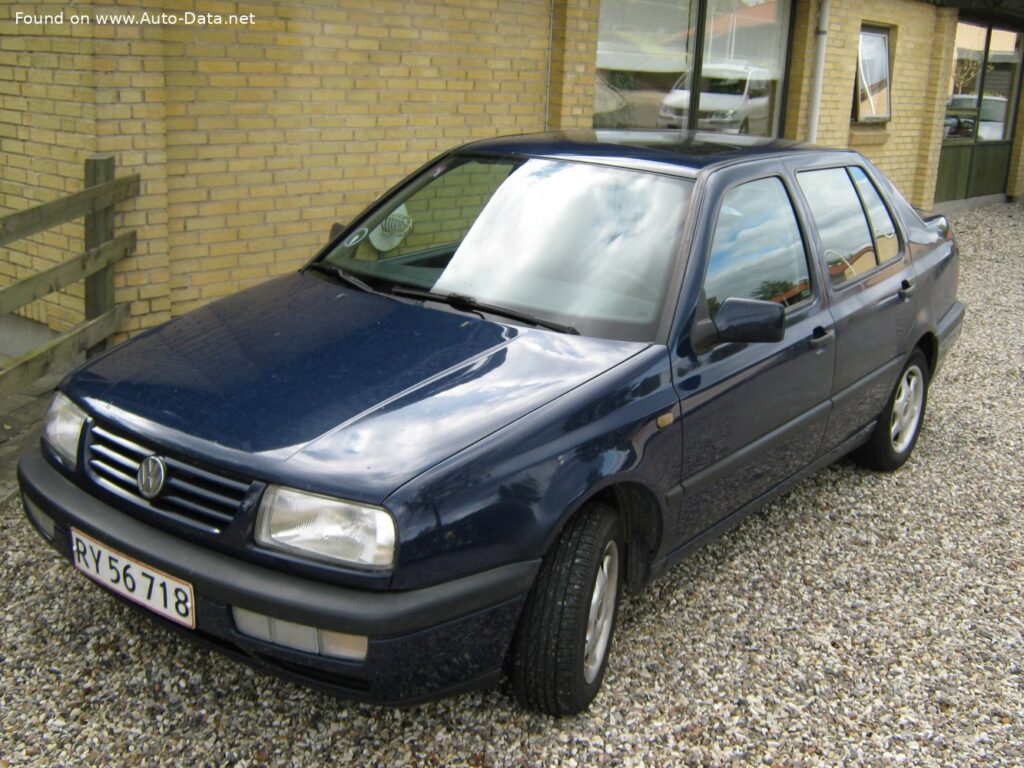
The Volkswagen Vento (1HX0) was a compact sedan produced between 1992 and 1998, primarily aimed at the European market. It represented Volkswagen’s second attempt at a dedicated sedan model in the C-segment, following the earlier Santana. The Vento was essentially the sedan version of the Volkswagen Golf Mk3, sharing its platform and many mechanical components. While not officially sold in the United States, understanding the Vento provides insight into Volkswagen’s global strategy during the early 1990s and its commitment to offering a diverse range of body styles. This article focuses on the 1.8-liter, 75 horsepower automatic variant of the Vento (1HX0).
Volkswagen Vento (1HX0): A European Sedan
The Vento was introduced as a more conventional, three-box sedan alternative to the hatchback-focused Golf. It was marketed as a practical and comfortable family car, offering a larger trunk capacity than the Golf. The name “Vento” itself means “wind” in several languages, aligning with Volkswagen’s naming convention of using natural elements. In some markets, particularly in Argentina, the Vento was sold under the name “Carat,” and it enjoyed considerable success due to its perceived quality and reliability. The Vento filled a niche for buyers who preferred the styling and practicality of a traditional sedan over a hatchback.
Engine & Performance
The 1.8-liter inline-four cylinder engine, designated AAM, was a mainstay of the Vento range. In this configuration, it produced 75 horsepower at 5000 rpm and 140 Nm (103.26 lb.-ft.) of torque at 2500 rpm. This engine utilized single-point fuel injection, a technology common in the early 1990s, and a compression ratio of 9:1. While not a performance-oriented engine, it provided adequate power for everyday driving. The engine’s power-to-weight ratio was 15.7 kg/Hp, and its torque-to-weight ratio was 8.4 kg/Nm. Paired with a four-speed automatic transmission, the Vento 1.8 achieved a 0-100 km/h (0-62 mph) acceleration time of 16.8 seconds and a top speed of 164 km/h (101.9 mph). Fuel economy figures were 11.4 l/100 km (20.6 US mpg) in urban conditions, 7.1 l/100 km (33.1 US mpg) on the extra-urban cycle, and 8.6 l/100 km (27.4 US mpg) combined.
Design & Features
The Vento’s design closely mirrored the Golf Mk3, sharing the same front end and interior layout. However, the Vento distinguished itself with its extended rear section and a more traditional sedan profile. The body type is a four-door sedan with seating for five passengers. The Vento offered a generous trunk space, ranging from 500 liters (17.66 cu. ft.) with the rear seats up to 885 liters (31.25 cu. ft.) with the rear seats folded down. Safety features for the time included an Anti-lock Braking System (ABS), which was becoming increasingly common on European vehicles. The suspension consisted of a wishbone setup at the front and a traction connecting lever system at the rear, providing a comfortable ride. The steering was rack and pinion with hydraulic power assistance. Standard tire size was 185/60 R14, mounted on 6J x 14 inch wheel rims.
Technical Specifications
| Brand | Volkswagen |
| Model | Vento |
| Generation | Vento (1HX0) |
| Type (Engine) | 1.8 (75 Hp) Automatic |
| Start of production | January, 1992 |
| End of production | 1998 |
| Powertrain Architecture | Internal Combustion engine |
| Body type | Sedan |
| Seats | 5 |
| Doors | 4 |
| Fuel consumption (urban) | 11.4 l/100 km (20.6 US mpg) |
| Fuel consumption (extra urban) | 7.1 l/100 km (33.1 US mpg) |
| Fuel consumption (combined) | 8.6 l/100 km (27.4 US mpg) |
| Fuel Type | Petrol (Gasoline) |
| Acceleration 0 – 100 km/h | 16.8 sec |
| Acceleration 0 – 62 mph | 16.8 sec |
| Acceleration 0 – 60 mph | 16 sec |
| Maximum speed | 164 km/h (101.9 mph) |
| Weight-to-power ratio | 15.7 kg/Hp |
| Weight-to-torque ratio | 8.4 kg/Nm |
| Power | 75 Hp @ 5000 rpm |
| Torque | 140 Nm @ 2500 rpm (103.26 lb.-ft. @ 2500 rpm) |
| Engine layout | Front, Transverse |
| Engine Model/Code | AAM |
| Engine displacement | 1781 cm3 (108.68 cu. in.) |
| Number of cylinders | 4 |
| Engine configuration | Inline |
| Cylinder Bore | 81 mm (3.19 in.) |
| Piston Stroke | 86.4 mm (3.4 in.) |
| Compression ratio | 9:1 |
| Number of valves per cylinder | 2 |
| Fuel injection system | Single-point injection |
| Engine aspiration | Naturally aspirated |
| Engine oil capacity | 3.8 l (4.02 US qt | 3.34 UK qt) |
| Kerb Weight | 1180 kg (2601.45 lbs.) |
| Max. weight | 1590 kg (3505.35 lbs.) |
| Max load | 410 kg (903.9 lbs.) |
| Trunk (boot) space – minimum | 500 l (17.66 cu. ft.) |
| Trunk (boot) space – maximum | 885 l (31.25 cu. ft.) |
| Fuel tank capacity | 55 l (14.53 US gal | 12.1 UK gal) |
| Length | 4380 mm (172.44 in.) |
| Width | 1695 mm (66.73 in.) |
| Height | 1425 mm (56.1 in.) |
| Wheelbase | 2475 mm (97.44 in.) |
| Front track | 1464 mm (57.64 in.) |
| Rear track | 1448 mm (57.01 in.) |
| Drivetrain Architecture | Front wheel drive |
| Number of gears | 4 |
| Gearbox type | Automatic transmission |
| Front suspension | Wishbone |
| Rear suspension | Suspension with traction connecting levers |
| Front brakes | Disc |
| Rear brakes | Drum |
| Assisting systems | ABS (Anti-lock braking system) |
| Steering type | Steering rack and pinion |
| Power steering | Hydraulic |
| Tires size | 185/60 R14 |
| Wheel rims size | 6J x 14 |
The Volkswagen Vento (1HX0) 1.8 Automatic, while not a high-performance vehicle, offered a practical and reliable transportation solution for European families in the early to mid-1990s. Its blend of Golf-derived engineering, a comfortable interior, and a spacious trunk made it a popular choice in its segment. Although never officially available in the US market, the Vento represents an important chapter in Volkswagen’s global product strategy and its commitment to providing a diverse range of vehicles to meet varying customer needs.
