
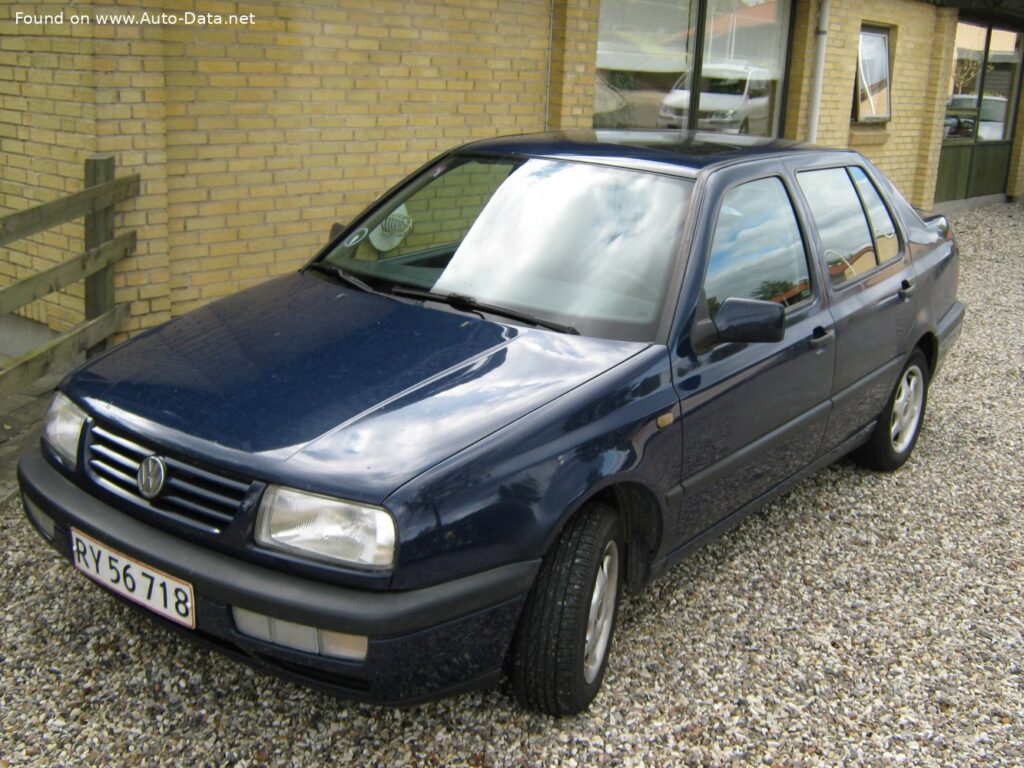
The Volkswagen Vento, produced from 1995 to 1997, represented Volkswagen’s continued presence in the compact sedan market. Built on the 1HX0 platform – shared with the third-generation Golf and Jetta – the Vento was primarily aimed at markets outside of North America, where the Jetta nameplate was preferred. Within the Vento lineup, the 1.9 SDI (64 hp) variant occupied the entry-level position, prioritizing fuel economy and affordability over outright performance. It served as a practical and economical choice for buyers seeking a no-frills, reliable sedan.
Volkswagen Vento 1.9 SDI (64 hp): An Overview
The 1.9 SDI model was a key component of the Vento’s appeal in Europe, South America, and Asia. It offered a diesel engine option for those seeking lower running costs, particularly in regions with higher gasoline prices. This variant distinguished itself from other Vento trims, such as the 1.8 and 2.0 gasoline engines, and later the 1.9 TDI, by its naturally aspirated diesel engine and typically more basic equipment levels. The 1.9 SDI was designed for drivers who valued efficiency and durability above all else.
Powertrain & Engine Architecture
The heart of the Vento 1.9 SDI was the AEY engine code, a 1.9-liter inline four-cylinder diesel engine. This engine utilized a direct injection (DI) system, a technology that improved fuel efficiency and reduced emissions compared to older indirect injection diesels. The direct injection system injected fuel directly into the combustion chamber, allowing for more complete combustion. The engine featured a single overhead camshaft (OHC) valvetrain with two valves per cylinder. This configuration was chosen for its simplicity and reliability.
The 1.9 SDI produced 64 horsepower at 4200 rpm and 92.2 lb-ft of torque at 2200 rpm. While not a powerhouse, the engine’s torque characteristics made it reasonably drivable in everyday conditions. The engine’s displacement was 1896 cm³ (115.7 cubic inches), with a bore of 79.5 mm (3.13 inches) and a stroke of 95.5 mm (3.76 inches). The compression ratio was a high 19.5:1, typical for diesel engines. The engine required 4.3 liters (4.54 US quarts) of engine oil, specified to Volkswagen standards.
Driving Characteristics
The Vento 1.9 SDI, with its 64 horsepower, was not designed for spirited driving. Acceleration was modest, taking approximately 18.3 seconds to reach 62 mph (100 km/h) and 17.4 seconds to reach 60 mph. The top speed was limited to around 96.93 mph (156 km/h). The engine’s strength lay in its low-end torque, which provided adequate pulling power for everyday driving situations. The five-speed manual transmission, standard on this model, allowed drivers to make the most of the available power. Compared to the more powerful 1.8 and 2.0 liter gasoline versions, the 1.9 SDI felt significantly slower, but it offered a more relaxed and fuel-efficient driving experience. The gear ratios were optimized for fuel economy rather than acceleration.
Equipment & Trim Levels
The 1.9 SDI Vento typically came with a relatively basic level of equipment, reflecting its position as the entry-level model. Standard features generally included power steering, cloth upholstery, and a basic stereo system. Air conditioning, power windows, and central locking were often optional extras. The interior was functional and durable, prioritizing practicality over luxury. Dashboard configuration was consistent across the Vento range, with a straightforward layout and easy-to-read gauges. Trim levels varied depending on the market, but generally, the 1.9 SDI was offered with minimal cosmetic enhancements.
Chassis & Braking
The Vento 1.9 SDI utilized a front-wheel-drive layout. The front suspension consisted of wishbones, providing a comfortable ride and predictable handling. The rear suspension employed a torsion beam with traction connecting levers, a cost-effective and space-saving design. The braking system featured disc brakes on the front wheels and drum brakes on the rear wheels. Hydraulic power steering was standard, making maneuvering at low speeds easier. The vehicle rode on 185/60 R14 T tires mounted on 14-inch steel wheels. The chassis was tuned for comfort and stability, rather than sporty handling.
Market Reception & Comparison
The Vento 1.9 SDI was generally well-received by critics as a practical and economical choice. Its fuel economy – rated at 48 US mpg (4.9 l/100 km) – was a major selling point, particularly in Europe where diesel fuel was often cheaper than gasoline. However, its performance was often criticized as being underwhelming. Compared to the gasoline-powered Vento models, the 1.9 SDI offered significantly lower running costs but at the expense of acceleration and refinement. The later introduction of the 1.9 TDI engine, which offered more power and torque, further highlighted the 1.9 SDI’s limitations. Despite this, the 1.9 SDI remained a popular choice for budget-conscious buyers and those who prioritized fuel efficiency.
Technical Specifications
| Brand | Volkswagen |
| Model | Vento |
| Generation | Vento (1HX0) |
| Type (Engine) | 1.9 SDI (64 Hp) |
| Start of production | 1995 |
| End of production | 1997 |
| Engine Type | Internal Combustion engine |
| Body type | Sedan |
| Seats | 5 |
| Doors | 4 |
| Fuel consumption (combined) | 4.9 l/100 km (48 US mpg, 57.6 UK mpg, 20.4 km/l) |
| Fuel Type | Diesel |
| Acceleration 0 – 100 km/h | 18.3 sec |
| Acceleration 0 – 62 mph | 18.3 sec |
| Acceleration 0 – 60 mph | 17.4 sec |
| Maximum speed | 156 km/h (96.93 mph) |
| Weight-to-power ratio | 19.1 kg/Hp |
| Weight-to-torque ratio | 9.8 kg/Nm |
| Power | 64 Hp @ 4200 rpm |
| Torque | 125 Nm @ 2200 rpm (92.2 lb.-ft. @ 2200 rpm) |
| Engine layout | Front, Transverse |
| Engine Model/Code | AEY |
| Engine displacement | 1896 cm3 (115.7 cu. in.) |
| Number of cylinders | 4 |
| Engine configuration | Inline |
| Cylinder Bore | 79.5 mm (3.13 in.) |
| Piston Stroke | 95.5 mm (3.76 in.) |
| Compression ratio | 19.5:1 |
| Number of valves per cylinder | 2 |
| Fuel injection system | Direct injection |
| Engine aspiration | Naturally aspirated |
| Valvetrain | OHC |
| Engine oil capacity | 4.3 l (4.54 US qt | 3.78 UK qt) |
| Kerb Weight | 1225 kg (2700.66 lbs.) |
| Max. weight | 1630 kg (3593.53 lbs.) |
| Max load | 405 kg (892.87 lbs.) |
| Trunk (boot) space – minimum | 500 l (17.66 cu. ft.) |
| Trunk (boot) space – maximum | 850 l (30.02 cu. ft.) |
| Fuel tank capacity | 55 l (14.53 US gal | 12.1 UK gal) |
| Length | 4980 mm (196.06 in.) |
| Width | 1695 mm (66.73 in.) |
| Height | 1425 mm (56.1 in.) |
| Wheelbase | 2475 mm (97.44 in.) |
| Front track | 1464 mm (57.64 in.) |
| Rear track | 1448 mm (57.01 in.) |
| Drive wheel | Front wheel drive |
| Number of gears | 5 |
| Gearbox type | Manual transmission |
Legacy
The Volkswagen Vento 1.9 SDI, while not a performance icon, has proven to be a remarkably durable and reliable vehicle. The 1.9 SDI engine, known for its simplicity and robustness, has a reputation for longevity, even with high mileage. In the used car market today, these Ventos are often sought after by buyers looking for an affordable and dependable transportation option. While parts availability may be becoming more challenging, the engine’s straightforward design makes it relatively easy to maintain and repair. The Vento 1.9 SDI remains a testament to Volkswagen’s commitment to building practical and long-lasting vehicles.
