
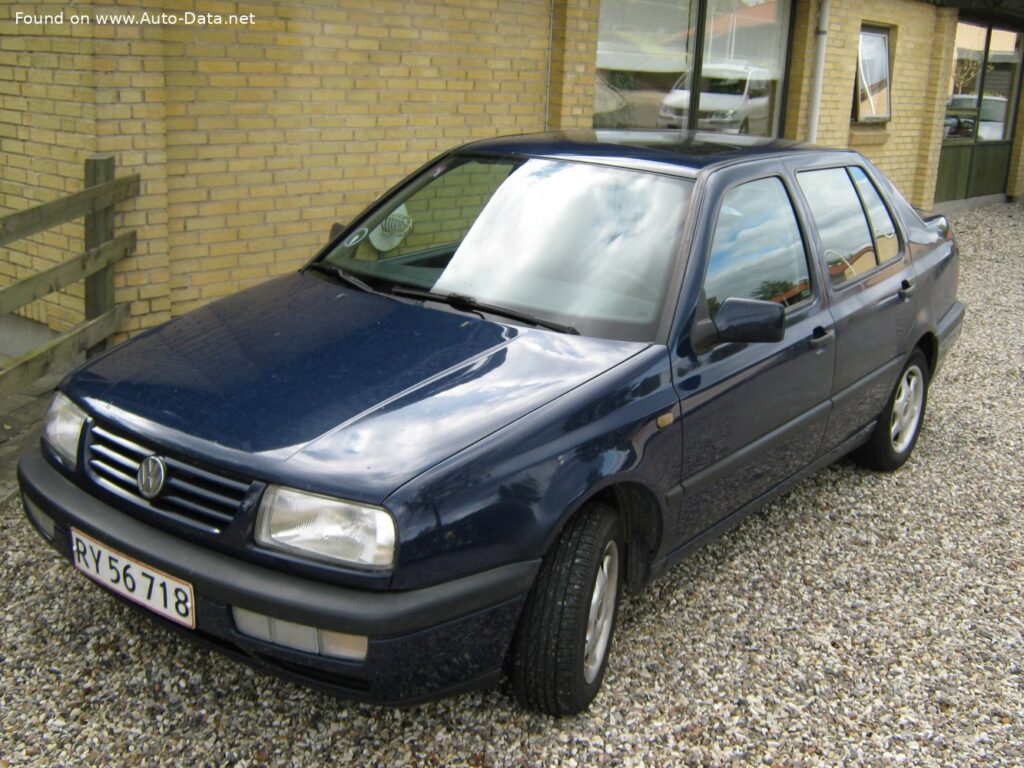
The Volkswagen Vento (1HX0), produced from January 1992 to 1998, was Volkswagen’s entry in the compact sedan market, primarily aimed at Europe, Asia, and Latin America. It represented a significant step forward from the aging Jetta II (B2) it replaced, sharing its underpinnings with the contemporary Golf Mk3 (1HX0/A3 platform). The Vento was offered with a range of engines and trim levels, catering to diverse buyer preferences. This article focuses specifically on the 2.0-liter (115 hp) variant, a mid-range offering that balanced performance with affordability, and its position within the Vento lineup.
The 2.0-Liter Vento: A Mid-Range Contender
The 2.0-liter Vento, designated by engine code ADY, occupied a crucial space in the Vento range. It sat above the base 1.6-liter models, offering a noticeable performance increase, but remained below the more powerful and expensive VR6 variants. This positioning made it an attractive option for buyers seeking a comfortable, well-equipped sedan with sufficient power for everyday driving and occasional highway journeys. It was marketed towards families and individuals who prioritized practicality and reliability over outright sporting performance.
Powertrain & Engine Architecture
The heart of the 2.0-liter Vento is the ADY engine, a naturally aspirated, inline four-cylinder gasoline engine displacing 1984cc (121.07 cubic inches). This engine featured multi-port fuel injection, a relatively common technology at the time, providing precise fuel delivery for improved efficiency and reduced emissions. The engine utilized a single overhead camshaft (OHC) valvetrain, operating two valves per cylinder. The bore and stroke measured 82.5mm and 92.8mm respectively, resulting in a compression ratio of 10:1. The ADY engine produced 115 horsepower at 5200 rpm and 170 Nm (125.39 lb-ft) of torque at 2400 rpm.
While manual transmissions were common, the 2.0-liter engine was also offered with a four-speed automatic transmission. This automatic, while providing convenience, was not known for its sportiness or fuel efficiency. It featured a traditional hydraulic torque converter and was geared towards smooth, comfortable shifts rather than rapid acceleration. The automatic transmission’s gear ratios were optimized for everyday drivability, prioritizing fuel economy at cruising speeds.
Driving Characteristics
The 2.0-liter Vento with the automatic transmission delivered a comfortable, if not particularly exhilarating, driving experience. Acceleration from 0 to 62 mph (0-100 km/h) took approximately 10.4 seconds, and top speed was rated at 198 km/h (123.03 mph). Compared to the manual transmission version of the same engine, the automatic resulted in a slight performance decrease due to the power loss through the torque converter and the less aggressive gear ratios. The automatic transmission’s shift points were programmed for smoothness, sometimes resulting in the engine feeling slightly strained during overtaking maneuvers. However, for typical urban and highway driving, the 2.0-liter automatic provided adequate power and responsiveness.
The Vento’s suspension, tuned for comfort, absorbed bumps and imperfections in the road well. Steering was precise, thanks to the rack and pinion system with hydraulic power assistance, but lacked the direct feel of more performance-oriented vehicles. The overall driving experience was geared towards providing a relaxed and refined ride.
Equipment & Trim Levels
The 2.0-liter Vento typically came equipped with a reasonable level of standard features. Base models included power steering, central locking, and a basic stereo system. Higher trim levels, often denoted by designations like “GL” or “Comfort,” added features such as electric windows, power mirrors, upgraded upholstery, and alloy wheels. Interior upholstery was typically cloth, with options for velour or leather available on higher-spec models. Dashboard configurations were relatively simple and functional, with clear instrumentation and logically placed controls. Optional extras included air conditioning, a sunroof, and upgraded audio systems.
Chassis & Braking
The Vento’s chassis was based on the Golf Mk3 platform, featuring independent front suspension with wishbones and a torsion beam rear suspension. This setup provided a good balance between ride comfort and handling. Braking systems varied depending on the trim level and market. Most 2.0-liter Ventos were equipped with ventilated disc brakes on the front wheels and disc brakes on the rear. However, some base models may have featured drum brakes on the rear axle. All models were equipped with an Anti-lock Braking System (ABS) as standard or optional equipment, enhancing safety and control during emergency braking situations. The front track measured 1464mm, while the rear track was 1448mm.
Market Reception & Comparison
The 2.0-liter Vento received generally positive reviews from automotive critics. It was praised for its comfortable ride, spacious interior, and reasonable performance. However, the automatic transmission was often criticized for its lack of responsiveness and its impact on fuel economy. Compared to the 1.6-liter models, the 2.0-liter offered a significant improvement in performance, making it a more enjoyable car to drive, particularly on the highway. In contrast to the VR6 variants, the 2.0-liter was more affordable and offered better fuel economy, appealing to a wider range of buyers. Fuel consumption figures were approximately 10.5 l/100 km (22.4 US mpg) in urban conditions, 6 l/100 km (39.2 US mpg) on the extra-urban cycle, and 7.5 l/100 km (31.4 US mpg) combined.
Technical Specifications
| Brand | Volkswagen |
| Model | Vento |
| Generation | Vento (1HX0) |
| Engine Type | 2.0 (115 Hp) |
| Start of Production | January 1992 |
| End of Production | 1998 |
| Fuel Type | Petrol (Gasoline) |
| Fuel Consumption (Urban) | 10.5 l/100 km (22.4 US mpg) |
| Fuel Consumption (Extra Urban) | 6 l/100 km (39.2 US mpg) |
| Fuel Consumption (Combined) | 7.5 l/100 km (31.4 US mpg) |
| Acceleration 0-100 km/h | 10.4 sec |
| Acceleration 0-62 mph | 10.4 sec |
| Maximum Speed | 198 km/h (123.03 mph) |
| Engine Displacement | 1984 cm3 (121.07 cu. in.) |
| Number of Cylinders | 4 |
| Engine Code | ADY |
| Power | 115 Hp @ 5200 rpm |
| Torque | 170 Nm @ 2400 rpm (125.39 lb.-ft. @ 2400 rpm) |
| Kerb Weight | 1235 kg (2722.71 lbs.) |
| Fuel Tank Capacity | 55 l (14.53 US gal) |
| Length | 4380 mm (172.44 in.) |
| Width | 1695 mm (66.73 in.) |
| Height | 1415 mm (55.71 in.) |
| Wheelbase | 2475 mm (97.44 in.) |
| Gearbox | 4-speed Automatic |
Legacy
The 2.0-liter ADY engine, while not known for being particularly groundbreaking, proved to be a reliable and durable powerplant. Ventos equipped with this engine and the four-speed automatic transmission are still found on the roads today, often with high mileage. The ADY engine is relatively simple to maintain, and spare parts are readily available. However, the automatic transmission can be prone to wear and tear, particularly if not serviced regularly. In the used car market, the 2.0-liter Vento represents a good value proposition, offering a comfortable and practical sedan at an affordable price. Its reputation for reliability and relatively low running costs makes it a popular choice for budget-conscious buyers.
