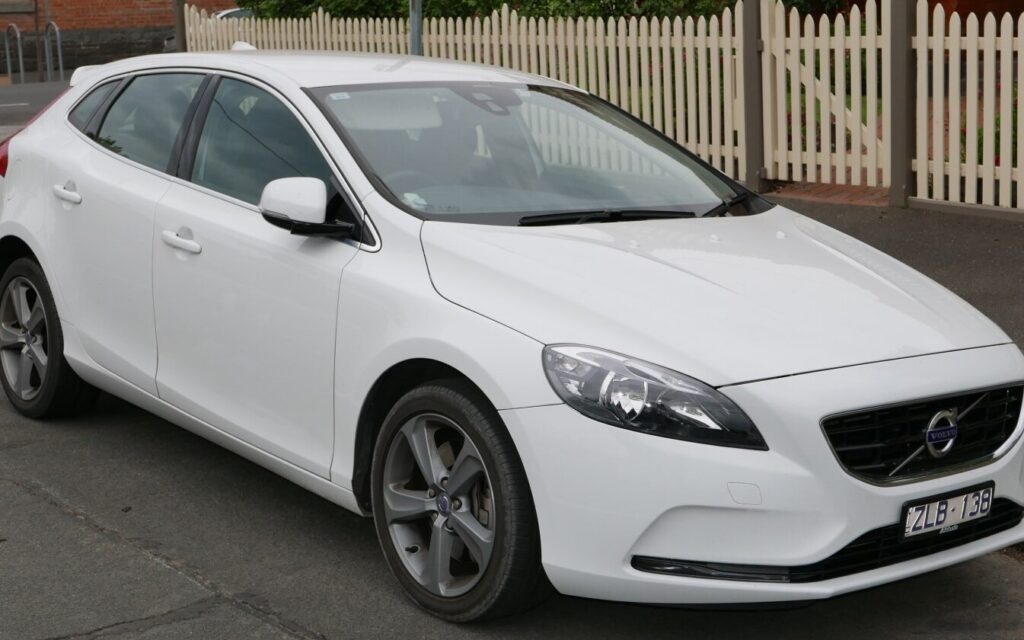
The Volvo V40 (facelift 2016): A Premium European Compact Hatchback
The Volvo V40 (facelift 2016) 2.0 D4 (190 Hp) Geartronic Restricted Start/Stop represents a significant iteration of Volvo’s premium compact hatchback, a model primarily targeted at the discerning European and other international markets where it competed directly with established German rivals. Launched in 2016 as a refreshed version of the second-generation V40, this particular variant, with its potent 2.0-liter D4 diesel engine, positioned itself as a compelling choice for buyers seeking a blend of Scandinavian design, robust performance, exceptional fuel efficiency, and Volvo’s renowned safety credentials. Though never officially sold in the United States, the V40 played a crucial role in cementing Volvo’s presence in the highly competitive premium compact segment in its primary markets, showcasing the brand’s evolving design language and advanced powertrain technologies.
The V40, in its facelifted form, maintained its distinctive, sleek profile, offering a more contemporary aesthetic that aligned with Volvo’s newer models like the XC90 and S90. It was a testament to Volvo’s commitment to offering a full range of vehicles, from larger sedans and SUVs down to the compact class. The 2.0 D4 powertrain, part of Volvo’s innovative Drive-E engine family, epitomized the brand’s strategy of delivering strong performance alongside impressive economy and reduced emissions, a critical factor in the European automotive landscape. This model served as a benchmark for what a premium compact could offer in terms of driving dynamics, interior refinement, and technological integration during its production run from 2016 to 2018.
Powertrain and Performance: The Volvo V40 (facelift 2016) D4 Diesel Engine
Engine Architecture and Output
At the heart of the Volvo V40 (facelift 2016) 2.0 D4 (190 Hp) Geartronic Restricted Start/Stop lies Volvo’s sophisticated D4204T14 engine, a 2.0-liter (1969 cm³) inline four-cylinder diesel unit from the brand’s modular Drive-E powertrain family. This engine exemplifies modern diesel engineering, featuring a common rail fuel injection system and a advanced twin-turbocharger setup with an intercooler. The twin-turbo configuration is particularly noteworthy, allowing for a broad power band and excellent responsiveness across the RPM range.
The D4 engine produces a robust 190 horsepower at 4250 rpm, delivering a power-per-liter output of 96.5 HP/L, which is highly competitive for its class. More impressively, it generates a substantial 295.02 lb.-ft. of torque, available from a low 1750 rpm and sustained up to 2500 rpm. This wide torque band is crucial for both brisk acceleration and flexible in-gear performance, making the V40 D4 feel effortlessly powerful in various driving scenarios, from city commuting to highway cruising. The engine’s bore and stroke measurements of 82 mm (3.23 in) and 93.2 mm (3.67 in), respectively, alongside a compression ratio of 15.8:1, are optimized for diesel efficiency and power delivery.
Transmission and Drivetrain
Power is channeled to the front wheels via a smooth-shifting 6-speed Geartronic automatic transmission. This automatic gearbox is well-matched to the D4 engine’s torque characteristics, providing seamless gear changes and contributing to both comfort and efficiency. The front-wheel-drive architecture, combined with a well-tuned independent front McPherson strut and independent coil spring rear suspension, ensures predictable handling and a comfortable ride quality, characteristic of Volvo vehicles. Electric power steering further enhances the driving experience, offering precise control and ease of maneuverability.
Performance Metrics and Efficiency
Despite its focus on economy, the V40 D4 is a genuinely quick car. It accelerates from 0 to 60 mph in a swift 6.8 seconds (0-100 km/h in 7.2 seconds) and can reach a top speed of 142.92 mph (230 km/h). These figures place it firmly in the performance territory of its premium compact rivals.
However, where the D4 truly shines is in its fuel efficiency. The official combined fuel consumption stands at an impressive 58.8 US mpg (4 liters per 100 km). In extra-urban driving, this figure climbs even higher to an astounding 67.2 US mpg (3.5 liters per 100 km), while urban driving still yields a respectable 48 US mpg (4.9 liters per 100 km). These figures are significantly aided by the “Restricted Start/Stop” system, which automatically shuts off the engine when the vehicle is stationary, reducing fuel consumption and emissions in traffic. With CO2 emissions of just 106 g/km, the V40 D4 met stringent Euro 6 emission standards, underscoring Volvo’s commitment to environmental responsibility. The vehicle also includes a particulate filter, a standard feature for modern diesels to reduce harmful emissions.
Refined Design and Advanced Features
Exterior and Interior Design
The Volvo V40 (facelift 2016) retained its characteristically sleek and dynamic hatchback silhouette, a design that blended practicality with a sporty aesthetic. The facelift introduced subtle yet impactful changes, most notably at the front, where it adopted Volvo’s signature “Thor’s Hammer” LED daytime running lights, first seen on the larger XC90. This instantly recognizable feature, combined with a revised grille and updated Volvo iron mark, gave the V40 a more contemporary and upscale appearance, aligning it with the brand’s evolving design language. The vehicle’s dimensions—172.01 inches long, 70.2 inches wide (80.35 inches including mirrors), and 56.65 inches tall, with a 104.21-inch wheelbase—contributed to its agile stance and spacious interior for a compact car.
Inside, the V40 continued to offer a cabin that was a hallmark of Scandinavian design: minimalist, ergonomic, and crafted from high-quality materials. The facelift brought new upholstery options, trim inserts, and an updated Sensus infotainment system (though specific details of the latter are not in the provided data, it’s a standard Volvo feature for the era). The floating center console, a Volvo design staple, provided both aesthetic appeal and practical storage. With seating for five passengers across five doors, the V40 offered good versatility. Trunk space ranged from 11.83 cubic feet with all seats up, expanding to a generous 52.97 cubic feet with the rear seats folded down, making it a highly practical choice for daily life and weekend trips.
Safety and Driver Assistance
As a Volvo, safety was an inherent and paramount design principle for the V40. While the provided data specifically mentions ABS (Anti-lock Braking System) and ventilated discs for the front brakes and disc brakes for the rear, the V40 in this generation was equipped with a comprehensive suite of active and passive safety features. These would typically include multiple airbags, stability and traction control systems, and Volvo’s City Safety system (standard in many markets), which could automatically brake the car to avoid or mitigate low-speed collisions. The robust body structure and advanced crumple zones were also central to its excellent crash test ratings in Europe.
Convenience and Practicality
Beyond performance and safety, the V40 offered a high degree of everyday practicality. Its compact dimensions, combined with a minimum turning circle of 35.43 feet (10.8 meters), made it highly maneuverable in urban environments. The 10.57 US gallon (40 liter) fuel tank, coupled with its excellent fuel economy, provided a substantial driving range. A maximum roof load of 165.35 lbs. (75 kg) and a permitted trailer load with brakes of 3306.93 lbs. (1500 kg) further underscored its utility, allowing owners to carry extra cargo or tow small trailers when needed.
Technical Specifications
| Feature | Value |
|---|---|
| General Information | |
| Brand | Volvo |
| Model | V40 |
| Generation | V40 (facelift 2016) |
| Type (Engine) | 2.0 D4 (190 Hp) Geartronic Restricted Start/Stop |
| Start of production | 2016 year |
| End of production | 2018 year |
| Powertrain Architecture | Internal Combustion engine |
| Body type | Hatchback |
| Seats | 5 |
| Doors | 5 |
| Performance Specs | |
| Fuel consumption (urban) | 4.9 l/100 km (48 US mpg) |
| Fuel consumption (extra urban) | 3.5 l/100 km (67.2 US mpg) |
| Fuel consumption (combined) | 4 l/100 km (58.8 US mpg) |
| CO2 emissions | 106 g/km |
| Fuel Type | Diesel |
| Acceleration 0 – 60 mph | 6.8 sec |
| Acceleration 0 – 100 km/h | 7.2 sec |
| Maximum speed | 230 km/h (142.92 mph) |
| Emission standard | Euro 6 |
| Engine Specs | |
| Power | 190 Hp @ 4250 rpm |
| Power per liter | 96.5 Hp/l |
| Torque | 400 Nm (295.02 lb.-ft.) @ 1750-2500 rpm |
| Engine layout | Front, Transverse |
| Engine Model/Code | D4204T14 |
| Engine displacement | 1969 cm³ (2.0 Liters / 120.16 cu. in.) |
| Number of cylinders | 4 |
| Engine configuration | Inline |
| Cylinder Bore | 82 mm (3.23 in) |
| Piston Stroke | 93.2 mm (3.67 in) |
| Compression ratio | 15.8:1 |
| Number of valves per cylinder | 4 |
| Fuel injection system | Diesel Commonrail |
| Engine aspiration | Twin-Turbo, Intercooler |
| Engine oil capacity | 5.2 l (5.49 US qt) |
| Coolant | 8 l (8.45 US qt) |
| Engine Systems | |
| Start & Stop System | Yes (Restricted) |
| Particulate filter | Yes |
| Space, Volume and Weights | |
| Trunk (boot) space – minimum | 335 l (11.83 cu. ft.) |
| Trunk (boot) space – maximum | 1500 l (52.97 cu. ft.) |
| Fuel tank capacity | 40 l (10.57 US gal) |
| Max. roof load | 75 kg (165.35 lbs.) |
| Permitted trailer load with brakes (12%) | 1500 kg (3306.93 lbs.) |
| Dimensions | |
| Length | 4369 mm (172.01 in) |
| Width | 1783 mm (70.2 in) |
| Width including mirrors | 2041 mm (80.35 in) |
| Height | 1439 mm (56.65 in) |
| Wheelbase | 2647 mm (104.21 in) |
| Front track | 1559 mm (61.38 in) |
| Rear (Back) track | 1546 mm (60.87 in) |
| Ride height (ground clearance) | 133-144 mm (5.24 – 5.67 in) |
| Drag coefficient (Cd) | 0.32 |
| Minimum turning circle (turning diameter) | 10.8 m (35.43 ft) |
| Drivetrain, Brakes and Suspension Specs | |
| Drivetrain Architecture | Front-wheel drive, Internal Combustion engine |
| Drive wheel | Front wheel drive |
| Number of gears and type of gearbox | 6 gears, automatic transmission Geartronic |
| Front suspension | Independent, type McPherson with coil spring and anti-roll bar |
| Rear suspension | Independent coil spring |
| Front brakes | Ventilated discs |
| Rear brakes | Disc |
| Assisting systems | ABS (Anti-lock braking system) |
| Steering type | Steering rack and pinion |
| Power steering | Electric Steering |
Legacy and Market Standing in the European Segment
The Volvo V40 (facelift 2016) 2.0 D4 (190 Hp) Geartronic Restricted Start/Stop held a distinct position in the European premium compact segment. While it faced formidable competition from the well-entrenched German trio—the Audi A3, BMW 1 Series, and Mercedes-Benz A-Class—the V40 carved out its own niche by offering a compelling alternative. Its appeal lay in a combination of factors: unmistakable Scandinavian design, a reputation for class-leading safety, a comfortable and sophisticated interior, and, particularly with the D4 engine, an outstanding balance of performance and fuel economy.
In markets where it was sold, the V40 was often chosen by buyers who valued understated luxury, robust build quality, and a focus on real-world usability over aggressive sportiness. The D4 engine, in particular, was lauded for its powerful yet refined character, making it a favorite for long-distance commuters and those who appreciated strong torque delivery. Its Euro 6 compliance and low CO2 emissions were significant selling points in environmentally conscious European countries, often translating into lower vehicle taxes and running costs.
Competitors like the Audi A3 offered a more overtly premium and technologically saturated experience, while the BMW 1 Series emphasized rear-wheel-drive dynamics (though later generations moved to FWD). The Mercedes-Benz A-Class brought a youthful, stylish edge. The V40, in contrast, offered a more mature, design-led approach, with a strong emphasis on occupant well-being and a less ostentatious presentation. It also indirectly competed with higher trims of mainstream compacts like the Volkswagen Golf and even the Lexus CT 200h, though the latter focused solely on hybrid powertrains.
The V40 generation, including this facelifted D4 model, was instrumental in showcasing Volvo’s modern design direction and its innovative Drive-E powertrain strategy. It demonstrated that Volvo could compete effectively in a segment dominated by established players, offering a unique blend of attributes that resonated with a specific demographic. Although its production concluded in 2019 without a direct successor in the traditional hatchback form, elements of its design philosophy and powertrain technology continued to influence subsequent Volvo models, particularly in the brand’s shift towards electrification and SUV-centric offerings. The V40’s legacy is that of a highly competent and distinctively Volvo entry into the premium compact world, remembered for its safety, efficiency, and elegant Scandinavian charm.