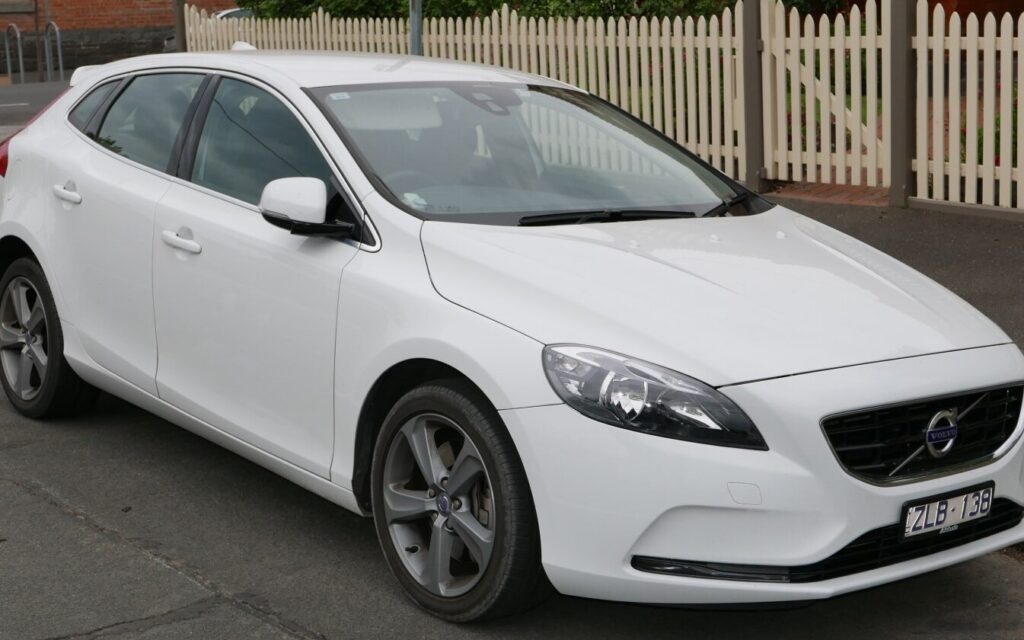
As an international automotive expert, I present a detailed analysis of the Volvo V40 (facelift 2016) 2.0 T2 (122 Hp).
Introduction: The Volvo V40 (facelift 2016) – Volvo’s Premium Compact Hatchback
The Volvo V40 (facelift 2016) represents a significant chapter in Volvo’s modern history, serving as the Swedish automaker’s primary contender in the highly competitive European premium compact hatchback segment. Launched in 2012, the V40 was designed to challenge established German rivals like the Audi A3, BMW 1 Series, and Mercedes-Benz A-Class, offering a distinctly Scandinavian alternative focused on safety, elegant design, and a refined driving experience. The 2016 facelift brought a series of aesthetic and technological updates, keeping the model fresh and aligned with Volvo’s evolving design language, particularly the introduction of the “Thor’s Hammer” LED daytime running lights, which became a signature element across the brand’s lineup.
This particular variant, the 2.0 T2 (122 Hp), positioned itself as an accessible yet capable entry point into the V40 range, balancing efficiency with adequate performance for daily European driving conditions. While the Volvo V40 was never officially sold in the United States, its influence and technological advancements were indicative of Volvo’s global trajectory, showcasing the brand’s commitment to sophisticated engineering and occupant safety that would eventually permeate its US-market offerings. For a market accustomed to larger sedans and SUVs, the V40 offered a compact, agile, and fuel-efficient package that resonated strongly with European consumers seeking a premium experience in a smaller footprint.
Engine & Performance: The Efficient 2.0 T2 Powertrain
The heart of the Volvo V40 (facelift 2016) 2.0 T2 (122 Hp) is a modern and efficient 2.0-liter (1969 cm³ or 120.16 cu. in.) inline-four gasoline engine, designated with the internal code B4204T38. This powerplant is a testament to Volvo’s commitment to downsized, turbocharged engines that deliver a strong blend of performance and fuel economy. Equipped with a turbocharger and intercooler, the engine benefits from forced induction, which significantly enhances its power delivery across a broad RPM range, a characteristic highly valued in compact vehicles.
The engine produces a respectable 122 horsepower at 5000 rpm, which, when combined with its substantial torque output, provides a lively driving experience for its class. Peak torque stands at 220 Newton-meters (162.26 lb.-ft.), available across an impressively wide band from just 1100 rpm up to 3500 rpm. This broad torque curve is crucial for excellent drivability, ensuring strong pull from low speeds and minimizing the need for frequent gear changes, particularly in urban environments or when navigating winding European roads. Power is sent to the front wheels via a precise 6-speed manual transmission, offering engaging control for the driver.
In terms of outright performance, the V40 2.0 T2 accelerates from 0 to 60 mph in a competitive 9.3 seconds (0-100 km/h in 9.8 seconds), reaching a maximum speed of 118.06 mph (190 km/h). These figures demonstrate its capability for both city commuting and comfortable highway cruising. Furthermore, the engine’s direct injection fuel system contributes to its impressive fuel efficiency, achieving a combined economy of 5.5 liters per 100 kilometers, equivalent to approximately 42.8 US miles per gallon. With CO2 emissions of 127 g/km, the V40 2.0 T2 met stringent Euro 6 emission standards, underscoring Volvo’s dedication to environmental responsibility.
Design & Features: Scandinavian Elegance and Practicality
The design of the Volvo V40 (facelift 2016) embodies Volvo’s distinctive Scandinavian aesthetic, characterized by clean lines, understated elegance, and a strong emphasis on functionality. As a 5-door hatchback, it offers a versatile body style that combines the practicality of a wagon with the compact dimensions of a sedan. The 2016 facelift introduced key visual updates, most notably the “Thor’s Hammer” LED daytime running lights integrated into the headlights, which gave the V40 a more modern and assertive front fascia, bringing it in line with the design language of newer Volvo models like the XC90.
Measuring 172.01 inches (4369 mm) in length, 70.2 inches (1783 mm) in width (80.35 inches or 2041 mm including mirrors), and 56.65 inches (1439 mm) in height, the V40 is perfectly sized for navigating crowded European city streets while offering a comfortable interior for five occupants. The wheelbase of 104.21 inches (2647 mm) contributes to both interior space and stable handling. Inside, the cabin reflects Volvo’s human-centric design philosophy, featuring high-quality materials, ergonomic controls, and a minimalist aesthetic. While specific infotainment details are not provided in the raw data, for a 2016 premium compact, one would expect a comprehensive system with connectivity options.
Practicality is a strong suit for the V40. The hatchback body provides flexible cargo solutions, with a minimum trunk space of 11.44 cubic feet (324 liters) that expands significantly to 52.97 cubic feet (1500 liters) with the rear seats folded down. This versatility makes it suitable for varied lifestyles, from daily commutes to weekend getaways. The vehicle’s kerb weight stands at 3243 lbs (1471 kg), with a maximum permissible weight of 4332.08 lbs (1965 kg), allowing for a substantial maximum load of 1089.08 lbs (494 kg). A fuel tank capacity of 16.38 US gallons (62 liters) ensures a good driving range.
Underneath, the V40 features a robust chassis designed for comfort and confident handling. It employs an independent McPherson strut front suspension with coil springs and an anti-roll bar, paired with an independent coil spring rear suspension. This setup provides a well-balanced ride, absorbing road imperfections while maintaining composure during dynamic driving. Braking is handled by ventilated discs at the front and solid discs at the rear, complemented by an Anti-lock Braking System (ABS) for enhanced safety. The electric power steering system, with a steering rack and pinion, offers precise control and light effort, making parking and low-speed maneuvers effortless, with a minimum turning circle of 35.43 feet (10.8 meters).
Technical Specifications
| Category | Specification | Metric Value | US Equivalent |
|---|---|---|---|
| General Information | |||
| Brand | Volvo | ||
| Model | V40 | ||
| Generation | V40 (facelift 2016) | ||
| Engine Type | 2.0 T2 (122 Hp) | ||
| Production Start | 2016 year | ||
| Production End | 2018 year | ||
| Powertrain Architecture | Internal Combustion engine, Front Wheel Drive | ||
| Body Type | Hatchback | ||
| Seats | 5 | ||
| Doors | 5 | ||
| Performance Specifications | |||
| Fuel Consumption (Combined) | 5.5 l/100 km | 5.5 l/100 km | 42.8 US mpg |
| CO2 Emissions | 127 g/km | 127 g/km | |
| Fuel Type | Petrol (Gasoline) | ||
| Acceleration 0 – 60 mph | 9.3 sec | 9.3 sec (calculated) | 9.3 sec |
| Acceleration 0 – 100 km/h | 9.8 sec | 9.8 sec | |
| Maximum Speed | 190 km/h | 190 km/h | 118.06 mph |
| Emission Standard | Euro 6 | ||
| Weight-to-Power Ratio | 12.1 kg/Hp | 12.1 kg/Hp | 26.68 lbs/Hp |
| Weight-to-Torque Ratio | 6.7 kg/Nm | 6.7 kg/Nm | 4.56 lbs/lb.-ft. |
| Engine Specifications | |||
| Power | 122 Hp @ 5000 rpm | 122 Hp @ 5000 rpm | 122 Hp @ 5000 rpm |
| Power per liter | 62 Hp/l | 62 Hp/l | |
| Torque | 220 Nm @ 1100-3500 rpm | 220 Nm @ 1100-3500 rpm | 162.26 lb.-ft. @ 1100-3500 rpm |
| Engine Layout | Front, Transverse | ||
| Engine Model/Code | B4204T38 | ||
| Engine Displacement | 1969 cm³ | 1969 cm³ | 120.16 cu. in. |
| Number of Cylinders | 4 | ||
| Engine Configuration | Inline | ||
| Cylinder Bore | 82 mm | 82 mm | 3.23 in. |
| Piston Stroke | 93.2 mm | 93.2 mm | 3.67 in. |
| Compression Ratio | 11.3:1 | ||
| Valves per Cylinder | 4 | ||
| Fuel Injection System | Direct injection | ||
| Engine Aspiration | Turbocharger, Intercooler | ||
| Engine Oil Capacity | 5.6 l | 5.6 l | 5.92 US qt |
| Coolant Capacity | 7.5 l | 7.5 l | 7.93 US qt |
| Space, Volume and Weights | |||
| Kerb Weight | 1471 kg | 1471 kg | 3243 lbs |
| Max. Weight | 1965 kg | 1965 kg | 4332.08 lbs |
| Max Load | 494 kg | 494 kg | 1089.08 lbs |
| Trunk Space (Min) | 324 l | 324 l | 11.44 cu. ft. |
| Trunk Space (Max) | 1500 l | 1500 l | 52.97 cu. ft. |
| Fuel Tank Capacity | 62 l | 62 l | 16.38 US gal |
| Max. Roof Load | 75 kg | 75 kg | 165.35 lbs |
| Permitted Trailer Load (with brakes, 12%) | 1500 kg | 1500 kg | 3306.93 lbs |
| Dimensions | |||
| Length | 4369 mm | 4369 mm | 172.01 in. |
| Width | 1783 mm | 1783 mm | 70.2 in. |
| Width (incl. mirrors) | 2041 mm | 2041 mm | 80.35 in. |
| Height | 1439 mm | 1439 mm | 56.65 in. |
| Wheelbase | 2647 mm | 2647 mm | 104.21 in. |
| Front Track | 1559 mm | 1559 mm | 61.38 in. |
| Rear Track | 1546 mm | 1546 mm | 60.87 in. |
| Ride Height (Ground Clearance) | 133-144 mm | 133-144 mm | 5.24 – 5.67 in. |
| Drag Coefficient (Cd) | 0.32 | ||
| Minimum Turning Circle | 10.8 m | 10.8 m | 35.43 ft. |
| Drivetrain, Brakes and Suspension | |||
| Drivetrain Architecture | Internal Combustion engine drives the front wheels | ||
| Drive Wheel | Front wheel drive | ||
| Gearbox Type | 6 gears, manual transmission | ||
| Front Suspension | Independent, type McPherson with coil spring and anti-roll bar | ||
| Rear Suspension | Independent coil spring | ||
| Front Brakes | Ventilated discs | ||
| Rear Brakes | Disc | ||
| Assisting Systems | ABS (Anti-lock braking system) | ||
| Steering Type | Steering rack and pinion | ||
| Power Steering | Electric Steering | ||
Legacy & Market Impact: The Volvo V40 in the European Landscape
The Volvo V40, particularly after its 2016 facelift, played a crucial role in Volvo’s product strategy within the European market. It was Volvo’s most compact offering and its direct competitor against the formidable German trio in the premium compact hatchback segment. While it didn’t achieve the sales volumes of its German rivals, the V40 carved out a significant niche for itself by offering a distinct blend of attributes that appealed to a specific segment of buyers.
Its primary competitors were the Audi A3 Sportback, BMW 1 Series, and Mercedes-Benz A-Class. Against these, the V40 stood out with its emphasis on safety, a hallmark of the Volvo brand, often featuring advanced safety technologies as standard or readily available options. Its Scandinavian design, both inside and out, offered a refreshing alternative to the more aggressive or conservative aesthetics of its competitors. The interior, with its