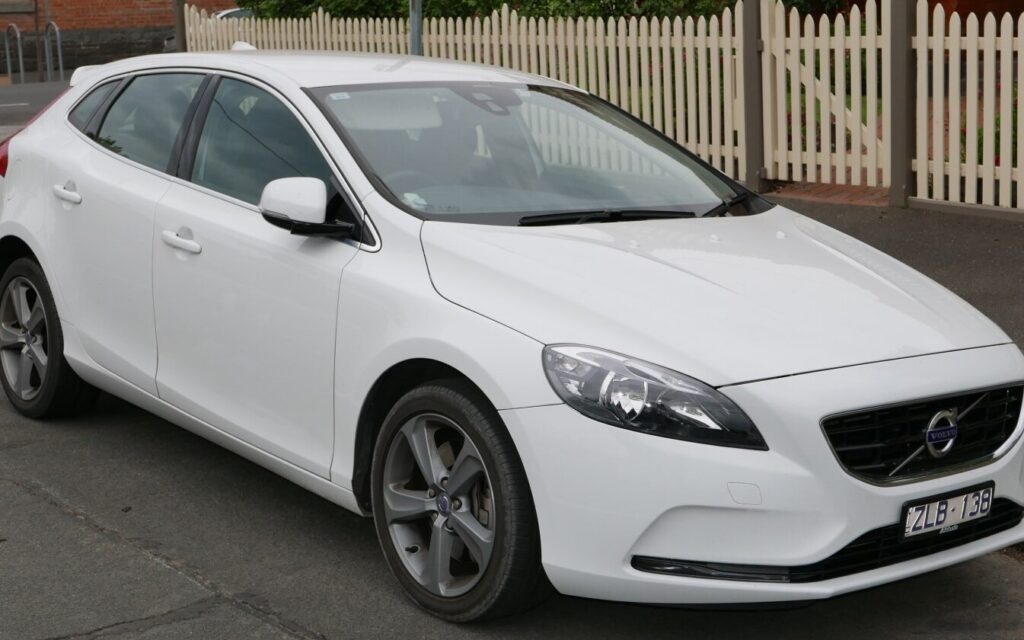
The Volvo V40 (facelift 2016) 2.0 T4 (190 Hp): A Refined European Compact
The Volvo V40 (facelift 2016) 2.0 T4 (190 Hp) represents a significant refresh of Volvo’s premium compact hatchback, a model primarily targeted at the discerning European market. Introduced in 2016 and produced until 2018, this iteration of the V40 aimed to solidify Volvo’s presence in the competitive C-segment, offering a compelling blend of Scandinavian design, advanced safety features, and efficient powertrains. Positioned as an upscale alternative to mainstream compacts, the V40 competed directly with established German rivals such as the Audi A3, BMW 1 Series, and Mercedes-Benz A-Class, leveraging Volvo’s renowned reputation for safety and understated luxury. This particular variant, equipped with the 2.0-liter T4 engine, offered a spirited yet economical driving experience, embodying Volvo’s commitment to modern engineering and driver engagement within a practical hatchback package.
Evolution and Market Positioning of the Volvo V40 (facelift 2016)
The original Volvo V40, launched in 2012, marked Volvo’s return to the compact hatchback segment after a hiatus. Its 2016 facelift brought a series of aesthetic and technological updates, aligning its design language more closely with the brand’s larger, newer models like the XC90 and S90. Key visual changes included the adoption of Volvo’s signature “Thor’s Hammer” LED daytime running lights, a refreshed grille, and new alloy wheel designs, lending the V40 a more contemporary and sophisticated appearance. While never officially sold in the United States, the V40 played a crucial role in Volvo’s global strategy, serving as an entry point into the brand for many European buyers. It combined practicality with premium aspirations, appealing to urban dwellers and small families seeking a safe, stylish, and well-built vehicle without the larger footprint of an SUV or sedan.
Engine and Performance: The 2.0 T4 Powertrain in the Volvo V40 (facelift 2016)
At the heart of the Volvo V40 (facelift 2016) 2.0 T4 (190 Hp) lies Volvo’s B4204T19 engine, a modern 2.0-liter inline four-cylinder gasoline unit. This powertrain architecture, featuring a front, transverse layout, is engineered for both performance and efficiency. Equipped with a turbocharger and intercooler, the T4 engine delivers a robust 190 horsepower at 4700 rpm, providing ample power for both city driving and highway cruising. More impressively, it generates a substantial 221.27 lb.-ft. of torque across a broad range, from a low 1300 rpm up to 4000 rpm. This wide torque band ensures responsive acceleration and flexible in-gear performance, minimizing the need for frequent downshifts.
The direct fuel injection system and a high compression ratio of 11.3:1 contribute to the engine’s efficiency and power output. Mated to a precise 6-speed manual transmission, this setup allows the V40 T4 to achieve a swift acceleration from 0 to 60 mph in just 6.6 seconds, with a top speed electronically limited to 130.49 mph. Despite its energetic performance, the V40 T4 remains commendable in terms of fuel economy for its class. It boasts a combined fuel consumption rating of 42.8 US mpg (5.5 l/100 km) and CO2 emissions of 127 g/km, adhering to the stringent Euro 6 emission standards. This balance of power and parsimony made the 2.0 T4 a popular choice for drivers seeking a dynamic yet responsible daily driver in its segment.
Drivetrain, Brakes, and Suspension
The Volvo V40 (facelift 2016) 2.0 T4 utilizes a front-wheel-drive architecture, a common and efficient layout for compact vehicles. The independent McPherson strut front suspension with coil springs and an anti-roll bar, combined with an independent coil spring rear suspension, provides a well-balanced ride quality. This setup strikes a commendable compromise between comfort and agile handling, soaking up road imperfections while maintaining composure through corners. Braking performance is handled by ventilated discs at the front and solid discs at the rear, complemented by an Anti-lock Braking System (ABS) for enhanced stopping power and stability. The electric power steering system offers precise control and variable assistance, making the V40 easy to maneuver in urban environments and stable at higher speeds.
Design and Features: Scandinavian Practicality and Innovation
The Volvo V40 (facelift 2016) retains its distinctive five-door hatchback body type, offering a practical and versatile package. Measuring 172.01 inches in length, 70.2 inches in width (80.35 inches including mirrors), and 56.65 inches in height, the V40 strikes a compact yet substantial presence. Its wheelbase of 104.21 inches contributes to a stable ride and generous interior space for its class. The exterior design, characterized by clean lines, a strong shoulder line, and the refreshed “Thor’s Hammer” LED headlights, exudes a sophisticated and modern Scandinavian aesthetic.
Inside, the V40 offers a cabin designed with typical Volvo ergonomics and high-quality materials. It comfortably accommodates five occupants, with supportive seating and thoughtful storage solutions. The minimum trunk space of 11.44 cubic feet is expandable to a generous 52.97 cubic feet with the rear seats folded down, underscoring its versatility for cargo. While specific interior technology features like infotainment screen size or advanced driver-assistance systems (ADAS) are not detailed in the provided data, it’s well-known that Volvo, even in 2016, equipped its vehicles with a strong suite of safety technologies beyond standard ABS. Features such as City Safety (autonomous emergency braking), pedestrian detection, and various driver aids were often standard or available, reinforcing Volvo’s reputation as a pioneer in automotive safety.
Other practical features include a 16.38 US gallon fuel tank, providing a decent range, and a maximum roof load capacity of 165.35 lbs., enhancing its utility. The drag coefficient (Cd) of 0.32 indicates a reasonably aerodynamic profile, contributing to both fuel efficiency and reduced wind noise at speed. Its tight minimum turning circle of 35.43 feet makes it remarkably nimble in tight city streets and parking situations.
Technical Specifications
| Volvo V40 (facelift 2016) 2.0 T4 (190 Hp) – Technical Specifications | |
|---|---|
General Information |
|
| Brand | Volvo |
| Model | V40 |
| Generation | V40 (facelift 2016) |
| Engine Type | 2.0 T4 (190 Hp) |
| Start of Production | 2016 year |
| End of Production | 2018 year |
| Powertrain Architecture | Internal Combustion engine |
| Body type | Hatchback |
| Seats | 5 |
| Doors | 5 |
Performance Specifications |
|
| Fuel consumption (economy) – urban | 7.3 l/100 km (32.2 US mpg) |
| Fuel consumption (economy) – extra urban | 4.5 l/100 km (52.3 US mpg) |
| Fuel consumption (economy) – combined | 5.5 l/100 km (42.8 US mpg) |
| CO2 emissions | 127 g/km |
| Fuel Type | Petrol (Gasoline) |
| Acceleration 0 – 60 mph | 6.6 sec |
| Acceleration 0 – 62 mph (0-100 km/h) | 6.9 sec |
| Maximum speed | 210 km/h (130.49 mph) |
| Emission standard | Euro 6 |
Engine Specifications |
|
| Power | 190 Hp @ 4700 rpm |
| Power per liter | 96.5 Hp/l |
| Torque | 300 Nm (221.27 lb.-ft.) @ 1300-4000 rpm |
| Engine layout | Front, Transverse |
| Engine Model/Code | B4204T19 |
| Engine displacement | 1969 cm3 (2.0 liters / 120.16 cu. in.) |
| Number of cylinders | 4 |
| Engine configuration | Inline |
| Cylinder Bore | 82 mm (3.23 in.) |
| Piston Stroke | 93.2 mm (3.67 in.) |
| Compression ratio | 11.3:1 |
| Number of valves per cylinder | 4 |
| Fuel injection system | Direct injection |
| Engine aspiration | Turbocharger, Intercooler |
| Engine oil capacity | 5.9 l (6.23 US qt) |
| Coolant capacity | 7.5 l (7.93 US qt) |
Space, Volume and Weights |
|
| Trunk (boot) space – minimum | 324 l (11.44 cu. ft.) |
| Trunk (boot) space – maximum | 1500 l (52.97 cu. ft.) |
| Fuel tank capacity | 62 l (16.38 US gal) |
| Max. roof load | 75 kg (165.35 lbs.) |
| Permitted trailer load with brakes (12%) | 1500 kg (3306.93 lbs.) |
Dimensions |
|
| Length | 4369 mm (172.01 in.) |
| Width | 1783 mm (70.2 in.) |
| Width including mirrors | 2041 mm (80.35 in.) |
| Height | 1439 mm (56.65 in.) |
| Wheelbase | 2647 mm (104.21 in.) |
| Front track | 1559 mm (61.38 in.) |
| Rear (Back) track | 1546 mm (60.87 in.) |
| Ride height (ground clearance) | 133-144 mm (5.24 – 5.67 in.) |
| Drag coefficient (Cd) | 0.32 |
| Minimum turning circle (turning diameter) | 10.8 m (35.43 ft.) |
Drivetrain, Brakes and Suspension |
|
| Drivetrain Architecture | The Internal combustion engine (ICE) drives the front wheels of the vehicle. |
| Drive wheel | Front wheel drive |
| Number of gears and type of gearbox | 6 gears, manual transmission |
| Front suspension | Independent, type McPherson with coil spring and anti-roll bar |
| Rear suspension | Independent coil spring |
| Front brakes | Ventilated discs |
| Rear brakes | Disc |
| Assisting systems | ABS (Anti-lock braking system) |
| Steering type | Steering rack and pinion |
| Power steering | Electric Steering |
Legacy and Market Impact of the Volvo V40 (facelift 2016)
Although the Volvo V40 (facelift 2016) was a relatively short-lived model in its refreshed guise (2016-2018), it played a vital role in Volvo’s product portfolio, particularly in Europe. It served as a crucial competitor in the premium compact hatchback segment, where it faced stiff competition from established German marques like the Audi A3, BMW 1 Series, and Mercedes-Benz A-Class. What set the V40 apart was its distinct Scandinavian approach: a blend of understated elegance, class-leading safety innovations, and a focus on user-friendly ergonomics rather than overt sportiness or aggressive styling.
The V40’s reputation was built on its solid build quality, comfortable ride, and, as expected from Volvo, its exceptional safety credentials. The facelifted model continued this tradition, often scoring highly in independent crash tests (like Euro NCAP) and featuring advanced active safety systems that were ahead of many competitors at the time. The 2.0 T4 engine variant, in particular, was well-regarded for offering a strong balance of performance and efficiency, making it an attractive option for those seeking a dynamic driving experience without excessive running costs.
Ultimately, the V40’s market impact was significant in reinforcing Volvo’s image as a premium brand capable of competing outside its traditional larger sedan and SUV segments. It introduced a new generation of buyers to the Volvo ethos of safety, quality, and distinctive design. While it never made it to North American shores, its success in Europe demonstrated Volvo’s adaptability and commitment to a diverse global market. The V40’s legacy paved the way for future compact offerings and contributed to the brand’s overall resurgence in the late 2010s, even as Volvo’s focus shifted towards SUVs and electrification. It remains a testament to Volvo’s ability to craft a compelling and uniquely Scandinavian offering in a highly competitive automotive landscape.