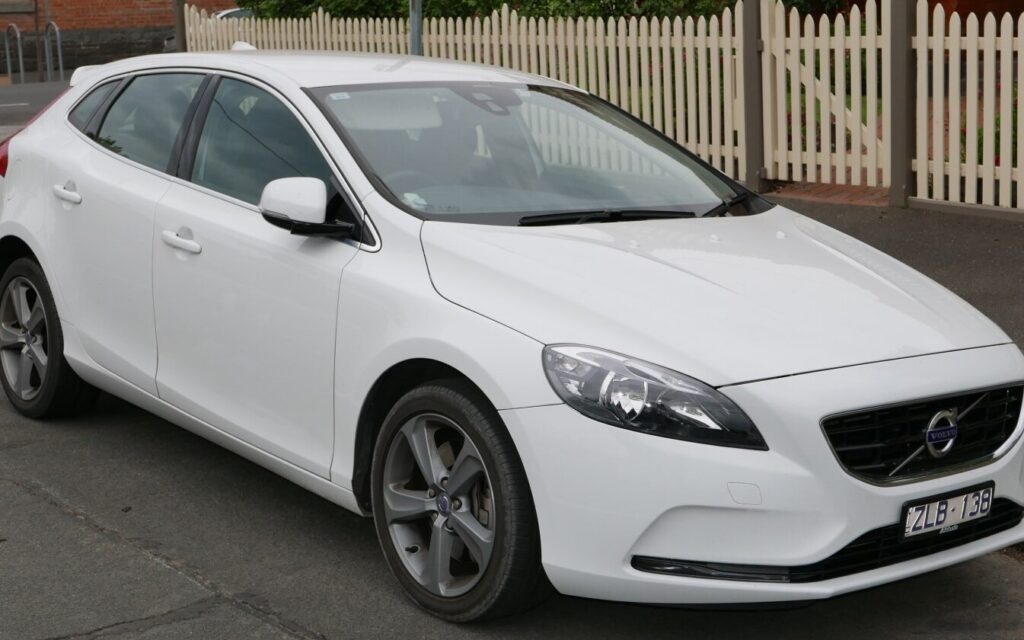
The Volvo V40 (facelift 2016): A Premium Compact Hatchback for the Global Stage
The Volvo V40 (facelift 2016) represents a significant refresh of Volvo’s premium compact hatchback, a model primarily targeted at the European and Asian markets. Introduced in 2016 and produced until 2018, this iteration of the V40 aimed to solidify Volvo’s presence in the highly competitive C-segment, offering a blend of Scandinavian design, advanced safety features, and efficient powertrains. While never officially sold in the United States, the V40 played a crucial role in showcasing Volvo’s modern design language and engineering capabilities before the brand’s full global platform overhaul.
This particular variant, the 2.0 T4 with 190 horsepower and an automatic transmission, exemplifies the V40’s appeal as a sophisticated and capable daily driver. It combined a responsive turbocharged gasoline engine with a smooth automatic gearbox, delivering a balanced driving experience suitable for both urban commuting and longer journeys. The V40’s refined demeanor and strong emphasis on passenger safety distinguished it within its class, appealing to a demographic that valued understated luxury and robust engineering.
Engine and Performance: Powering the Volvo V40 (facelift 2016)
Under the hood of the Volvo V40 (facelift 2016) 2.0 T4 lies Volvo’s Drive-E family of engines, specifically the B4204T19 inline four-cylinder gasoline unit. This powertrain architecture, featuring a front, transverse engine layout, was a cornerstone of Volvo’s strategy for efficiency and performance during this era. With an engine displacement of 1,969 cm³ (approximately 2.0 liters or 120.16 cubic inches), the T4 variant was equipped with a sophisticated turbocharger and intercooler system, along with direct fuel injection, to maximize both power output and fuel economy.
The engine generates a robust 190 horsepower at 4,700 rpm, translating to an impressive 96.5 horsepower per liter. More significantly for real-world driving, it produces a substantial 221.27 lb.-ft. of torque, available across a broad rev range from a low 1,300 rpm all the way up to 4,000 rpm. This wide torque band ensures strong, flexible acceleration and effortless cruising, reducing the need for frequent gear changes. Power is channeled through a smooth 6-speed automatic transmission to the front wheels, providing a refined and comfortable driving experience.
Performance figures for the V40 2.0 T4 are quite respectable for a premium compact hatchback. It can accelerate from 0 to 60 mph in a quick 6.6 seconds, with 0 to 100 km/h achieved in 6.9 seconds. The top speed is electronically limited to 130.49 mph (210 km/h). Despite its lively performance, the V40 T4 maintains impressive fuel efficiency, with a combined fuel economy rating of 42.8 US mpg (5.5 l/100 km). It also meets the stringent Euro 6 emission standard, with CO2 emissions of 128 g/km, reflecting Volvo’s commitment to environmental responsibility.
Design and Features: Scandinavian Elegance and Practicality
The Volvo V40 (facelift 2016) retained its distinctive five-door hatchback body type, characterized by its sleek lines and dynamic stance. The facelift introduced several key aesthetic enhancements, most notably the “Thor’s Hammer” LED daytime running lights, which became a signature design element across the Volvo lineup. These, combined with a refreshed grille featuring the updated Volvo Iron Mark badge, gave the V40 a more contemporary and sophisticated appearance, aligning it with newer models like the XC90.
Measuring 172.01 inches in length, 70.2 inches in width (80.35 inches including mirrors), and 56.65 inches in height, the V40 presented a compact yet well-proportioned profile. Its wheelbase of 104.21 inches contributed to stable handling and a comfortable ride. The interior, designed to accommodate five occupants, exemplified Scandinavian minimalism and ergonomic excellence. High-quality materials, comfortable seating, and an intuitive layout were hallmarks of the V40’s cabin. While not explicitly detailed in the provided data, the V40 of this era would typically feature Volvo’s Sensus Connect infotainment system, offering connectivity and multimedia functions.
Safety remained paramount for Volvo, and the V40 was no exception. It came equipped with a comprehensive suite of safety features, including ABS (Anti-lock Braking System) as standard. Other advanced safety systems, often available as options or in higher trim levels, included City Safety (autonomous emergency braking), pedestrian detection, lane keeping aid, and blind spot information system. The V40 also featured an innovative pedestrian airbag, an industry-first at its launch, further underscoring Volvo’s commitment to protecting all road users. Practicality was addressed with a minimum trunk space of 11.44 cubic feet (324 liters), expandable to a generous 52.97 cubic feet (1500 liters) with the rear seats folded, making it versatile for various cargo needs.
Technical Specifications
| Category | Specification |
|---|---|
| Brand | Volvo |
| Model | V40 (facelift 2016) |
| Type (Engine) | 2.0 T4 (190 Hp) Automatic |
| Start of Production | 2016 year |
| End of Production | 2018 year |
| Body Type | Hatchback |
| Seats | 5 |
| Doors | 5 |
| Performance Specs | |
| Fuel Consumption (Urban) | 7.2 l/100 km (32.7 US mpg) |
| Fuel Consumption (Extra Urban) | 4.6 l/100 km (51.1 US mpg) |
| Fuel Consumption (Combined) | 5.5 l/100 km (42.8 US mpg) |
| CO2 Emissions | 128 g/km |
| Fuel Type | Petrol (Gasoline) |
| Acceleration 0 – 60 mph | 6.6 sec |
| Acceleration 0 – 100 km/h | 6.9 sec |
| Maximum Speed | 130.49 mph (210 km/h) |
| Emission Standard | Euro 6 |
| Engine Specs | |
| Power | 190 Hp @ 4700 rpm |
| Power per Liter | 96.5 Hp/l |
| Torque | 221.27 lb.-ft. @ 1300-4000 rpm (300 Nm) |
| Engine Layout | Front, Transverse |
| Engine Model/Code | B4204T19 |
| Engine Displacement | 1969 cm³ (120.16 cu. in.) |
| Number of Cylinders | 4 |
| Engine Configuration | Inline |
| Cylinder Bore | 3.23 in. (82 mm) |
| Piston Stroke | 3.67 in. (93.2 mm) |
| Compression Ratio | 11.3:1 |
| Number of Valves per Cylinder | 4 |
| Fuel Injection System | Direct injection |
| Engine Aspiration | Turbocharger, Intercooler |
| Engine Oil Capacity | 6.23 US qt (5.9 l) |
| Coolant Capacity | 7.93 US qt (7.5 l) |
| Space, Volume and Weights | |
| Trunk (boot) Space – Minimum | 11.44 cu. ft. (324 l) |
| Trunk (boot) Space – Maximum | 52.97 cu. ft. (1500 l) |
| Fuel Tank Capacity | 16.38 US gal (62 l) |
| Max. Roof Load | 165.35 lbs. (75 kg) |
| Permitted Trailer Load with Brakes (12%) | 3306.93 lbs. (1500 kg) |
| Dimensions | |
| Length | 172.01 in. (4369 mm) |
| Width | 70.2 in. (1783 mm) |
| Width Including Mirrors | 80.35 in. (2041 mm) |
| Height | 56.65 in. (1439 mm) |
| Wheelbase | 104.21 in. (2647 mm) |
| Front Track | 61.38 in. (1559 mm) |
| Rear (Back) Track | 60.87 in. (1546 mm) |
| Ride Height (Ground Clearance) | 5.24 – 5.67 in. (133-144 mm) |
| Drag Coefficient (Cd) | 0.32 |
| Minimum Turning Circle (Turning Diameter) | 35.43 ft. (10.8 m) |
| Drivetrain, Brakes and Suspension Specs | |
| Drivetrain Architecture | Internal Combustion engine drives the front wheels. |
| Drive Wheel | Front wheel drive |
| Number of Gears and Type of Gearbox | 6 gears, automatic transmission |
| Front Suspension | Independent, type McPherson with coil spring and anti-roll bar |
| Rear Suspension | Independent coil spring |
| Front Brakes | Ventilated discs |
| Rear Brakes | Disc |
| Assisting Systems | ABS (Anti-lock braking system) |
| Steering Type | Steering rack and pinion |
| Power Steering | Electric Steering |
Legacy and Market Impact
The Volvo V40, particularly its facelifted 2016 iteration, carved out a distinct niche in the highly competitive premium compact segment. While it did not compete in the North American market, in Europe, Asia, and other international territories, it faced formidable rivals such as the Audi A3 Sportback, BMW 1 Series, Mercedes-Benz A-Class, and Volkswagen Golf. Against these established competitors, the V40 offered a compelling alternative, emphasizing attributes that resonated strongly with a specific buyer demographic.
Its primary market impact stemmed from its unwavering commitment to safety, a hallmark of the Volvo brand. The V40 consistently achieved high safety ratings and introduced innovative features like the pedestrian airbag, reinforcing Volvo’s reputation as a leader in automotive safety. Beyond safety, the V40 distinguished itself with its understated yet elegant Scandinavian design, both inside and out. It appealed to consumers seeking a premium experience that was less ostentatious than some of its German counterparts, offering a blend of sophisticated aesthetics and practical functionality.
The 2.0 T4 engine variant, with its balance of performance and efficiency, was particularly well-suited to the demands of European driving, where fuel economy and emissions standards are critical. Its refined powertrain and comfortable ride quality contributed to its reputation as a mature and capable compact car. The V40 also played a vital role in bridging Volvo’s product lineup between the older Ford-derived platforms and the newer, modular SPA (Scalable Product Architecture) and CMA (Compact Modular Architecture) platforms that would underpin future models like the S60, V60, and XC40.
Ultimately, the Volvo V40 (facelift 2016) solidified Volvo’s position in the compact premium segment, demonstrating the brand’s ability to combine distinctive design, advanced technology, and world-class safety in a smaller package. Its legacy is one of quiet competence and thoughtful engineering, setting the stage for Volvo’s subsequent expansion into the compact crossover market with the highly successful XC40, which effectively became its spiritual successor in many markets.