The Volvo V50 (Facelift 2007): A Refined Swedish Compact Wagon
The Volvo V50 (facelift 2007) represents a significant evolution in Volvo’s strategy to offer premium compact vehicles that blend Scandinavian design, renowned safety, and practical utility. Introduced in 2007 as an update to the original V50 launched in 2004, this generation aimed to refresh the model’s aesthetics and enhance its technological offerings. Positioned in the compact executive car segment, the V50 was Volvo’s answer to European premium compact wagons, offering a more versatile alternative to traditional sedans. Sharing its underpinnings with the Ford C1 platform, which also supported the Ford Focus and Mazda3, the V50 brought a dynamic driving experience while retaining Volvo’s core values of safety and understated luxury. The model under review, specifically the 2.4 (140 Hp) Geartronic variant, emphasized smooth performance and efficiency for everyday driving, making it a popular choice for families and individuals seeking a refined and practical vehicle.
Engine and Performance of the Volvo V50 (facelift 2007) 2.4 Geartronic
At the heart of the Volvo V50 (facelift 2007) 2.4 Geartronic lies a naturally aspirated 2.4-liter, inline five-cylinder engine, designated by Volvo as the B5244S5. This engine configuration, a hallmark of many Volvo models, is celebrated for its distinctive sound and inherent smoothness. Producing a respectable 140 horsepower at 5000 revolutions per minute (rpm) and 162.26 lb.-ft. of torque at 4000 rpm, this powertrain was designed for reliable, linear power delivery rather than outright sporting performance. The engine’s power per liter stands at 57.5 Hp/l, indicating a balanced approach to output and longevity.
Power is routed to the front wheels through Volvo’s Geartronic 5-speed automatic transmission. This sophisticated automatic gearbox offers both conventional automatic operation and a manual shift mode, allowing the driver to select gears sequentially. While not a dual-clutch system, the Geartronic provided a comfortable and responsive driving experience for its era, smoothly managing the engine’s output. The V50 2.4 Geartronic accelerates from 0 to 60 mph in a calculated 10.2 seconds, with a top speed of 124.27 mph. These figures underscore its role as a capable daily driver, comfortable on highways and agile enough for urban environments.
Fuel economy for this variant was rated at a combined 25.8 US mpg (9.1 liters per 100 km) under the NEDC cycle, with urban consumption at 17.8 US mpg (13.2 l/100 km) and extra-urban at 35.1 US mpg (6.7 l/100 km). These figures, while not groundbreaking by today’s standards, were competitive for a premium compact wagon with an automatic transmission in the late 2000s. The engine adheres to the Euro 4 emission standard, reflecting its environmental compliance during its production years.
Design and Features
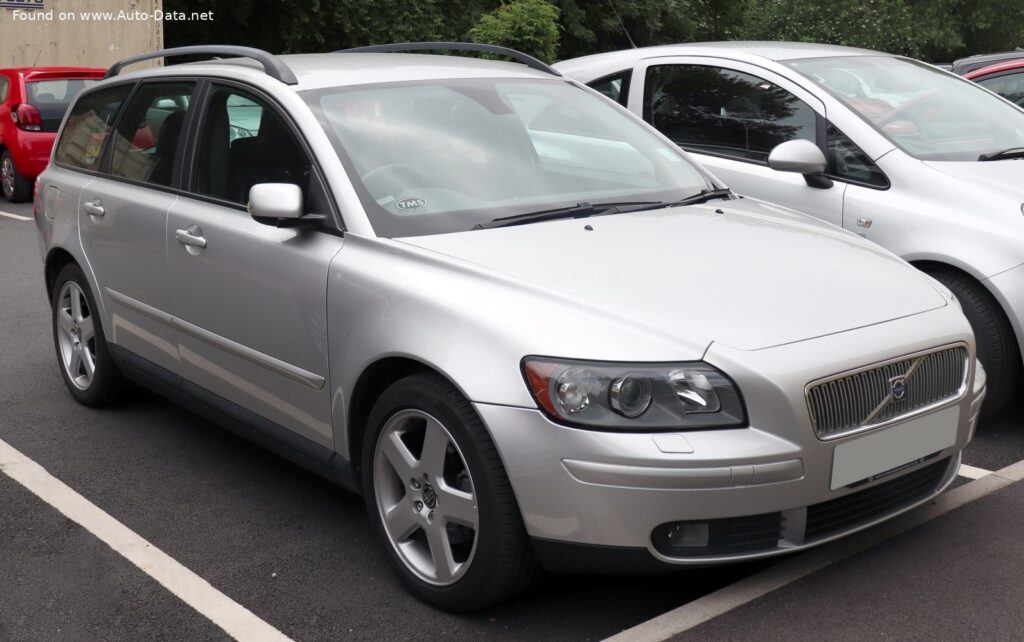
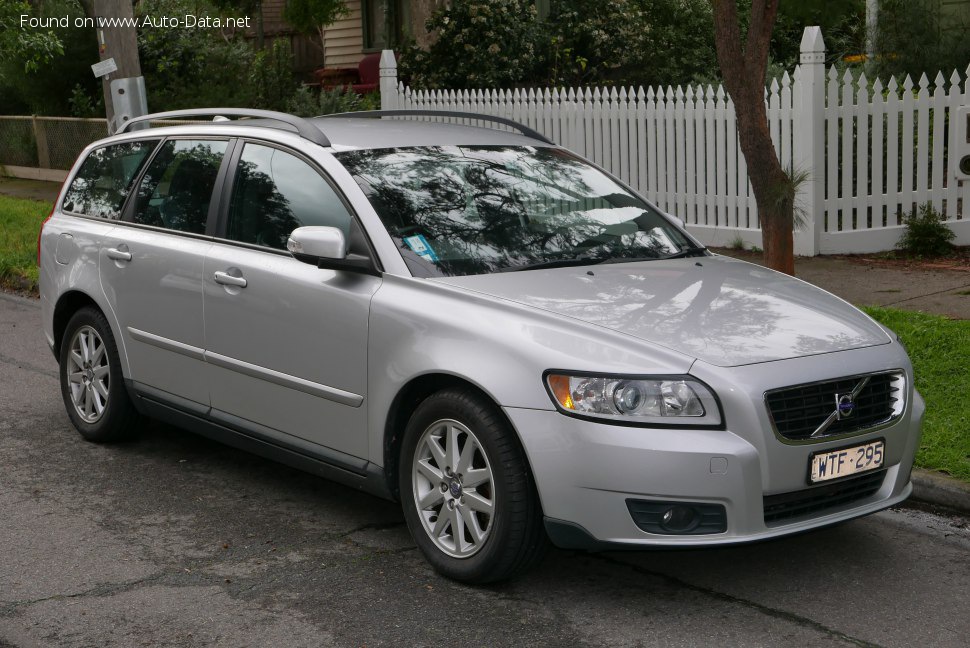
The Volvo V50 (facelift 2007) retained the elegant and understated design language characteristic of the brand, while incorporating subtle refinements. As a five-door, five-seat station wagon (or estate, as it’s known in Europe), the V50 offered a practical yet stylish alternative to sedans. Its exterior dimensions – 178.03 inches in length, 69.69 inches in width (79.61 inches including mirrors), and 57.36 inches in height – provided a compact footprint ideal for maneuverability, coupled with a generous interior. The 2640 mm (103.94 inches) wheelbase contributed to a stable ride and ample cabin space.
The facelift introduced minor aesthetic tweaks, including updated front and rear bumpers, revised grille, and new headlamp designs, giving the V50 a fresher, more contemporary look. Volvo’s commitment to safety was paramount, and the V50 was equipped with a comprehensive suite of passive and active safety features. Standard equipment included ABS (Anti-lock Braking System), multiple airbags, and Volvo’s robust body structure designed to absorb impact energy. The independent McPherson strut front suspension with coil springs and an anti-roll bar, coupled with an independent multi-link rear suspension, ensured a comfortable ride and predictable handling. Ventilated disc brakes up front and solid discs at the rear provided confident stopping power.
Inside, the V50 featured a minimalist yet highly functional cabin, characterized by Volvo’s signature “floating” center console. This design element, first introduced in the larger S40/V50 models, created a sense of spaciousness and modern aesthetic. Standard features typically included power windows, air conditioning, and a quality audio system. Optional upgrades might have included leather upholstery, dual-zone climate control, and advanced infotainment systems for the time. Cargo versatility was a strong point, with a minimum trunk space of 14.73 cubic feet (417 liters) that expanded to an impressive 46.16 cubic feet (1307 liters) with the rear seats folded down, making it highly practical for hauling luggage, groceries, or sports equipment.
Technical Specifications
General Information |
|
| Brand | Volvo |
| Model | V50 |
| Generation | V50 (facelift 2007) |
| Type (Engine) | 2.4 (140 Hp) Geartronic |
| Start of Production | 2007 year |
| End of Production | 2009 year |
| Powertrain Architecture | Internal Combustion engine |
| Body type | Station wagon (estate) |
| Seats | 5 |
| Doors | 5 |
Performance Specifications |
|
| Fuel Consumption (economy) – urban (NEDC) | 13.2 l/100 km (17.8 US mpg) |
| Fuel Consumption (economy) – extra urban (NEDC) | 6.7 l/100 km (35.1 US mpg) |
| Fuel Consumption (economy) – combined (NEDC) | 9.1 l/100 km (25.8 US mpg) |
| CO2 emissions (NEDC) | 217 g/km |
| Fuel Type | Petrol (Gasoline) |
| Acceleration 0 – 60 mph | 10.2 sec |
| Maximum speed | 200 km/h (124.27 mph) |
| Emission standard | Euro 4 |
| Weight-to-power ratio | 9.9 kg/Hp (100.6 Hp/tonne) |
| Weight-to-torque ratio | 6.3 kg/Nm (158 Nm/tonne) |
Engine Specifications |
|
| Power | 140 Hp @ 5000 rpm |
| Power per liter | 57.5 Hp/l |
| Torque | 220 Nm @ 4000 rpm (162.26 lb.-ft. @ 4000 rpm) |
| Engine layout | Front, Transverse |
| Engine Model/Code | B5244S5 |
| Engine displacement | 2435 cm3 (2.4 liters, 148.59 cu. in.) |
| Number of cylinders | 5 |
| Engine configuration | Inline |
| Cylinder Bore | 83 mm (3.27 in.) |
| Piston Stroke | 90 mm (3.54 in.) |
| Compression ratio | 10.3:1 |
| Number of valves per cylinder | 4 |
| Fuel injection system | Multi-port manifold injection |
| Engine aspiration | Naturally aspirated engine |
| Valvetrain | DOHC |
| Engine oil capacity | 5.8 l (6.13 US qt) |
| Coolant | 10 l (10.57 US qt) |
Space, Volume and Weights |
|
| Kerb Weight | 1392 kg (3068.83 lbs.) |
| Max. weight | 1960 kg (4321.06 lbs.) |
| Max load | 568 kg (1252.23 lbs.) |
| Trunk (boot) space – minimum | 417 l (14.73 cu. ft.) |
| Trunk (boot) space – maximum | 1307 l (46.16 cu. ft.) |
| Fuel tank capacity | 62 l (16.38 US gal) |
| Max. roof load | 75 kg (165.35 lbs.) |
| Permitted trailer load with brakes (12%) | 1500 kg (3306.93 lbs.) |
| Permitted trailer load without brakes | 700 kg (1543.24 lbs.) |
| Permitted towbar download | 75 kg (165.35 lbs.) |
Dimensions |
|
| Length | 4522 mm (178.03 in.) |
| Width | 1770 mm (69.69 in.) |
| Width including mirrors | 2022 mm (79.61 in.) |
| Height | 1457 mm (57.36 in.) |
| Wheelbase | 2640 mm (103.94 in.) |
| Front track | 1535 mm (60.43 in.) |
| Rear (Back) track | 1531 mm (60.28 in.) |
| Minimum turning circle (turning diameter) | 10.6 m (34.78 ft.) |
Drivetrain, Brakes and Suspension Specifications |
|
| Drivetrain Architecture | The Internal combustion engine (ICE) drives the front wheels of the vehicle. |
| Drive wheel | Front wheel drive |
| Number of gears and type of gearbox | 5 gears, automatic transmission Geartronic |
| Front suspension | Independent, type McPherson with coil spring and anti-roll bar |
| Rear suspension | Independent multi-link spring suspension with stabilizer |
| Front brakes | Ventilated discs |
| Rear brakes | Disc |
| Assisting systems | ABS (Anti-lock braking system) |
| Steering type | Steering rack and pinion |
| Power steering | Electric Steering |
| Tires size | 205/55 R16; 205/50 R17; 215/45 R18 |
| Wheel rims size | 6.5J x 16; 7J x 17; 7.5J x 18 |
Legacy and Market Impact
The Volvo V50 (facelift 2007), particularly the 2.4 Geartronic variant, played a crucial role in Volvo’s global lineup, especially in markets like North America and Europe where compact premium wagons held significant appeal. It carved out a niche for itself by offering a unique blend of safety, Scandinavian design, and practical utility in a more compact and fuel-efficient package than its larger V70 sibling. Its reputation for solid build quality and longevity contributed to its continued desirability in the used car market years after its production ceased.
In its segment, the V50 competed against formidable European rivals such as the BMW 3 Series Touring, Audi A4 Avant, and the Saab 9-3 SportCombi. While it might not have matched the outright sporty dynamics of a BMW or the interior opulence of an Audi, the V50 distinguished itself with its focus on comfort, safety, and a more understated, functional luxury. Its unique inline five-cylinder engine offered a distinct character that many enthusiasts appreciated.
The V50’s platform sharing with the Ford Focus and Mazda3 allowed Volvo to leverage economies of scale, providing a sophisticated chassis with a European feel. This collaboration helped Volvo expand its reach into the compact segment without compromising its brand identity. The facelifted model, with its subtle enhancements, ensured the V50 remained competitive and visually fresh during its production run from 2007 to 2009.
Ultimately, the V50’s legacy is that of a highly competent and reliable premium compact wagon that embodied Volvo’s core values. It demonstrated that practicality and safety could coexist with elegant design and a refined driving experience, even in a smaller footprint. Its continued presence on roads today is a testament to its robust engineering and enduring appeal as a sensible yet stylish choice for those who value substance and safety in their vehicle. The 2.4 Geartronic model, with its smooth engine and automatic transmission, remains a compelling option for those seeking a comfortable and capable daily driver with a touch of Swedish character.