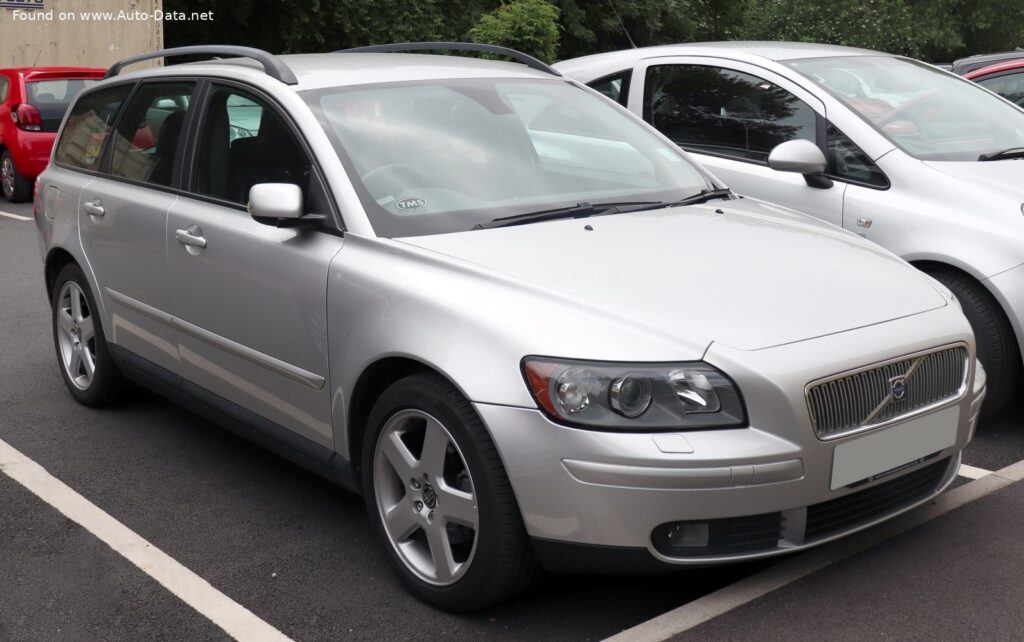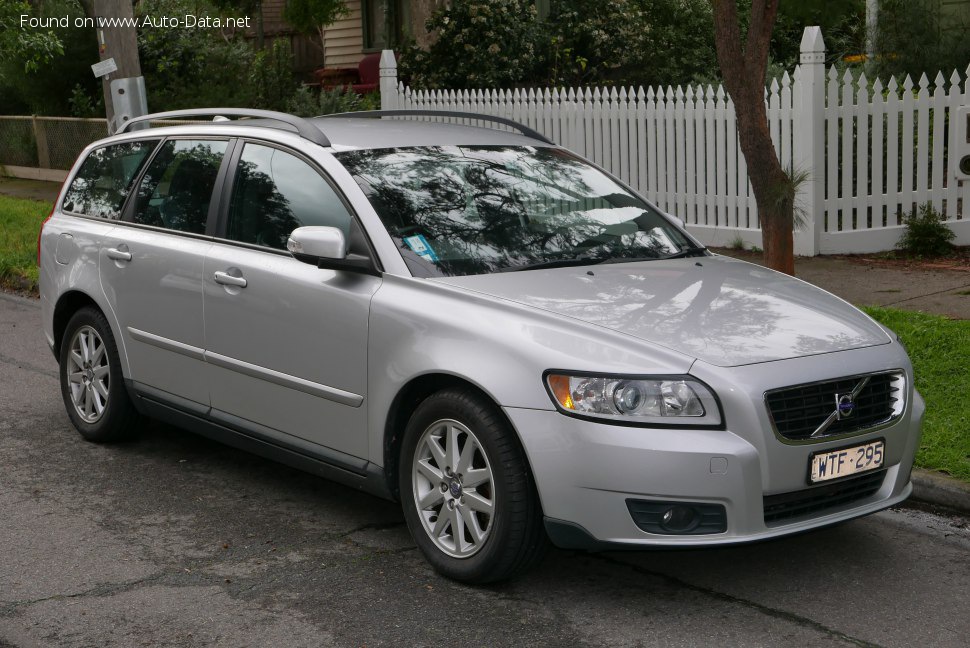
The Volvo V50 (facelift 2007) 2.4 D5 (180 Hp) Geartronic: A European Premium Compact Wagon
The Volvo V50, introduced in 2004, represented Volvo’s entry into the premium compact segment, offering a more dynamic and youthful alternative to its larger wagons while retaining the brand’s core values of safety and practicality. Based on the Ford C1 platform, shared with the Ford Focus and Mazda3, the V50 successfully blended Swedish design with accessible underpinnings. The specific model under review, the Volvo V50 (facelift 2007) 2.4 D5 (180 Hp) Geartronic, represents the updated version of this popular station wagon, produced from 2007 to 2010. This particular variant, powered by Volvo’s renowned 2.4-liter D5 turbodiesel engine and paired with a Geartronic automatic transmission, was a significant offering predominantly in the European market, where diesel powertrains were highly favored for their blend of performance and fuel efficiency.
Positioned as a sophisticated and versatile option for families and individuals seeking a compact vehicle with ample cargo space and a premium feel, the V50 facelift brought subtle yet impactful enhancements to its exterior styling, interior refinement, and technological features. While the V50 was sold in North America, this specific D5 diesel engine variant was not offered in the US market, making it a distinctive example of Volvo’s European-focused powertrain strategy. It showcased Volvo’s commitment to advanced diesel technology, providing strong performance figures, respectable fuel economy, and compliance with the Euro 4 emission standards of its time.
Engine & Performance: The Robust 2.4 D5 Powertrain
At the heart of the Volvo V50 (facelift 2007) 2.4 D5 (180 Hp) Geartronic is Volvo’s venerable D5 diesel engine, an inline-five cylinder, 2.4-liter (2400 cm3 or 146.46 cu. in.) unit. This engine, designated D5244T8, is a testament to Volvo’s engineering prowess, known for its smooth operation, robust torque delivery, and impressive durability. Equipped with a turbocharger and intercooler, along with a common rail fuel injection system, it generates a healthy 180 horsepower at 4000 rpm. More significantly for a diesel, it produces a substantial 258.15 lb-ft (350 Nm) of torque, available across a broad rev range from 1750 to 3250 rpm. This wide torque band ensures strong pulling power and effortless acceleration in various driving conditions.
Power is channeled to the front wheels through a 5-speed Geartronic automatic transmission. This unit offers both fully automatic operation and a manual shift mode, allowing drivers to engage more directly with the powertrain. The combination of the potent D5 engine and Geartronic transmission enables the V50 to accelerate from 0 to 60 mph in a brisk 8.1 seconds (0-100 km/h in 8.5 seconds), with a top speed of 136.7 mph (220 km/h). These figures place it firmly in the performance territory for a compact wagon of its era, especially considering its diesel nature.
Fuel efficiency was a key selling point for the D5 in Europe. The V50 2.4 D5 Geartronic achieved a combined fuel economy of 33.6 US mpg (7 liters per 100 km) under the NEDC cycle. Urban driving returned 24.2 US mpg (9.7 l/100 km), while extra-urban driving could see figures as high as 43.6 US mpg (5.4 l/100 km). With CO2 emissions of 184 g/km and compliance with Euro 4 standards, the vehicle was competitive in its segment for environmental performance at the time. The inclusion of a particulate filter was also a crucial feature for reducing emissions, demonstrating Volvo’s commitment to cleaner diesel technology.
Design & Features: Scandinavian Practicality and Style
The Volvo V50 (facelift 2007) maintained the elegant and understated Scandinavian design language that characterized its predecessor. As a five-door station wagon (often referred to as an “estate” in Europe), it offered a practical and stylish alternative to traditional sedans. The facelift brought subtle but effective updates, including a redesigned front bumper, a larger Volvo iron mark on the grille, new headlight clusters, and LED taillights, enhancing its contemporary appeal. Its compact dimensions, with a length of 178.03 inches (4522 mm) and a width of 69.69 inches (1770 mm), made it maneuverable in urban environments while still offering significant interior volume.
Inside, the V50 continued to impress with its minimalist yet functional cabin. The “floating” center console, a signature design element across Volvo’s P1 platform vehicles, remained a focal point, housing controls for climate and audio systems in an elegant, space-saving manner. High-quality materials and excellent ergonomics were hallmarks of the V50’s interior. Seating for five occupants was comfortable, with Volvo’s renowned orthopedic seat design providing excellent support for long journeys. Practicality was further enhanced by a minimum trunk space of 14.73 cubic feet (417 liters), expandable to a generous 46.16 cubic feet (1307 liters) with the rear seats folded down, making it highly versatile for cargo. A maximum roof load of 165.35 lbs (75 kg) and a permitted trailer load of 3306.93 lbs (1500 kg) with brakes further underscored its utility.
Safety, as always with Volvo, was paramount. The V50 incorporated a suite of advanced safety features for its time, including ABS (Anti-lock Braking System), multiple airbags, and Volvo’s proprietary SIPS (Side Impact Protection System) and WHIPS (Whiplash Protection System). The chassis featured an independent McPherson strut front suspension and an independent multi-link rear suspension, both with anti-roll bars, providing a balanced ride with competent handling. Electric power steering offered precise control, while ventilated disc brakes at the front and disc brakes at the rear ensured strong stopping power. The vehicle typically came with tire sizes ranging from 205/55 R16 to 215/45 R18, depending on the trim and wheel options.
Technical Specifications: Volvo V50 (facelift 2007) 2.4 D5 (180 Hp) Geartronic
| General Information | |
|---|---|
| Brand | Volvo |
| Model | V50 |
| Generation | V50 (facelift 2007) |
| Type (Engine) | 2.4 D5 (180 Hp) Geartronic |
| Start of Production | 2007 year |
| End of Production | 2010 year |
| Powertrain Architecture | Internal Combustion engine |
| Body Type | Station wagon (estate) |
| Seats | 5 |
| Doors | 5 |
| Performance Specifications | |
| Fuel Consumption (Economy) – Urban (NEDC) | 9.7 l/100 km (24.2 US mpg) |
| Fuel Consumption (Economy) – Extra Urban (NEDC) | 5.4 l/100 km (43.6 US mpg) |
| Fuel Consumption (Economy) – Combined (NEDC) | 7 l/100 km (33.6 US mpg) |
| CO2 Emissions (NEDC) | 184 g/km |
| Fuel Type | Diesel |
| Acceleration 0 – 60 mph (Calculated) | 8.1 sec |
| Acceleration 0 – 100 km/h | 8.5 sec |
| Maximum Speed | 220 km/h (136.7 mph) |
| Emission Standard | Euro 4 |
| Weight-to-Power Ratio | 8 kg/Hp (124.9 Hp/tonne) |
| Weight-to-Torque Ratio | 4.1 kg/Nm (242.9 Nm/tonne) |
| Engine Specifications | |
| Power | 180 Hp @ 4000 rpm |
| Power per Liter | 75 Hp/l |
| Torque | 350 Nm @ 1750-3250 rpm (258.15 lb-ft) |
| Engine Layout | Front, Transverse |
| Engine Model/Code | D5244T8 |
| Engine Displacement | 2400 cm3 (2.4 l / 146.46 cu. in.) |
| Number of Cylinders | 5 |
| Engine Configuration | Inline |
| Cylinder Bore | 81 mm (3.19 in.) |
| Piston Stroke | 93.15 mm (3.67 in.) |
| Compression Ratio | 17.3:1 |
| Number of Valves per Cylinder | 4 |
| Fuel Injection System | Diesel Commonrail |
| Engine Aspiration | Turbocharger, Intercooler |
| Valvetrain | DOHC |
| Engine Oil Capacity | 6 l (6.34 US qt) |
| Engine Oil Specification | Not specified |
| Coolant | 10 l (10.57 US qt) |
| Engine Systems | Particulate filter |
| Space, Volume and Weights | |
| Kerb Weight | 1441 kg (3176.86 lbs) |
| Max. Weight | 2020 kg (4453.34 lbs) |
| Max Load | 579 kg (1276.48 lbs) |
| Trunk (Boot) Space – Minimum | 417 l (14.73 cu. ft.) |
| Trunk (Boot) Space – Maximum | 1307 l (46.16 cu. ft.) |
| Fuel Tank Capacity | 60 l (15.85 US gal) |
| Max. Roof Load | 75 kg (165.35 lbs) |
| Permitted Trailer Load with Brakes (12%) | 1500 kg (3306.93 lbs) |
| Permitted Trailer Load without Brakes | 750 kg (1653.47 lbs) |
| Permitted Towbar Download | 75 kg (165.35 lbs) |
| Dimensions | |
| Length | 4522 mm (178.03 in.) |
| Width | 1770 mm (69.69 in.) |
| Width Including Mirrors | 2022 mm (79.61 in.) |
| Height | 1457 mm (57.36 in.) |
| Wheelbase | 2640 mm (103.94 in.) |
| Front Track | 1535 mm (60.43 in.) |
| Rear (Back) Track | 1531 mm (60.28 in.) |
| Minimum Turning Circle (Turning Diameter) | 10.6 m (34.78 ft.) |
| Drivetrain, Brakes and Suspension Specifications | |
| Drivetrain Architecture | Internal combustion engine (ICE) drives the front wheels. |
| Drive Wheel | Front wheel drive |
| Number of Gears and Type of Gearbox | 5 gears, automatic transmission Geartronic |
| Front Suspension | Independent, McPherson with coil spring and anti-roll bar |
| Rear Suspension | Independent multi-link spring suspension with stabilizer |
| Front Brakes | Ventilated discs |
| Rear Brakes | Disc |
| Assisting Systems | ABS (Anti-lock braking system) |
| Steering Type | Steering rack and pinion |
| Power Steering | Electric Steering |
| Tires Size | 205/55 R16; 205/50 R17; 215/45 R18 |
| Wheel Rims Size | 6.5J x 16; 7J x 17; 7.5J x 17; 7.5J x 18 |
Legacy & Market Impact of the Volvo V50 (facelift 2007)
The Volvo V50, particularly in its facelifted iteration and with the potent D5 engine, carved out a significant niche in the highly competitive European premium compact segment. It offered a compelling alternative to rivals like the Audi A4 Avant, BMW 3 Series Touring, and Mercedes-Benz C-Class Estate, often at a more accessible price point, while still delivering a premium experience. Its blend of stylish design, robust performance, and renowned Volvo safety resonated with a discerning customer base that valued understated luxury and practical utility.
The 2.4 D5 engine was a cornerstone of the V50’s appeal in Europe. Its characteristic five-cylinder thrum, combined with strong torque and decent fuel economy, made it a popular choice for long-distance commuters and families alike. The Geartronic automatic transmission further enhanced its ease of use, contributing to a relaxed yet capable driving experience. While the V50 with gasoline engines was available in the US, the absence of the D5 variant meant American consumers missed out on a particularly efficient and powerful option that was well-suited to European driving conditions and fuel prices.
The V50’s platform sharing with the Ford Focus and Mazda3 allowed Volvo to achieve economies of scale, making it a more profitable venture for the brand. However, Volvo successfully imbued the V50 with its distinct identity, distinguishing it through superior interior materials, advanced safety systems, and a unique design aesthetic. Its strong emphasis on safety, a long-standing Volvo tradition, continued to be a significant draw, reinforcing the brand’s reputation for protecting its occupants.
Even after its production ceased in 2010, the Volvo V50, especially the D5 models, maintained a strong reputation in the used car market, particularly in Europe. Its durability, timeless design, and practical nature ensured continued demand. It stands as a testament to Volvo’s ability to create a compact, premium vehicle that didn’t compromise on the core values of the brand, solidifying its place as a well-regarded and influential model in the history of premium station wagons.