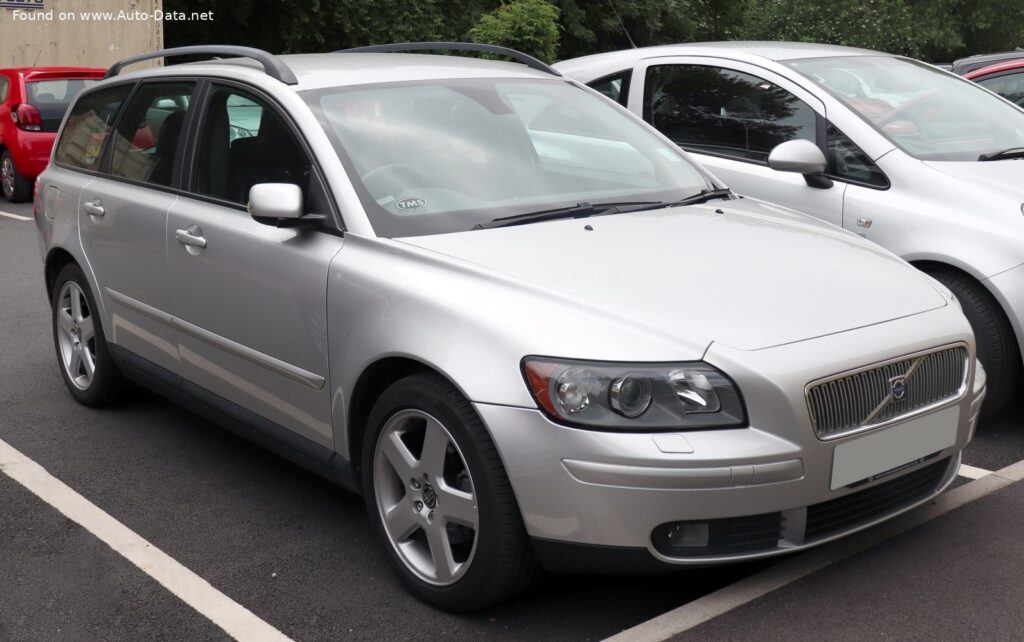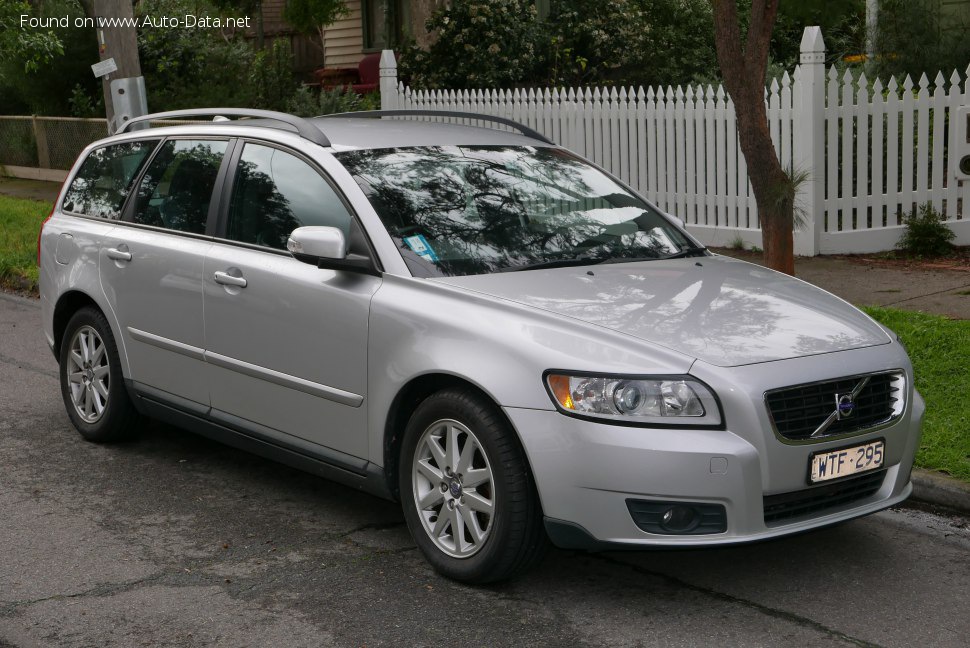
Introduction to the Volvo V50 (facelift 2007) 2.4i (170 Hp) Geartronic
The Volvo V50, introduced in 2004, represented a pivotal moment for the Swedish automaker, signaling a more youthful and dynamic direction while retaining the brand’s core values of safety and practicality. The model under scrutiny here is the Volvo V50 (facelift 2007) 2.4i (170 Hp) Geartronic, which arrived as part of a mid-cycle refresh that refined its aesthetics and technology. Positioned in the compact executive car segment, the V50 was Volvo’s answer to premium European wagons, offering a more compact and agile alternative to its larger V70 sibling. It shared its P1 platform with the second-generation Ford Focus and Mazda3, a testament to its contemporary underpinnings and a departure from Volvo’s traditional, more conservative engineering.
During its production run from 2007 to 2009 for this specific powertrain variant, the facelifted V50 continued to embody Volvo’s commitment to stylish utility. It appealed to a demographic seeking the versatility of a station wagon without the bulk of a larger vehicle, coupled with a distinctly European driving feel. The 2.4i engine, a naturally aspirated five-cylinder unit, paired with Volvo’s Geartronic automatic transmission, offered a blend of smooth power delivery and comfortable cruising, making it a popular choice across various international markets, including North America and its strongholds in Europe. This article delves into the intricacies of this particular model, examining its engineering, design, and market significance.
Engine and Performance: The Heart of the Volvo V50 (facelift 2007) 2.4i (170 Hp) Geartronic
At the core of the Volvo V50 (facelift 2007) 2.4i (170 Hp) Geartronic lies a robust 2.4-liter (2435 cm³ or 148.59 cu. in.) naturally aspirated inline five-cylinder engine, designated by Volvo as the B5244S4. This engine configuration is a hallmark of Volvo engineering, renowned for its distinctive thrum, smooth power delivery, and inherent balance. With a compression ratio of 10.3:1 and a DOHC (Double Overhead Camshaft) valvetrain featuring four valves per cylinder, the engine is designed for efficiency and responsiveness. Fuel is delivered via a multi-port manifold injection system, ensuring precise fuel-air mixture for optimal combustion.
The 2.4i engine generates a respectable 170 horsepower at 6000 rpm, providing ample power for daily driving and highway cruising. Its torque output stands at 230 Nm (169.64 lb.-ft.) at 4400 rpm, delivering a satisfying pull across the mid-range. This power is channeled to the front wheels via a 5-speed Geartronic automatic transmission. Volvo’s Geartronic system offers the convenience of an automatic gearbox with the option for manual gear selection, allowing drivers to engage more actively with the vehicle’s performance characteristics. This combination contributes to a 0-60 mph acceleration time of 8.6 seconds (or 0-100 km/h in 9 seconds) and a top speed of 133.59 mph (215 km/h), making the V50 a capable performer in its class.
Despite its spirited performance, the Volvo V50 (facelift 2007) 2.4i (170 Hp) Geartronic also demonstrated a commendable level of fuel efficiency for its era and engine size. The combined fuel economy is rated at 25.8 US mpg (9.1 l/100 km), with urban consumption at 17.8 US mpg (13.2 l/100 km) and extra-urban consumption at 35.1 US mpg (6.7 l/100 km). This efficiency is coupled with CO2 emissions of 217 g/km, adhering to the Euro 4 emission standard, which was the prevailing benchmark at the time of its production. The engine’s design prioritizes a balance of power, refinement, and environmental responsibility, making it a well-rounded choice for the discerning driver.
Design and Features: Scandinavian Practicality Meets Modern Aesthetics
The Volvo V50 (facelift 2007) 2.4i (170 Hp) Geartronic, with its station wagon (estate) body type, exemplifies Volvo’s commitment to functional design. The facelift introduced subtle yet effective changes, including redesigned bumpers, headlights, and LED tail lights, giving the V50 a more contemporary and sophisticated appearance. Its dimensions – a length of 178.03 inches, a width of 69.69 inches (79.61 inches including mirrors), and a height of 57.36 inches – contribute to its compact yet substantial road presence. The 103.94-inch wheelbase ensures a stable ride and comfortable interior space for five occupants across its five doors.
Inside, the V50 maintains Volvo’s reputation for ergonomic design and high-quality materials. The cabin is characterized by its signature floating center console, a design element that became iconic for Volvo during this period, offering both aesthetic appeal and practical storage solutions. Material choices were premium, featuring soft-touch plastics, optional leather upholstery, and tasteful metallic accents. Practicality is a strong suit for any Volvo wagon, and the V50 is no exception. It offers a minimum trunk (boot) space of 14.73 cu. ft. (417 liters), which expands significantly to 46.16 cu. ft. (1307 liters) with the rear seats folded down, providing ample cargo capacity for luggage, groceries, or sports equipment. The maximum roof load capacity of 165.35 lbs (75 kg) further enhances its utility.
Safety, as always with Volvo, is paramount. The V50 features a robust chassis with independent McPherson front suspension and an independent multi-link spring suspension at the rear, both equipped with anti-roll bars to ensure stable handling and a comfortable ride. Braking is handled by ventilated discs at the front and solid discs at the rear, supported by an Anti-lock Braking System (ABS) for enhanced control during emergency stops. The electric power steering system, with a steering rack and pinion setup, provides precise feedback and a tight minimum turning circle of 34.78 feet (10.6 m), making it maneuverable in urban environments. Standard tire sizes ranged from 205/55 R16 to larger 215/45 R18 options, mounted on corresponding wheel rims, contributing to both aesthetics and handling dynamics.
Technical Specifications
| Category | Specification | Value |
|---|---|---|
General Information |
||
| Brand | Volvo | |
| Model | V50 | |
| Generation | V50 (facelift 2007) | |
| Type (Engine) | 2.4i (170 Hp) Geartronic | |
| Start of Production | 2007 year | |
| End of Production | 2009 year | |
| Powertrain Architecture | Internal Combustion engine | |
| Body type | Station wagon (estate) | |
| Seats | 5 | |
| Doors | 5 | |
Performance Specs |
||
| Fuel consumption (economy) – urban (NEDC) | 13.2 l/100 km (17.8 US mpg) | |
| Fuel consumption (economy) – extra urban (NEDC) | 6.7 l/100 km (35.1 US mpg) | |
| Fuel consumption (economy) – combined (NEDC) | 9.1 l/100 km (25.8 US mpg) | |
| CO2 emissions (NEDC) | 217 g/km | |
| Fuel Type | Petrol (Gasoline) | |
| Acceleration 0 – 60 mph | 8.6 sec | |
| Acceleration 0 – 100 km/h | 9 sec | |
| Maximum speed | 215 km/h (133.59 mph) | |
| Emission standard | Euro 4 | |
| Weight-to-power ratio | 8.2 kg/Hp (122 Hp/tonne) | |
| Weight-to-torque ratio | 6.1 kg/Nm (165 Nm/tonne) | |
Engine Specs |
||
| Power | 170 Hp @ 6000 rpm | |
| Power per liter | 69.8 Hp/l | |
| Torque | 230 Nm @ 4400 rpm (169.64 lb.-ft. @ 4400 rpm) | |
| Engine layout | Front, Transverse | |
| Engine Model/Code | B5244S4 | |
| Engine displacement | 2435 cm³ (148.59 cu. in.) | |
| Number of cylinders | 5 | |
| Engine configuration | Inline | |
| Cylinder Bore | 83 mm (3.27 in.) | |
| Piston Stroke | 90 mm (3.54 in.) | |
| Compression ratio | 10.3:1 | |
| Number of valves per cylinder | 4 | |
| Fuel injection system | Multi-port manifold injection | |
| Engine aspiration | Naturally aspirated engine | |
| Valvetrain | DOHC | |
| Engine oil capacity | 5.8 l (6.13 US qt) | |
| Engine oil specification | Not provided | |
| Coolant capacity | 10 l (10.57 US qt) | |
Space, Volume and Weights |
||
| Kerb Weight | 1394 kg (3073.24 lbs.) | |
| Max. weight | 1960 kg (4321.06 lbs.) | |
| Max load | 566 kg (1247.82 lbs.) | |
| Trunk (boot) space – minimum | 417 l (14.73 cu. ft.) | |
| Trunk (boot) space – maximum | 1307 l (46.16 cu. ft.) | |
| Fuel tank capacity | 62 l (16.38 US gal) | |
| Max. roof load | 75 kg (165.35 lbs.) | |
| Permitted trailer load with brakes (12%) | 1500 kg (3306.93 lbs.) | |
| Permitted trailer load without brakes | 700 kg (1543.24 lbs.) | |
| Permitted towbar download | 75 kg (165.35 lbs.) | |
Dimensions |
||
| Length | 4522 mm (178.03 in.) | |
| Width | 1770 mm (69.69 in.) | |
| Width including mirrors | 2022 mm (79.61 in.) | |
| Height | 1457 mm (57.36 in.) | |
| Wheelbase | 2640 mm (103.94 in.) | |
| Front track | 1535 mm (60.43 in.) | |
| Rear (Back) track | 1531 mm (60.28 in.) | |
| Minimum turning circle (turning diameter) | 10.6 m (34.78 ft.) | |
Drivetrain, Brakes and Suspension Specs |
||
| Drivetrain Architecture | The Internal combustion engine (ICE) drives the front wheels of the vehicle. | |
| Drive wheel | Front wheel drive | |
| Number of gears and type of gearbox | 5 gears, automatic transmission Geartronic | |
| Front suspension | Independent, type McPherson with coil spring and anti-roll bar | |
| Rear suspension | Independent multi-link spring suspension with stabilizer | |
| Front brakes | Ventilated discs | |
| Rear brakes | Disc | |
| Assisting systems | ABS (Anti-lock braking system) | |
| Steering type | Steering rack and pinion | |
| Power steering | Electric Steering | |
| Tires size | 205/55 R16; 205/50 R17; 215/45 R18 | |
| Wheel rims size | 6.5J x 16; 7J x 17; 7.5J x 18 | |
Legacy and Market Impact
The Volvo V50 (facelift 2007) 2.4i (170 Hp) Geartronic carved out a significant niche in the global automotive market, particularly in Europe and North America. It represented Volvo’s successful endeavor to offer a more compact, stylish, and engaging vehicle without abandoning the brand’s core tenets of safety, quality, and practicality. The V50 was instrumental in broadening Volvo’s appeal, attracting a younger demographic that appreciated its blend of modern Scandinavian design and dynamic driving characteristics, a departure from the more staid image of previous Volvo wagons.
In its competitive landscape, the V50 faced formidable rivals such as the Audi A4 Avant, BMW 3 Series Touring, and Mercedes-Benz C-Class Estate. While these German competitors often emphasized outright sportiness or luxury, the V50 offered a compelling alternative with its unique five-cylinder engine, distinctive styling, and renowned safety features. It was often praised for its comfortable ride, refined interior, and the sheer utility of its wagon body, which provided generous cargo space in a relatively small footprint. The 2.4i engine, in particular, was lauded for its smooth operation and sufficient power for most driving scenarios, making it a popular choice for families and individuals seeking a versatile and premium compact vehicle.
The V50’s platform sharing with the Ford Focus and Mazda3 was a strategic move under Ford’s ownership, allowing Volvo to leverage economies of scale