
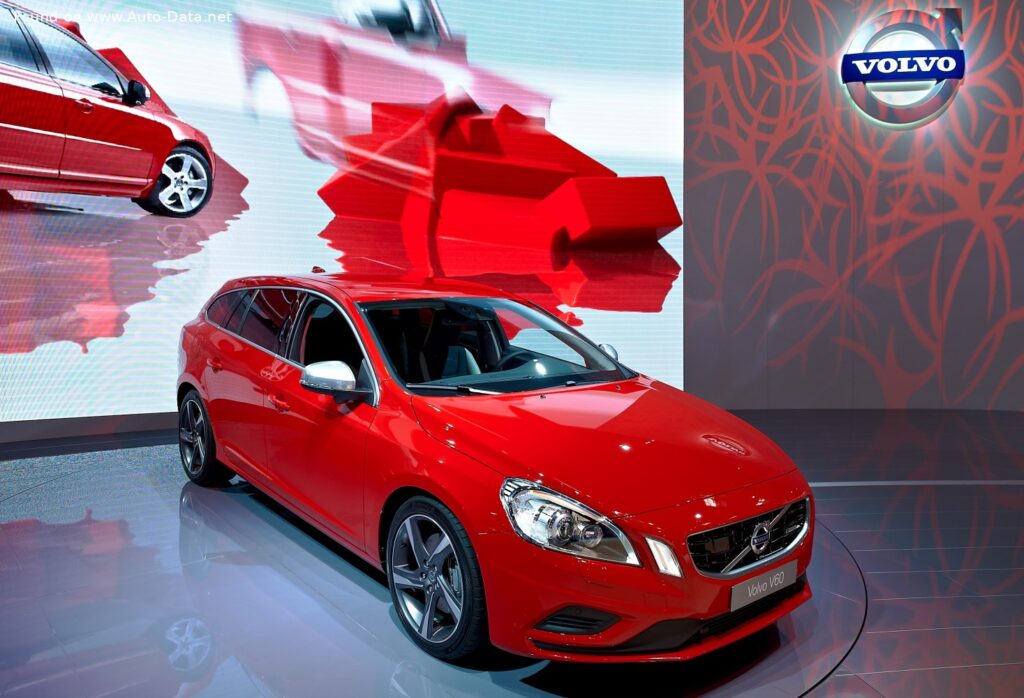
Volvo V60 I 2.4 D5 (215 Hp): A Premium European Mid-Size Wagon
The Volvo V60 I 2.4 D5 (215 Hp) represents the first generation of Volvo’s compact executive station wagon,
produced from 2012 to 2015. Positioned as a stylish and practical alternative in the premium mid-size segment,
the V60 I was primarily aimed at the European market, where its combination of elegant design, robust diesel
powertrain, and renowned Volvo safety features resonated strongly with consumers. Unlike its American counterpart,
which often featured gasoline engines, this specific D5 variant with its potent 2.4-liter five-cylinder turbodiesel
engine and a manual transmission underscored its European roots, emphasizing fuel efficiency and strong torque
delivery, characteristics highly valued in regions with higher fuel costs and extensive highway driving.
The V60 I, a five-door, five-seat station wagon, built upon Volvo’s established reputation for blending
sophistication with utility, offering a compelling package for families and professionals alike.
Engine and Performance: The D5 Powerplant
At the heart of the Volvo V60 I 2.4 D5 (215 Hp) lies Volvo’s venerable D5244T11 engine, a 2.4-liter (146.46 cubic inches)
inline five-cylinder turbodiesel unit. This powertrain was celebrated for its smooth operation, distinctive
five-cylinder thrum, and impressive output. The engine delivers a robust 215 horsepower at 4000 rpm,
providing ample power for both spirited driving and comfortable highway cruising. More significantly,
the D5 engine generates a substantial 420 Nm (309.78 lb.-ft.) of torque, available across a broad
range from 1500 to 3250 rpm. This wide torque band ensures strong, effortless acceleration from low
speeds, making it particularly well-suited for hauling cargo or navigating varied terrain.
Mated to a six-speed manual transmission, this front-wheel-drive configuration offered an engaging
driving experience, allowing the driver direct control over the engine’s power delivery.
Performance figures were quite respectable for a premium family wagon, with the V60 I 2.4 D5
accelerating from 0 to 60 mph in an estimated 7.1 seconds (0-100 km/h in 7.5 seconds).
This made it a surprisingly quick vehicle capable of holding its own against many gasoline-powered rivals.
Fuel efficiency was a key selling point for the D5 engine, especially in Europe. The combined
fuel consumption was rated at an impressive 4.9 liters per 100 km, translating to approximately
48 US mpg. Urban consumption stood at 6 l/100 km (39.2 US mpg), while extra-urban driving
could achieve an outstanding 4.3 l/100 km (54.7 US mpg). With CO2 emissions of 129 g/km,
the V60 I 2.4 D5 met the Euro 5 emission standard, reflecting Volvo’s commitment to environmental
responsibility even with a powerful diesel engine. The engine was equipped with a particulate filter,
a crucial component for reducing harmful emissions.
Design and Features: Scandinavian Practicality and Elegance
The Volvo V60 I, with its station wagon (estate) body type, exemplified Volvo’s modern design language
of the early 2010s. It blended the sleek, coupe-like lines of a sedan with the practical utility
expected of a wagon. The exterior design was characterized by its flowing silhouette, prominent
shoulder lines, and distinctive Volvo grille. At 182.2 inches long, 73.43 inches wide, and
58.43 inches tall, with a wheelbase of 109.29 inches, the V60 I struck a balance between
maneuverability and interior space. Its relatively compact footprint for a premium wagon
made it suitable for both urban environments and long-distance travel.
Inside, the V60 I offered a typical Volvo cabin: ergonomic, minimalist, and built with high-quality
materials. The five-seat configuration provided comfortable seating for all occupants, while the
focus on driver-centric controls and intuitive infotainment systems contributed to a refined
driving experience. Practicality was paramount, with a minimum trunk space of 692 liters (24.44 cu. ft.),
allowing for ample luggage or cargo. This generous cargo capacity, combined with the versatility
of a wagon, made it a highly functional vehicle for families.
Safety, a cornerstone of the Volvo brand, was thoroughly integrated into the V60 I. While specific
advanced driver-assistance systems (ADAS) are not detailed in the provided data, the inclusion
of ABS (Anti-lock Braking System) as a standard assisting system highlights the foundational
safety technologies present. Volvo’s commitment to occupant protection and accident prevention
was evident in the V60’s robust structure and comprehensive passive safety features, which
typically included multiple airbags, stability control, and advanced seatbelt systems for the era.
The steering system, a rack and pinion type, ensured precise and responsive handling, contributing
to both driving enjoyment and safety.
Technical Specifications: Volvo V60 I 2.4 D5 (215 Hp)
| Category | Specification | Value |
|---|---|---|
| General Information | Brand | Volvo |
| Model | V60 | |
| Generation | V60 I | |
| Type (Engine) | 2.4 D5 (215 Hp) | |
| Production Start | 2012 | |
| Production End | 2015 | |
| Powertrain Architecture | Internal Combustion Engine | |
| Body Type | Station wagon (estate) | |
| Seats | 5 | |
| Doors | 5 | |
| Performance Specs | Fuel Consumption (Urban) | 6 l/100 km (39.2 US mpg) |
| Fuel Consumption (Extra Urban) | 4.3 l/100 km (54.7 US mpg) | |
| Fuel Consumption (Combined) | 4.9 l/100 km (48 US mpg) | |
| CO2 Emissions | 129 g/km | |
| Fuel Type | Diesel | |
| Acceleration 0-60 mph | 7.1 sec | |
| Acceleration 0-100 km/h | 7.5 sec | |
| Emission Standard | Euro 5 | |
| Weight-to-Power Ratio | 7.5 kg/Hp (134 Hp/tonne) | |
| Weight-to-Torque Ratio | 3.8 kg/Nm (261.7 Nm/tonne) | |
| Engine Specs | Power | 215 Hp @ 4000 rpm |
| Power per liter | 89.6 Hp/l | |
| Torque | 420 Nm (309.78 lb.-ft.) @ 1500-3250 rpm | |
| Engine Layout | Front, Transverse | |
| Engine Model/Code | D5244T11 | |
| Engine Displacement | 2400 cm3 (2.4 liters / 146.46 cu. in.) | |
| Number of Cylinders | 5 | |
| Engine Configuration | Inline | |
| Cylinder Bore | 81 mm (3.19 in.) | |
| Piston Stroke | 93.15 mm (3.67 in.) | |
| Fuel Injection System | Diesel Commonrail | |
| Engine Aspiration | Turbocharger, Intercooler | |
| Engine Oil Capacity | 5.9 liters (6.23 US qt) | |
| Coolant Capacity | 8.9 liters (9.4 US qt) | |
| Engine Systems | Particulate filter | |
| Space, Volume and Weights | Kerb Weight | 1605 kg (3538.42 lbs.) |
| Max. Weight | 2180 kg (4806.08 lbs.) | |
| Max Load | 575 kg (1267.66 lbs.) | |
| Trunk (Boot) Space – Minimum | 692 liters (24.44 cu. ft.) | |
| Fuel Tank Capacity | 67.5 liters (17.83 US gal) | |
| Dimensions | Length | 4628 mm (182.2 in.) |
| Width | 1865 mm (73.43 in.) | |
| Height | 1484 mm (58.43 in.) | |
| Wheelbase | 2776 mm (109.29 in.) | |
| Front Track | 1588 mm (62.52 in.) | |
| Rear Track | 1585 mm (62.4 in.) | |
| Minimum Turning Circle | 11.5 m (37.73 ft.) | |
| Drivetrain, Brakes & Suspension | Drivetrain Architecture | Internal combustion engine drives front wheels |
| Drive Wheel | Front-wheel drive | |
| Number of Gears & Gearbox Type | 6 gears, manual transmission | |
| Assisting Systems | ABS (Anti-lock braking system) | |
| Steering Type | Steering rack and pinion |
Legacy and Market Impact: The Enduring Appeal of the Volvo V60 I 2.4 D5 (215 Hp)
The Volvo V60 I 2.4 D5 (215 Hp) carved out a significant niche in the highly competitive European premium
mid-size segment. Its direct competitors included established German rivals such as the Audi A4 Avant,
BMW 3 Series Touring, and Mercedes-Benz C-Class Estate, as well as other European contenders like
the Volkswagen Passat Variant and the Skoda Superb Combi. What set the V60 I apart was its unique
blend of Scandinavian luxury, distinctive design, and a strong emphasis on real-world practicality
and safety, coupled with the robust and efficient D5 diesel engine.
In its primary markets, the V60 I 2.4 D5 was highly regarded for its long-distance comfort, making
it an ideal choice for extensive highway travel. The powerful D5 engine, with its ample torque,
provided confident overtaking capability and relaxed cruising, while the manual transmission appealed
to drivers seeking a more engaging experience. Its fuel efficiency was a major draw, offering a
cost-effective option for consumers facing higher fuel prices. The substantial trunk space,
a hallmark of Volvo wagons, further cemented its reputation as a versatile family vehicle.
The V60 I, particularly in its D5 configuration, underscored Volvo’s commitment to offering
premium alternatives that didn’t solely rely on outright performance but rather on a holistic
package of safety, comfort, and efficiency. It represented a period where Volvo was refining
its design language, moving towards a more contemporary and dynamic aesthetic while retaining
its core values. The success of the V60 I helped pave the way for subsequent generations,
solidifying Volvo’s position as a respected player in the global automotive landscape,
especially in the premium wagon segment. Its legacy is one of a well-engineered, safe,
and highly practical vehicle that perfectly encapsulated the brand’s ethos for a discerning
European clientele.
