Introduction: The Volvo V60 I Cross Country 2.0 D3 (150 Hp)
The Volvo V60 I Cross Country, specifically the 2.0 D3 (150 Hp) variant, represents a distinctive offering within the premium compact executive segment, blending the practicality of a station wagon with the rugged appeal and increased capability of a crossover. Introduced in 2015 as part of the first-generation V60 lineup, the Cross Country model was designed to cater to consumers seeking a versatile vehicle capable of handling diverse driving conditions, from paved urban streets to unpaved country roads. Its production run spanned from 2015 to 2018, positioning it as a key player in Volvo’s strategy to expand its market presence with niche, lifestyle-oriented vehicles.
While the standard Volvo V60 was a sleek, dynamically styled wagon, the Cross Country iteration elevated its stance and added protective body cladding, signaling its adventurous spirit. The 2.0 D3 (150 Hp) engine, a four-cylinder diesel powerplant, was particularly popular in European markets due to its compelling combination of fuel efficiency, robust torque delivery, and relatively low emissions, aligning with regional preferences and regulations. This model embodied Volvo’s commitment to safety, sophisticated design, and functional engineering, making it a compelling choice for those desiring a premium, all-weather family vehicle that stood apart from traditional SUVs.
Engine and Performance: Powering the Volvo V60 I Cross Country
At the heart of the Volvo V60 I Cross Country 2.0 D3 (150 Hp) lies a modern 2.0-liter (1969 cm³ or 120.16 cu. in.) inline four-cylinder diesel engine, part of Volvo’s highly efficient Drive-E powertrain family, designated by the engine code D4204T4. This sophisticated unit is equipped with a common rail fuel injection system, a turbocharger, and an intercooler, all designed to maximize both power output and fuel economy. It produces a respectable 150 horsepower at 4250 rpm, delivering a smooth and accessible powerband suitable for both daily commuting and longer journeys.
Perhaps more impressive than its horsepower is the engine’s torque delivery. The 2.0 D3 generates a substantial 258.15 lb.-ft. (350 Nm) of torque, available across a broad range from 1600 to 2500 rpm. This wide torque band ensures strong pulling power from low engine speeds, translating into confident acceleration and effortless highway cruising. Mated to a precise 6-speed manual transmission, this powertrain architecture drives the front wheels, offering a direct and engaging driving experience.
In terms of raw performance, the V60 I Cross Country 2.0 D3 (150 Hp) is capable of accelerating from 0 to 60 mph in a brisk 8.6 seconds, with a top speed reaching 127.38 mph (205 km/h). These figures demonstrate a well-balanced blend of performance and efficiency. On the fuel economy front, the vehicle truly shines, especially for its segment. It achieves an impressive combined fuel consumption of 56 US mpg (4.2 l/100 km), with urban economy rated at 51.1 US mpg (4.6 l/100 km) and extra-urban at an even more remarkable 58.8 US mpg (4.0 l/100 km). This efficiency is complemented by relatively low CO2 emissions of 111 g/km, making it an environmentally conscious choice within its class, particularly relevant for European markets where diesel efficiency is highly valued. The engine’s compression ratio of 15.8:1 further underscores its optimized diesel combustion process.
Design and Features: The Rugged Elegance of the V60 Cross Country
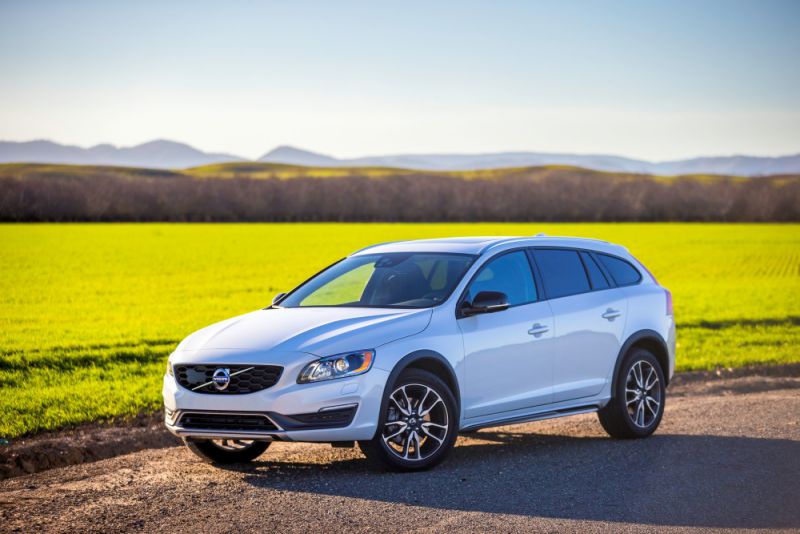
The Volvo V60 I Cross Country carved out its own aesthetic niche, merging Volvo’s elegant wagon design with a robust, off-road-inspired character. Its body type is best described as a station wagon (estate) with distinct crossover elements. The most prominent design feature distinguishing the Cross Country from the standard V60 wagon is its increased ride height, offering a substantial 7.91 inches (201 mm) of ground clearance. This elevated stance not only enhances its visual presence but also improves its capability over uneven terrain or through deeper snow.
Visually, the V60 Cross Country featured rugged black plastic cladding around the wheel arches, sills, and lower bumpers, providing protection against minor scrapes and adding to its adventurous persona. A unique honeycomb grille, skid plates (front and rear), and integrated roof rails further emphasized its utility and readiness for outdoor activities. Despite these rugged additions, the V60 Cross Country maintained Volvo’s signature Scandinavian design language, characterized by clean lines, sophisticated proportions, and a strong, confident stance. Its overall length of 182.6 inches (4638 mm), width of 71.85 inches (1825 mm), and height of 60.83 inches (1545 mm) provided a substantial road presence without being overly cumbersome.
Inside, the V60 Cross Country offered a cabin designed for comfort and practicality, accommodating five occupants across its two rows of seating. Volvo’s reputation for ergonomic excellence and high-quality materials was evident, with well-bolstered seats and an intuitive dashboard layout. Standard features for the era would have included a Sensus infotainment system, dual-zone automatic climate control, and a suite of passive and active safety features. While the provided data specifically mentions ABS (Anti-lock Braking System), Volvo is renowned for pioneering advanced safety technologies. Therefore, it’s reasonable to expect features like Dynamic Stability and Traction Control (DSTC), City Safety (an autonomous emergency braking system), and potentially options for blind-spot monitoring or lane-keeping assist, depending on the trim level and market. The wagon body style ensured impressive cargo versatility, with a minimum trunk space of 43.83 cu. ft. (1241 liters), allowing for ample luggage or equipment. Practicality was further enhanced by a maximum roof load of 165.35 lbs. (75 kg) and significant towing capacities, up to 4188.78 lbs. (1900 kg) with brakes at an 8% gradient.
Technical Specifications: Volvo V60 I Cross Country 2.0 D3 (150 Hp)
| Category | Specification |
|---|---|
| General Information | |
| Brand | Volvo |
| Model | V60 |
| Generation | V60 I Cross Country |
| Type (Engine) | 2.0 D3 (150 Hp) |
| Start of Production | 2015 year |
| End of Production | 2018 year |
| Powertrain Architecture | Internal Combustion Engine |
| Body Type | Station wagon (estate), Crossover |
| Seats | 5 |
| Doors | 5 |
| Performance Specs | |
| Fuel Consumption (Urban) | 51.1 US mpg (4.6 l/100 km) |
| Fuel Consumption (Extra Urban) | 58.8 US mpg (4.0 l/100 km) |
| Fuel Consumption (Combined) | 56 US mpg (4.2 l/100 km) |
| CO2 Emissions | 111 g/km |
| Fuel Type | Diesel |
| Acceleration 0 – 60 mph | 8.6 sec |
| Acceleration 0 – 100 km/h | 9.1 sec |
| Maximum Speed | 127.38 mph (205 km/h) |
| Engine Specs | |
| Power | 150 Hp @ 4250 rpm |
| Power per liter | 76.2 Hp/l |
| Torque | 258.15 lb.-ft. (350 Nm) @ 1600-2500 rpm |
| Engine Layout | Front, Transverse |
| Engine Model/Code | D4204T4 |
| Engine Displacement | 120.16 cu. in. (1969 cm³) |
| Number of Cylinders | 4 |
| Engine Configuration | Inline |
| Cylinder Bore | 3.23 in. (82 mm) |
| Piston Stroke | 3.67 in. (93.2 mm) |
| Compression Ratio | 15.8:1 |
| Number of Valves per Cylinder | 4 |
| Fuel Injection System | Diesel Commonrail |
| Engine Aspiration | Turbocharger, Intercooler |
| Valvetrain | DOHC |
| Engine Oil Capacity | 5.49 US qt (5.2 l) |
| Coolant Capacity | 9.4 US qt (8.9 l) |
| Space, Volume and Weights | |
| Trunk (Boot) Space – Minimum | 43.83 cu. ft. (1241 l) |
| Fuel Tank Capacity | 17.83 US gal (67.5 l) |
| Max. Roof Load | 165.35 lbs. (75 kg) |
| Permitted Trailer Load with Brakes (8%) | 4188.78 lbs. (1900 kg) |
| Permitted Trailer Load with Brakes (12%) | 3527.4 lbs. (1600 kg) |
| Dimensions | |
| Length | 182.6 in. (4638 mm) |
| Width | 71.85 in. (1825 mm) |
| Width with mirrors folded | 73.46 in. (1866 mm) |
| Width including mirrors | 82.56 in. (2097 mm) |
| Height | 60.83 in. (1545 mm) |
| Wheelbase | 109.21 in. (2774 mm) |
| Front Track | 63.74 – 63.35 in. (1619-1609 mm) |
| Rear (Back) Track | 62.09 – 61.69 in. (1577-1567 mm) |
| Ride Height (Ground Clearance) | 7.91 in. (201 mm) |
| Drag Coefficient (Cd) | 0.34 |
| Minimum Turning Circle (Turning Diameter) | 38.71 ft. (11.8 m) |
| Drivetrain, Brakes and Suspension Specs | |
| Drivetrain Architecture | The Internal combustion engine (ICE) drives the front wheels of the vehicle. |
| Drive Wheel | Front wheel drive |
| Number of Gears and Type of Gearbox | 6 gears, manual transmission |
| Front Suspension | Independent, type McPherson with coil spring and anti-roll bar |
| Rear Suspension | Independent coil spring |
| Front Brakes | Ventilated discs |
| Rear Brakes | Disc |
| Assisting Systems | ABS (Anti-lock braking system) |
| Steering Type | Steering rack and pinion |
Legacy and Market Impact
The Volvo V60 I Cross Country, particularly with the efficient 2.0 D3 (150 Hp) powertrain, carved out a significant niche in the European automotive landscape during its production years from 2015 to 2018. It represented Volvo’s astute response to evolving consumer preferences, offering an appealing alternative to both traditional SUVs and conventional sedans. For many European buyers, the Cross Country variant offered the best of both worlds: the refined driving dynamics and fuel efficiency of a wagon, combined with the rugged aesthetics and enhanced ground clearance often associated with sport utility vehicles.
In its primary markets, the V60 Cross Country competed with vehicles like the Audi A4 Allroad and the Volkswagen Passat Alltrack, both of which also offered a lifted, ruggedized wagon formula. While the Subaru Outback also occupies a similar conceptual space, the Volvo positioned itself as a more premium, design-focused option, leveraging Volvo’s reputation for understated luxury and unparalleled safety. The D3 diesel engine played a crucial role in its market appeal, providing the high fuel economy and strong low-end torque that European drivers often prioritize, especially given the continent’s well-established diesel infrastructure. Its low CO2 emissions further bolstered its attractiveness in regions with strict environmental regulations.
The V60 I Cross Country also contributed significantly to Volvo’s brand image, showcasing its ability to innovate and diversify its lineup beyond its core sedan and wagon offerings. It underscored Volvo’s commitment to creating practical, versatile vehicles that don’t compromise on style or safety. This model was part of a broader trend within the automotive industry toward crossover vehicles, and Volvo’s Cross Country range (including the larger V90 Cross Country) has been instrumental in keeping the wagon body style relevant in an SUV-dominated market. The transition to the new Drive-E engine architecture, as exemplified by the 2.0 D3, marked a pivotal moment for Volvo, moving away from a diverse range of engines to a more streamlined, modular family focused on efficiency and performance.
Ultimately, the Volvo V60 I Cross Country 2.0 D3 (150 Hp) left a legacy as a highly capable, efficient, and stylish vehicle. It offered a compelling blend of utility, comfort, and adventure, solidifying Volvo’s position as a leader in premium, lifestyle-oriented automobiles. Its success paved the way for future Cross Country models and reinforced the enduring appeal of the rugged wagon, demonstrating that practicality and elegance could indeed coexist.