The Volvo V60 I Cross Country: A Swedish Crossover Wagon for the Global Market
The Volvo V60 I Cross Country, produced from 2015 to 2018, represents a distinctive chapter in Volvo’s commitment to blending the practicality of a station wagon with the rugged capability of a crossover. This first-generation V60 Cross Country variant, specifically the 2.0 D3 (150 Hp) Automatic model, carved out a niche in the premium mid-size segment, particularly in European and other international markets where diesel powertrains and versatile body styles held significant appeal. While not a primary focus for the American market in this exact configuration, its design philosophy and engineering prowess reflect Volvo’s global strategy to offer safe, comfortable, and capable vehicles tailored to diverse consumer needs.
Positioned as an upscale alternative to traditional SUVs, the V60 I Cross Country offered enhanced ground clearance, protective body cladding, and a sophisticated all-wheel-drive system (though this specific D3 variant was front-wheel drive) to navigate less-than-perfect roads and light off-road conditions with confidence. It maintained the elegant lines and practical interior space of the standard V60 wagon while adding an adventurous spirit, appealing to families and individuals seeking versatility without compromising on style or driving dynamics. This model underscored Volvo’s heritage of producing robust and family-friendly vehicles, adapting them for an increasingly active lifestyle demographic.
Engine and Performance of the Volvo V60 I Cross Country 2.0 D3
Under the hood of the Volvo V60 I Cross Country 2.0 D3 (150 Hp) Automatic lies a meticulously engineered powertrain designed for efficiency and smooth delivery. This variant featured Volvo’s D4204T4 engine, a 2.0-liter (1969 cm³, 120.16 cu. in.) inline four-cylinder diesel unit. Employing a common rail direct injection system and a turbocharger with an intercooler, this engine generated a respectable 150 horsepower at 4250 rpm. Its power-per-liter output stood at 76.2 horsepower per liter, indicating a well-optimized design for its displacement.
More impressive than its peak horsepower was the engine’s torque delivery. It produced a robust 350 Newton-meters (258.15 lb.-ft.) of torque, available across a broad and usable rev range from 1600 to 2500 rpm. This ample torque at low engine speeds was crucial for the vehicle’s everyday drivability, providing strong acceleration from a standstill and effortless cruising, especially when carrying passengers or cargo. The engine was paired with a smooth and efficient 8-speed automatic transmission, which expertly managed power delivery to the front wheels, ensuring a refined driving experience.
In terms of outright performance, the V60 I Cross Country 2.0 D3 was capable of accelerating from 0 to 60 mph in an estimated 8.6 seconds, with 0 to 100 km/h achieved in 9.1 seconds. Its top speed reached 205 km/h (127.38 mph), making it capable of comfortable long-distance highway travel. Despite its solid performance, fuel economy remained a strong suit, a hallmark of modern diesel engines. The combined fuel consumption was rated at an impressive 4.6 liters per 100 kilometers, translating to approximately 51.1 US miles per gallon, with CO2 emissions of 120 g/km. This efficiency, combined with a 67.5-liter (17.83 US gallon) fuel tank, provided an excellent cruising range, a significant advantage for European drivers covering long distances.
Design and Features
Exterior Design and Stance
The Volvo V60 I Cross Country distinguishes itself from its standard V60 counterpart through a series of thoughtful design modifications that emphasize its rugged capabilities. The body type is officially classified as a station wagon (estate) with crossover characteristics, featuring five doors and seating for five occupants. Its overall length measures 4638 mm (182.6 inches), with a width of 1825 mm (71.85 inches) and a height of 1545 mm (60.83 inches). A key differentiator is the increased ride height, boasting 201 mm (7.91 inches) of ground clearance, significantly more than the standard V60, allowing it to tackle uneven terrain with greater ease.
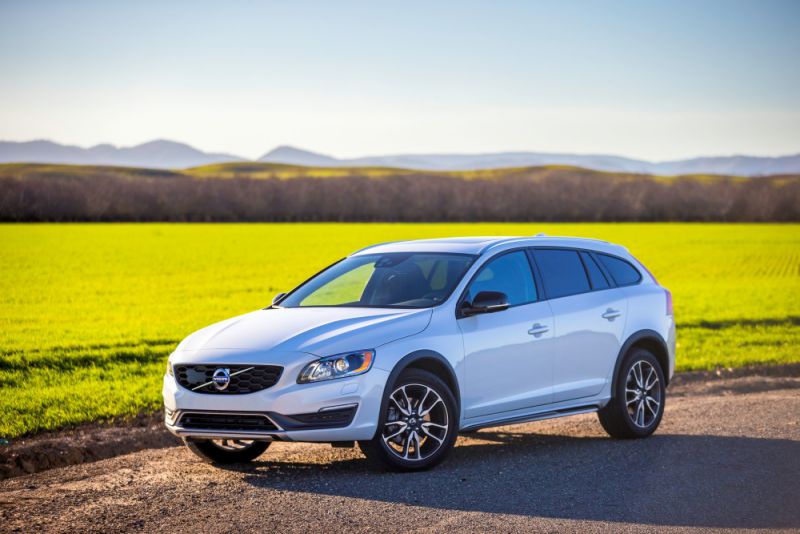
Visually, the V60 Cross Country adopted a more robust aesthetic. This included prominent black plastic cladding around the wheel arches and lower body, skid plates integrated into the front and rear bumpers, and unique Cross Country badging. These elements not only provided practical protection against minor scuffs and stone chips but also visually communicated the vehicle’s adventurous intent. The elevated stance, combined with specific alloy wheel designs, contributed to a purposeful and confident road presence, making it instantly recognizable within the Volvo lineup.
Interior Comfort and Practicality
Inside, the V60 Cross Country maintained Volvo’s reputation for ergonomic design, high-quality materials, and exceptional comfort. The cabin provided a serene and well-appointed environment, typical of premium European vehicles. Seats were designed for long-distance comfort, offering excellent support and adjustability. The dashboard layout was clean and intuitive, with controls logically placed for ease of use. While the V60 I generation predates Volvo’s large Sensus touchscreen systems, it featured a well-integrated infotainment system with physical buttons and a clear display, providing navigation, audio, and connectivity options relevant to its era.
Practicality was a cornerstone of the V60 Cross Country. With all five seats in use, the vehicle offered ample passenger space. When the rear seats were folded, the cargo area expanded significantly to a maximum of 1241 liters (43.83 cubic feet) of trunk space, making it highly versatile for carrying luggage, sports equipment, or larger items. Additional practical features included a maximum roof load of 75 kg (165.35 lbs.) and a substantial towing capacity, allowing for a permitted trailer load with brakes of up to 1900 kg (4188.78 lbs.) at 8% incline or 1600 kg (3527.4 lbs.) at 12% incline. These capabilities underlined its suitability for active families and those requiring a vehicle with genuine utility.
Safety, as always with Volvo, was paramount. The V60 Cross Country came equipped with a comprehensive suite of safety features, including multiple airbags, ABS (Anti-lock Braking System), and Volvo’s renowned passive and active safety systems that were at the forefront of automotive technology during its production years. These systems were designed to protect occupants and help prevent accidents, reinforcing Volvo’s long-standing commitment to safety innovation.
Technical Specifications
| Volvo V60 I Cross Country 2.0 D3 (150 Hp) Automatic – Specifications | |
|---|---|
| General Information | |
| Brand | Volvo |
| Model | V60 |
| Generation | V60 I Cross Country |
| Type (Engine) | 2.0 D3 (150 Hp) Automatic |
| Start of Production | 2015 year |
| End of Production | 2018 year |
| Powertrain Architecture | Internal Combustion engine |
| Body type | Station wagon (estate), Crossover |
| Seats | 5 |
| Doors | 5 |
| Performance Specs | |
| Fuel consumption (economy) – urban | 5.3 l/100 km (44.4 US mpg) |
| Fuel consumption (economy) – extra urban | 4.2 l/100 km (56 US mpg) |
| Fuel consumption (economy) – combined | 4.6 l/100 km (51.1 US mpg) |
| CO2 emissions | 120 g/km |
| Fuel Type | Diesel |
| Acceleration 0 – 60 mph | 8.6 sec |
| Acceleration 0 – 100 km/h | 9.1 sec |
| Maximum speed | 205 km/h (127.38 mph) |
| Engine Specs | |
| Power | 150 Hp @ 4250 rpm |
| Power per liter | 76.2 Hp/l |
| Torque | 350 Nm (258.15 lb.-ft.) @ 1600-2500 rpm |
| Engine layout | Front, Transverse |
| Engine Model/Code | D4204T4 |
| Engine displacement | 1969 cm³ (120.16 cu. in.) |
| Number of cylinders | 4 |
| Engine configuration | Inline |
| Cylinder Bore | 82 mm (3.23 in.) |
| Piston Stroke | 93.2 mm (3.67 in.) |
| Compression ratio | 15.8:1 |
| Number of valves per cylinder | 4 |
| Fuel injection system | Diesel Commonrail |
| Engine aspiration | Turbocharger, Intercooler |
| Valvetrain | DOHC |
| Engine oil capacity | 5.2 l (5.49 US qt) |
| Coolant | 8.9 l (9.4 US qt) |
| Space, Volume and Weights | |
| Trunk (boot) space – minimum | 1241 l (43.83 cu. ft.) |
| Fuel tank capacity | 67.5 l (17.83 US gal) |
| Max. roof load | 75 kg (165.35 lbs.) |
| Permitted trailer load with brakes (8%) | 1900 kg (4188.78 lbs.) |
| Permitted trailer load with brakes (12%) | 1600 kg (3527.4 lbs.) |
| Dimensions | |
| Length | 4638 mm (182.6 in.) |
| Width | 1825 mm (71.85 in.) |
| Width with mirrors folded | 1866 mm (73.46 in.) |
| Width including mirrors | 2097 mm (82.56 in.) |
| Height | 1545 mm (60.83 in.) |
| Wheelbase | 2774 mm (109.21 in.) |
| Front track | 1619-1609 mm (63.74 – 63.35 in.) |
| Rear (Back) track | 1577-1567 mm (62.09 – 61.69 in.) |
| Ride height (ground clearance) | 201 mm (7.91 in.) |
| Minimum turning circle (turning diameter) | 11.8 m (38.71 ft.) |
| Drivetrain, Brakes and Suspension Specs | |
| Drivetrain Architecture | The Internal combustion engine (ICE) drives the front wheels of the vehicle. |
| Drive wheel | Front wheel drive |
| Number of gears and type of gearbox | 8 gears, automatic transmission |
| Front suspension | Independent, type McPherson with coil spring and anti-roll bar |
| Rear suspension | Independent coil spring |
| Front brakes | Ventilated discs |
| Rear brakes | Disc |
| Assisting systems | ABS (Anti-lock braking system) |
| Steering type | Steering rack and pinion |
Legacy and Market Impact of the Volvo V60 I Cross Country
The Volvo V60 I Cross Country, particularly the 2.0 D3 variant, played a significant role in Volvo’s strategy to diversify its offerings and cater to a growing demand for versatile, adventure-ready vehicles. While the V60 Cross Country was available in the US market, this specific front-wheel-drive, 2.0-liter diesel D3 variant was primarily targeted at European and other international markets where diesel engines and smaller displacements were more prevalent and economically viable. In these regions, it competed with rivals such as the Audi A4 Allroad, Volkswagen Passat Alltrack, and to some extent, the Subaru Outback (though the Outback typically offered standard AWD and a different brand positioning). Its appeal lay in offering a compelling blend of traditional wagon practicality, enhanced ground clearance for light off-road capability, and the fuel efficiency inherent in its diesel powertrain.
Volvo’s decision to introduce the Cross Country variant of the V60 was a shrewd move, capitalizing on the increasing popularity of crossovers and SUVs without abandoning its strong heritage in station wagons. It provided a refined driving experience on paved roads, characteristic of a premium sedan, while offering the added confidence and utility for gravel roads, snowy conditions, or simply navigating urban obstacles like curbs and potholes. For many European consumers, it represented a more stylish and less bulky alternative to a full-sized SUV, offering comparable utility with superior driving dynamics and fuel economy. The D3 engine, with its balance of power and efficiency, was particularly well-suited to the driving conditions and tax structures of many European countries.
The V60 I Cross Country’s legacy is rooted in its demonstration of Volvo’s engineering flexibility and its ability to adapt a beloved body style for a new generation of buyers. It reinforced Volvo’s brand values of safety, practicality, and sophisticated Scandinavian design, while also injecting an element of rugged individualism. This model helped solidify the “Cross Country” designation as a distinct sub-brand for Volvo, paving the way for subsequent generations and other Cross Country models in the lineup. It proved that a station wagon could be both elegant and adventurous, practical and aspirational, and that Volvo was adept at meeting the evolving demands of a global automotive landscape.
Even after its production ended in 2018, the V60 I Cross Country remains a sought-after used vehicle in its primary markets, appreciated for its robust build quality, enduring safety features, and timeless design. Its efficient diesel engine options, like the 2.0 D3, continue to offer an economical and capable solution for those seeking a versatile family vehicle that stands apart from the typical SUV crowd.