Introduction to the Volvo V60 I (2013 facelift)
The Volvo V60 I (2013 facelift) represents a pivotal moment for the Swedish automaker, blending its renowned safety heritage with a more dynamic and contemporary design language. Launched in 2010, the first-generation V60 was Volvo’s entry into the premium compact executive wagon segment, aiming to offer a sportier alternative to traditional family haulers. The significant facelift introduced in 2013 brought a refreshed aesthetic, updated technology, and a revised powertrain lineup, including the efficient 1.5 T3 (152 Hp) Automatic variant, which commenced production in 2016 and ran until 2018. This particular model, a front-wheel-drive station wagon, was specifically tailored for European and other international markets, where its blend of performance, practicality, and fuel economy resonated strongly. While this specific engine configuration was not offered in the United States, the V60 nameplate itself has been a consistent presence in Volvo’s global portfolio, embodying the brand’s commitment to sophisticated design and engineering.
Exploring the Volvo V60 I (2013 facelift) 1.5 T3 (152 Hp) Automatic
Engine and Performance
At the heart of the Volvo V60 I (2013 facelift) 1.5 T3 Automatic lies a modern, turbocharged gasoline engine designed to deliver a balance of performance and efficiency. This powertrain architecture features an Internal Combustion Engine (ICE) driving the front wheels, a configuration common for its segment. The engine itself is Volvo’s B4154T4, a 1.5-liter (1498 cm3 or 91.41 cu. in.) inline four-cylinder unit. Equipped with a turbocharger and intercooler, along with direct fuel injection and a DOHC (Double Overhead Camshaft) valvetrain, it produces a respectable 152 horsepower at 5000 rpm, translating to a power output of 101.5 horsepower per liter.
Torque delivery is equally impressive for an engine of this size, with 184.39 lb.-ft. available across a broad rev range from 1700 to 4000 rpm. This wide torque band ensures responsive acceleration and flexible driving characteristics, whether navigating urban environments or cruising on the highway. Mated to a smooth 6-speed automatic transmission, the V60 1.5 T3 can accelerate from 0 to 60 mph in a swift 8.3 seconds. Its top speed is electronically limited to 127.38 mph (205 km/h), making it a capable performer for its class.
Fuel economy was a key selling point for this variant in its primary markets. The V60 1.5 T3 boasts a combined fuel consumption rating of 39.9 US mpg (5.9 liters per 100 km), which is highly competitive for a premium compact wagon. This efficiency, coupled with CO2 emissions of 138 g/km, underscored Volvo’s commitment to environmental responsibility and made it an attractive option in regions with stringent emissions regulations or tax structures based on displacement and CO2 output. The engine’s layout is front, transverse, contributing to efficient packaging and optimal weight distribution for front-wheel-drive dynamics.
Design and Features
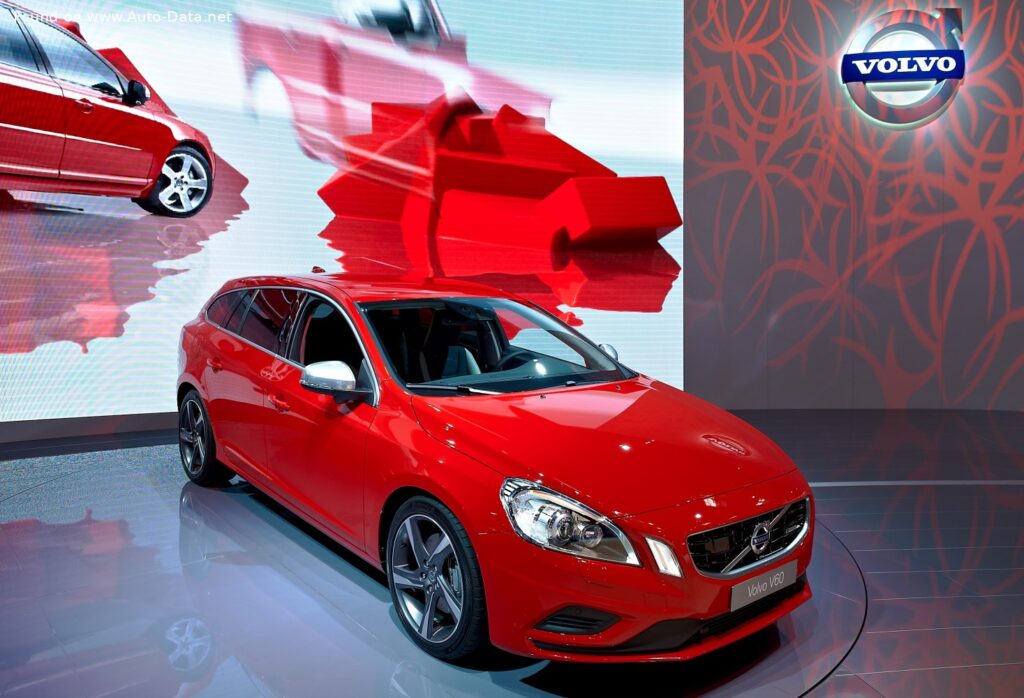
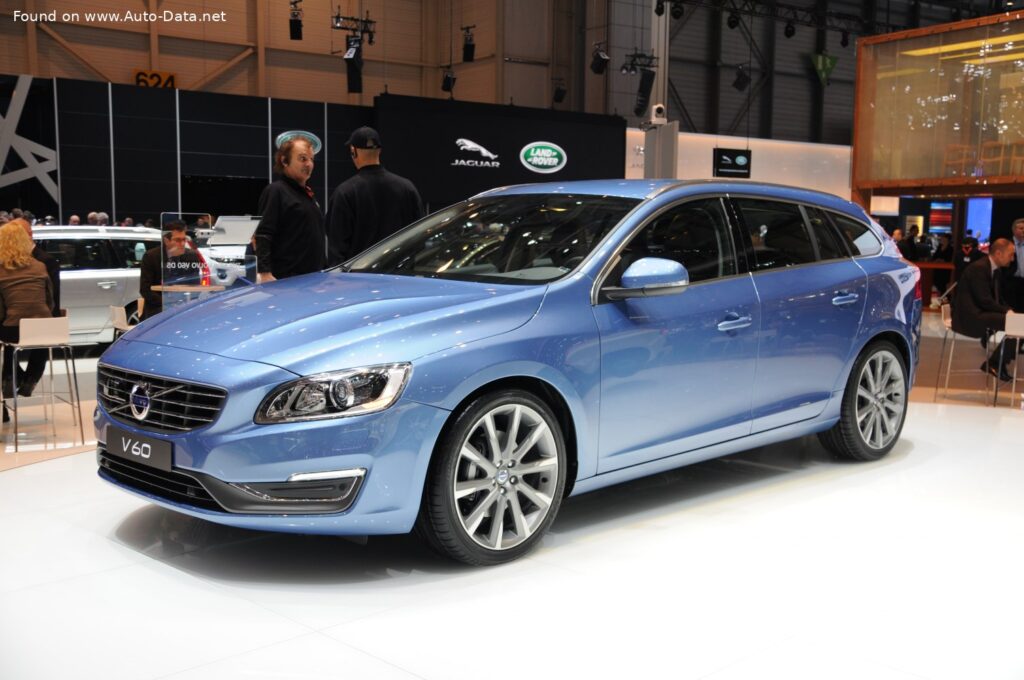
The Volvo V60 I (2013 facelift) retained the sleek and athletic “Sportswagon” design language that debuted with the original V60. Unlike the more upright V70 or XC70, the V60 was penned with a coupe-like roofline and a more dynamic stance, aiming to appeal to buyers seeking style without sacrificing practicality. The facelift brought revised front and rear fascias, including a wider grille, new headlights, and updated taillights, giving the car a more cohesive and sophisticated appearance. Its body type is a traditional 5-door station wagon (often referred to as an “estate” in Europe), offering seating for five occupants.
Measuring 182.48 inches in length, 71.85 inches in width (82.56 inches including mirrors), and 58.43 inches in height, with a wheelbase of 109.29 inches, the V60 strikes a balance between maneuverability and interior space. While its 15.19 cu. ft. (430 liters) of minimum trunk space might not be class-leading compared to more utilitarian wagons, it was ample for most daily needs and could be expanded significantly with the rear seats folded. Volvo’s commitment to intelligent design is also evident in the thoughtful interior, which emphasizes ergonomics, high-quality materials, and a clean, user-friendly layout.
As a Volvo, safety features were paramount. While specific advanced driver-assistance systems (ADAS) are not fully detailed in the provided data, the V60 I generation was well-known for pioneering features like City Safety (automatic braking at low speeds), pedestrian detection, and a host of other passive and active safety technologies. The standard Anti-lock Braking System (ABS), ventilated front discs, and disc rear brakes ensured confident stopping power. The independent McPherson strut front suspension with coil springs and an anti-roll bar, combined with an independent coil spring rear suspension, provided a comfortable yet engaging ride, characteristic of a premium European wagon.
Technical Specifications
| Category | Specification |
|---|---|
| Brand | Volvo |
| Model | V60 I (2013 facelift) |
| Type (Engine) | 1.5 T3 (152 Hp) Automatic |
| Production Start | 2016 year |
| Production End | 2018 year |
| Body type | Station wagon (estate) |
| Seats | 5 |
| Doors | 5 |
| Fuel Consumption (Combined) | 39.9 US mpg (5.9 l/100 km) |
| CO2 emissions | 138 g/km |
| Fuel Type | Petrol (Gasoline) |
| Acceleration 0 – 60 mph | 8.3 sec |
| Maximum speed | 127.38 mph (205 km/h) |
| Power | 152 Hp @ 5000 rpm |
| Power per liter | 101.5 Hp/l |
| Torque | 184.39 lb.-ft. @ 1700-4000 rpm (250 Nm) |
| Engine layout | Front, Transverse |
| Engine Model/Code | B4154T4 |
| Engine displacement | 1.5 liters (1498 cm3 / 91.41 cu. in.) |
| Number of cylinders | 4 |
| Engine configuration | Inline |
| Cylinder Bore | 3.23 in. (82 mm) |
| Piston Stroke | 2.79 in. (70.9 mm) |
| Compression ratio | 10.5:1 |
| Number of valves per cylinder | 4 |
| Fuel injection system | Direct injection |
| Engine aspiration | Turbocharger, Intercooler |
| Valvetrain | DOHC |
| Engine oil capacity | 5.92 US qt (5.6 l) |
| Coolant capacity | 8.77 US qt (8.3 l) |
| Trunk (boot) space – minimum | 15.19 cu. ft. (430 l) |
| Fuel tank capacity | 17.83 US gal (67.5 l) |
| Max. roof load | 165.35 lbs. (75 kg) |
| Permitted trailer load with brakes (8%) | 3968.32 lbs. (1800 kg) |
| Permitted trailer load with brakes (12%) | 3306.93 lbs. (1500 kg) |
| Length | 182.48 in. (4635 mm) |
| Width | 71.85 in. (1825 mm) |
| Width with mirrors folded | 74.76 in. (1899 mm) |
| Width including mirrors | 82.56 in. (2097 mm) |
| Height | 58.43 in. (1484 mm) |
| Wheelbase | 109.29 in. (2776 mm) |
| Front track | 62.52 – 62.13 in. (1588-1578 mm) |
| Rear (Back) track | 62.4 – 62.01 in. (1585-1575 mm) |
| Ride height (ground clearance) | 5.35 in. (136 mm) |
| Drag coefficient (Cd) | 0.29 |
| Minimum turning circle (turning diameter) | 37.73 – 40.68 ft. (11.5 – 12.4 m) |
| Drivetrain Architecture | Internal combustion engine drives the front wheels |
| Drive wheel | Front wheel drive |
| Number of gears and type of gearbox | 6 gears, automatic transmission |
| Front suspension | Independent, type McPherson with coil spring and anti-roll bar |
| Rear suspension | Independent coil spring |
| Front brakes | Ventilated discs |
| Rear brakes | Disc |
| Assisting systems | ABS (Anti-lock braking system) |
| Steering type | Steering rack and pinion |
Legacy and Market Impact
The Volvo V60 I, particularly in its post-facelift guise with engines like the 1.5 T3, played a crucial role in Volvo’s strategy to expand its market share in the premium segment, especially across Europe and Asia. In these markets, the V60 competed directly with established German rivals such as the BMW 3 Series Touring, Audi A4 Avant, and Mercedes-Benz C-Class Estate, as well as mainstream but highly competent offerings like the Volkswagen Passat Variant and Skoda Superb Combi. The 1.5 T3 engine, specifically, allowed Volvo to offer a compelling entry-level premium option that was attractive due to its lower running costs and favorable tax implications in countries where vehicle taxation is often linked to engine displacement and CO2 emissions.
The V60’s reputation was built on Volvo’s core values: uncompromising safety, understated Scandinavian design, and a practical approach to luxury. It offered a distinct alternative to its competitors, often perceived as less ostentatious but equally sophisticated. The 1.5 T3 automatic variant, with its efficient yet capable powertrain, reinforced this image by providing a refined driving experience without excessive fuel consumption. Its drag coefficient of 0.29 was commendable for a wagon, contributing to both fuel efficiency and reduced wind noise at speed.
While not a high-volume seller in every global market, the V60 I was instrumental in showcasing Volvo’s modern design direction and technological prowess before the brand’s full renaissance with the introduction of the Scalable Product Architecture (SPA) platform. The decision to offer a smaller, turbocharged gasoline engine like the 1.5 T3 demonstrated Volvo’s adaptability to global market demands and the ongoing trend of engine downsizing for efficiency. This particular engine variant, produced for a relatively short period (2016-2018), served as a bridge, offering a contemporary powertrain in a mature, well-regarded platform. Its legacy is one of a stylish, safe, and efficient premium wagon that successfully navigated the competitive European landscape, upholding Volvo’s reputation for intelligent engineering and design.