The Volvo V60 I (2013 facelift): A Premium European Wagon Defined by Efficiency
The Volvo V60 I (2013 facelift) represents a pivotal moment for the Swedish automaker, blending its renowned commitment to safety and practicality with a more dynamic and contemporary design language. Produced between 2013 and 2015 for this specific powertrain variant, this generation of the V60 firmly established itself in the competitive European premium compact executive segment. The 1.6 D2 (115 Hp) start/stop model, in particular, was engineered with a strong emphasis on fuel efficiency and reduced emissions, making it a highly attractive option in markets where diesel powertrains were favored for their economic advantages and robust torque delivery.
As a sophisticated station wagon (or estate, as commonly known in Europe), the Volvo V60 I (2013 facelift) was designed to cater to families and professionals seeking a versatile vehicle that did not compromise on style or driving pleasure. While the V60 nameplate did eventually make its way to the United States market, this specific 1.6-liter diesel engine variant was primarily targeted at European consumers, where its combination of performance, low running costs, and compliance with Euro 5 emission standards made it a compelling choice against rivals from Germany and elsewhere.
Engine and Performance: The Efficient Heart of the Volvo V60 I (2013 facelift)
At the core of the Volvo V60 I (2013 facelift) 1.6 D2 lies a highly optimized 1.6-liter (1560 cm3 or 95.2 cu. in.) inline four-cylinder diesel engine, designated internally as D4162T. This powerplant was a testament to Volvo’s focus on downsizing and efficiency without sacrificing usability. Equipped with a turbocharger and intercooler, it generated a respectable 115 horsepower at 3600 rpm. More significantly, it delivered a healthy 199.14 lb.-ft. (270 Nm) of torque across a broad and accessible rev range, from 1750 to 2500 rpm. This ample low-end torque was crucial for effortless daily driving, providing strong acceleration from a standstill and confident overtaking capabilities, even with a full load.
Power was channeled to the front wheels via a smooth-shifting 6-speed manual transmission, a common and popular choice in European markets for its direct engagement and contribution to fuel economy. The V60 1.6 D2 was also equipped with a Start/Stop system and a particulate filter, technologies essential for meeting stringent Euro 5 emission standards and further enhancing fuel efficiency, particularly in urban driving conditions. These systems automatically shut off the engine when the vehicle was stationary and restarted it seamlessly, minimizing idle time and fuel consumption.
Performance figures for this variant were pragmatic, reflecting its family-oriented nature rather than outright sportiness. The V60 1.6 D2 could accelerate from 0 to 60 mph in a respectable 10.7 seconds. However, its true strength lay in its impressive fuel economy. The combined cycle consumption was rated at an outstanding 52.3 US mpg (4.5 liters/100 km), with extra-urban figures reaching an even more remarkable 57.4 US mpg (4.1 liters/100 km). Urban consumption stood at 45.2 US mpg (5.2 liters/100 km). These figures, coupled with CO2 emissions of just 119 g/km, underscored the V60 D2’s credentials as an environmentally conscious and cost-effective daily driver in its primary European market.
Design and Features: Scandinavian Practicality Meets Modern Elegance
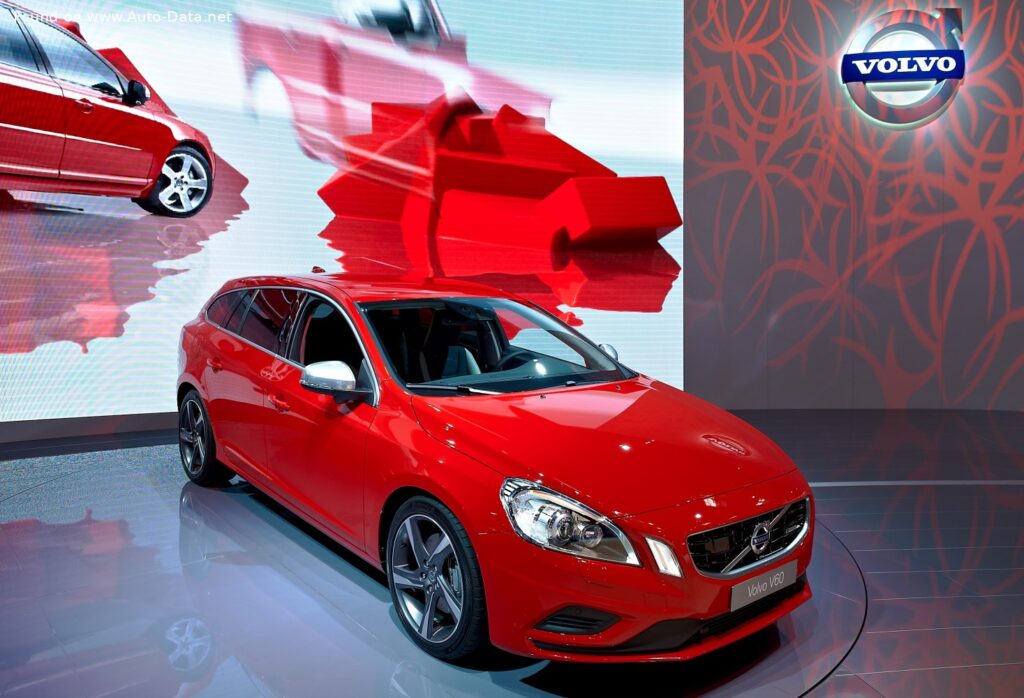
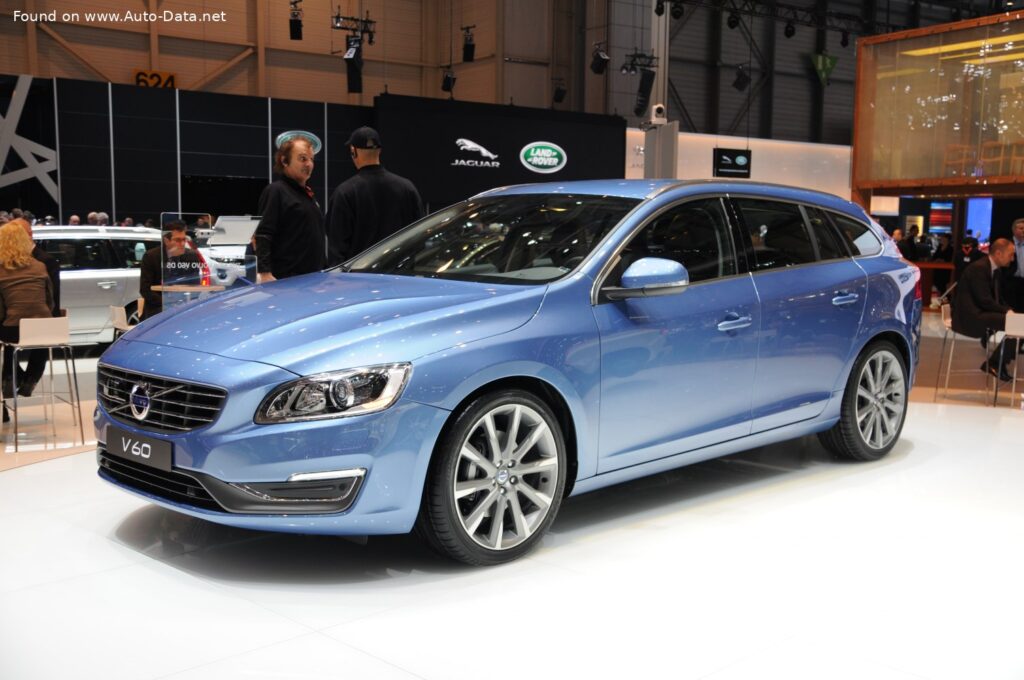
The Volvo V60 I (2013 facelift) maintained Volvo’s characteristic blend of elegant design and functional practicality. As a five-door station wagon, it offered a versatile body type highly prized for its cargo capacity and family-friendliness. The facelift introduced subtle but impactful changes, including revised front fascias, new headlights, and updated interior trim, giving the V60 a fresher, more sophisticated appearance that aligned with Volvo’s evolving design language.
Measuring 182.48 inches (4635 mm) in length, 71.85 inches (1825 mm) in width, and 58.43 inches (1484 mm) in height, with a substantial wheelbase of 109.29 inches (2776 mm), the V60 offered a spacious cabin capable of comfortably seating five occupants. Volvo’s unwavering commitment to ergonomic design was evident in the intuitive layout of the controls and the supportive seating, making long journeys enjoyable. The trunk space, while not class-leading, provided a practical 15.19 cu. ft. (430 liters) behind the rear seats, expandable for larger items, reinforcing its utility as a family vehicle.
Beyond aesthetics, the V60 came equipped with standard safety features, including ABS (Anti-lock Braking System), which was a cornerstone of Volvo’s reputation. While the data provided focuses on the powertrain, it’s important to note that Volvo vehicles of this era typically featured a comprehensive suite of passive and active safety technologies, often including multiple airbags, stability control, and advanced structural designs to protect occupants. The steering system utilized a rack and pinion setup, offering precise and responsive handling, contributing to a refined driving experience that balanced comfort with engagement.
Technical Specifications: Volvo V60 I (2013 facelift) 1.6 D2 (115 Hp) start/stop
| General Information | |
|---|---|
| Brand | Volvo |
| Model | V60 |
| Generation | V60 I (2013 facelift) |
| Type (Engine) | 1.6 D2 (115 Hp) start/stop |
| Start of production | 2013 year |
| End of production | 2015 year |
| Powertrain Architecture | Internal Combustion engine |
| Body type | Station wagon (estate) |
| Seats | 5 |
| Doors | 5 |
| Performance Specifications | |
| Fuel consumption (economy) – urban | 5.2 l/100 km (45.2 US mpg) |
| Fuel consumption (economy) – extra urban | 4.1 l/100 km (57.4 US mpg) |
| Fuel consumption (economy) – combined | 4.5 l/100 km (52.3 US mpg) |
| CO2 emissions | 119 g/km |
| Fuel Type | Diesel |
| Acceleration 0 – 60 mph | 10.7 sec |
| Acceleration 0 – 100 km/h | 11.3 sec |
| Emission standard | Euro 5 |
| Weight-to-power ratio | 14.6 kg/Hp, 68.5 Hp/tonne |
| Weight-to-torque ratio | 6.2 kg/Nm, 160.7 Nm/tonne |
| Engine Specifications | |
| Power | 115 Hp @ 3600 rpm |
| Power per liter | 73.7 Hp/l |
| Torque | 270 Nm (199.14 lb.-ft.) @ 1750-2500 rpm |
| Engine layout | Front, Transverse |
| Engine Model/Code | D4162T |
| Engine displacement | 1560 cm3 (95.2 cu. in.) |
| Number of cylinders | 4 |
| Engine configuration | Inline |
| Cylinder Bore | 75 mm (2.95 in.) |
| Piston Stroke | 88.3 mm (3.48 in.) |
| Fuel injection system | Diesel Commonrail |
| Engine aspiration | Turbocharger, Intercooler |
| Engine oil capacity | 3.8 l (4.02 US qt) |
| Coolant | 10.5 l (11.1 US qt) |
| Engine systems | Start & Stop System, Particulate filter |
| Space, Volume and Weights | |
| Kerb Weight | 1680 kg (3703.77 lbs.) |
| Max. weight | 2110 kg (4651.75 lbs.) |
| Max load | 430 kg (947.99 lbs.) |
| Trunk (boot) space – minimum | 430 l (15.19 cu. ft.) |
| Fuel tank capacity | 67.5 l (17.83 US gal) |
| Dimensions | |
| Length | 4635 mm (182.48 in.) |
| Width | 1825 mm (71.85 in.) |
| Height | 1484 mm (58.43 in.) |
| Wheelbase | 2776 mm (109.29 in.) |
| Front track | 1588 mm (62.52 in.) |
| Rear (Back) track | 1585 mm (62.4 in.) |
| Minimum turning circle (turning diameter) | 11.3 m (37.07 ft.) |
| Drivetrain, Brakes and Suspension Specifications | |
| Drivetrain Architecture | The Internal combustion engine (ICE) drives the front wheels of the vehicle. |
| Drive wheel | Front wheel drive |
| Number of gears and type of gearbox | 6 gears, manual transmission |
| Assisting systems | ABS (Anti-lock braking system) |
| Steering type | Steering rack and pinion |
Legacy and Market Impact: The Volvo V60 I (2013 facelift) in a Competitive Landscape
The Volvo V60 I (2013 facelift) 1.6 D2 carved out a significant niche for itself in the European automotive market, especially among discerning buyers who valued a blend of premium quality, safety, and exceptional fuel economy. Volvo’s brand reputation for building some of the safest cars on the road was a major draw, and the V60 continued this legacy with its robust construction and comprehensive safety features. It offered a compelling alternative to the more overtly sporty offerings from German manufacturers, appealing to those who prioritized understated elegance and practical luxury.
In its primary market, the V60 1.6 D2 faced stiff competition from a host of well-established rivals. Key competitors included the BMW 3 Series Touring (particularly the 316d and 318d models), the Audi A4 Avant (with its 2.0 TDI engines), the Mercedes-Benz C-Class Estate (C 200 CDI), and even more mainstream but highly capable options like the Volkswagen Passat Variant (1.6 TDI) and the Skoda Octavia Combi (1.6 TDI). The V60 differentiated itself with its distinctive Scandinavian design, which offered a refreshing alternative to the more conservative aesthetics of some German rivals, and its famously comfortable and ergonomic interior.
The significance of the 1.6 D2 engine within the V60 lineup cannot be overstated. During its production run from 2013 to 2015, smaller displacement diesel engines with excellent fuel economy and low emissions were highly desirable in Europe due to tax incentives and rising fuel costs. The V60 1.6 D2 perfectly encapsulated this trend, providing a premium experience with the running costs typically associated with smaller, less luxurious vehicles. Its inclusion of Start/Stop technology and a particulate filter underscored Volvo’s commitment to environmental responsibility, a crucial aspect of modern automotive design.
While the V60 nameplate has continued to evolve and is now sold in the United States with different powertrain options, this particular 1.6 D2 diesel variant remains a distinctly European offering. It represents an era when diesel technology was at its peak in terms of efficiency and refinement, playing a vital role in Volvo’s strategy to offer a diverse and competitive product portfolio globally, tailored to regional market demands. The Volvo V60 I (2013 facelift) 1.6 D2 (115 Hp) start/stop therefore stands as a testament to Volvo’s enduring appeal as a maker of practical, safe, and increasingly efficient premium vehicles.