Introduction to the Volvo V60 I (2013 facelift)
The Volvo V60 I (2013 facelift) represents a significant refresh of Volvo’s first-generation compact executive wagon, a model that carved out a niche in the competitive premium segment. Introduced in 2010, the V60 was designed to combine the practicality of a station wagon with the dynamic styling and driving characteristics of a sports sedan, embodying Volvo’s shift towards more emotionally engaging designs. The 2013 facelift, which remained in production until 2015, brought a series of aesthetic and technological updates, enhancing its appeal and aligning it with Volvo’s evolving design language.
This particular variant, the 1.6 T3 (150 Hp) with start/stop technology, was a key offering in European markets, where efficiency and lower emissions were increasingly prioritized. While larger engine options were available, and often preferred in markets like the United States, the 1.6 T3 showcased Volvo’s commitment to downsizing and incorporating advanced fuel-saving technologies. It positioned the V60 as a versatile and environmentally conscious choice for families and professionals seeking a premium wagon without compromising on performance or Volvo’s renowned safety standards.
Engine and Performance: The 1.6 T3 Powertrain in the Volvo V60 I (2013 facelift)
At the heart of this specific Volvo V60 I (2013 facelift) model lies the 1.6-liter T3 engine, a turbocharged inline-four gasoline (petrol) unit designed for a balance of power and efficiency. With an engine displacement of 1596 cubic centimeters (97.39 cubic inches), this compact yet potent powerplant generates a respectable 150 horsepower at 5700 rpm. Crucially for everyday driving, it delivers a robust 240 Newton-meters (177.01 lb.-ft.) of torque across a broad rev range, from 1600 to 4000 rpm. This wide torque band ensures responsive acceleration and flexible performance, making it well-suited for both city driving and highway cruising.
The engine’s architecture features a front, transverse layout and utilizes direct injection for precise fuel delivery, contributing to its efficiency and power output. A turbocharger and intercooler system further enhance performance by forcing more air into the engine, resulting in a more potent combustion process than a naturally aspirated engine of the same displacement. Power is sent to the front wheels via a 6-speed manual transmission, offering an engaging driving experience and allowing the driver to maximize the engine’s potential.
Performance figures for the V60 1.6 T3 are commendable for its class and powertrain size. It can accelerate from 0 to 60 mph in a calculated 9.1 seconds, or 0 to 100 km/h in 9.6 seconds. This allows for confident merging onto highways and comfortable overtaking maneuvers. Fuel efficiency was a key selling point for this variant, particularly with the integrated start/stop system, which automatically shuts off the engine when the vehicle is stationary and restarts it when the driver is ready to move. This technology significantly reduces fuel consumption and CO2 emissions, especially in urban environments. The combined fuel economy is rated at 6 liters per 100 kilometers (39.2 US mpg), with urban consumption at 7.5 l/100 km (31.4 US mpg) and extra-urban at an impressive 5.1 l/100 km (46.1 US mpg). With CO2 emissions of 139 g/km, the vehicle meets the stringent Euro 5 emission standard, reflecting its environmental consciousness.
Design and Features: Scandinavian Elegance and Practicality
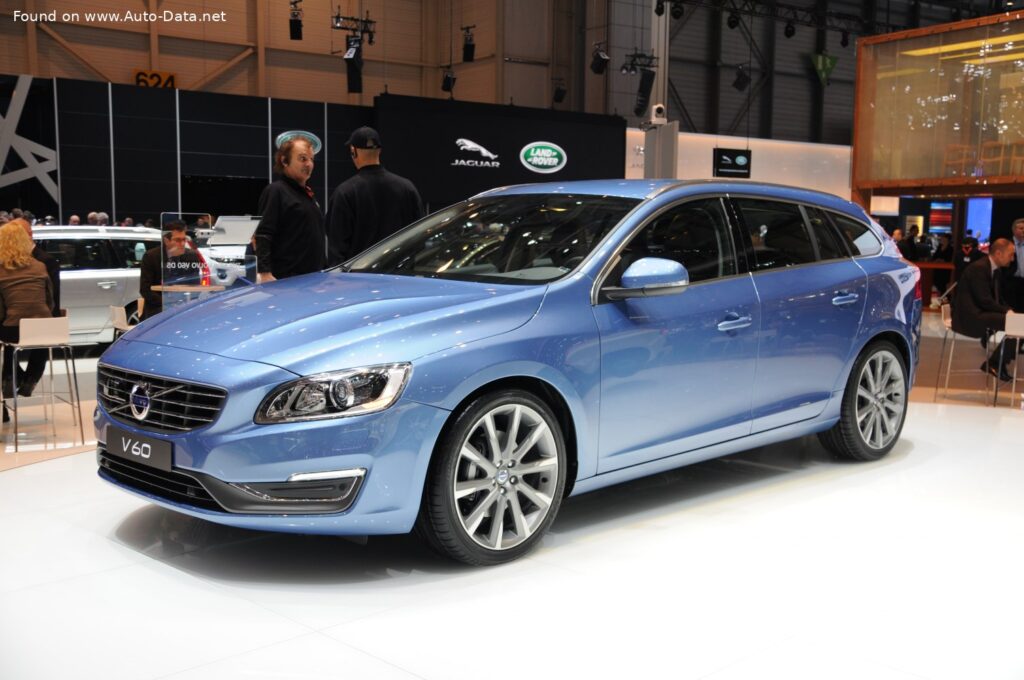
The Volvo V60 I (2013 facelift) maintains Volvo’s distinctive Scandinavian design philosophy, characterized by clean lines, understated elegance, and a strong emphasis on functionality. The facelift introduced several key design updates that refined its appearance. The most notable changes were to the front fascia, featuring a wider grille, revised headlights that integrated into the new design, and a more sculpted bumper, giving the car a more assertive and modern presence. The rear also received subtle updates to the taillights and bumper, ensuring a cohesive design language throughout the vehicle.
As a five-door station wagon (often referred to as an “estate” in Europe), the V60 offers a compelling blend of style and practicality. Its dimensions—182.48 inches in length, 71.85 inches in width, and 58.43 inches in height—provide a spacious interior for five occupants, along with a wheelbase of 109.29 inches that contributes to a comfortable ride and stable handling. The interior, while not explicitly detailed in the provided data, typically featured Volvo’s ergonomic and user-friendly layout, with high-quality materials and intuitive controls.
The V60’s wagon body style inherently offers superior cargo versatility compared to a sedan. With a minimum trunk (boot) space of 430 liters (15.19 cubic feet), it can comfortably accommodate luggage for family trips or daily errands. When the rear seats are folded, this capacity significantly expands, making it a highly practical vehicle for various lifestyles. Safety, a cornerstone of the Volvo brand, is underscored by standard features like ABS (Anti-lock Braking System). Although not explicitly listed in the raw data, it’s safe to assume that a vehicle from this era and brand would also incorporate a suite of advanced safety systems, including multiple airbags, stability control, and potentially more advanced driver-assistance features depending on the trim level, reinforcing Volvo’s reputation for occupant protection. The steering system is a rack and pinion type, providing precise and responsive handling.
Technical Specifications
| Category | Specification | Metric / US Equivalent |
|---|---|---|
| General Information | ||
| Brand | Volvo | |
| Model | V60 | |
| Generation | V60 I (2013 facelift) | |
| Type (Engine) | 1.6 T3 (150 Hp) start/stop | |
| Start of Production | 2013 year | |
| End of Production | 2015 year | |
| Powertrain Architecture | Internal Combustion engine | |
| Body Type | Station wagon (estate) | |
| Seats | 5 | |
| Doors | 5 | |
| Performance Specs | ||
| Fuel Consumption (Urban) | 7.5 l/100 km | 31.4 US mpg |
| Fuel Consumption (Extra Urban) | 5.1 l/100 km | 46.1 US mpg |
| Fuel Consumption (Combined) | 6 l/100 km | 39.2 US mpg |
| CO2 Emissions | 139 g/km | |
| Fuel Type | Petrol (Gasoline) | |
| Acceleration 0 – 60 mph | 9.1 sec | |
| Acceleration 0 – 100 km/h | 9.6 sec | |
| Emission Standard | Euro 5 | |
| Weight-to-power ratio | 11 kg/Hp | 91.2 Hp/tonne |
| Weight-to-torque ratio | 6.9 kg/Nm | 146 Nm/tonne |
| Engine Specs | ||
| Power | 150 Hp @ 5700 rpm | |
| Power per liter | 94 Hp/l | |
| Torque | 240 Nm @ 1600-4000 rpm | 177.01 lb.-ft. @ 1600-4000 rpm |
| Engine Layout | Front, Transverse | |
| Engine Model/Code | B4164T3 | |
| Engine Displacement | 1596 cm3 | 1.6 Liters / 97.39 cu. in. |
| Number of Cylinders | 4 | |
| Engine Configuration | Inline | |
| Cylinder Bore | 79 mm | 3.11 in. |
| Piston Stroke | 81.4 mm | 3.2 in. |
| Fuel Injection System | Direct injection | |
| Engine Aspiration | Turbocharger, Intercooler | |
| Engine Oil Capacity | 4.1 l | 4.33 US qt |
| Coolant Capacity | 9.2 l | 9.72 US qt |
| Engine Systems | Start & Stop System | |
| Space, Volume and Weights | ||
| Kerb Weight | 1644 kg | 3624.4 lbs. |
| Max. Weight | 2100 kg | 4629.71 lbs. |
| Max Load | 456 kg | 1005.31 lbs. |
| Trunk (Boot) Space – minimum | 430 l | 15.19 cu. ft. |
| Fuel Tank Capacity | 67.5 l | 17.83 US gal |
| Dimensions | ||
| Length | 4635 mm | 182.48 in. |
| Width | 1825 mm | 71.85 in. |
| Height | 1484 mm | 58.43 in. |
| Wheelbase | 2776 mm | 109.29 in. |
| Front Track | 1588 mm | 62.52 in. |
| Rear (Back) Track | 1585 mm | 62.4 in. |
| Minimum Turning Circle (Turning Diameter) | 11.3 m | 37.07 ft. |
| Drivetrain, Brakes and Suspension Specs | ||
| Drivetrain Architecture | Internal combustion engine (ICE) drives front wheels | |
| Drive Wheel | Front wheel drive | |
| Number of Gears and Type of Gearbox | 6 gears, manual transmission | |
| Assisting Systems | ABS (Anti-lock braking system) | |
| Steering Type | Steering rack and pinion | |
Legacy and Market Impact of the Volvo V60 I (2013 facelift)
The Volvo V60 I (2013 facelift), particularly with its efficient 1.6 T3 engine, played a crucial role in Volvo’s strategy to compete in the European premium compact executive segment. In markets outside the United States, where fuel costs and vehicle taxation often correlate with engine displacement and CO2 emissions, smaller, turbocharged engines like the 1.6 T3 were highly desirable. This variant offered a compelling balance of adequate power, refined driving dynamics, and impressive fuel economy, making it a popular choice for consumers seeking a practical yet upscale vehicle without the higher running costs associated with larger engines.
In its primary European market, the V60 competed fiercely with established rivals such as the BMW 3 Series Touring, Audi A4 Avant, and Mercedes-Benz C-Class Estate. While these German competitors often emphasized sportier driving dynamics or more opulent interiors, the V60 carved out its own niche by offering a distinctively Scandinavian approach: understated luxury, unparalleled safety, and a focus on ergonomic comfort and practicality. The facelift helped keep the V60 fresh and competitive against newer iterations from its rivals, ensuring it remained relevant throughout its production run.
The V60’s legacy is rooted in its contribution to modernizing Volvo’s image, moving away from its historically boxy designs towards more dynamic and elegant aesthetics, a trend that continues to define the brand today. It reinforced Volvo’s commitment to safety, not just through passive measures but also through the integration of active safety technologies. Furthermore, the adoption of efficient powertrains like the 1.6 T3, coupled with features like the start/stop system, showcased Volvo’s early efforts in environmental responsibility and efficient engineering, setting the stage for its future electrification strategy. While this specific engine variant was not offered in the North American market, the V60 as a model line proved that wagons could be stylish and desirable, maintaining a loyal following among those who appreciated its unique blend of attributes. It remains a testament to Volvo’s ability to combine practicality, safety, and sophisticated design into a cohesive and appealing package.