Introduction to the Volvo V60 I (2013 facelift) 2.0 D3 (150 Hp)
The Volvo V60 I (2013 facelift) 2.0 D3 (150 Hp) represents a significant iteration of Volvo’s premium compact executive station wagon, serving as a cornerstone of the brand’s European lineup during its production run from 2015 to 2018. As part of the first generation V60, the 2013 facelift brought a refreshed aesthetic and updated powertrains, aligning the model with Volvo’s evolving design language and efficiency objectives. Positioned as a versatile and stylish alternative in a highly competitive segment, the V60 offered a compelling blend of Scandinavian design, renowned safety features, and practical utility. While the V60 was available in various markets, this specific 2.0 D3 diesel variant was primarily targeted at European consumers, where diesel powertrains were highly favored for their fuel efficiency and robust torque delivery. This model, with its 150 horsepower D3 engine, underscored Volvo’s commitment to delivering an engaging driving experience coupled with reduced environmental impact, a critical consideration in its primary sales regions.
Engine & Performance: The Efficient Heart of the Volvo V60 I (2013 facelift) 2.0 D3 (150 Hp)
At the core of this particular V60 variant lies Volvo’s D4204T9 engine, a 2.0-liter (120.16 cu. in.) inline four-cylinder diesel unit designed for optimal balance between power and economy. This powertrain architecture, featuring a front, transverse engine layout, drives the front wheels, a common configuration for efficiency and packaging advantages in this class. The engine benefits from a sophisticated Diesel Commonrail fuel injection system and is boosted by a turbocharger and intercooler, ensuring a strong and consistent power delivery across the rev range.
The 2.0 D3 engine produces a respectable 150 horsepower at 3750 rpm, translating to a power output of 76.2 horsepower per liter. More impressively for a diesel, it generates a substantial 236.02 lb.-ft. of torque, available from a low 1750 rpm up to 3000 rpm. This broad torque band is crucial for real-world driving, providing excellent responsiveness and effortless acceleration, particularly beneficial when carrying passengers or cargo, or when navigating varied terrain.
Paired with a 6-speed manual transmission, the Volvo V60 I (2013 facelift) 2.0 D3 (150 Hp) achieves a 0-60 mph acceleration time of a brisk 8.6 seconds (calculated by Auto-Data.net), or 9.1 seconds for the 0-62 mph (0-100 km/h) sprint. Its maximum speed is rated at 130.49 mph (210 km/h), making it perfectly capable for highway cruising. However, where this D3 engine truly excels is in its fuel economy. With a combined fuel consumption rating of 58.8 US mpg (4 liters per 100 km), it stands out as an exceptionally efficient option. This efficiency is further highlighted by its low CO2 emissions of just 105 g/km, making it an environmentally conscious choice within its segment, particularly appealing in markets with strict emissions regulations. The engine’s DOHC valvetrain and 16:1 compression ratio further contribute to its refined operation and robust performance.
Design & Features: Scandinavian Practicality and Elegance
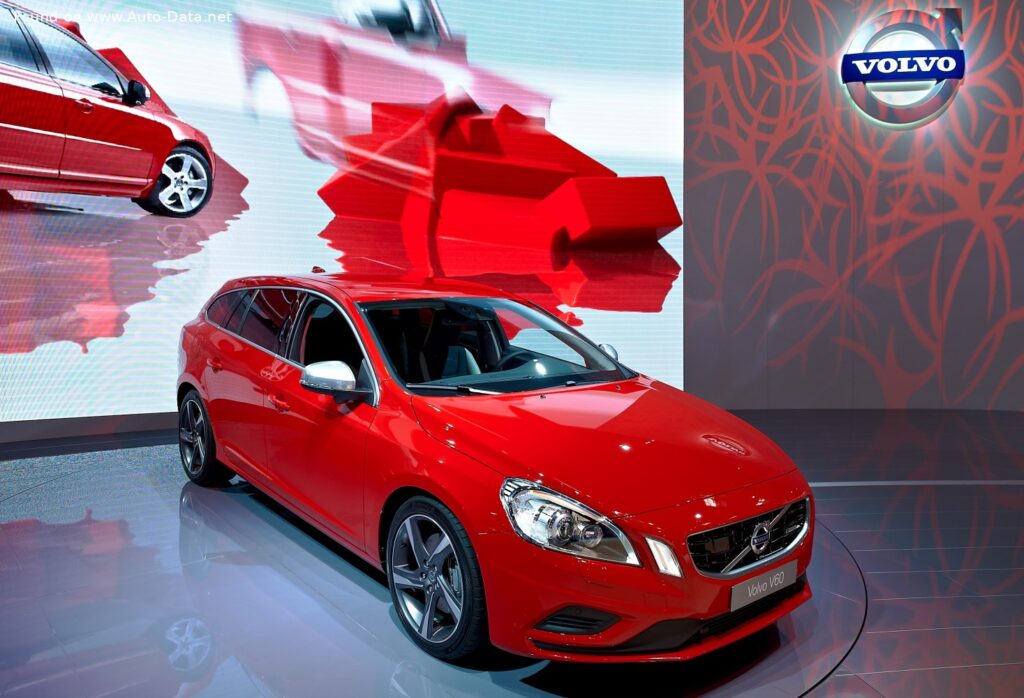
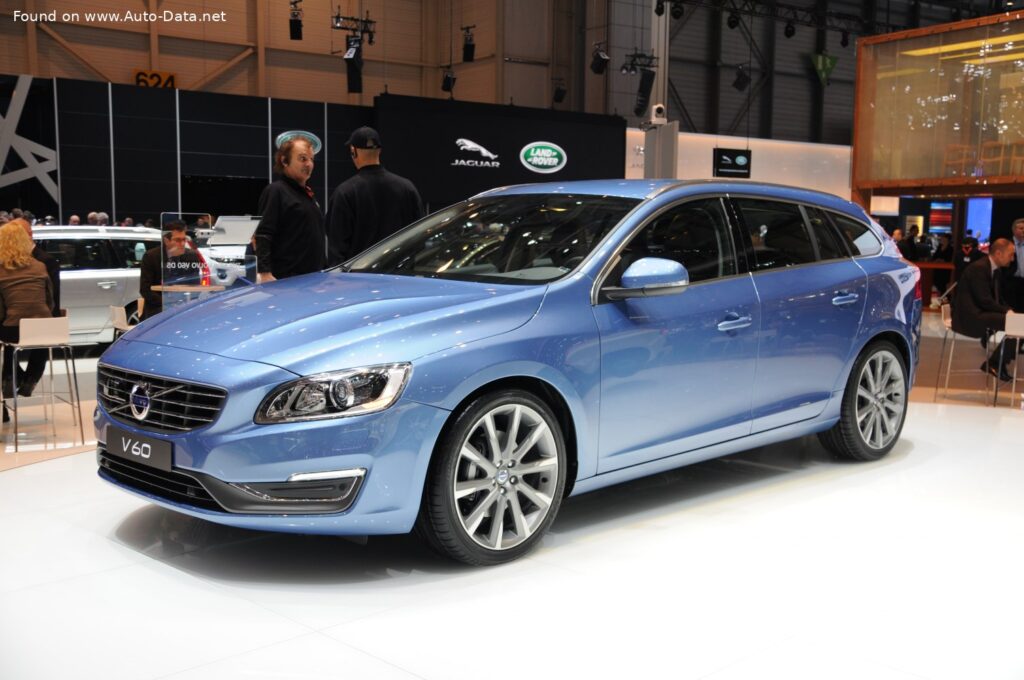
The Volvo V60 I (2013 facelift) continued to embody Volvo’s distinct Scandinavian design philosophy, characterized by clean lines, understated elegance, and a strong emphasis on functionality. The station wagon (estate) body type, with its five doors and seating for five occupants, offers a practical yet stylish alternative to traditional sedans. The 2013 facelift brought several enhancements, including a redesigned front fascia with a wider grille and more prominent headlights, giving the V60 a more assertive and modern presence. The integrated tailpipes also contributed to a more cohesive and upscale rear design.
Inside, the V60 maintained Volvo’s reputation for ergonomic design and high-quality materials. The cabin is spacious and driver-focused, with comfortable seats that are a hallmark of the brand, offering excellent support for long journeys. The trunk space of 15.19 cu. ft. (430 liters) provides ample room for luggage and everyday essentials, a key advantage of the station wagon body style. Furthermore, the V60 offers practical features such as a maximum roof load capacity of 165.35 lbs. (75 kg) and impressive towing capabilities, with a permitted trailer load of 3968.32 lbs. (1800 kg) with brakes (8% incline), underscoring its versatility.
Safety, as always with Volvo, was paramount. The V60 I (2013 facelift) came equipped with a comprehensive suite of active and passive safety features. While specific advanced driver-assistance systems (ADAS) would vary by trim level and optional packages for this era, standard features like ABS (Anti-lock Braking System), robust ventilated disc brakes at the front and disc brakes at the rear, and a finely tuned independent suspension system (McPherson struts with coil springs and anti-roll bar at the front, independent coil spring at the rear) ensured confident handling and stopping power. The steering rack and pinion system provided precise and responsive control, contributing to a secure and engaging driving experience. The vehicle’s dimensions, including a length of 182.48 inches (4635 mm) and a width of 71.85 inches (1825 mm), coupled with a relatively low drag coefficient of 0.29, contributed to both its aesthetic appeal and aerodynamic efficiency.
Technical Specifications
| Category | Specification | Value |
|---|---|---|
| General Information | ||
| Brand | Volvo | |
| Model | V60 | |
| Generation | V60 I (2013 facelift) | |
| Type (Engine) | 2.0 D3 (150 Hp) | |
| Start of Production | 2015 year | |
| End of Production | 2018 year | |
| Powertrain Architecture | Internal Combustion engine | |
| Body Type | Station wagon (estate) | 5 Doors, 5 Seats |
| Performance Specifications | ||
| Fuel Consumption (combined) | 58.8 US mpg (4 l/100 km) | |
| CO2 Emissions | 105 g/km | |
| Fuel Type | Diesel | |
| Acceleration 0 – 60 mph | 8.6 sec (Calculated by Auto-Data.net) | |
| Acceleration 0 – 62 mph (0-100 km/h) | 9.1 sec | |
| Maximum Speed | 130.49 mph (210 km/h) | |
| Engine Specifications | ||
| Power | 150 Hp @ 3750 rpm | |
| Power per Liter | 76.2 Hp/l | |
| Torque | 236.02 lb.-ft. @ 1750-3000 rpm (320 Nm) | |
| Engine Layout | Front, Transverse | |
| Engine Model/Code | D4204T9 | |
| Engine Displacement | 2.0 l (120.16 cu. in. / 1969 cm3) | |
| Number of Cylinders | 4 | |
| Engine Configuration | Inline | |
| Cylinder Bore | 3.23 in. (82 mm) | |
| Piston Stroke | 3.67 in. (93.2 mm) | |
| Compression Ratio | 16:1 | |
| Number of Valves per Cylinder | 4 | |
| Fuel Injection System | Diesel Commonrail | |
| Engine Aspiration | Turbocharger, Intercooler | |
| Valvetrain | DOHC | |
| Engine Oil Capacity | 5.49 US qt (5.2 l) | |
| Coolant Capacity | 9.4 US qt (8.9 l) | |
| Space, Volume and Weights | ||
| Trunk (boot) Space – minimum | 15.19 cu. ft. (430 l) | |
| Fuel Tank Capacity | 17.83 US gal (67.5 l) | |
| Max. Roof Load | 165.35 lbs. (75 kg) | |
| Permitted Trailer Load with brakes (8%) | 3968.32 lbs. (1800 kg) | |
| Permitted Trailer Load with brakes (12%) | 3306.93 lbs. (1500 kg) | |
| Dimensions | ||
| Length | 182.48 in. (4635 mm) | |
| Width | 71.85 in. (1825 mm) | |
| Width with Mirrors Folded | 74.76 in. (1899 mm) | |
| Width Including Mirrors | 82.56 in. (2097 mm) | |
| Height | 58.43 in. (1484 mm) | |
| Wheelbase | 109.29 in. (2776 mm) | |
| Front Track | 62.52 – 62.13 in. (1588-1578 mm) | |
| Rear (Back) Track | 62.4 – 62.01 in. (1585-1575 mm) | |
| Ride Height (Ground Clearance) | 5.35 in. (136 mm) | |
| Drag Coefficient (Cd) | 0.29 | |
| Minimum Turning Circle (Turning Diameter) | 37.73 – 40.68 ft. (11.5 – 12.4 m) | |
| Drivetrain, Brakes and Suspension Specifications | ||
| Drivetrain Architecture | The Internal combustion engine (ICE) drives the front wheels of the vehicle. | |
| Drive Wheel | Front wheel drive | |
| Number of Gears and Type of Gearbox | 6 gears, manual transmission | |
| Front Suspension | Independent, type McPherson with coil spring and anti-roll bar | |
| Rear Suspension | Independent coil spring | |
| Front Brakes | Ventilated discs | |
| Rear Brakes | Disc | |
| Assisting Systems | ABS (Anti-lock braking system) | |
| Steering Type | Steering rack and pinion | |
Legacy & Market Impact of the Volvo V60 I (2013 facelift)
The Volvo V60 I (2013 facelift) 2.0 D3 (150 Hp) played a crucial role in Volvo’s strategy to maintain its competitive edge in the European premium compact executive segment. In a market dominated by German rivals such as the BMW 3 Series Touring, Audi A4 Avant, and Mercedes-Benz C-Class Estate, the V60 D3 offered a distinct Scandinavian proposition. Its key differentiators included Volvo’s unparalleled reputation for safety, a more unconventional yet elegant design, and a strong emphasis on comfort and practicality.
The D3 engine, part of Volvo’s Drive-E powertrain family, was particularly significant. It showcased Volvo’s engineering prowess in developing highly efficient and clean diesel engines, crucial for meeting stringent European emissions standards while delivering the performance and fuel economy desired by consumers. The popularity of diesel engines in Europe during this period meant that variants like the 2.0 D3 were central to the V60’s sales success in that region. For buyers, the V60 offered a compelling combination of low running costs due to its excellent fuel economy, along with sufficient power and torque for daily driving and longer trips.
The V60’s legacy is also tied to its contribution to Volvo’s brand image. It reinforced the company’s commitment to designing vehicles that are not only safe and reliable but also aesthetically pleasing and enjoyable to drive. While the V60 with diesel engines was not a primary offering in the North American market, where gasoline engines and SUVs dominated, its success in Europe allowed Volvo to maintain a strong global presence and fund the development of future models. The first-generation V60, particularly after its facelift, paved the way for the critically acclaimed second-generation V60, which continued Volvo’s tradition of premium wagons with even more advanced technology and refined design. The Volvo V60 I (2013 facelift) 2.0 D3 (150 Hp) remains a testament to Volvo’s ability to blend efficiency, performance, and distinctive design into a highly practical and desirable package for its target market.