The Volvo V60 I (2013 facelift) 2.0 D4 (181 Hp): A Paragon of Practicality and Efficiency
The Volvo V60 I, particularly the iteration introduced with the 2013 facelift and powered by the advanced 2.0 D4 (181 Hp) engine, represents a significant chapter in Volvo’s modern history. Positioned in the highly competitive premium mid-size station wagon segment, this model was a cornerstone of Volvo’s European lineup from its production start in 2013 until 2015. While the V60 nameplate has had a presence in the North American market, this specific diesel variant, the 2.0 D4 (181 Hp), was primarily tailored for European markets where diesel powertrains traditionally hold a strong appeal due to their superior fuel economy and torque characteristics.
The 2013 facelift brought a refreshed aesthetic and refined interior, but perhaps most crucially, it heralded the introduction of Volvo’s groundbreaking Drive-E engine family. The 2.0 D4 (181 Hp) engine showcased Volvo’s engineering prowess, demonstrating how a four-cylinder diesel could deliver both robust performance and exceptional fuel efficiency. This vehicle epitomized Volvo’s commitment to safety, sophisticated design, and environmental responsibility, establishing itself as a compelling choice for families and discerning drivers seeking a blend of utility and driving pleasure in the European premium segment.
Engine and Performance of the Volvo V60 I (2013 facelift) 2.0 D4 (181 Hp)
At the heart of the 2013 facelifted Volvo V60 D4 lay a truly innovative powertrain: the 2.0-liter (1969 cm³) inline four-cylinder diesel engine, internally designated D4204T5. This engine was a prime example of Volvo’s then-new Drive-E philosophy, aiming to consolidate a wide range of power outputs from a compact, efficient four-cylinder architecture. Utilizing a sophisticated common rail fuel injection system and a turbocharger with an intercooler, this powerplant generated a substantial 181 horsepower at 4250 rpm, providing ample thrust for diverse driving conditions. More impressively, it delivered a robust 295.02 lb.-ft. of torque across a broad and accessible rev range, from 1750 to 2500 rpm. This high torque output made the V60 D4 feel remarkably responsive and effortless in everyday driving, whether navigating city streets or cruising on the highway.
Performance figures for the Volvo V60 I (2013 facelift) 2.0 D4 (181 Hp) were commendable for a family-oriented station wagon. It could accelerate from 0 to 60 mph in a swift 7.2 seconds (0-100 km/h in 7.6 seconds), making it capable of confident overtakes and spirited driving. The top speed was rated at 139.81 mph (225 km/h). Power was delivered to the front wheels via a smooth and precise 6-speed manual transmission, offering engaging control for the driver. The engine’s layout was front, transverse, contributing to efficient packaging and optimal weight distribution for front-wheel-drive dynamics.
Beyond its performance, the D4 engine truly shone in its fuel economy and emissions. The combined fuel consumption was an outstanding 3.9 liters per 100 kilometers, translating to an impressive 60.3 US mpg. Even in urban environments, it achieved 54.7 US mpg, while extra-urban driving saw figures climb to 63.6 US mpg. These numbers, coupled with CO2 emissions of just 103 g/km, underscored Volvo’s commitment to environmental efficiency without compromising on power or refinement. The engine’s high compression ratio of 15.8:1 and DOHC valvetrain further contributed to its efficiency and smooth operation, establishing the D4 as a benchmark for modern diesel technology in its class.
Design and Features
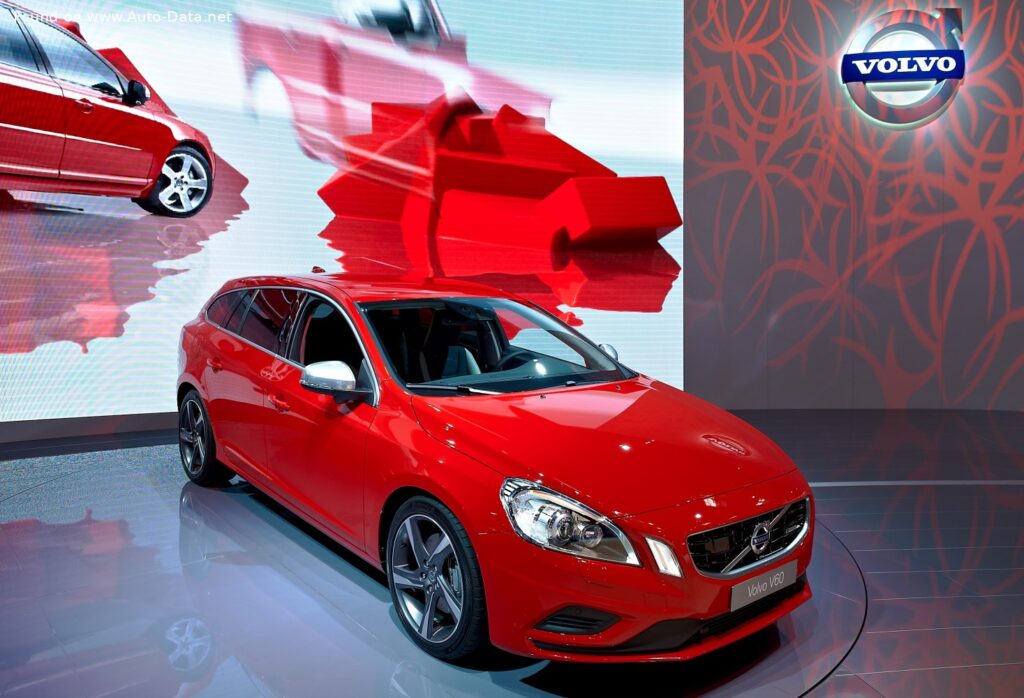
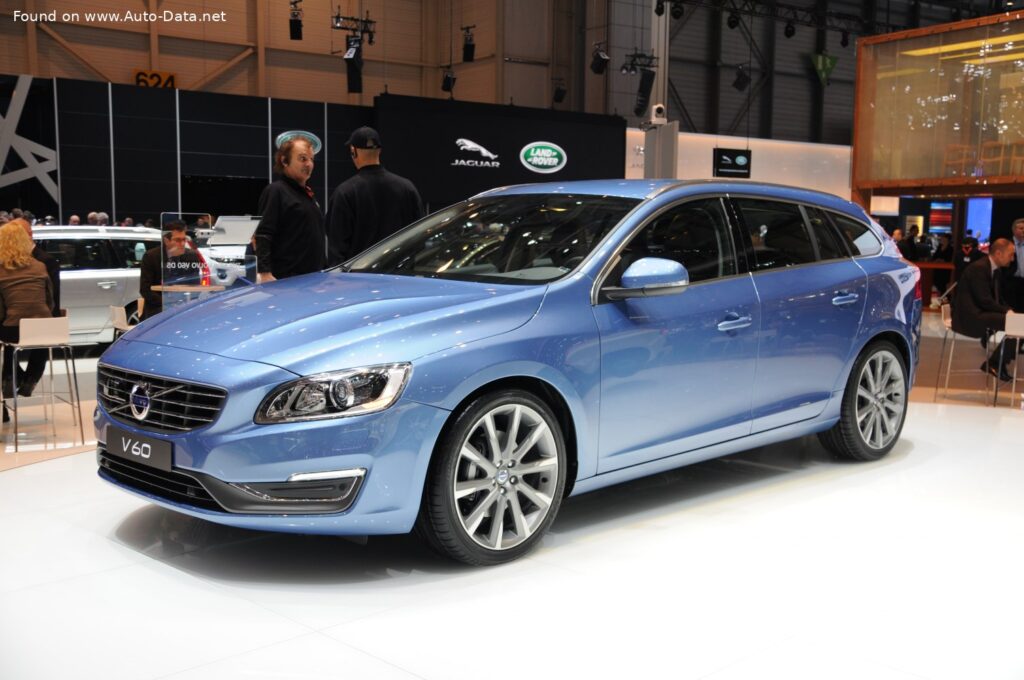
The 2013 facelift of the Volvo V60 I brought a more contemporary and unified look to Volvo’s lineup, aligning it with the larger S60 sedan. The exterior received a significant refresh, most notably with a wider grille and new headlights that integrated seamlessly into the front fascia, giving the car a more assertive and sophisticated presence. The V60 retained its distinctive “sport wagon” profile, which blended the practicality of an estate with the sleek lines of a coupe, distinguishing it from more boxy traditional wagons. Its five-door, five-seat configuration offered versatile space for passengers and cargo, making it an ideal family vehicle.
Inside, the V60 continued Volvo’s tradition of ergonomic excellence and high-quality craftsmanship. The cabin exuded a sense of Scandinavian minimalism and functionality, with premium materials and intuitive controls. The floating center console, a Volvo hallmark, remained a prominent design feature, providing both aesthetic appeal and clever storage solutions. For the 2013 model year, the Sensus infotainment system was refined, offering enhanced connectivity and user-friendliness, though still operating within the technological constraints of its era.
As expected from a Volvo, safety was paramount. While the raw data doesn’t detail every safety feature, the V60 I was equipped with a comprehensive suite of active and passive safety systems typical of Volvo at the time. This included advanced high-strength steel construction, multiple airbags, and a robust ABS (Anti-lock Braking System). Beyond the basics, it would have offered features like Volvo’s City Safety system (automatic braking at low speeds), pedestrian detection, and potentially options such as Lane Keeping Aid and Blind Spot Information System (BLIS), all designed to protect occupants and prevent accidents. The thoughtful design extended to the independent McPherson strut front suspension and independent coil spring rear suspension, providing a comfortable yet composed ride, while ventilated discs at the front and disc brakes at the rear ensured strong stopping power.
Technical Specifications: Volvo V60 I (2013 facelift) 2.0 D4 (181 Hp)
| Category | Specification |
|---|---|
| General Information | |
| Brand | Volvo |
| Model | V60 |
| Generation | V60 I (2013 facelift) |
| Type (Engine) | 2.0 D4 (181 Hp) |
| Start of Production | 2013 year |
| End of Production | 2015 year |
| Powertrain Architecture | Internal Combustion engine |
| Body type | Station wagon (estate) |
| Seats | 5 |
| Doors | 5 |
| Performance Specs | |
| Fuel Consumption (Urban) | 4.3 l/100 km (54.7 US mpg) |
| Fuel Consumption (Extra Urban) | 3.7 l/100 km (63.6 US mpg) |
| Fuel Consumption (Combined) | 3.9 l/100 km (60.3 US mpg) |
| CO2 Emissions | 103 g/km |
| Fuel Type | Diesel |
| Acceleration 0 – 60 mph | 7.2 sec |
| Acceleration 0 – 100 km/h | 7.6 sec |
| Maximum Speed | 225 km/h (139.81 mph) |
| Engine Specs | |
| Power | 181 Hp @ 4250 rpm |
| Power per liter | 91.9 Hp/l |
| Torque | 400 Nm (295.02 lb.-ft.) @ 1750-2500 rpm |
| Engine Layout | Front, Transverse |
| Engine Model/Code | D4204T5 |
| Engine Displacement | 1969 cm³ (2.0 l / 120.16 cu. in.) |
| Number of Cylinders | 4 |
| Engine Configuration | Inline |
| Cylinder Bore | 82 mm (3.23 in.) |
| Piston Stroke | 93.2 mm (3.67 in.) |
| Compression Ratio | 15.8:1 |
| Valves per Cylinder | 4 |
| Fuel Injection System | Diesel Commonrail |
| Engine Aspiration | Turbocharger, Intercooler |
| Valvetrain | DOHC |
| Engine Oil Capacity | 5.6 l (5.92 US qt) |
| Coolant Capacity | 8.9 l (9.4 US qt) |
| Space, Volume and Weights | |
| Fuel Tank Capacity | 67.5 l (17.83 US gal) |
| Dimensions | |
| Length | 4635 mm (182.48 in.) |
| Width | 1899 mm (74.76 in.) |
| Height | 1484 mm (58.43 in.) |
| Wheelbase | 2776 mm (109.29 in.) |
| Front Track | 1588-1578 mm (62.52 – 62.13 in.) |
| Rear (Back) Track | 1585-1575 mm (62.4 – 62.01 in.) |
| Ride Height (Ground Clearance) | 136 mm (5.35 in.) |
| Minimum Turning Circle | 11.5 – 12.4 m (37.73 – 40.68 ft.) |
| Drivetrain, Brakes and Suspension Specs | |
| Drivetrain Architecture | The Internal combustion engine (ICE) drives the front wheels of the vehicle. |
| Drive Wheel | Front wheel drive |
| Number of Gears and Type of Gearbox | 6 gears, manual transmission |
| Front Suspension | Independent, type McPherson with coil spring and anti-roll bar |
| Rear Suspension | Independent coil spring |
| Front Brakes | Ventilated discs |
| Rear Brakes | Disc |
| Assisting Systems | ABS (Anti-lock braking system) |
| Steering Type | Steering rack and pinion |
Legacy and Market Impact
The Volvo V60 I (2013 facelift) 2.0 D4 (181 Hp) played a pivotal role in Volvo’s strategy to redefine itself in the premium segment. In its primary European markets, it competed fiercely with established rivals such as the BMW 3 Series Touring, Audi A4 Avant, Mercedes-Benz C-Class Estate, and the Volkswagen Passat Variant. What set the V60 apart was its unique blend of Scandinavian design, unparalleled safety reputation, and the compelling efficiency of its Drive-E powertrains. The 2.0 D4 engine, in particular, was a game-changer, demonstrating that a four-cylinder diesel could deliver the performance and refinement expected in a premium vehicle while achieving class-leading fuel economy and low emissions.
This model helped solidify Volvo’s reputation not just for safety, but also for increasingly sophisticated technology and a more dynamic driving experience. The V60’s “sport wagon” aesthetic appealed to buyers who desired the practicality of an estate without sacrificing style or driving engagement. Its advanced safety features, even in 2013, were often ahead of the curve, reinforcing Volvo’s core brand values. The introduction of the Drive-E engines, exemplified by the D4, marked a strategic shift for Volvo, moving away from a diverse range of larger engines towards a more modular and efficient powertrain family. This strategy allowed Volvo to standardize components, reduce manufacturing complexity, and invest more heavily in electrification later on.
The V60 D4’s market impact was significant in demonstrating Volvo’s engineering capabilities and its commitment to environmental responsibility. It became a popular choice for fleet buyers and private customers alike, who appreciated its low running costs, comfortable cabin, and robust build quality. While diesel engines have faced increasing scrutiny in recent years, during its production run, the V60 2.0 D4 was celebrated as a highly efficient and potent option. It laid much of the groundwork for the subsequent generations of Volvo vehicles, influencing their design language, technological integration, and powertrain philosophy. Today, the Volvo V60 I (2013 facelift) 2.0 D4 (181 Hp) remains a respected and sought-after used vehicle in Europe, valued for its enduring qualities of safety, comfort, and remarkable fuel efficiency.