The Volvo V60 I (2013 Facelift) 2.0 D5 (225 Hp) Automatic: A Premium European Estate
The Volvo V60 I (2013 facelift) represents a significant iteration of Volvo’s premium compact executive station wagon, serving as a cornerstone of the brand’s European lineup during its production run from 2015 to 2018. This particular variant, equipped with the potent 2.0 D5 (225 Hp) Automatic powertrain, showcased Volvo’s commitment to combining strong performance with impressive fuel efficiency, particularly appealing to the European market where diesel engines remained a popular choice for their torque and long-distance economy. While not a primary offering in the North American market in this specific diesel configuration, understanding this model provides insight into Volvo’s global strategy and its engineering prowess during a pivotal period of the company’s modernization.
The V60, first introduced in 2010, was designed to compete in a highly contested segment against established German rivals like the BMW 3 Series Touring, Audi A4 Avant, and Mercedes-Benz C-Class Estate. The 2013 facelift brought a refreshed exterior design, interior enhancements, and updated powertrain options, aligning the V60 with Volvo’s evolving design language and technological advancements. The D5 engine variant, in particular, was lauded for its blend of power and refinement, making the V60 a compelling choice for consumers seeking a practical yet engaging driving experience with the characteristic safety and comfort Volvo is renowned for.
Engine and Performance of the Volvo V60 I (2013 Facelift)
At the heart of the Volvo V60 I (2013 facelift) 2.0 D5 lies Volvo’s sophisticated D4204T11 engine, a 2.0-liter (120.16 cubic inches) inline four-cylinder diesel unit. This powerplant is a testament to Volvo’s Drive-E powertrain philosophy, emphasizing modularity, efficiency, and performance. Employing a twin-turbo setup and an intercooler, the engine delivers a robust 225 horsepower at 4250 rpm. More impressively, it generates a substantial 346.65 lb.-ft. of torque across a broad and accessible rev range, from 1750 to 2500 rpm. This low-end torque is crucial for effortless acceleration and strong pulling power, a hallmark of modern diesel engines.
Power is channeled to the front wheels via a smooth and responsive 8-speed automatic transmission, ensuring optimal power delivery and refined gear changes. This combination allows the V60 D5 to achieve a commendable 0-60 mph acceleration time of just 6.2 seconds, with a top speed electronically limited to 142.92 mph. For a practical family station wagon, these performance figures underscore its sporting capabilities.
Beyond raw power, efficiency was a key design objective. The 2.0 D5 engine boasts an impressive combined fuel economy rating of 49 US mpg, making it an economical choice for long-distance travel. Furthermore, its CO2 emissions of 125 g/km reflect Volvo’s commitment to environmental responsibility, particularly important in the European regulatory landscape. The engine’s architecture, featuring a 15.8:1 compression ratio, common rail fuel injection, and a DOHC valvetrain with four valves per cylinder, contributes to its refined operation and efficient combustion. The 5.2-liter engine oil capacity and 8.9-liter coolant capacity ensure robust thermal management and lubrication for sustained performance.
Design and Features
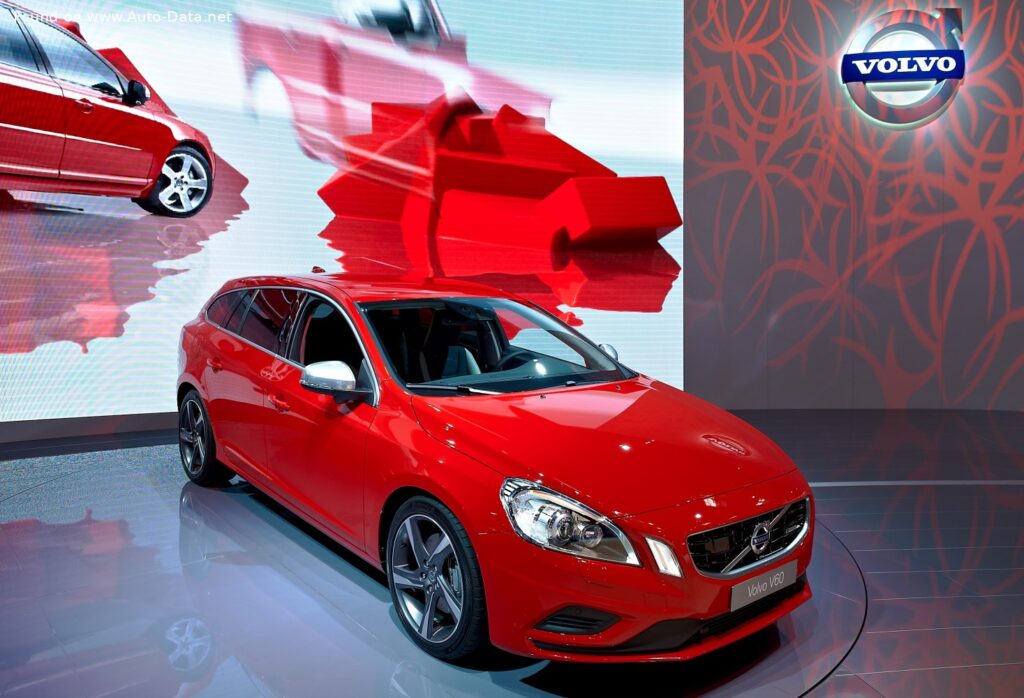
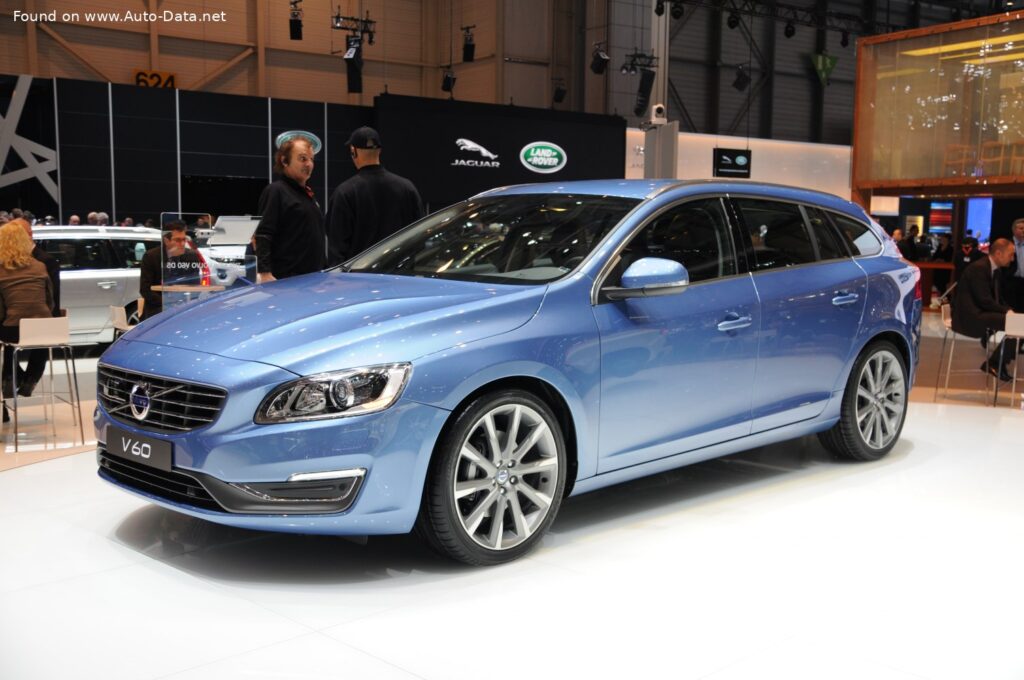
The Volvo V60 I (2013 facelift) retained the elegant and dynamic design language that characterized the first-generation V60, while introducing subtle yet impactful updates. As a five-door station wagon (often referred to as an “estate” in European markets), it seamlessly blended Volvo’s traditional emphasis on practicality with a more sporting, coupe-like profile. The facelift introduced a wider, more assertive front grille, revised headlights that integrated seamlessly with the bodywork, and new front and rear bumpers, giving the car a more cohesive and contemporary appearance. Its drag coefficient of 0.29 was competitive for its class, contributing to both aesthetics and aerodynamic efficiency.
Measuring 182.48 inches in length, 71.85 inches in width (82.56 inches including mirrors), and 58.43 inches in height, with a wheelbase of 109.29 inches, the V60 offered a well-proportioned stance. The interior, designed with typical Scandinavian minimalism and ergonomic excellence, accommodated five occupants comfortably. High-quality materials, intuitive controls, and supportive seating were hallmarks of the V60’s cabin. While the trunk space of 15.19 cubic feet (430 liters) was adequate for daily use, it was slightly less capacious than some direct rivals, reflecting its more lifestyle-oriented, sport wagon design rather than a pure cargo hauler.
Volvo’s unwavering commitment to safety was evident in the V60. Beyond standard features like ABS (Anti-lock Braking System) and a robust chassis, the V60 I generation incorporated a suite of advanced safety technologies, many of which were pioneering for their time. While specific advanced driver-assistance systems are not detailed in the provided data, a Wikipedia-style article on a Volvo of this era would typically highlight innovations like City Safety (automatic braking to prevent low-speed collisions), pedestrian detection, and various collision mitigation systems, underpinning Volvo’s reputation as a leader in automotive safety. The car’s independent McPherson front suspension with coil springs and anti-roll bar, paired with an independent coil spring rear suspension, delivered a comfortable and composed ride, characteristic of a premium European touring car. Steering was managed by a responsive rack and pinion system, and braking power was provided by ventilated discs at the front and disc brakes at the rear.
Technical Specifications
| Category | Specification | US Equivalent |
|---|---|---|
| General Information | ||
| Brand | Volvo | |
| Model | V60 | |
| Generation | V60 I (2013 facelift) | |
| Type (Engine) | 2.0 D5 (225 Hp) Automatic | |
| Start of production | 2015 year | |
| End of production | 2018 year | |
| Powertrain Architecture | Internal Combustion engine | |
| Body type | Station wagon (estate) | |
| Seats | 5 | |
| Doors | 5 | |
| Performance Specs | ||
| Fuel consumption (combined) | 4.8 l/100 km | 49 US mpg |
| CO2 emissions | 125 g/km | |
| Fuel Type | Diesel | |
| Acceleration 0 – 60 mph | 6.2 sec | |
| Acceleration 0 – 100 km/h | 6.5 sec | |
| Maximum speed | 230 km/h | 142.92 mph |
| Engine Specs | ||
| Power | 225 Hp @ 4250 rpm | |
| Power per liter | 114.3 Hp/l | |
| Torque | 470 Nm @ 1750-2500 rpm | 346.65 lb.-ft. @ 1750-2500 rpm |
| Engine layout | Front, Transverse | |
| Engine Model/Code | D4204T11 | |
| Engine displacement | 1969 cm3 | 120.16 cu. in. |
| Number of cylinders | 4 | |
| Engine configuration | Inline | |
| Cylinder Bore | 82 mm | 3.23 in. |
| Piston Stroke | 93.2 mm | 3.67 in. |
| Compression ratio | 15.8:1 | |
| Number of valves per cylinder | 4 | |
| Fuel injection system | Diesel Commonrail | |
| Engine aspiration | Twin-Turbo, Intercooler | |
| Valvetrain | DOHC | |
| Engine oil capacity | 5.2 l | 5.49 US qt |
| Coolant | 8.9 l | 9.4 US qt |
| Space, Volume and Weights | ||
| Trunk (boot) space – minimum | 430 l | 15.19 cu. ft. |
| Fuel tank capacity | 67.5 l | 17.83 US gal |
| Max. roof load | 75 kg | 165.35 lbs. |
| Permitted trailer load with brakes (8%) | 1800 kg | 3968.32 lbs. |
| Permitted trailer load with brakes (12%) | 1500 kg | 3306.93 lbs. |
| Dimensions | ||
| Length | 4635 mm | 182.48 in. |
| Width | 1825 mm | 71.85 in. |
| Width with mirrors folded | 1899 mm | 74.76 in. |
| Width including mirrors | 2097 mm | 82.56 in. |
| Height | 1484 mm | 58.43 in. |
| Wheelbase | 2776 mm | 109.29 in. |
| Front track | 1588-1578 mm | 62.52 – 62.13 in. |
| Rear (Back) track | 1585-1575 mm | 62.4 – 62.01 in. |
| Ride height (ground clearance) | 136 mm | 5.35 in. |
| Drag coefficient (Cd) | 0.29 | |
| Minimum turning circle (turning diameter) | 11.5 – 12.4 m | 37.73 – 40.68 ft. |
| Drivetrain, Brakes and Suspension Specs | ||
| Drivetrain Architecture | Internal combustion engine drives front wheels | |
| Drive wheel | Front wheel drive | |
| Number of gears and type of gearbox | 8 gears, automatic transmission | |
| Front suspension | Independent, type McPherson with coil spring and anti-roll bar | |
| Rear suspension | Independent coil spring | |
| Front brakes | Ventilated discs | |
| Rear brakes | Disc | |
| Assisting systems | ABS (Anti-lock braking system) | |
| Steering type | Steering rack and pinion |
Legacy and Market Impact
The Volvo V60 I, particularly in its 2.0 D5 (225 Hp) Automatic facelift guise, carved out a significant niche in the European premium compact executive segment. Its primary competitors were formidable: the BMW 3 Series Touring, Audi A4 Avant, and Mercedes-Benz C-Class Estate, all of which offered powerful and efficient diesel variants. However, the V60 distinguished itself with a unique blend of attributes. While its German rivals often emphasized sporty dynamics or outright luxury, the V60 offered a more understated, sophisticated appeal, prioritizing comfort, safety, and a distinctly Scandinavian approach to design and functionality.
The D5 engine was particularly impactful for Volvo in Europe, providing a high-performance diesel option that satisfied the demands of drivers who covered extensive mileage. Its combination of strong torque, brisk acceleration, and impressive fuel economy made it an ideal choice for both executive fleet vehicles and private buyers seeking a capable, long-distance cruiser. This variant reinforced Volvo’s reputation for building robust and reliable powertrains, while also demonstrating the brand’s ability to innovate within the rapidly evolving automotive landscape.
The V60’s legacy is multifaceted. It represented a crucial model in Volvo’s transition period, bridging the gap between its more traditional, boxy wagon heritage and its modern, design-forward future. It showcased Volvo’s ability to create a desirable and competitive product without sacrificing its core values of safety and practicality. The V60 I also paved the way for the critically acclaimed second-generation V60, which built upon its predecessor’s strengths and further cemented Volvo’s position as a formidable player in the premium segment, increasingly with an eye towards electrification. For enthusiasts and families alike, the V60 D5 of this era remains a testament to Volvo’s engineering prowess and its enduring appeal as a maker of distinctive, safe, and engaging automobiles.