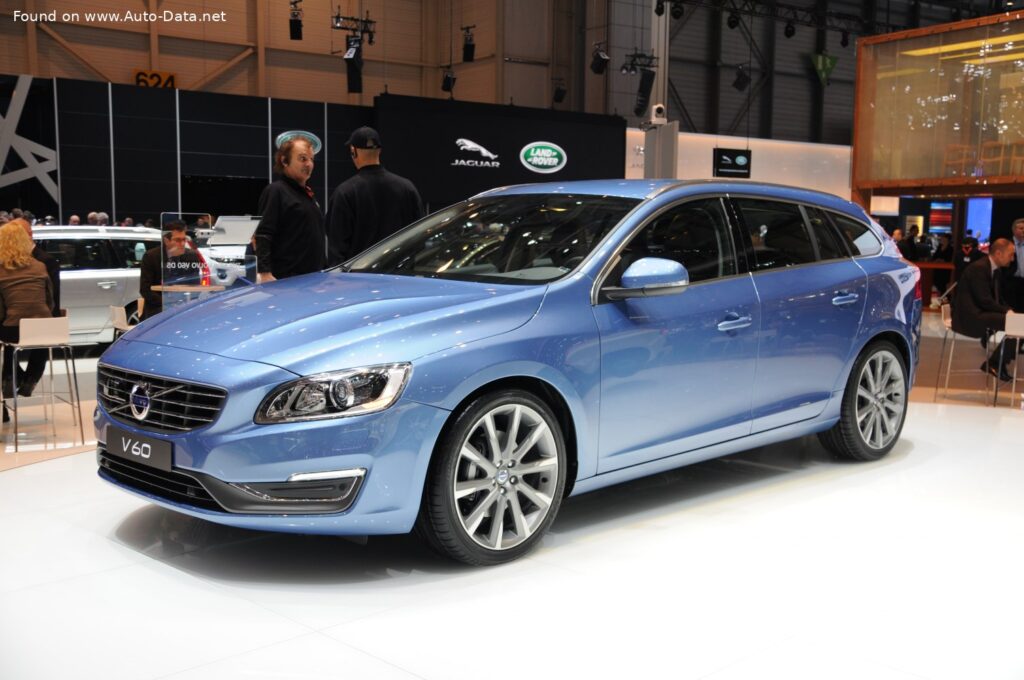
The Volvo V60 I (2013 facelift) 2.4 D5 (215 Hp) Automatic: A European Executive Wagon
The Volvo V60 I (2013 facelift) 2.4 D5 (215 Hp) Automatic represents a significant iteration of Volvo’s premium compact executive station wagon, a vehicle type deeply embedded in the Swedish automaker’s heritage. Introduced in 2013 as part of a comprehensive refresh for the first-generation V60, this particular model combined Volvo’s renowned safety philosophy with a potent and efficient five-cylinder turbodiesel engine, a staple of the brand’s European powertrain offerings. While the V60 itself did see some presence in the North American market, this specific 2.4 D5 diesel variant, with its 215 horsepower output and automatic transmission, was primarily targeted at and found considerable success in European and other international markets where diesel powertrains and station wagons held a stronger appeal than in the United States. It carved out a niche for discerning buyers seeking a blend of practicality, luxury, and long-distance cruising capability, all wrapped in Volvo’s distinctive Scandinavian design language.
Positioned against rivals like the BMW 3 Series Touring, Audi A4 Avant, and Mercedes-Benz C-Class Estate, the Volvo V60 I (2013 facelift) aimed to distinguish itself through its commitment to passenger safety, ergonomic interior design, and a unique powertrain configuration. The 2013 facelift brought a host of exterior and interior refinements, enhancing its contemporary appeal and aligning its aesthetics more closely with Volvo’s evolving design direction. This particular V60 variant, produced from 2013 to 2015, showcased Volvo’s engineering prowess in balancing performance with fuel efficiency, particularly relevant in a market increasingly sensitive to environmental impact and running costs.
Engine and Performance: The Robust D5 Powertrain of the Volvo V60 I (2013 facelift)
At the heart of the Volvo V60 I (2013 facelift) 2.4 D5 (215 Hp) Automatic lies Volvo’s venerable D5 engine, a 2.4-liter (2400 cm3 or 146.46 cu. in.) inline five-cylinder turbodiesel unit, coded D5244T15. This engine configuration has long been a hallmark of Volvo’s larger and more powerful vehicles, offering a distinctive sound and a robust power delivery that often belies its diesel nature. The engine features a sophisticated common rail fuel injection system, paired with a turbocharger and intercooler, to maximize both power output and fuel efficiency while adhering to Euro 5 emission standards.
This D5 engine produces a healthy 215 horsepower at 4000 rpm, translating to a power-per-liter ratio of 89.6 Hp/l, which is competitive for its class. More impressively, the engine generates a substantial 324.53 lb.-ft. (440 Nm) of torque, available across a broad and usable rev range from 1500 to 3000 rpm. This wide torque band is crucial for effortless acceleration and strong mid-range pull, characteristic of a premium diesel powertrain, making it well-suited for both urban driving and high-speed highway cruising. The engine is mounted transversely at the front, driving the front wheels, a typical layout for Volvo’s more compact platforms.
Power is channeled through a smooth and responsive 6-speed automatic transmission, which complements the engine’s torque characteristics by providing seamless gear changes. The combination allows the V60 D5 to accelerate from 0 to 60 mph in a brisk 7.3 seconds (0-100 km/h in 7.7 seconds), a respectable figure for a family station wagon weighing 3836.04 lbs. (1740 kg) curb weight. Despite its performance capabilities, the vehicle also boasts commendable fuel economy figures. The combined fuel consumption is rated at 37.9 US mpg (6.2 l/100 km), with extra-urban driving achieving an impressive 48 US mpg (4.9 l/100 km). Urban consumption stands at 27.7 US mpg (8.5 l/100 km). These figures, alongside CO2 emissions of 162 g/km, highlight the engine’s efficiency in its class. A particulate filter system helps to reduce harmful emissions, aligning with the Euro 5 standard.
Design and Features: Scandinavian Practicality and Elegance
The Volvo V60 I (2013 facelift) maintained its distinctive five-door station wagon (often referred to as an “estate” in Europe) body style, which is a core part of Volvo’s brand identity. The facelift introduced several key design updates that gave the V60 a more contemporary and unified look. The most noticeable changes were to the front fascia, featuring a wider grille, new headlights that integrated into the grille, and a revised bumper design. These updates gave the V60 a more assertive and sophisticated presence, aligning it with the design language of its larger S60 and XC60 siblings. The rear also saw minor tweaks to the taillights and bumper, though the overall silhouette remained largely unchanged, emphasizing its sleek, coupe-like profile for a wagon.
Inside, the V60 offers seating for five occupants, with a focus on ergonomic design and high-quality materials, typical of Volvo. The interior received subtle updates during the facelift, including new instrument clusters and infotainment system enhancements, though the overall layout remained driver-centric and intuitive. Volvo’s commitment to safety is evident throughout the design, with a robust chassis and a comprehensive suite of passive and active safety features. While specific advanced driver-assistance systems are not detailed in the raw data, Volvo vehicles of this era typically included features like ABS (Anti-lock Braking System) as standard, and often offered optional systems such as City Safety (automatic braking), pedestrian detection, and lane-keeping assist, reinforcing its reputation as a leader in automotive safety.
Practicality is a strong suit of the V60 wagon. It offers a minimum trunk space of 15.19 cu. ft. (430 liters), which, while not class-leading compared to some larger wagons, is still ample for most daily needs and travel luggage. The rear seats could be folded down to expand cargo capacity. The vehicle’s dimensions—182.48 inches (4635 mm) in length, 71.85 inches (1825 mm) in width, and 58.43 inches (1484 mm) in height—along with a wheelbase of 109.29 inches (2776 mm), contribute to a stable ride and comfortable interior space, balanced with a manageable footprint for urban environments. The steering system is a rack and pinion type, providing precise control, and the minimum turning circle of 37.07 ft. (11.3 m) aids maneuverability.
Technical Specifications
| Category | Specification |
|---|---|
| General Information | |
| Brand | Volvo |
| Model | V60 |
| Generation | V60 I (2013 facelift) |
| Type (Engine) | 2.4 D5 (215 Hp) Automatic |
| Production Start | 2013 |
| Production End | 2015 |
| Powertrain Architecture | Internal Combustion Engine |
| Body Type | Station Wagon (Estate) |
| Seats | 5 |
| Doors | 5 |
| Performance Specs | |
| Fuel Consumption (Urban) | 27.7 US mpg (8.5 l/100 km) |
| Fuel Consumption (Extra Urban) | 48 US mpg (4.9 l/100 km) |
| Fuel Consumption (Combined) | 37.9 US mpg (6.2 l/100 km) |
| CO2 Emissions | 162 g/km |
| Fuel Type | Diesel |
| Acceleration 0-60 mph | 7.3 sec |
| Acceleration 0-100 km/h | 7.7 sec |
| Emission Standard | Euro 5 |
| Weight-to-Power Ratio | 8.1 kg/Hp (123.6 Hp/tonne) |
| Weight-to-Torque Ratio | 4 kg/Nm (252.9 Nm/tonne) |
| Engine Specs | |
| Power | 215 Hp @ 4000 rpm |
| Power per Liter | 89.6 Hp/l |
| Torque | 324.53 lb.-ft. (440 Nm) @ 1500-3000 rpm |
| Engine Layout | Front, Transverse |
| Engine Model/Code | D5244T15 |
| Engine Displacement | 2.4 Liters (2400 cm3 / 146.46 cu. in.) |
| Number of Cylinders | 5 |
| Engine Configuration | Inline |
| Cylinder Bore | 3.19 in. (81 mm) |
| Piston Stroke | 3.67 in. (93.15 mm) |
| Fuel Injection System | Diesel Commonrail |
| Engine Aspiration | Turbocharger, Intercooler |
| Engine Oil Capacity | 6.23 US qt (5.9 l) |
| Coolant Capacity | 9.4 US qt (8.9 l) |
| Engine Systems | Particulate filter |
| Space, Volume, and Weights | |
| Kerb Weight | 3836.04 lbs. (1740 kg) |
| Max. Weight (GVWR) | 4850.17 lbs. (2200 kg) |
| Max Load | 1014.13 lbs. (460 kg) |
| Trunk (Boot) Space – Minimum | 15.19 cu. ft. (430 l) |
| Fuel Tank Capacity | 17.83 US gal (67.5 l) |
| Dimensions | |
| Length | 182.48 in. (4635 mm) |
| Width | 71.85 in. (1825 mm) |
| Height | 58.43 in. (1484 mm) |
| Wheelbase | 109.29 in. (2776 mm) |
| Front Track | 62.52 in. (1588 mm) |
| Rear Track | 62.4 in. (1585 mm) |
| Minimum Turning Circle | 37.07 ft. (11.3 m) |
| Drivetrain, Brakes, and Suspension Specs | |
| Drivetrain Architecture | Front-wheel drive (ICE drives front wheels) |
| Drive Wheel | Front wheel drive |
| Number of Gears & Type | 6 gears, automatic transmission |
| Assisting Systems | ABS (Anti-lock Braking System) |
| Steering Type | Steering rack and pinion |
Legacy and Market Impact: The Volvo V60 I (2013 facelift) in its Segment
The Volvo V60 I (2013 facelift) 2.4 D5 (215 Hp) Automatic holds a significant place in Volvo’s modern history, particularly in markets outside of North America. It represented Volvo’s continued dedication to the station wagon segment, a body style that has been synonymous with the brand for decades. In Europe and other regions, the V60 D5 was highly regarded for its unique combination of attributes: robust performance from the distinctive five-cylinder diesel, impressive fuel efficiency for its power output, and Volvo’s unwavering commitment to safety. Its position as a premium compact executive wagon placed it in direct competition with established German rivals, and it often appealed to buyers looking for a distinctive alternative that prioritized understated elegance, comfort, and practicality over outright sporty dynamics.
The D5 engine, with its characteristic thrum and strong torque delivery, contributed significantly to the V60’s reputation as an excellent long-distance cruiser. Its ability to effortlessly cover ground while returning strong fuel economy made it a favorite among business travelers and families in countries with higher fuel prices and a strong preference for diesel power. While the V60 nameplate did reach the USA, this specific D5 diesel variant was largely absent from the American market, where gasoline engines and SUVs dominated sales. For American enthusiasts of European cars, the V60 D5 represents a fascinating “what if” scenario, offering a blend of attributes that never quite found widespread traction in the domestic market but was highly successful abroad.
The 2013 facelift ensured the V60 remained competitive during its production run, keeping its design fresh and its technology up-to-date with evolving consumer expectations. Its legacy is tied to Volvo’s brand identity: a car that is safe, sensible, and stylish, but with an underlying character provided by its unique powertrain. It solidified Volvo’s position as a credible alternative in the premium segment, demonstrating that practicality and performance could coexist with Scandinavian design and a strong focus on occupant well-being. Today, these first-generation facelift V60 models, particularly the potent D5 variants, are sought after in their primary markets for their durability, comfort, and the distinctive driving experience offered by the five-cylinder engine, a configuration that has since become a rarity in the automotive landscape.