The Volvo V60 II 2.0 B6 (299 Hp) Mild Hybrid AWD Automatic: A Blend of Scandinavian Practicality and Modern Performance
The Volvo V60 II 2.0 B6 (299 Hp) Mild Hybrid AWD Automatic, introduced in March 2020, represents the second generation of Volvo’s mid-size premium station wagon, embodying the brand’s commitment to safety, sophisticated design, and advanced powertrain technology. Positioned in the competitive luxury compact executive segment, the V60 II offers a compelling alternative to SUVs, appealing to discerning buyers who prioritize versatility, driving dynamics, and elegant aesthetics. This particular variant, the B6, stands out with its innovative mild hybrid (MHEV) powertrain, combining a potent twin-charged gasoline engine with an electric motor to deliver a harmonious balance of robust performance and enhanced fuel efficiency. It showcases Volvo’s strategic shift towards electrification, integrating sustainable technologies without compromising on the premium driving experience expected from the Swedish marque.
Engine and Performance of the Volvo V60 II 2.0 B6 (299 Hp) Mild Hybrid AWD Automatic
At the heart of the Volvo V60 II 2.0 B6 (299 Hp) Mild Hybrid AWD Automatic lies a sophisticated 2.0-liter (120.16 cubic inches) inline-four gasoline engine, designated as the B420T. This powerplant is a marvel of modern engineering, featuring both turbocharging and supercharging, coupled with an intercooler, to eliminate turbo lag and provide immediate, linear power delivery across the entire RPM range. This twin-charging setup helps the engine produce a formidable 299 horsepower at 5400 rpm and 309.78 pound-feet of torque, available broadly from 2100 to 4800 rpm, ensuring responsive acceleration and effortless highway cruising.
Complementing the internal combustion engine is a mild hybrid electric vehicle (MHEV) system. This powertrain architecture integrates a 14-horsepower electric motor, which also generates 29.5 pound-feet of torque. While not capable of propelling the vehicle on electric power alone for extended periods, the mild hybrid system plays a crucial role in improving efficiency and refining the driving experience. It assists the gasoline engine during acceleration, recovers energy during braking, and enables a smoother, more seamless operation of the Start & Stop system, significantly reducing fuel consumption and emissions in urban environments. The system’s intelligent design means the electric motor and the internal combustion engine primarily drive the front wheels, with the all-wheel-drive (AWD) system engaging the rear wheels via an electrically or mechanically controlled clutch only when additional traction is needed.
Power is channeled through an advanced 8-speed Geartronic automatic transmission, renowned for its smooth shifts and intelligent gear selection, optimizing both performance and efficiency. The all-wheel-drive system ensures confident handling and stability in various driving conditions, from dry pavement to slippery roads. The V60 B6 accelerates from 0 to 60 mph in a swift 5.7 seconds and has an electronically limited top speed of 111.85 mph, a common practice for modern Volvos prioritizing safety and efficiency.
Despite its impressive performance, the V60 B6 Mild Hybrid maintains a focus on environmental responsibility. It meets the stringent Euro 6d emission standard, aided by its MHEV system and a particulate filter. Combined fuel economy (WLTP) ranges from 28.3 to 32.7 US mpg, with CO2 emissions between 163-186 g/km, underscoring Volvo’s commitment to reducing its carbon footprint while delivering a premium driving experience.
Design and Features
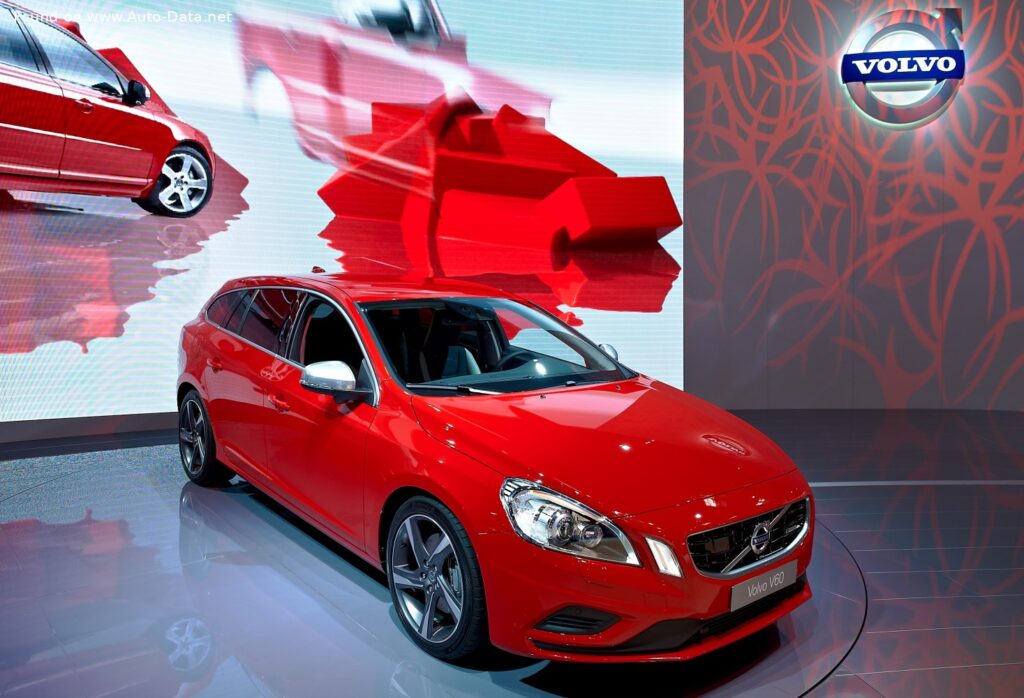
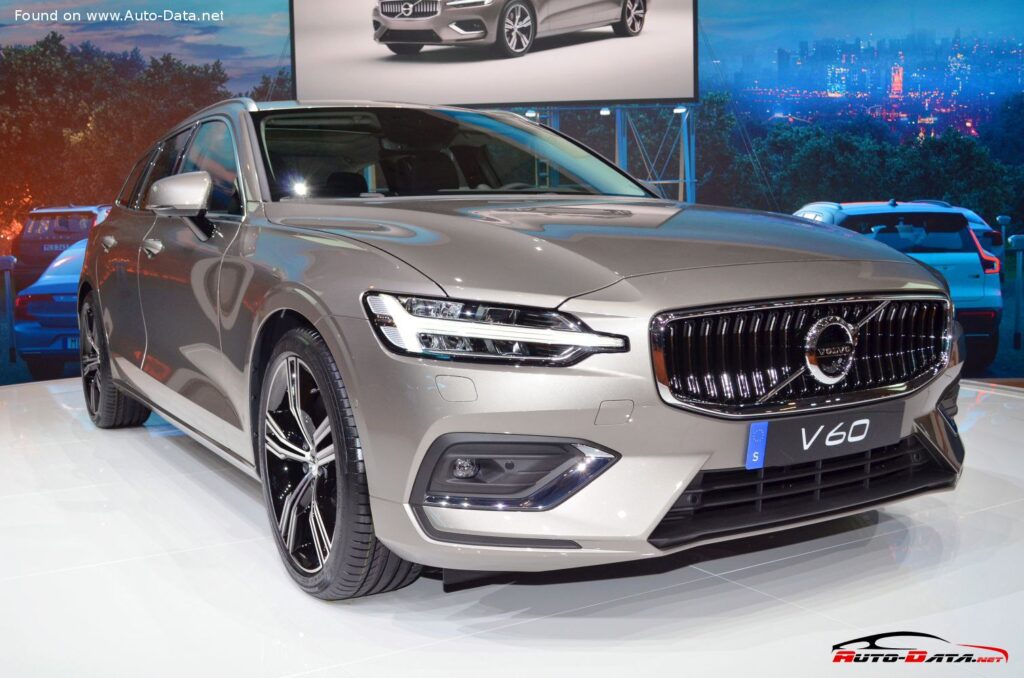
The Volvo V60 II continues the brand’s acclaimed Scandinavian design language, characterized by clean lines, elegant proportions, and a strong sense of understated luxury. As a station wagon, or “estate” in European markets, it offers a distinct profile that blends sportiness with practicality. The exterior features Volvo’s signature “Thor’s Hammer” LED daytime running lights, a prominent grille, and muscular rear shoulders that give it a confident stance. Its overall length of 187.44 inches, width of 72.83 inches (80.31 inches including mirrors), and height of 56.38 inches contribute to a sleek, ground-hugging appearance, distinguishing it from the prevalent SUV trend.
Inside, the V60 II provides a serene and sophisticated cabin designed with comfort and ergonomics in mind. High-quality materials, such as genuine wood accents, metal finishes, and premium upholstery, create an inviting atmosphere. The minimalist dashboard design is centered around Volvo’s Sensus infotainment system, featuring a large, vertically oriented touchscreen that controls most vehicle functions, from navigation to climate control. Seating for five occupants is exceptionally comfortable, with supportive seats engineered for long journeys.
Practicality is a hallmark of the station wagon body style, and the V60 B6 excels in this regard. It offers a generous minimum trunk space of 18.68 cubic feet, which expands to an impressive 50.89 cubic feet with the rear seats folded down, making it highly versatile for cargo needs. The vehicle also boasts a substantial towing capacity of 4409.25 pounds with brakes, further enhancing its utility. Safety, a core Volvo value, is paramount in the V60. While the data specifically lists ABS (Anti-lock Braking System), the V60 II comes standard with a comprehensive suite of advanced safety features typical of modern Volvos, including City Safety with steering support, run-off road mitigation, lane keeping aid, and various driver assistance systems, solidifying its reputation as one of the safest vehicles in its class.
Additional features include an electric power steering system for precise control, a robust suspension setup with double wishbones at the front and a transverse leaf spring at the rear for a balanced ride, and disc brakes all around. The vehicle is available with a variety of wheel rim sizes, ranging from 16 to 20 inches, allowing for personalization and varying ride characteristics.
Technical Specifications for the Volvo V60 II 2.0 B6 (299 Hp) Mild Hybrid AWD Automatic
| Category | Specification |
|---|---|
| General Information | |
| Brand | Volvo |
| Model | V60 II |
| Type (Engine) | 2.0 B6 (299 Hp) Mild Hybrid AWD Automatic |
| Start of Production | March, 2020 |
| Powertrain Architecture | MHEV (Mild Hybrid Electric Vehicle) |
| Body Type | Station wagon |
| Seats | 5 |
| Doors | 5 |
| Performance Specs | |
| Combined Fuel Consumption (WLTP) | 28.3 – 32.7 US mpg (7.2-8.3 l/100 km) |
| CO2 Emissions (WLTP) | 163-186 g/km |
| Fuel Type | Gasoline |
| Acceleration 0-60 mph | 5.7 sec |
| Maximum Speed | 111.85 mph (180 km/h) |
| Emission Standard | Euro 6d |
| Electric Cars and Hybrids Specs | |
| Electric Motor 1 Power | 14 Hp |
| Electric Motor Torque | 29.5 lb.-ft. (40 Nm) |
| Internal Combustion Engine Specs | |
| Power | 299 Hp @ 5400 rpm |
| Power per liter | 151.9 Hp/l |
| Torque | 309.78 lb.-ft. @ 2100-4800 rpm (420 Nm) |
| Maximum Engine Speed | 6300 rpm |
| Engine Layout | Front, Transverse |
| Engine Model/Code | B420T |
| Engine Displacement | 2.0 l (1969 cm3 / 120.16 cu. in.) |
| Number of Cylinders | 4, Inline |
| Cylinder Bore | 3.23 in. (81.99 mm) |
| Piston Stroke | 3.67 in. (93.19 mm) |
| Compression Ratio | 9:1 |
| Number of Valves per Cylinder | 4 |
| Fuel Injection System | Direct injection |
| Engine Aspiration | Turbocharging and Supercharger, Intercooler |
| Valvetrain | DOHC |
| Engine Oil Capacity | 6.45 US qt (6.1 l) |
| Engine Systems | Start & Stop System, Particulate filter |
| Space, Volume and Weights | |
| Trunk (boot) space – minimum | 18.68 cu. ft. (529 l) |
| Trunk (boot) space – maximum | 50.89 cu. ft. (1441 l) |
| Fuel Tank Capacity | 15.85 US gal (60 l) |
| Max. Roof Load | 165.35 lbs. (75 kg) |
| Permitted Trailer Load with Brakes (12%) | 4409.25 lbs. (2000 kg) |
| Permitted Trailer Load without Brakes | 1653.47 lbs. (750 kg) |
| Dimensions | |
| Length | 187.44 in. (4761 mm) |
| Width | 72.83 in. (1850 mm) |
| Width with mirrors folded | 75.43 in. (1916 mm) |
| Width including mirrors | 80.31 in. (2040 mm) |
| Height | 56.38 in. (1432 mm) |
| Wheelbase | 113.07 in. (2872 mm) |
| Front Track | 62.72 – 63.39 in. (1593-1610 mm) |
| Rear Track | 62.72 – 63.39 in. (1593-1610 mm) |
| Ride Height (Ground Clearance) | 5.59 in. (142 mm) |
| Drag Coefficient (Cd) | 0.29 |
| Minimum Turning Circle (Turning Diameter) | 37.4 – 39.7 ft. (11.4-12.1 m) |
| Drivetrain, Brakes and Suspension Specs | |
| Drivetrain Architecture | ICE and electric motor permanently drive front wheels; rear wheels driven via clutch if necessary. |
| Drive Wheel | All-wheel drive (4×4) |
| Number of Gears and Type of Gearbox | 8 gears, automatic transmission Geartronic |
| Front Suspension | Double wishbone, Transverse stabilizer |
| Rear Suspension | Transverse stabilizer, Leaf spring |
| Front Brakes | Disc, 11.65-14.61 in. (296-371 mm) |
| Rear Brakes | Disc, 11.89-12.60 in. (302-320 mm) |
| Assisting Systems | ABS (Anti-lock braking system) |
| Steering Type | Steering rack and pinion |
| Power Steering | Electric Steering |
| Wheel Rims Size | 16; 17; 18; 19; 20 inches |
Legacy and Market Impact
The Volvo V60 II 2.0 B6 (299 Hp) Mild Hybrid AWD Automatic plays a pivotal role in Volvo’s contemporary lineup, serving as a sophisticated and practical choice in the premium mid-size segment. While the American market has largely shifted its preference towards SUVs, Volvo has steadfastly maintained its commitment to the station wagon, understanding that a loyal and discerning customer base values the unique blend of car-like driving dynamics, elegant design, and superior cargo capacity that only a wagon can offer. The V60, particularly in its B6 mild-hybrid guise, stands as a testament to this philosophy, catering to those who seek a vehicle that is both sensible and luxurious, without conforming to the SUV trend.
In its primary markets, including North America and Europe, the V60 competes with established luxury rivals such as the Audi A4 Allroad and, in some global markets, the BMW 3 Series Wagon and Mercedes-Benz C-Class Wagon. What sets the V60 apart is its distinct Scandinavian identity, characterized by minimalist design, an unwavering focus on safety, and a progressive approach to powertrain technology. The introduction of the B6 mild hybrid powertrain underscores Volvo’s broader strategy of electrification, positioning the V60 as an environmentally conscious choice without sacrificing performance or luxury. It serves as a bridge technology, offering enhanced efficiency and lower emissions as the automotive industry transitions towards fully electric vehicles.
The V60’s reputation is built on its robust safety features, which are consistently at the forefront of automotive innovation, and its comfortable, well-appointed interior. Its all-wheel-drive capability, combined with a potent yet efficient engine, makes it an ideal vehicle for varied climates and lifestyles, from urban commuting to weekend adventures. The station wagon body style, while niche in the US, is a point of pride for Volvo, symbolizing a practical elegance that resonates with a segment of buyers who appreciate its understated sophistication and versatility over the taller, bulkier profile of an SUV. The V60 II, particularly with the advanced B6 mild hybrid powertrain, reinforces Volvo’s legacy as a leader in safety, design, and thoughtful engineering, cementing its place as a compelling and distinctive option in the premium automotive landscape.