
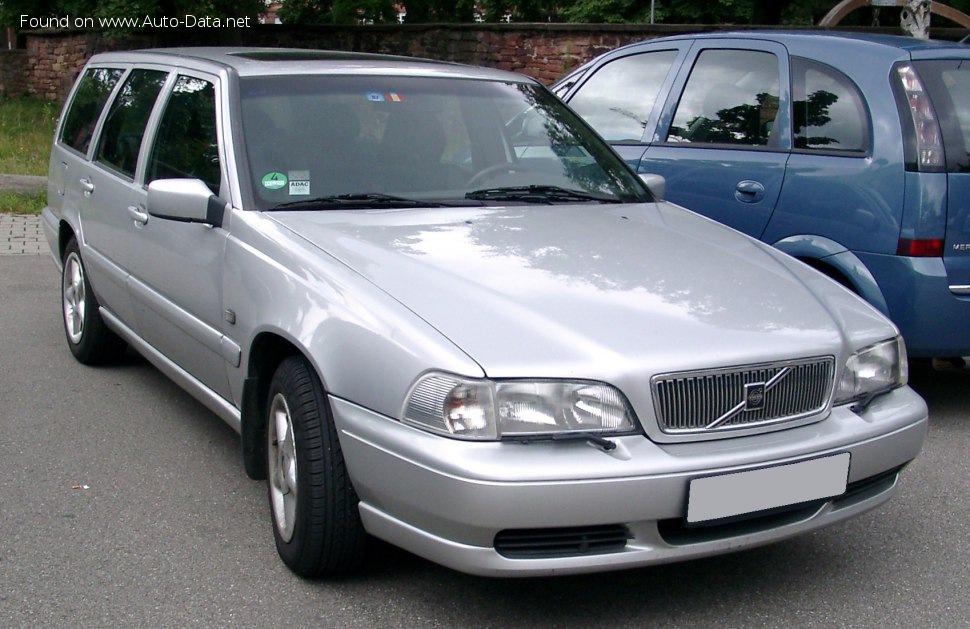
An Overview of the Volvo V70 I 2.0 (126 Hp) Automatic
The Volvo V70, introduced in 1996, marked a significant evolution in Volvo’s highly successful mid-size wagon lineage, directly succeeding the acclaimed 850 series. Representing the first generation of the V70, often referred to as the P80 platform, this vehicle quickly established itself as a benchmark for practicality, safety, and understated luxury. The specific variant, the Volvo V70 I 2.0 (126 Hp) Automatic, produced from 1996 to 2000, was a particularly relevant offering in markets where engine displacement and fuel efficiency were key considerations, such as many European and Asian countries. While larger displacement engines were typically favored for the North American market, this 2.0-liter, five-cylinder model showcased Volvo’s ability to deliver a capable and comfortable family vehicle with a focus on balanced performance and economy for its intended regional audience.
The Volvo V70 I 2.0 (126 Hp) Automatic: A European Workhorse
The V70 I generation built upon the robust foundations of the 850, carrying over much of its acclaimed engineering while refining its aesthetics and improving interior ergonomics. The Volvo V70 I 2.0 (126 Hp) Automatic retained the core identity of a spacious and safe family station wagon, a segment where Volvo had long been a dominant force. Its introduction signaled Volvo’s commitment to continuous improvement, offering a more refined driving experience and updated styling without sacrificing the brand’s core values.
Powertrain and Driving Dynamics
At the heart of this particular V70 I variant was Volvo’s B5202FS engine, a 2.0-liter (1984 cm3 or 121.07 cu. in.) inline five-cylinder gasoline unit. This naturally aspirated engine featured a DOHC (Double Overhead Camshaft) valvetrain with two valves per cylinder and utilized a multi-port manifold injection system for efficient fuel delivery. It produced a respectable 126 horsepower at 6250 rpm and 125.39 lb.-ft. (170 Nm) of torque at 4800 rpm. The five-cylinder configuration was a hallmark of Volvo engineering during this era, renowned for its distinctive, smooth operating character and a pleasing, albeit subdued, engine note.
Power was channeled to the front wheels via a 4-speed automatic transmission, a common setup for family vehicles of its time. While not designed for blistering acceleration, the powertrain provided adequate performance for daily commuting and highway cruising. The Volvo V70 I 2.0 (126 Hp) Automatic could accelerate from 0 to 60 mph in a calculated 11.9 seconds, with a top speed of 118.06 mph (190 km/h). Fuel economy, a critical factor for this engine size, was rated at approximately 17.4 US mpg in urban conditions and an impressive 28.7 US mpg on the extra-urban cycle, making it a relatively economical choice for a vehicle of its size and capability.
The V70 I featured a robust chassis with a wishbone front suspension and a coil spring rear suspension, providing a comfortable and stable ride characteristic of Volvo vehicles. Its hydraulic power steering system ensured precise control and good road feel, contributing to a confident driving experience. Ventilated disc brakes at the front and disc brakes at the rear, complemented by an Anti-lock Braking System (ABS), offered strong and consistent stopping power, reinforcing Volvo’s commitment to safety.
Exterior and Interior Design Philosophy
The V70 I retained the familiar, robust profile of its 850 predecessor but introduced softer, more rounded edges and updated styling cues that gave it a more modern and aerodynamic appearance. With a drag coefficient (Cd) of 0.32, it was quite efficient for a station wagon of its size. Its dimensions — 186.22 inches in length, 69.29 inches in width, and 56.3 inches in height, with a 104.72-inch wheelbase — underscored its substantial road presence and generous interior volume.
Inside, the Volvo V70 I 2.0 (126 Hp) Automatic was designed with a strong emphasis on comfort, ergonomics, and practicality. It offered seating for five adults, with Volvo’s legendary supportive seats ensuring comfort even on long journeys. The interior materials were of high quality, designed for durability and ease of maintenance. Perhaps the V70’s most defining characteristic was its cavernous cargo capacity. With the rear seats in place, it offered 14.83 cubic feet (420 liters) of trunk space, which expanded to an impressive 55.8 cubic feet (1580 liters) with the rear seats folded down, making it an exceptionally versatile vehicle for families, outdoor enthusiasts, or anyone requiring significant hauling capability.
Safety and Practicality
Safety remained paramount for Volvo, and the V70 I continued this tradition with a comprehensive suite of passive and active safety features for its era. Beyond the standard ABS, the car’s robust body structure was engineered to absorb impact forces effectively, protecting occupants. It featured multiple airbags and Volvo’s SIPS (Side Impact Protection System), which was groundbreaking at the time, offering enhanced protection in side-on collisions. The inherent stability of the V70’s chassis and its predictable handling characteristics also contributed significantly to active safety.
Practicality extended beyond just cargo space. Thoughtful storage compartments, durable surfaces, and a well-laid-out dashboard made the V70 I a user-friendly vehicle for everyday life. The 18.49 US gallon (70-liter) fuel tank provided a substantial cruising range, further enhancing its appeal as a long-distance tourer.
Technical Specifications
| General Information | |
|---|---|
| Brand | Volvo |
| Model | V70 |
| Generation | V70 I |
| Type (Engine) | 2.0 (126 Hp) Automatic |
| Start of Production | 1996 year |
| End of Production | 2000 year |
| Powertrain Architecture | Internal Combustion engine |
| Body type | Station wagon (estate) |
| Seats | 5 |
| Doors | 5 |
| Performance Specs | |
| Fuel consumption (economy) – urban | 13.5 l/100 km (17.4 US mpg) |
| Fuel consumption (economy) – extra urban | 8.2 l/100 km (28.7 US mpg) |
| Fuel Type | Petrol (Gasoline) |
| Acceleration 0 – 60 mph | 11.9 sec |
| Acceleration 0 – 100 km/h | 12.5 sec |
| Maximum speed | 190 km/h (118.06 mph) |
| Weight-to-power ratio | 11.7 kg/Hp (85.7 Hp/tonne) |
| Weight-to-torque ratio | 8.6 kg/Nm (115.6 Nm/tonne) |
| Engine Specs | |
| Power | 126 Hp @ 6250 rpm |
| Power per liter | 63.5 Hp/l |
| Torque | 170 Nm @ 4800 rpm (125.39 lb.-ft. @ 4800 rpm) |
| Engine layout | Front, Transverse |
| Engine Model/Code | B5202FS |
| Engine displacement | 1984 cm3 (121.07 cu. in.) |
| Number of cylinders | 5 |
| Engine configuration | Inline |
| Cylinder Bore | 81 mm (3.19 in.) |
| Piston Stroke | 77 mm (3.03 in.) |
| Compression ratio | 10:1 |
| Number of valves per cylinder | 2 |
| Fuel injection system | Multi-port manifold injection |
| Engine aspiration | Naturally aspirated engine |
| Valvetrain | DOHC |
| Engine oil capacity | 5.8 l (6.13 US qt) |
| Coolant | 7.2 l (7.61 US qt) |
| Space, Volume and Weights | |
| Kerb Weight | 1470 kg (3240.8 lbs.) |
| Max. weight | 1970 kg (4343.11 lbs.) |
| Max load | 500 kg (1102.31 lbs.) |
| Trunk (boot) space – minimum | 420 l (14.83 cu. ft.) |
| Trunk (boot) space – maximum | 1580 l (55.8 cu. ft.) |
| Fuel tank capacity | 70 l (18.49 US gal) |
| Dimensions | |
| Length | 4730 mm (186.22 in.) |
| Width | 1760 mm (69.29 in.) |
| Height | 1430 mm (56.3 in.) |
| Wheelbase | 2660 mm (104.72 in.) |
| Front track | 1520 mm (59.84 in.) |
| Rear (Back) track | 1470 mm (57.87 in.) |
| Drag coefficient (Cd) | 0.32 |
| Drivetrain, Brakes and Suspension Specs | |
| Drivetrain Architecture | The Internal combustion engine (ICE) drives the front wheels of the vehicle. |
| Drive wheel | Front wheel drive |
| Number of gears and type of gearbox | 4 gears, automatic transmission |
| Front suspension | Wishbone |
| Rear suspension | Coil spring |
| Front brakes | Ventilated discs |
| Rear brakes | Disc |
| Assisting systems | ABS (Anti-lock braking system) |
| Steering type | Steering rack and pinion |
| Power steering | Hydraulic Steering |
| Tires size | 185/65 R15 |
| Wheel rims size | 15 |
Legacy & Market Impact
The Volvo V70 I, including the Volvo V70 I 2.0 (126 Hp) Automatic variant, cemented Volvo’s reputation as a purveyor of safe, reliable, and practical family vehicles. While the 2.0-liter engine was primarily a choice for markets outside North America, it underscored Volvo’s flexible approach to powertrain offerings, catering to diverse global demands for taxation, fuel economy, and performance expectations. In its primary markets, this V70 variant competed against premium European offerings like the BMW 3 Series Touring, Mercedes-Benz C-Class Estate, and Audi A4 Avant, as well as mainstream large estates such as the Ford Mondeo Estate and Volkswagen Passat Variant. The V70 consistently held its own by offering a unique blend of Scandinavian design, unparalleled safety, and exceptional utility.
Its historical significance lies in its role as a bridge between the highly angular designs of the 850 and the more fluid, rounded aesthetics of the subsequent P2 generation V70. The V70 I successfully modernized Volvo’s image while retaining the core values that had endeared the brand to millions. It continued the tradition of robust build quality and longevity, making it a popular choice in the used car market for years after its production ceased. Even today, the V70 I is often praised for its comfortable ride, spacious interior, and enduring reliability, a testament to Volvo’s engineering prowess during a pivotal era for the automotive industry.
